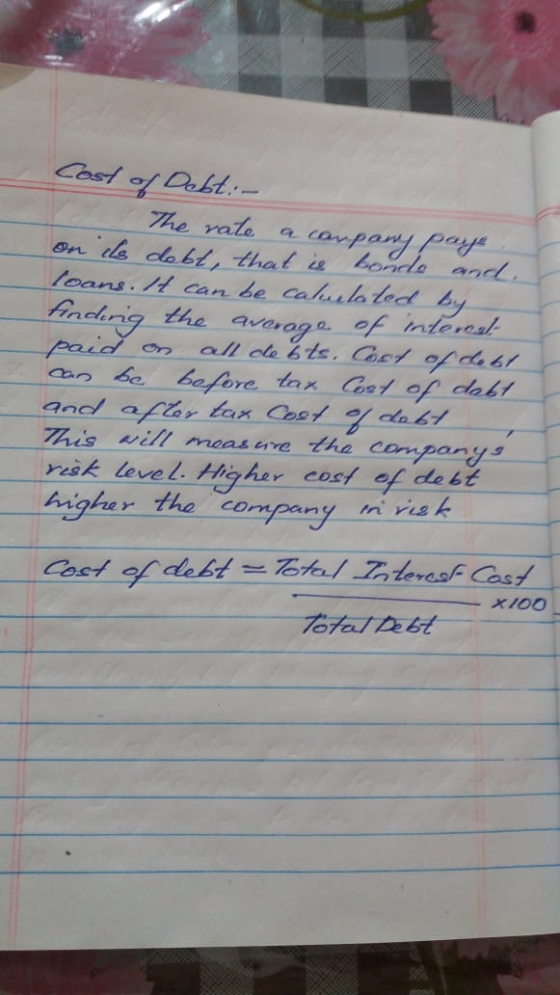
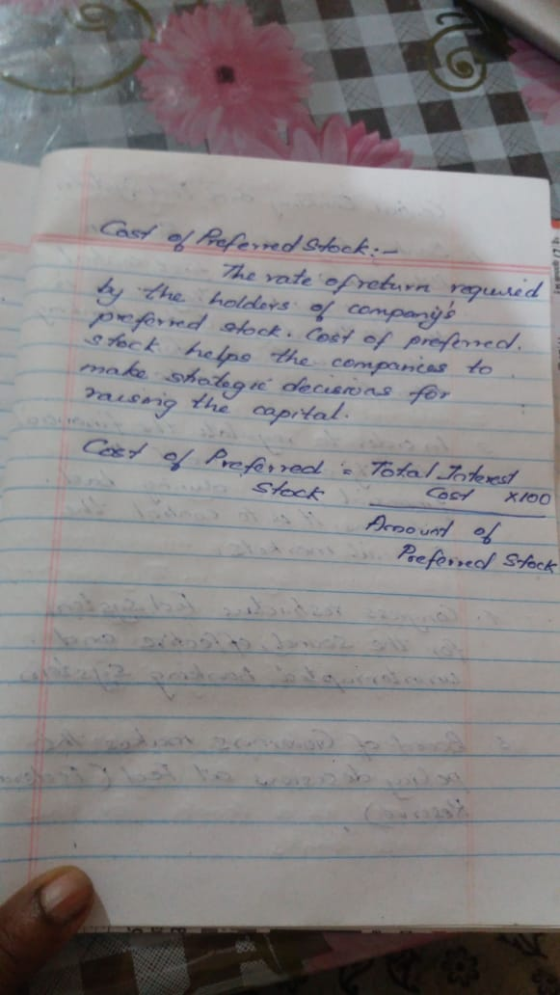
2. Define and calculate the component costs of debt and preferred stock.
2. Define and calculate the component costs of debt and preferred stock.
Homework Answers
Add Answer to:
2. Define and calculate the component costs of debt and
preferred stock.
A. Calculate the after-tax cost of debt. b. Calculate the cost of preferred stock. c. Calculate t...
 a. Calculate the after-tax cost of debt.
b. Calculate the cost of preferred stock.
c. Calculate the cost of common stock (both retained earnings
and new common stock).
d. Calculate the WACC for Dillon Labs.
Calculation of individual costs and WACC Dillon Labs has asked its financial manager to measure the cost of each specific type of capital as well as the weighted average cost of capital. The weighted average cost is to be measured by using the following weights:...
a. Calculate the after-tax cost of debt.
b. Calculate the cost of preferred stock.
c. Calculate the cost of common stock (both retained earnings
and new common stock).
d. Calculate the WACC for Dillon Labs.
Calculation of individual costs and WACC Dillon Labs has asked its financial manager to measure the cost of each specific type of capital as well as the weighted average cost of capital. The weighted average cost is to be measured by using the following weights:...
11. Define preferred stock, determine the value of a share of preferred stock, or given its...
11. Define preferred stock, determine the value of a share of preferred stock, or given its value, calculate its expected return?
Save Awe 5 points COB has the following pre-tax component costs of capital: Debt-8%, common stock...
 Save Awe 5 points COB has the following pre-tax component costs of capital: Debt-8%, common stock = 14%, preferred stock 124. COB is financed 50% by debt, 40% by common stock, and 10% by preferred stock. If COB's tax rate is 40%, what is COB's weighted average cost of capital? 9.60% 9.404 8.75% 9.2015 9.50% Moving to another question will save this response Question 50 of 60 esc 0 20 << 000 PO W FI # 3 $ 4 &...
The Aztec Corporation has the following market capital components and costs. Calculate Aztec's WACC. Component Value...
 The Aztec Corporation has the following market capital components and costs. Calculate Aztec's WACC. Component Value Cost Debt $ 23,625 12.0% 13.5% Preferred Stock Common Equity $ 4,350 $ 52,275 19.2% Aztec has a 35% marginal tax rate.
Calcul The Aztec Corporation has the following market capital components and costs. Calculate Aztec's WACC Component...
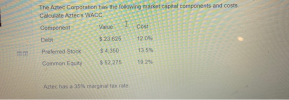 Calcul The Aztec Corporation has the following market capital components and costs. Calculate Aztec's WACC Component Value Cost Debt $ 23,625 Preferred Stock $ 4,350 13.5% Common Equity S 52,275 19.2% eot S Aztec has a 35% marginal tax rate
The WACC is a weighted average of the costs of debt, preferred stock, and common equity....
The WACC is a weighted average of the costs of debt, preferred stock, and common equity. Would the WACC be different if the equity for the coming year came solely in the form of retained earnings versus equity from the sale of new common stock? Would the calculated WACC depend in any way on the size of the capital budget? How might dividend policy affect the WACC?
Problem 11-15 Comparison of the costs of debt and preferred stock (LO11- 3) 1.7 points The treasurer of Riley Coal Co....
 Problem 11-15 Comparison of the costs of debt and preferred stock (LO11- 3) 1.7 points The treasurer of Riley Coal Co. is asked to compute the cost of fixed income securities for her corporation. Even before making the calculations, she assumes the aftertax cost of debt is at least 2 percent less than that for preferred stock. eBook Debt can be issued at a yield of 8.5 percent, and the corporate tax rate is 25 percent. Preferred stock will be...
Oxy Corporation uses debt, preferred stock, and common stock to raise capital. The firm's capital structure...
 Oxy Corporation uses debt, preferred stock, and common stock to raise capital. The firm's capital structure targets the following proportions: debt, 50% preferred stock, 13%, and common stock, 37%. If the cost of debt is 6.1%, preferred stock costs 9.2%, and common stock costs 11.2%, what is Oxy's weighted average cost of capital (WACC)? Oxy's weighted average cost of capital (WACC) is % (Round to two decimal places.)
Wally’s plans to finance the project with 25% debt, 15% preferred stock, 35% retained earnings, and...
Wally’s plans to finance the project with 25% debt, 15% preferred stock, 35% retained earnings, and 25% newly issued equity. The company’s cost of debt for six years is 3%, while the cost of preferred stock is estimated to be 8%. The company’s cost of equity (retained earnings) is estimated to be 12%. Flotation costs for any new equity issued would be 10%. Calculate the WACC for the project. Round the percentage to two decimal places.
Assume that the company has the following capital structure: Debt $15,000,000 Preferred stock $7,500,000 Common stock...
Assume that the company has the following capital structure: Debt $15,000,000 Preferred stock $7,500,000 Common stock $27,500,000 What will be the cost of capital if the company decide to raise the needed capital proportionally and with following costs? Please use the following information to calculate the weighted cost of capital: Bond: A 30-year bond with a face value of $1000 and coupon interest rate of 13% and floatation cost of $20 (Tax is 35%) Preferred stock: Face value of $35...
 a. Calculate the after-tax cost of debt.
b. Calculate the cost of preferred stock.
c. Calculate the cost of common stock (both retained earnings
and new common stock).
d. Calculate the WACC for Dillon Labs.
Calculation of individual costs and WACC Dillon Labs has asked its financial manager to measure the cost of each specific type of capital as well as the weighted average cost of capital. The weighted average cost is to be measured by using the following weights:...
a. Calculate the after-tax cost of debt.
b. Calculate the cost of preferred stock.
c. Calculate the cost of common stock (both retained earnings
and new common stock).
d. Calculate the WACC for Dillon Labs.
Calculation of individual costs and WACC Dillon Labs has asked its financial manager to measure the cost of each specific type of capital as well as the weighted average cost of capital. The weighted average cost is to be measured by using the following weights:...
 Save Awe 5 points COB has the following pre-tax component costs of capital: Debt-8%, common stock = 14%, preferred stock 124. COB is financed 50% by debt, 40% by common stock, and 10% by preferred stock. If COB's tax rate is 40%, what is COB's weighted average cost of capital? 9.60% 9.404 8.75% 9.2015 9.50% Moving to another question will save this response Question 50 of 60 esc 0 20 << 000 PO W FI # 3 $ 4 &...
 The Aztec Corporation has the following market capital components and costs. Calculate Aztec's WACC. Component Value Cost Debt $ 23,625 12.0% 13.5% Preferred Stock Common Equity $ 4,350 $ 52,275 19.2% Aztec has a 35% marginal tax rate.
 Calcul The Aztec Corporation has the following market capital components and costs. Calculate Aztec's WACC Component Value Cost Debt $ 23,625 Preferred Stock $ 4,350 13.5% Common Equity S 52,275 19.2% eot S Aztec has a 35% marginal tax rate
 Problem 11-15 Comparison of the costs of debt and preferred stock (LO11- 3) 1.7 points The treasurer of Riley Coal Co. is asked to compute the cost of fixed income securities for her corporation. Even before making the calculations, she assumes the aftertax cost of debt is at least 2 percent less than that for preferred stock. eBook Debt can be issued at a yield of 8.5 percent, and the corporate tax rate is 25 percent. Preferred stock will be...
 Oxy Corporation uses debt, preferred stock, and common stock to raise capital. The firm's capital structure targets the following proportions: debt, 50% preferred stock, 13%, and common stock, 37%. If the cost of debt is 6.1%, preferred stock costs 9.2%, and common stock costs 11.2%, what is Oxy's weighted average cost of capital (WACC)? Oxy's weighted average cost of capital (WACC) is % (Round to two decimal places.)
Most questions answered within 3 hours.
-
Where is the error in this code sequence?
String s1 = "Hello";
String s2 = "ello";...
asked 10 months ago -
Financial data for Joel de Paris, Inc., for last year
follow:
Joel de Paris, Inc.
Balance...
asked 10 months ago -
Consider this reaction:
Al2(SO4)3 (aq)+ BaCl3
(aq) Al2Cl6 (aq)- +
3BaSO4(s) . What is the...
asked 10 months ago -
Suppose that Savneet is considering increasing her
recent random sample from 20 car rentals to 40...
asked 10 months ago -
Trucks arrive at an unloading terminal at an average rate of 120
per hour.
Trucks arrive...
asked 10 months ago -
Why are methanol and ethanol completely soluble in water while
octanol is not very little soluble....
asked 10 months ago -
A facilities manager at a university reads in a research report
that the mean amount of...
asked 10 months ago -
When the CuSO4 is rehydrated by adding water to the anhydrous
compound, is this an endothermic...
asked 10 months ago -
A ray of sunlight is passing from diamond into crown glass; the
angle of incidence is...
asked 10 months ago -
A block of mass 0.249 kg is placed on top of a light, vertical
spring of...
asked 10 months ago -
how do the kidneys compensate in the presences of acidosis
a) trigger hyperventilate
b) reserve acid...
asked 10 months ago -
Question 501 pts
The rental rate of capital to the firm increases. Which of the
following...
asked 10 months ago