TRUE OR FALSE QUESTION please explain the reason briefly (3 sentences) 3) Max’s utility function is...
TRUE OR FALSE QUESTION please explain the reason briefly (3 sentences)
3) Max’s utility function is U(x,y) = (x+2)(y+1). If his consumption of both x and yare doubled, then his marginal rate of substitution between x and y remains constant.
Homework Answers
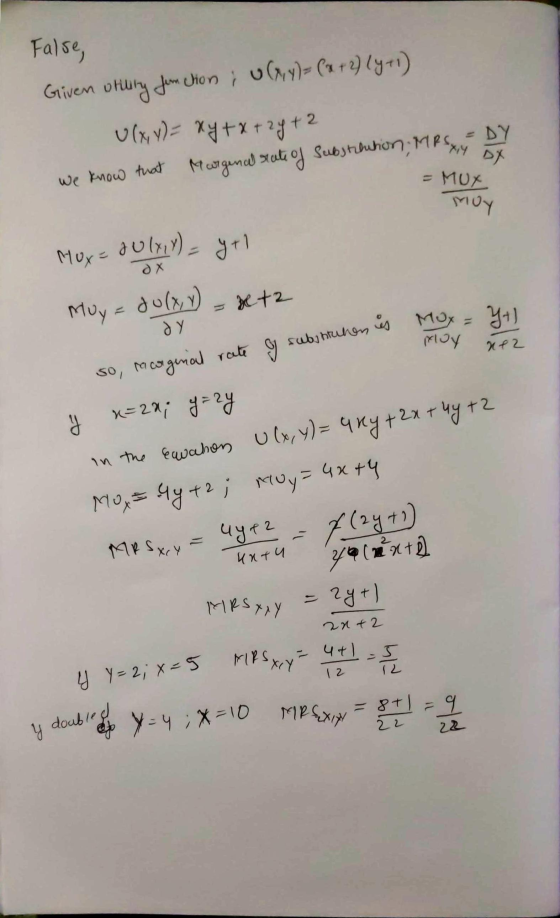
False, we can derive marginal rate of subsitution in below and we can say that, if values are doubled for X and Y, MRS will change and it is not a constant.
Add Answer to:
TRUE OR FALSE QUESTION please explain the reason briefly (3
sentences)
3) Max’s utility function is...
1. True or False, and explain briefly. 1) The assumption that more is better implies that...
 1. True or False, and explain briefly. 1) The assumption that more is better implies that the indifference curves are upward sloping 2) Convexity of indifference curves implies that consumers are willing to give up more to get an extra the more they have 3) Consider the following three bundles. Bundle Good Goody If Bundles A and B are on the same indifference curve, preferences satisfy all the usual assumptions introduced in the lecture, Bundle Cis preferred to Bundle A...
QUESTION; Given Biwei’s utility function U=4XY, where X is consumption of beer and Y is consumption...
QUESTION; Given Biwei’s utility function U=4XY, where X is consumption of beer and Y is consumption of pizza. For this utility function, the marginal utility of X is MUx = 4Y; the marginal utility of Y is MUY = 4X. 1) Suppose Y = 3. Calculate Biwei’s utility for X = 2, 3, 10, and 11. For a given level of Y, does good X display diminishing marginal utility? 2) Suppose X = 3. Calculate Biwei’s utility for Y =...
5. Consider the utility function U(x, y) = 2/x + y. 1) Is the assumption that...
 5. Consider the utility function U(x, y) = 2/x + y. 1) Is the assumption that "more is better” satisfied for both goods? 2) What is MRS, for this utility function? 3) Is the marginal rate of substitution diminishing, constant, or increasing in x as the consumer substitutes x for y along an indifference curve? 4) Will the indifference curve corresponding to this utility function be convex to the origin, concave to the origin, or straight lines? Explain.
For U(x,y) -xy, MRS ▼ , while Uxx_ and Uyy This means that this utility function...
 For U(x,y) -xy, MRS ▼ , while Uxx_ and Uyy This means that this utility function has MRS, while exhibiting marginal utility in x andy For U(x,y)-x2y2, MRS ▼ , while Uxx_ and Uyy This means that this utility function has MRS, while exhibiting marginal utility in x and y For U(x,y) = In x + In y, MRS- ,while Ux- and Uyy ▼ . This means that this utility function has MRS, while exhibiting marginal utility in x and...
10. For this question, use the utility function U(X,Y)= In(X) + 3 In(Y). (a) (2 Points)...
 10. For this question, use the utility function U(X,Y)= In(X) + 3 In(Y). (a) (2 Points) What is the marginal utility of X? (b) (2 Points) What is the marginal utility of Y? (c) (2 Points) What is the marginal rate of substitution of X for Y? (d) (2 Points) What is the equation for the slope of the indifference curves?
True or False: You need to explain briefly your answers. (a) (10pts) In the CAPM model,...
True or False: You need to explain briefly your answers. (a) (10pts) In the CAPM model, if a stock lies strictly below the budget line (recall that we label the standard deviation of a stock’s return on the x-axis and the mean of that on the y-axis), then it is for sure that no one will want to hold this stock in his optimal choice since there is always an alternative with less risk or greater expected return. (b) (10pts)If...
(Use this information to answer a, b, c below) Suppose Mary’s utility function for two goods...
(Use this information to answer a, b, c below) Suppose Mary’s utility function for two goods X and Y is given by: U(X,Y) = 3X1/2Y1/2 . Suppose consumption bundle A consists of 10 units of X and 30 units of Y, and consumption bundle B consists of 40 units of X and 20 units of Y. a. Consumption bundle A lies on a higher/lower/same indifference curve than consumption bundle B. Show computations. b. Compute Mary’s MRSxy at consumption bundle A....
Question 1 For the following utility functions (3 pts each for a, b, and c): •...
Question 1 For the following utility functions (3 pts each for a, b, and c): • Find the marginal utility of each good at the point (5, 5) and at the point (5, 15) • Determine whether the marginal utility decreases as consumption of each good increases (i.e., does the utility function exhibit diminishing marginal utility in each good?) • Find the marginal rate of substitution at the point (5, 5) and at the point (5, 15) • Discuss how...
Suppose a consumer's preferences can be represented by the utility function: U(X,Y)=X3/5Y1/4 a. Derive the function...
Suppose a consumer's preferences can be represented by the utility function: U(X,Y)=X3/5Y1/4 a. Derive the function for the marginal rate of substitution holding utility constant: U X Y b. Derive the demand curves for the two goods, X and Y. c. Confirm that both demand curves slope downward. d. Calculate the price elasticity for each of the goods. e. Calculate the income elasticity for each of the goods.
Clark gains utility from consumption c and leisure l and his preferences for consumption and leisure...
Clark gains utility from consumption c and leisure l and his preferences for consumption and leisure can be expressed as U(c, l) = 2(√ c)(l). This utility function implies that Clark’s marginal utility of leisure is 2√ c and his marginal utility of consumption is l √ c . He has 16 hours per day to allocate between leisure (l) and work (h). His hourly wage is $12 after taxes. Clark also receives a daily check of $30 from the...
 1. True or False, and explain briefly. 1) The assumption that more is better implies that the indifference curves are upward sloping 2) Convexity of indifference curves implies that consumers are willing to give up more to get an extra the more they have 3) Consider the following three bundles. Bundle Good Goody If Bundles A and B are on the same indifference curve, preferences satisfy all the usual assumptions introduced in the lecture, Bundle Cis preferred to Bundle A...
 5. Consider the utility function U(x, y) = 2/x + y. 1) Is the assumption that "more is better” satisfied for both goods? 2) What is MRS, for this utility function? 3) Is the marginal rate of substitution diminishing, constant, or increasing in x as the consumer substitutes x for y along an indifference curve? 4) Will the indifference curve corresponding to this utility function be convex to the origin, concave to the origin, or straight lines? Explain.
 For U(x,y) -xy, MRS ▼ , while Uxx_ and Uyy This means that this utility function has MRS, while exhibiting marginal utility in x andy For U(x,y)-x2y2, MRS ▼ , while Uxx_ and Uyy This means that this utility function has MRS, while exhibiting marginal utility in x and y For U(x,y) = In x + In y, MRS- ,while Ux- and Uyy ▼ . This means that this utility function has MRS, while exhibiting marginal utility in x and...
 10. For this question, use the utility function U(X,Y)= In(X) + 3 In(Y). (a) (2 Points) What is the marginal utility of X? (b) (2 Points) What is the marginal utility of Y? (c) (2 Points) What is the marginal rate of substitution of X for Y? (d) (2 Points) What is the equation for the slope of the indifference curves?
Most questions answered within 3 hours.
-
Where is the error in this code sequence?
String s1 = "Hello";
String s2 = "ello";...
asked 10 months ago -
Financial data for Joel de Paris, Inc., for last year
follow:
Joel de Paris, Inc.
Balance...
asked 10 months ago -
Consider this reaction:
Al2(SO4)3 (aq)+ BaCl3
(aq) Al2Cl6 (aq)- +
3BaSO4(s) . What is the...
asked 10 months ago -
Suppose that Savneet is considering increasing her
recent random sample from 20 car rentals to 40...
asked 10 months ago -
Trucks arrive at an unloading terminal at an average rate of 120
per hour.
Trucks arrive...
asked 10 months ago -
Why are methanol and ethanol completely soluble in water while
octanol is not very little soluble....
asked 10 months ago -
A facilities manager at a university reads in a research report
that the mean amount of...
asked 10 months ago -
When the CuSO4 is rehydrated by adding water to the anhydrous
compound, is this an endothermic...
asked 10 months ago -
A ray of sunlight is passing from diamond into crown glass; the
angle of incidence is...
asked 10 months ago -
A block of mass 0.249 kg is placed on top of a light, vertical
spring of...
asked 10 months ago -
how do the kidneys compensate in the presences of acidosis
a) trigger hyperventilate
b) reserve acid...
asked 10 months ago -
Question 501 pts
The rental rate of capital to the firm increases. Which of the
following...
asked 10 months ago