what are the uses of relative risk in terms of a) to the clinician b) to...
what are the uses of relative risk in terms of
a) to the clinician
b) to the researcher
(epidemiology question)
Homework Answers
Researcher-relative risk is a risk of probabilities.its the likelihood of an event in relation to all the possible events. hence it compares incidence or risk of an event among those with a specific exposure with those who are not exposed. example, measuring the event of myocardial infarction in patients who smoke and who do not smoke. hence , Relative risk is of major use fro researchers to study prospective cohort studies as here the exposure status of the study participants is already known .fro example, it is probability of one group (e.g. men) thinking an item is a necessity compared with the other group (e.g. women). Thus, a relative risk of 2.0 means twice the risk, a score of 0.5 means half the risk, a score of 3.0 is three times the risk and a score of 0.33 is a third of the risk, etc. A relative risk of 1 would mean that there are no differences between the two groups.
In most epidemiological studies one aims to compare the occurrence of a disease or other health outcome between two groups: a group that is exposed to a certain treatment or risk factor—the exposed group—and a group that is not exposed to this treatment or risk factor, which is called the unexposed or control group. In both of these groups the outcome of interest is measured. Based on the outcomes measured one can calculate for each of the two groups, the risk or the incidence rate of the outcome.
clinician- hence in terms of a clinician, relative risk is of use to decide on to which mode of treatment he should opt for a patient. the clinician can tell the patient also about what line of treatments are available and which one has how much chances of healing . for example, say in case of appendicectomy, a particular drug acts well but has 80% chance of recurrence, whereas surgery at once will give final solution to the problem. then a doctor can can put all these option front of the patient and choose for the best one.
another use is in diagnosis of diseases through established facts done by various studies. example, it is known that smoking causes lung cancer, hence a clinician have a fair idea about patients disease diagnoses if his history of smoking is known.
a clinician can educate and create awareness among his patients regarding ill effects or non competency of some drugs, operational interventions, vaccines etc. according to the knowledge of relative risks known for an event.
Add Answer to:
what are the uses of relative risk in terms of
a) to the clinician
b) to...
What are the uses of attributable risk To the physician responsible for preventative measures...
What are the uses of attributable risk To the physician responsible for preventative measures b. To the physician responsible for health planning for large groups (epidemiology question)
Question 1. Other than indicating positive association, what does a relative risk of 2.3 means in terms of expose a...
 Question 1. Other than indicating positive association, what does a relative risk of 2.3 means in terms of expose and non-exposed group? Provide one more meaning. Question 2. Explain the difference between the risk difference and relative risk.
What are the main differences between epidemiology and risk assessment in terms of goals and approaches?
What are the main differences between epidemiology and risk assessment in terms of goals and approaches?
The relative risk of lung cancer associated with passive smoking is low, but the population attributable...
The relative risk of lung cancer associated with passive smoking is low, but the population attributable risk is considerable. What is the explanation for this? Basic epidemiology Book 2nd Edition chapter 2 study questions
In terms of strength of association, which of the following relative risk estimates provides the most...
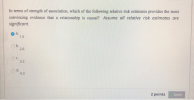 In terms of strength of association, which of the following relative risk estimates provides the most convincing evidence that a relationship is causal? Assume all relative risk estimates are significant 2.1.5 2 points Saved
Epidemiology If you calculated relative risk turned out to be 2.46, how would interpret this?
Epidemiology If you calculated relative risk turned out to be 2.46, how would interpret this?
What are the tools that the clinician uses to make a diagnosis of bacterial pneumonia? Select...
What are the tools that the clinician uses to make a diagnosis of bacterial pneumonia? Select all that apply. Group of answer choices a. white blood cell count >15,000/mm3 b. Echocardiography demonstrating right-sided failure with cor pulmonale c. history and physical examination findings including recurrent chills, cough, dyspnea, and abnormal chest sounds (rales, egophony, pleural friction rub) d. sputum cuture (+) causative organism e. temperature readings (often as high as 106o F) f. chest x-ray findings of white shadows in...
Relative risk (RR) is a statistical term used to describe the risk of a certain event...
Relative risk (RR) is a statistical term used to describe the risk of a certain event happening in one group versus another. It is commonly used in epidemiology and evidence based medicine. For example smoking is found to be a cause for cancer. The formula for calculating the risk of cancer for smoking cigarettes is RR= (__A___) / (__C____) where A=number of people who smoke and also have cancer, B=number of smokers not having cancer, C=number of people who did...
1. How are age, race, gender, socioeconomic status associated with disease? 2. What are modifiable risk...
 1. How are age, race, gender, socioeconomic status associated with disease? 2. What are modifiable risk factors? 3. What is descriptive epidemiology? 4. Relative to the HIV Clinics in Kentucky case study, what criteria should be used to locate a new clinic? 5. How is a Geographic Information System used in descriptive epidemiology?
a. What are the purposes and uses of assets? b. What is the main risk of...
a. What are the purposes and uses of assets? b. What is the main risk of buying or borrowing capital to invest in an asset? c. What financial factors should you consider when deciding to borrow capital?
 Question 1. Other than indicating positive association, what does a relative risk of 2.3 means in terms of expose and non-exposed group? Provide one more meaning. Question 2. Explain the difference between the risk difference and relative risk.
 In terms of strength of association, which of the following relative risk estimates provides the most convincing evidence that a relationship is causal? Assume all relative risk estimates are significant 2.1.5 2 points Saved
 1. How are age, race, gender, socioeconomic status associated with disease? 2. What are modifiable risk factors? 3. What is descriptive epidemiology? 4. Relative to the HIV Clinics in Kentucky case study, what criteria should be used to locate a new clinic? 5. How is a Geographic Information System used in descriptive epidemiology?
Most questions answered within 3 hours.
-
Where is the error in this code sequence?
String s1 = "Hello";
String s2 = "ello";...
asked 11 months ago -
Financial data for Joel de Paris, Inc., for last year
follow:
Joel de Paris, Inc.
Balance...
asked 11 months ago -
Consider this reaction:
Al2(SO4)3 (aq)+ BaCl3
(aq) Al2Cl6 (aq)- +
3BaSO4(s) . What is the...
asked 11 months ago -
Suppose that Savneet is considering increasing her
recent random sample from 20 car rentals to 40...
asked 11 months ago -
Trucks arrive at an unloading terminal at an average rate of 120
per hour.
Trucks arrive...
asked 11 months ago -
Why are methanol and ethanol completely soluble in water while
octanol is not very little soluble....
asked 11 months ago -
A facilities manager at a university reads in a research report
that the mean amount of...
asked 11 months ago -
When the CuSO4 is rehydrated by adding water to the anhydrous
compound, is this an endothermic...
asked 11 months ago -
A ray of sunlight is passing from diamond into crown glass; the
angle of incidence is...
asked 11 months ago -
A block of mass 0.249 kg is placed on top of a light, vertical
spring of...
asked 11 months ago -
how do the kidneys compensate in the presences of acidosis
a) trigger hyperventilate
b) reserve acid...
asked 11 months ago -
Question 501 pts
The rental rate of capital to the firm increases. Which of the
following...
asked 11 months ago