what are opportunistic infections related to HIV detail one specific opportunistic infection what are the consequences...
what are opportunistic infections related to HIV
detail one specific opportunistic infection
what are the consequences of not treating
AIDS
Homework Answers
ANSWER.
* Opportunistic infections related to HIV.
Different type of infections can occurs associated with poor immune status
due to HIV infection,infections includes
* Oral and esophagial candidiasis.
* Tuberculosis.
* Respiratory infections caused by penumocystis jiroveci.
* Cryptococcus meningitis.
* Toxoplasmosis.
* Cryptosporidiosis.
* Hepatitis C.
* Oral candidiasis.
* It is a fungal infection caused by candida albicans results in formation
of lesions in the oral cavity.
Clinical manifestations.
* Formation of white patches in the mouth.
* Halitosis.
* Dry tongue.
* Painful swallowing.
* Oral mucous membrane swelling.
* Redness of gumes and tongue.
Treatment.
* Administration of antifungal medications (eg; Ketoconazole)along with strict oral
hygiene.
* Consequence of not treating AIDS.
* If the patient is not treating AIDS it results in
* Chain of severe systemic opportunistic infections.
* Severe sepsis associated with multiorgan failure.
* Different types of cancers (Eg; B-cell lymphoma,Kaposi sarcoma).
* Unexplained weight loss.
* Death may occur wtihin 2 years due to sudden progession of infections
due to lack of treatment.
Add Answer to:
what are opportunistic infections related to HIV
detail one specific opportunistic infection
what are the consequences...
What is an AIDS defining condition? / Low virulent opportunistic infections indicating a patient is in...
 What is an AIDS defining condition? / Low virulent opportunistic infections indicating a patient is in clinical latency Highly virulent opportunistic infections indicating a patient is in clinical latency Highly virulent opportunistic infections a patient has progressed to AIDS Low virulent opportunistic infections indicating a patient has progressed to AIDS
please help me with these 4 questions i will give a tumbs up thanksss HIV Infections...
 please help me with these 4 questions i will give a tumbs up
thanksss
HIV Infections and AIDS - Question 11 of 15. Infection with HIV a. Generally progresses to AIDS after 8 to 10 years, because the virus replicates slowly within the body b. Attacks a specific type of immune system cell called CD4 c. Destroys the cells in which it replicates d. All of the above HIV Infections and AIDS - Question 11 of 15. Infection with HIV...
please help me with these 4 questions i will give a tumbs up
thanksss
HIV Infections and AIDS - Question 11 of 15. Infection with HIV a. Generally progresses to AIDS after 8 to 10 years, because the virus replicates slowly within the body b. Attacks a specific type of immune system cell called CD4 c. Destroys the cells in which it replicates d. All of the above HIV Infections and AIDS - Question 11 of 15. Infection with HIV...
1. Identify the at-risk groups for HIV infection. 2. Describe disabling conditions seen in those with HIV and...
1. Identify the at-risk groups for HIV infection. 2. Describe disabling conditions seen in those with HIV and AIDS infection. 3. Explain the pathophysiology, manifestations, and treatment of peripheral neuropathies, muscle disorders, spinal cord disorders, brain disorders, and bone diseases. 4. Understand the complex pharmacology of medications given for HIV/AIDS and related conditions. 5. Name the most common psychological conditions associated with HIV/AIDS. 6. Detail the services and support that may be available to those with HIV/AIDS and their families.
please help me with these 5 questions i will give a tumbs up thanksss HIV infections...
 please help me with these 5 questions i will give a tumbs up
thanksss
HIV infections and AIDS - Question 6 of 15. The most severe phase of HIV infection is: a Acute HIV infection b. Acquired immune deficiency syndrome c. Clinical/latent infection d. None of the above HIV infections and AIDS - Question 7 of 15. This is one of the riskiest behaviors to acquire HIV a. Condomless receptive anal sex b. Using clean needles c. Condomless vaginal sex...
please help me with these 5 questions i will give a tumbs up
thanksss
HIV infections and AIDS - Question 6 of 15. The most severe phase of HIV infection is: a Acute HIV infection b. Acquired immune deficiency syndrome c. Clinical/latent infection d. None of the above HIV infections and AIDS - Question 7 of 15. This is one of the riskiest behaviors to acquire HIV a. Condomless receptive anal sex b. Using clean needles c. Condomless vaginal sex...
please help me with these 5 questions thankss i will give a tumbs up HIV infections...
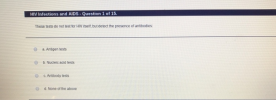 please help me with these 5 questions thankss i will give a
tumbs up
HIV infections and AIDS - Question 1 of 15. These tests do not test for HIV itself, but detect the presence of antibodies: a Antigen tests b. Nucleic acid tests c. Antibody tests d. None of the above HIV Infections and AIDS - Question 2 of 15. The initial manifestation of HIV infection: a. Acute HIV infection b. AIDS c. Clinical/atent HIV infection d. When people...
please help me with these 5 questions thankss i will give a
tumbs up
HIV infections and AIDS - Question 1 of 15. These tests do not test for HIV itself, but detect the presence of antibodies: a Antigen tests b. Nucleic acid tests c. Antibody tests d. None of the above HIV Infections and AIDS - Question 2 of 15. The initial manifestation of HIV infection: a. Acute HIV infection b. AIDS c. Clinical/atent HIV infection d. When people...
Discuss why it is important as nurses to educate the public about HIV transmission, diagnosis of...
Discuss why it is important as nurses to educate the public about HIV transmission, diagnosis of HIV, and opportunistic infections associated with HIV. Explore various web sites that would be appropriate for educating the public about HIV transmission, the diagnosis of HIV infection, and opportunistic infections. #2: How does the nurse’s role in health promotion, coupled with disease specific websites, enhance the learning of the general public about HIV?
1. Please choose the correct statement describing the treatment of opportunistic fungal infections. Common antibiotics in...
1. Please choose the correct statement describing the treatment of opportunistic fungal infections. Common antibiotics in the penicillin class are used to treat fungal infections. Many of the antifungal drugs are highly toxic. Surgery is the common procedure to remove infected tissue of patients having fungal infections. The opportunistic fungi are much more resistant to antifungal drugs than the true fungal pathogens. Opportunistic fungal infections are usually easy to eliminate. 2. Persons suffering from AIDS are particularly susceptible to fungal...
Hi there, Answer correcly only please. Thank you Question 3 (Three parts) A. Opportunistic infections are...
 Hi there,
Answer correcly only please.
Thank you
Question 3 (Three parts) A. Opportunistic infections are so apply named because when natural defenses are compromised, they seize the "opportunityto invade tissues and cause disease. a. True b. False B. Evidence indicates that AlDS-dementia complex (ADC) is caused by HIV itself a. True b. False C. Cytomegalovirus (CMV) is not considered an opportunistic infection a. True b. False
Hi there,
Answer correcly only please.
Thank you
Question 3 (Three parts) A. Opportunistic infections are so apply named because when natural defenses are compromised, they seize the "opportunityto invade tissues and cause disease. a. True b. False B. Evidence indicates that AlDS-dementia complex (ADC) is caused by HIV itself a. True b. False C. Cytomegalovirus (CMV) is not considered an opportunistic infection a. True b. False
Which of the following represents information? a. 14 b. ICD-9 code of 250.0 c. HIV infection...
Which of the following represents information? a. 14 b. ICD-9 code of 250.0 c. HIV infection leads to opportunistic infections d. 120/80 is a normal BP of an adult male
1. What are the key risk factors for STI infections? What kinds of behaviors should one...
1. What are the key risk factors for STI infections? What kinds of behaviors should one avoid to cut down on the risk of contracting a sexually transmitted infections? 2. Identify 5 STI's and the following information: What are their symptoms, how are they transmitted, long term effects, how are they treated. 3. What factors have led to decreasing rates of HIV/AIDS in the US? what are women more susceptible to HIS infection than men?
 What is an AIDS defining condition? / Low virulent opportunistic infections indicating a patient is in clinical latency Highly virulent opportunistic infections indicating a patient is in clinical latency Highly virulent opportunistic infections a patient has progressed to AIDS Low virulent opportunistic infections indicating a patient has progressed to AIDS
 please help me with these 4 questions i will give a tumbs up
thanksss
HIV Infections and AIDS - Question 11 of 15. Infection with HIV a. Generally progresses to AIDS after 8 to 10 years, because the virus replicates slowly within the body b. Attacks a specific type of immune system cell called CD4 c. Destroys the cells in which it replicates d. All of the above HIV Infections and AIDS - Question 11 of 15. Infection with HIV...
please help me with these 4 questions i will give a tumbs up
thanksss
HIV Infections and AIDS - Question 11 of 15. Infection with HIV a. Generally progresses to AIDS after 8 to 10 years, because the virus replicates slowly within the body b. Attacks a specific type of immune system cell called CD4 c. Destroys the cells in which it replicates d. All of the above HIV Infections and AIDS - Question 11 of 15. Infection with HIV...
 please help me with these 5 questions i will give a tumbs up
thanksss
HIV infections and AIDS - Question 6 of 15. The most severe phase of HIV infection is: a Acute HIV infection b. Acquired immune deficiency syndrome c. Clinical/latent infection d. None of the above HIV infections and AIDS - Question 7 of 15. This is one of the riskiest behaviors to acquire HIV a. Condomless receptive anal sex b. Using clean needles c. Condomless vaginal sex...
please help me with these 5 questions i will give a tumbs up
thanksss
HIV infections and AIDS - Question 6 of 15. The most severe phase of HIV infection is: a Acute HIV infection b. Acquired immune deficiency syndrome c. Clinical/latent infection d. None of the above HIV infections and AIDS - Question 7 of 15. This is one of the riskiest behaviors to acquire HIV a. Condomless receptive anal sex b. Using clean needles c. Condomless vaginal sex...
 please help me with these 5 questions thankss i will give a
tumbs up
HIV infections and AIDS - Question 1 of 15. These tests do not test for HIV itself, but detect the presence of antibodies: a Antigen tests b. Nucleic acid tests c. Antibody tests d. None of the above HIV Infections and AIDS - Question 2 of 15. The initial manifestation of HIV infection: a. Acute HIV infection b. AIDS c. Clinical/atent HIV infection d. When people...
please help me with these 5 questions thankss i will give a
tumbs up
HIV infections and AIDS - Question 1 of 15. These tests do not test for HIV itself, but detect the presence of antibodies: a Antigen tests b. Nucleic acid tests c. Antibody tests d. None of the above HIV Infections and AIDS - Question 2 of 15. The initial manifestation of HIV infection: a. Acute HIV infection b. AIDS c. Clinical/atent HIV infection d. When people...
 Hi there,
Answer correcly only please.
Thank you
Question 3 (Three parts) A. Opportunistic infections are so apply named because when natural defenses are compromised, they seize the "opportunityto invade tissues and cause disease. a. True b. False B. Evidence indicates that AlDS-dementia complex (ADC) is caused by HIV itself a. True b. False C. Cytomegalovirus (CMV) is not considered an opportunistic infection a. True b. False
Hi there,
Answer correcly only please.
Thank you
Question 3 (Three parts) A. Opportunistic infections are so apply named because when natural defenses are compromised, they seize the "opportunityto invade tissues and cause disease. a. True b. False B. Evidence indicates that AlDS-dementia complex (ADC) is caused by HIV itself a. True b. False C. Cytomegalovirus (CMV) is not considered an opportunistic infection a. True b. False
Most questions answered within 3 hours.
-
Where is the error in this code sequence?
String s1 = "Hello";
String s2 = "ello";...
asked 11 months ago -
Financial data for Joel de Paris, Inc., for last year
follow:
Joel de Paris, Inc.
Balance...
asked 11 months ago -
Consider this reaction:
Al2(SO4)3 (aq)+ BaCl3
(aq) Al2Cl6 (aq)- +
3BaSO4(s) . What is the...
asked 11 months ago -
Suppose that Savneet is considering increasing her
recent random sample from 20 car rentals to 40...
asked 11 months ago -
Trucks arrive at an unloading terminal at an average rate of 120
per hour.
Trucks arrive...
asked 11 months ago -
Why are methanol and ethanol completely soluble in water while
octanol is not very little soluble....
asked 11 months ago -
A facilities manager at a university reads in a research report
that the mean amount of...
asked 11 months ago -
When the CuSO4 is rehydrated by adding water to the anhydrous
compound, is this an endothermic...
asked 11 months ago -
A ray of sunlight is passing from diamond into crown glass; the
angle of incidence is...
asked 11 months ago -
A block of mass 0.249 kg is placed on top of a light, vertical
spring of...
asked 11 months ago -
how do the kidneys compensate in the presences of acidosis
a) trigger hyperventilate
b) reserve acid...
asked 11 months ago -
Question 501 pts
The rental rate of capital to the firm increases. Which of the
following...
asked 11 months ago