
Homework Answers
Add Answer to:
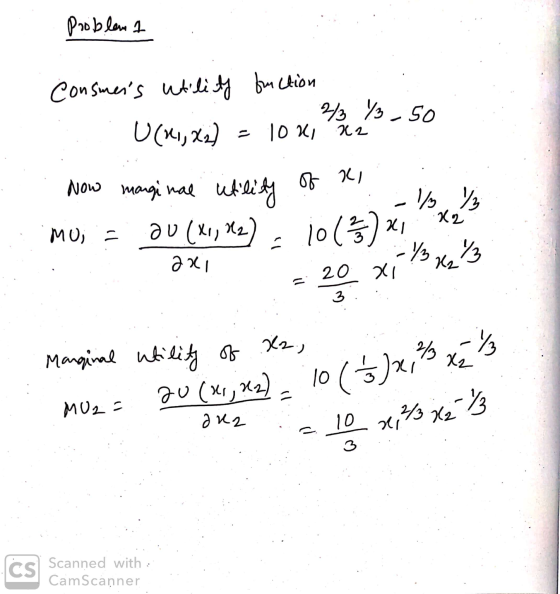
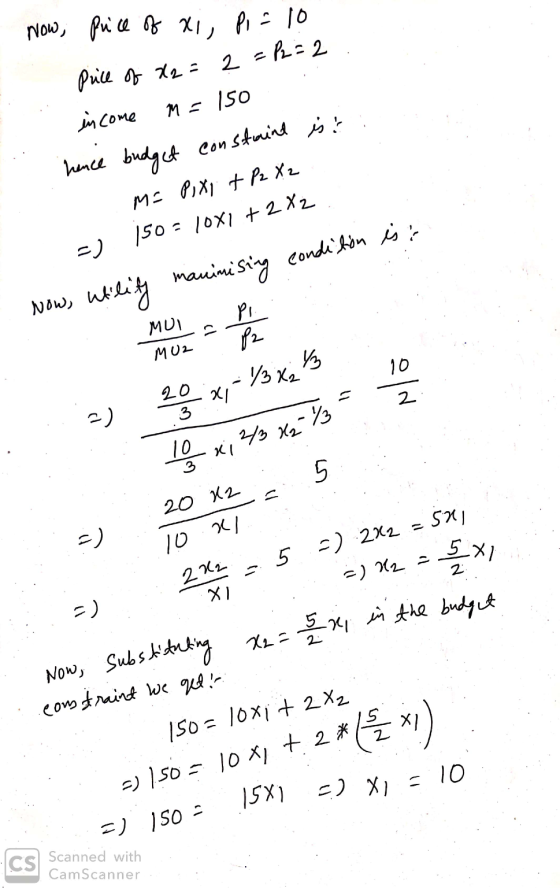
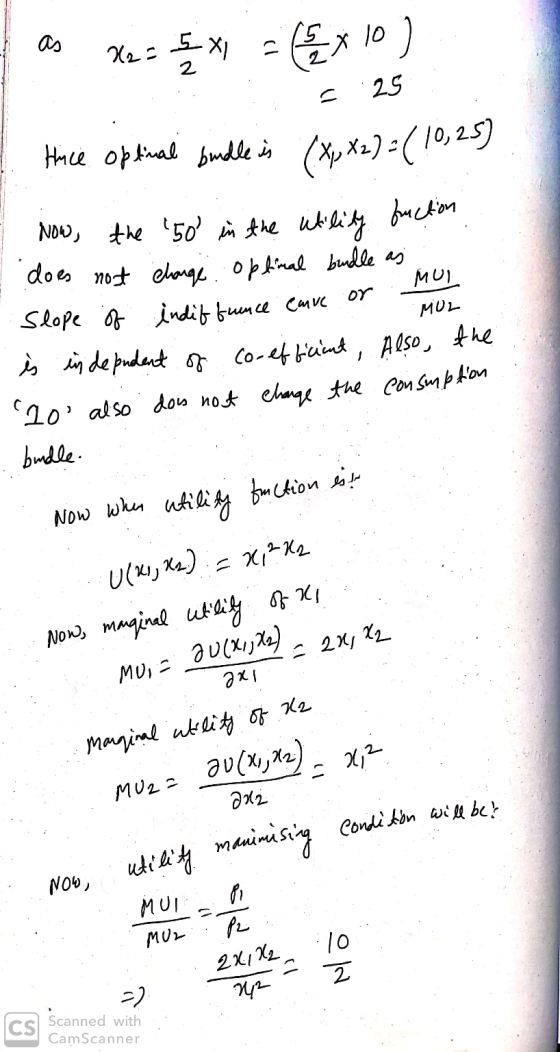
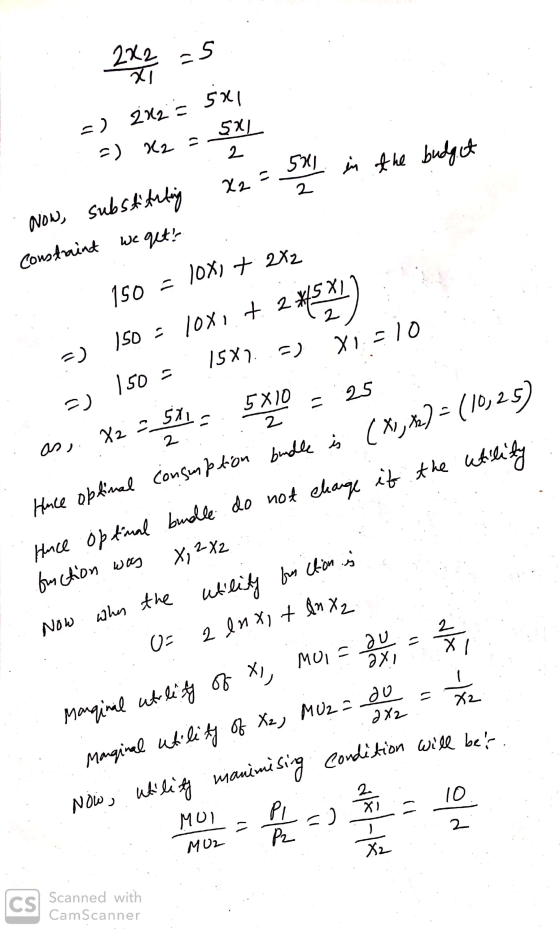
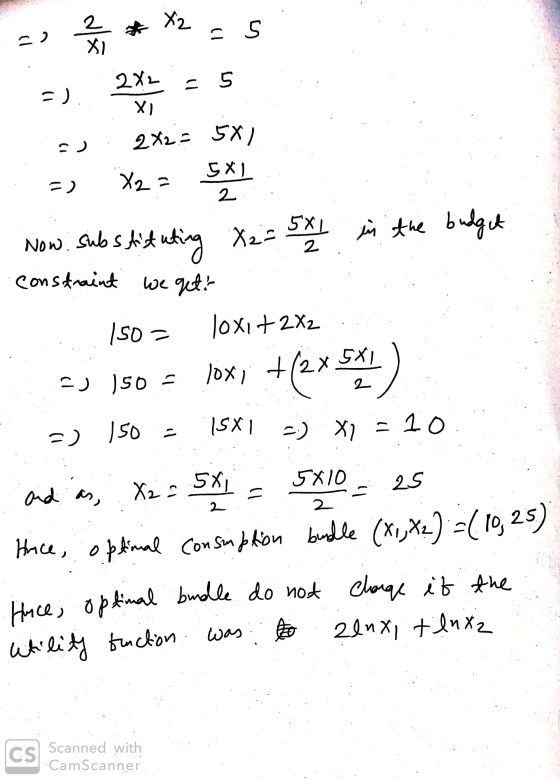
Problem 1 Consider a consumer with the utility function U(21,22) = 10x 23 -50. Suppose the...
Suppose that a consumer has a utility function given by u(x1, x2) = 2x1 + x2. Initially the consumer faces prices (2, 2) and has income 24. i. Graph the budget constraint and indifference curves. Find...
Suppose that a consumer has a utility function given by u(x1, x2) = 2x1 + x2. Initially the consumer faces prices (2, 2) and has income 24. i. Graph the budget constraint and indifference curves. Find the initial optimal bundle. ii. If the prices change to (6, 2), find the new optimal bundle. Show this in your graph in (i). iii. How much of the change in demand for x1 is due to the substitution effect? How much due to...
Consider a consumer with a utility function u(x1, x2) = min{21, 222}. Suppose the prices of...
 Consider a consumer with a utility function u(x1, x2) = min{21, 222}. Suppose the prices of good 1 and good 2 are p1 = P2 = 4. The consumer's income is m = 120. (a) Find the consumer's preferred bundle. (b) Draw the consumer's budget line. (c) On the same graph, indicate the consumer's preferred bundle and draw the indifference curve through it. (d) Now suppose that the consumer gets a discount on good 1: each unit beyond the 4th...
2. Consider the Cobb-Douglas utility function u(x,y) = x2y2. Let the budget 1, where pr, py...
 2. Consider the Cobb-Douglas utility function u(x,y) = x2y2. Let the budget 1, where pr, py are the prices and I denotes the constraint be prx + pyy income. (a) Write the Lagrangian for this utility maximization problem. (b) Solve the first-order conditions to find the demand functions for both good a and good y. [Hint: Your results should only depend on the pa- rameters pa, Py, I.] (c) In the optimal consumption bundle, how much money is spend on...
Suppose that the utility function of a typical visitor to an amusement park is U (r,...
 Suppose that the utility function of a typical visitor to an amusement park is U (r, y) = r - (1/2)p2 + y, where r is the number of rides and y is expenditure on all other goods. The current price per ride is p. Each visitor has income of M. The MU, = 1-r. (a) Derive the Marshallian or ordinary demand function for rides. Com- ment the demand function. (b) On a diagram, graph the visitor's optimal number of...
20. A consumer has a utility function of U = xx for good 1 and 2....
 20. A consumer has a utility function of U = xx for good 1 and 2. The price of one unit of good 1 is 2 and the price of good 2 is 4 per unit. In this case, if the consumer is choosing the optimal (utility- maximising) bundle: а. x2 2.5 с. 1 d. 50 e. None of the above 21. A consumer has a utility function of U = xx3 for good 1 and 2. The price of...
1. (24 total points) Suppose a consumer’s utility function is given by U(X,Y) = X1/2*Y1/2. Also,...
1. (24 total points) Suppose a consumer’s utility function is given by U(X,Y) = X1/2*Y1/2. Also, the consumer has $72 to spend, and the price of Good X, PX = $4. Let Good Y be a composite good whose price is PY = $1. So on the Y-axis, we are graphing the amount of money that the consumer has available to spend on all other goods for any given value of X. a) (2 points) How much X and Y...
how did they get MRS= -x2/x1? Consider the utility function u ( 2 2) = Inc. +Inc. Suppose that the initial situation...
 how
did they get MRS= -x2/x1?
Consider the utility function u ( 2 2) = Inc. +Inc. Suppose that the initial situation s given by Pi = 1, P2 = 2 and m = 100. Note that MU = 1 and MU2 = a) Find the consumer's optimal consumption bundle (0,2) and his utility at this consumption bundle. Solution: The budget line is 2.02 = 100 - 21 (1) Since the optimal bundle is an interior point, the tangency condition...
how
did they get MRS= -x2/x1?
Consider the utility function u ( 2 2) = Inc. +Inc. Suppose that the initial situation s given by Pi = 1, P2 = 2 and m = 100. Note that MU = 1 and MU2 = a) Find the consumer's optimal consumption bundle (0,2) and his utility at this consumption bundle. Solution: The budget line is 2.02 = 100 - 21 (1) Since the optimal bundle is an interior point, the tangency condition...
Anna spends all her income on wine (good 1) and cheese (good 2). Her utility function...
Anna spends all her income on wine (good 1) and cheese (good 2). Her utility function is u(x1; x2) = x1x2. Her income is m = $200. The prices for the two goods are p1 = $20 and p2 = $10 respectively. Find Annaís optimal consumption bundle. Show the complete calculations, and illustrate your answer graphically (draw the indi§erence curve and the budget constraint). How would your answer change to part (a) if Annaís utility function were given by v(x1;...
Lorelai's choice behavior can be represented by the utility function u(x1, 2) 0.9n(x)0.1x2. The prices of...
 Lorelai's choice behavior can be represented by the utility function u(x1, 2) 0.9n(x)0.1x2. The prices of both xi and x2 are $5 and she has an income of $40. 1. What preference does this utility function represent? (Hint: the utility is function is not linear, but at least linear in good x2) 2. Drawinwg indifference curves: you can copy down the graph on your paper using econgraphs. Set the preferences and parameters accordingly as given in the question. Click on...
Question 2: Lorelai's choice behavior can be represented by the utility function u(x1, 2)0.9Inx)0.1x2 The prices...
 Question 2: Lorelai's choice behavior can be represented by the utility function u(x1, 2)0.9Inx)0.1x2 The prices of both x1 and x2 are $5 and she has an income of $40. 1. What preference does this utility function represent? (Hint: the utility is function is not linear, 2. Drawinwg indifference curves: you can copy down the graph on your paper using econgraphs. Set but at least linear in good x2) the preferences and parameters accordingly as given in the question. Click...
 Consider a consumer with a utility function u(x1, x2) = min{21, 222}. Suppose the prices of good 1 and good 2 are p1 = P2 = 4. The consumer's income is m = 120. (a) Find the consumer's preferred bundle. (b) Draw the consumer's budget line. (c) On the same graph, indicate the consumer's preferred bundle and draw the indifference curve through it. (d) Now suppose that the consumer gets a discount on good 1: each unit beyond the 4th...
 2. Consider the Cobb-Douglas utility function u(x,y) = x2y2. Let the budget 1, where pr, py are the prices and I denotes the constraint be prx + pyy income. (a) Write the Lagrangian for this utility maximization problem. (b) Solve the first-order conditions to find the demand functions for both good a and good y. [Hint: Your results should only depend on the pa- rameters pa, Py, I.] (c) In the optimal consumption bundle, how much money is spend on...
 Suppose that the utility function of a typical visitor to an amusement park is U (r, y) = r - (1/2)p2 + y, where r is the number of rides and y is expenditure on all other goods. The current price per ride is p. Each visitor has income of M. The MU, = 1-r. (a) Derive the Marshallian or ordinary demand function for rides. Com- ment the demand function. (b) On a diagram, graph the visitor's optimal number of...
 20. A consumer has a utility function of U = xx for good 1 and 2. The price of one unit of good 1 is 2 and the price of good 2 is 4 per unit. In this case, if the consumer is choosing the optimal (utility- maximising) bundle: а. x2 2.5 с. 1 d. 50 e. None of the above 21. A consumer has a utility function of U = xx3 for good 1 and 2. The price of...
 how
did they get MRS= -x2/x1?
Consider the utility function u ( 2 2) = Inc. +Inc. Suppose that the initial situation s given by Pi = 1, P2 = 2 and m = 100. Note that MU = 1 and MU2 = a) Find the consumer's optimal consumption bundle (0,2) and his utility at this consumption bundle. Solution: The budget line is 2.02 = 100 - 21 (1) Since the optimal bundle is an interior point, the tangency condition...
how
did they get MRS= -x2/x1?
Consider the utility function u ( 2 2) = Inc. +Inc. Suppose that the initial situation s given by Pi = 1, P2 = 2 and m = 100. Note that MU = 1 and MU2 = a) Find the consumer's optimal consumption bundle (0,2) and his utility at this consumption bundle. Solution: The budget line is 2.02 = 100 - 21 (1) Since the optimal bundle is an interior point, the tangency condition...
 Lorelai's choice behavior can be represented by the utility function u(x1, 2) 0.9n(x)0.1x2. The prices of both xi and x2 are $5 and she has an income of $40. 1. What preference does this utility function represent? (Hint: the utility is function is not linear, but at least linear in good x2) 2. Drawinwg indifference curves: you can copy down the graph on your paper using econgraphs. Set the preferences and parameters accordingly as given in the question. Click on...
 Question 2: Lorelai's choice behavior can be represented by the utility function u(x1, 2)0.9Inx)0.1x2 The prices of both x1 and x2 are $5 and she has an income of $40. 1. What preference does this utility function represent? (Hint: the utility is function is not linear, 2. Drawinwg indifference curves: you can copy down the graph on your paper using econgraphs. Set but at least linear in good x2) the preferences and parameters accordingly as given in the question. Click...
Most questions answered within 3 hours.
-
Where is the error in this code sequence?
String s1 = "Hello";
String s2 = "ello";...
asked 10 months ago -
Financial data for Joel de Paris, Inc., for last year
follow:
Joel de Paris, Inc.
Balance...
asked 10 months ago -
Consider this reaction:
Al2(SO4)3 (aq)+ BaCl3
(aq) Al2Cl6 (aq)- +
3BaSO4(s) . What is the...
asked 10 months ago -
Suppose that Savneet is considering increasing her
recent random sample from 20 car rentals to 40...
asked 10 months ago -
Trucks arrive at an unloading terminal at an average rate of 120
per hour.
Trucks arrive...
asked 10 months ago -
Why are methanol and ethanol completely soluble in water while
octanol is not very little soluble....
asked 10 months ago -
A facilities manager at a university reads in a research report
that the mean amount of...
asked 10 months ago -
When the CuSO4 is rehydrated by adding water to the anhydrous
compound, is this an endothermic...
asked 10 months ago -
A ray of sunlight is passing from diamond into crown glass; the
angle of incidence is...
asked 10 months ago -
A block of mass 0.249 kg is placed on top of a light, vertical
spring of...
asked 10 months ago -
how do the kidneys compensate in the presences of acidosis
a) trigger hyperventilate
b) reserve acid...
asked 10 months ago -
Question 501 pts
The rental rate of capital to the firm increases. Which of the
following...
asked 10 months ago