
Homework Answers
As instructed, MS Excel has been used for this question.
Yahoo Finance was used to find data on the historical prices of
Apple and Google, as on the Nasdaq Stock Exchange. The Adjusted
Closing Prices of the months from January 2010 to January 2020 have
been used. This data was pasted on Excel and the returns for each
period was calculated using the given formula. Additionally, the
average returns, the standard deviation of returns and the variance
of returns were calculated using the =average function, the
=stdev.p function and the =var.p function respectively. The
following is the table output: (TABLE was deleted as the answer
length was more than 65,000 characters. I have kept relevant
data.)
| Apple | ||
| Average returns | 0.02423878 | |
| Standard Dev | 0.07315595 | |
| Variance | 0.00535179 |
| Average | 0.01629237 | |
| Standard Dev | 0.06570118 | |
| Variance | 0.00431665 |
For Part 1 of the question, weights were assigned to the companies. These are percentages of the portfolio assigned to the companies.
| WA | WG | Sum of Weights | Average Return | Standard Deviation |
| -1 | 2 | 1 | 0.008345963 | 0.058246415 |
| -0.9 | 1.9 | 1 | 0.009140604 | 0.058991891 |
| -0.8 | 1.8 | 1 | 0.009935245 | 0.059737368 |
| -0.7 | 1.7 | 1 | 0.010729886 | 0.060482845 |
| -0.6 | 1.6 | 1 | 0.011524527 | 0.061228321 |
| -0.5 | 1.5 | 1 | 0.012319168 | 0.061973798 |
| -0.4 | 1.4 | 1 | 0.013113809 | 0.062719275 |
| -0.3 | 1.3 | 1 | 0.01390845 | 0.063464751 |
| -0.2 | 1.2 | 1 | 0.014703091 | 0.064210228 |
| -0.1 | 1.1 | 1 | 0.015497732 | 0.064955705 |
| 0 | 1 | 1 | 0.016292373 | 0.065701181 |
| 0.1 | 0.9 | 1 | 0.017087013 | 0.066446658 |
| 0.2 | 0.8 | 1 | 0.017881654 | 0.067192135 |
| 0.3 | 0.7 | 1 | 0.018676295 | 0.067937612 |
| 0.4 | 0.6 | 1 | 0.019470936 | 0.068683088 |
| 0.5 | 0.5 | 1 | 0.020265577 | 0.069428565 |
| 0.6 | 0.4 | 1 | 0.021060218 | 0.070174042 |
| 0.7 | 0.3 | 1 | 0.021854859 | 0.070919518 |
| 0.8 | 0.2 | 1 | 0.0226495 | 0.071664995 |
| 0.9 | 0.1 | 1 | 0.023444141 | 0.072410472 |
| 1 | 0 | 1 | 0.024238782 | 0.073155948 |
| 1.1 | -0.1 | 1 | 0.025033423 | 0.073901425 |
| 1.2 | -0.2 | 1 | 0.025828064 | 0.074646902 |
| 1.3 | -0.3 | 1 | 0.026622705 | 0.075392378 |
| 1.4 | -0.4 | 1 | 0.027417346 | 0.076137855 |
| 1.5 | -0.5 | 1 | 0.028211987 | 0.076883332 |
| 1.6 | -0.6 | 1 | 0.029006628 | 0.077628809 |
| 1.7 | -0.7 | 1 | 0.029801269 | 0.078374285 |
| 1.8 | -0.8 | 1 | 0.03059591 | 0.079119762 |
| 1.9 | -0.9 | 1 | 0.031390551 | 0.079865239 |
| 2 | -1 | 1 | 0.032185191 | 0.080610715 |
The following scatter plot shows the average returns and standard deviation of the portfolio when short selling is used. The X-axis contains the weights of Apple in the portfolio and the Y-axis shows the average returns and the standard deviations.
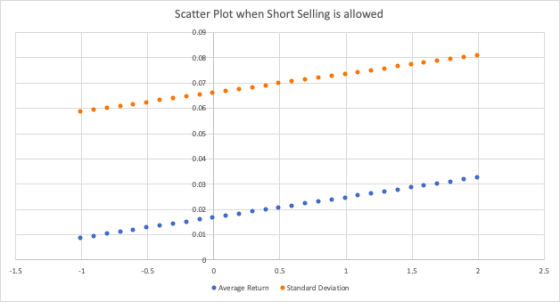
It can be seen that the average returns and standard deviations have a linear relationship with the weight in the portfolio.
Part 2 of the question: The following table has
the average returns and variance of the portfolio when no short
selling is allowed:
| No Short Selling | ||||
| WA | WG | Sum of Weights | Average Return | Variance |
| 0 | 1 | 1 | 0.016292373 | 0.004316645 |
| 0.05 | 0.95 | 1 | 0.016689693 | 0.004368403 |
| 0.1 | 0.9 | 1 | 0.017087013 | 0.00442016 |
| 0.15 | 0.85 | 1 | 0.017484334 | 0.004471917 |
| 0.2 | 0.8 | 1 | 0.017881654 | 0.004523675 |
| 0.25 | 0.75 | 1 | 0.018278975 | 0.004575432 |
| 0.3 | 0.7 | 1 | 0.018676295 | 0.00462719 |
| 0.35 | 0.65 | 1 | 0.019073616 | 0.004678947 |
| 0.4 | 0.6 | 1 | 0.019470936 | 0.004730704 |
| 0.45 | 0.55 | 1 | 0.019868257 | 0.004782462 |
| 0.5 | 0.5 | 1 | 0.020265577 | 0.004834219 |
| 0.55 | 0.45 | 1 | 0.020662898 | 0.004885976 |
| 0.6 | 0.4 | 1 | 0.021060218 | 0.004937734 |
| 0.65 | 0.35 | 1 | 0.021457539 | 0.004989491 |
| 0.7 | 0.3 | 1 | 0.021854859 | 0.005041249 |
| 0.75 | 0.25 | 1 | 0.02225218 | 0.005093006 |
| 0.8 | 0.2 | 1 | 0.0226495 | 0.005144763 |
| 0.85 | 0.15 | 1 | 0.023046821 | 0.005196521 |
| 0.9 | 0.1 | 1 | 0.023444141 | 0.005248278 |
| 0.95 | 0.05 | 1 | 0.023841462 | 0.005300035 |
| 1 | 0 | 1 | 0.024238782 | 0.005351793 |
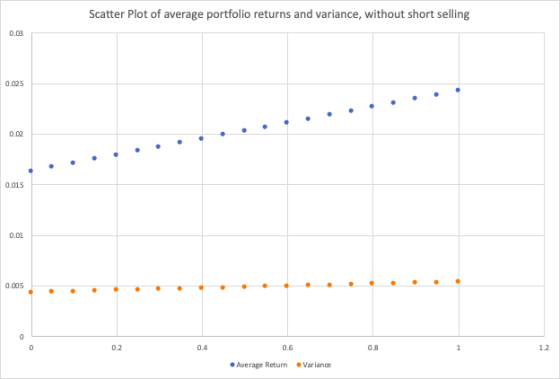
The following is the scatter plot, with percentages of returns and variances on the Y-axis and weights of apple on the X-axis:
For Part 3 of the question:
There are several points of difference between the situation when short selling is allowed to when it is not allowed. As can be seen from both the scatter plots, there is a positive linear relationship between weights and returns. But, when short selling is allowed, the maximum average return of the portfolio is a little over 3%, whereas it is just below 2.5% when short selling is not allowed. Hence, short selling allows returns to only marginally increase. The significant difference between the 2 situations is that the curve of the variance of the returns has become flatter. This shows that the return adjusted for the risk has also increased when short selling is not allowed. Hence, the risk-adjusted returns rise when short selling is not allowed.
For part 4 of the question:
Beta is a measure of the volatility of the stock with respect to the market. It is calculated using historical data of the average returns of the stock and the average returns of the market portfolio, which is taken to be the S&P 500.
| Correlation | 0.504901135 |
The correlation of the market returns with that of apple is calculated using the =correl function on Excel. The standard deviation of returns is also computed. They come out to be:
| Apple | Market | |
| Standard Deviation | 0.073155948 | 0.035611626 |
Beta = (Standard deviation of apple/ standard deviation of the
market)* Correlation between apple and market returns
= (0.073155948/0.035611626)*0.504901135
=
| 1.037204015 |
Apple beta is > 1. Apple can be said to have a relative risk a little bit higher than the market.
Add Answer to:
Please
help I have no idea how to do this question.
Download monthly adjusted close price...
Suppose we have the following information about two stocks: Beta Expected Return 11% 6% 1.6 Stock...
 Suppose we have the following information about two stocks: Beta Expected Return 11% 6% 1.6 Stock 1 Stock 2 0.5 If the CAPM holds, what is the risk-free interest rate, the expected stock market return, and the market risk premium? (hint: Use CAPM equation for each separately; plug in known values and see if you can find unknown parameters through the two equations. Question #5 (30 points) Download monthly price data for Cigna (CI) and Amazon.com (MNZ) for the period...
I know how to do part a but i really need help with part B. Thanks...
 I know how to do part a but i really need help with part B.
Thanks
1. a) Use MATLAB or Excel to create a Bode plot of the transfer function G(S) +0.5 0.5 s 1.0. for 0.0 1 a) 100 b) Discretize the transfer function using a backwards difference (Euler) transformation. Write a routine in MATLAB or Excel to calculate the output of the transfer function given an input signal. Use your routine to calculate the outputs for the...
I know how to do part a but i really need help with part B.
Thanks
1. a) Use MATLAB or Excel to create a Bode plot of the transfer function G(S) +0.5 0.5 s 1.0. for 0.0 1 a) 100 b) Discretize the transfer function using a backwards difference (Euler) transformation. Write a routine in MATLAB or Excel to calculate the output of the transfer function given an input signal. Use your routine to calculate the outputs for the...
Please help with the graph. Where do I plot? For the bottom question, the options are...
 Please help with the graph. Where do I plot?
For the bottom question, the options are as follows.
1. equals, is more than, is less than.
2. in equilibrium, undervalued, overvalued.
3. in equilibrium, undervalued, overvalued.
Keith holds a portfolio that is invested equally in three stocks (wD = wA = w-1/3). Each stock is described in the following table Stock Beta Standard Deviation Expected Return DET 0.7 AIL 1.0 INO 1.6 25% 38% 34% 8.0% 10.0% 13.5% An analyst...
Please help with the graph. Where do I plot?
For the bottom question, the options are as follows.
1. equals, is more than, is less than.
2. in equilibrium, undervalued, overvalued.
3. in equilibrium, undervalued, overvalued.
Keith holds a portfolio that is invested equally in three stocks (wD = wA = w-1/3). Each stock is described in the following table Stock Beta Standard Deviation Expected Return DET 0.7 AIL 1.0 INO 1.6 25% 38% 34% 8.0% 10.0% 13.5% An analyst...
PROBLEM i Create a column of monthly returns for your 2 stocks and the following 3...
 PROBLEM i Create a column of monthly returns for your 2 stocks and the following 3 portfolios. Organize your spreadsheet as follows: a. Date VRSN (#1) Portfolio 1 80% in A 20% in B Portfolio 2 50% in A 50% in B Portfolio 3 20% in A 80% in B MNST (#2) S&P 500 X.x X.x Xx Xx Xx b. Calculate the historical average return and standard deviation for your stocks and the portfolios. Recall you are using historical data,...
I need help understanding what I need to do to complete this spreadsheet (steps on how...
 I need help understanding what I need to do to complete this
spreadsheet (steps on how to start it) in Excel, thank you!
Spreadsheet Assignment 2 Riesk and Return Historical Data NSTRUCTIONS listorical price data are obtained for Stocks X, Y, Z. To erform the required analysis, as demonstrated in the preadsheet modeling video, first calculate the rates f return for each stock. Then use the RETURNS data not price) to perform the required analysis. Please be ure to watch...
I need help understanding what I need to do to complete this
spreadsheet (steps on how to start it) in Excel, thank you!
Spreadsheet Assignment 2 Riesk and Return Historical Data NSTRUCTIONS listorical price data are obtained for Stocks X, Y, Z. To erform the required analysis, as demonstrated in the preadsheet modeling video, first calculate the rates f return for each stock. Then use the RETURNS data not price) to perform the required analysis. Please be ure to watch...
 Suppose we have the following information about two stocks: Beta Expected Return 11% 6% 1.6 Stock 1 Stock 2 0.5 If the CAPM holds, what is the risk-free interest rate, the expected stock market return, and the market risk premium? (hint: Use CAPM equation for each separately; plug in known values and see if you can find unknown parameters through the two equations. Question #5 (30 points) Download monthly price data for Cigna (CI) and Amazon.com (MNZ) for the period...
 I know how to do part a but i really need help with part B.
Thanks
1. a) Use MATLAB or Excel to create a Bode plot of the transfer function G(S) +0.5 0.5 s 1.0. for 0.0 1 a) 100 b) Discretize the transfer function using a backwards difference (Euler) transformation. Write a routine in MATLAB or Excel to calculate the output of the transfer function given an input signal. Use your routine to calculate the outputs for the...
I know how to do part a but i really need help with part B.
Thanks
1. a) Use MATLAB or Excel to create a Bode plot of the transfer function G(S) +0.5 0.5 s 1.0. for 0.0 1 a) 100 b) Discretize the transfer function using a backwards difference (Euler) transformation. Write a routine in MATLAB or Excel to calculate the output of the transfer function given an input signal. Use your routine to calculate the outputs for the...
 Please help with the graph. Where do I plot?
For the bottom question, the options are as follows.
1. equals, is more than, is less than.
2. in equilibrium, undervalued, overvalued.
3. in equilibrium, undervalued, overvalued.
Keith holds a portfolio that is invested equally in three stocks (wD = wA = w-1/3). Each stock is described in the following table Stock Beta Standard Deviation Expected Return DET 0.7 AIL 1.0 INO 1.6 25% 38% 34% 8.0% 10.0% 13.5% An analyst...
Please help with the graph. Where do I plot?
For the bottom question, the options are as follows.
1. equals, is more than, is less than.
2. in equilibrium, undervalued, overvalued.
3. in equilibrium, undervalued, overvalued.
Keith holds a portfolio that is invested equally in three stocks (wD = wA = w-1/3). Each stock is described in the following table Stock Beta Standard Deviation Expected Return DET 0.7 AIL 1.0 INO 1.6 25% 38% 34% 8.0% 10.0% 13.5% An analyst...
 PROBLEM i Create a column of monthly returns for your 2 stocks and the following 3 portfolios. Organize your spreadsheet as follows: a. Date VRSN (#1) Portfolio 1 80% in A 20% in B Portfolio 2 50% in A 50% in B Portfolio 3 20% in A 80% in B MNST (#2) S&P 500 X.x X.x Xx Xx Xx b. Calculate the historical average return and standard deviation for your stocks and the portfolios. Recall you are using historical data,...
 I need help understanding what I need to do to complete this
spreadsheet (steps on how to start it) in Excel, thank you!
Spreadsheet Assignment 2 Riesk and Return Historical Data NSTRUCTIONS listorical price data are obtained for Stocks X, Y, Z. To erform the required analysis, as demonstrated in the preadsheet modeling video, first calculate the rates f return for each stock. Then use the RETURNS data not price) to perform the required analysis. Please be ure to watch...
I need help understanding what I need to do to complete this
spreadsheet (steps on how to start it) in Excel, thank you!
Spreadsheet Assignment 2 Riesk and Return Historical Data NSTRUCTIONS listorical price data are obtained for Stocks X, Y, Z. To erform the required analysis, as demonstrated in the preadsheet modeling video, first calculate the rates f return for each stock. Then use the RETURNS data not price) to perform the required analysis. Please be ure to watch...
Most questions answered within 3 hours.
-
Where is the error in this code sequence?
String s1 = "Hello";
String s2 = "ello";...
asked 10 months ago -
Financial data for Joel de Paris, Inc., for last year
follow:
Joel de Paris, Inc.
Balance...
asked 10 months ago -
Consider this reaction:
Al2(SO4)3 (aq)+ BaCl3
(aq) Al2Cl6 (aq)- +
3BaSO4(s) . What is the...
asked 10 months ago -
Suppose that Savneet is considering increasing her
recent random sample from 20 car rentals to 40...
asked 10 months ago -
Trucks arrive at an unloading terminal at an average rate of 120
per hour.
Trucks arrive...
asked 10 months ago -
Why are methanol and ethanol completely soluble in water while
octanol is not very little soluble....
asked 10 months ago -
A facilities manager at a university reads in a research report
that the mean amount of...
asked 10 months ago -
When the CuSO4 is rehydrated by adding water to the anhydrous
compound, is this an endothermic...
asked 10 months ago -
A ray of sunlight is passing from diamond into crown glass; the
angle of incidence is...
asked 10 months ago -
A block of mass 0.249 kg is placed on top of a light, vertical
spring of...
asked 10 months ago -
how do the kidneys compensate in the presences of acidosis
a) trigger hyperventilate
b) reserve acid...
asked 10 months ago -
Question 501 pts
The rental rate of capital to the firm increases. Which of the
following...
asked 10 months ago