In 1929, the United States Health Service worked with state and local departments of health in...
In 1929, the United States Health Service worked with state and local departments of health in six states to find a method to control venereal disease. The statistical reports that were conducted between 1930 and 1932 demonstrated a high rate of syphilis in Macon County, Alabama, where over 84 percent of the population were black and 40 percent of the men were infected with syphilis. The methods used for treating this disease consisted of the injection of mercury and other toxic chemicals. Some men recovered with this treatment; others were made even more ill; and in some cases in which no treatment was given, the patient was able to live for several decades.
After funding to treat the disease ran out during the Depression, the researchers conducting the Tuskegee Study attempted to discover how severe this disease was if left untreated. For this study, the U.S. Public Health Service selected 600 men. Of these 600 research subjects, 400 of the men had syphilis and the other 200 nonsyphilitic men became the control group of research subjects who received no treatment. The infected patients were not told about the purpose or nature of the research. In fact, the researchers would refer to procedures such as spinal taps as “treatments” to induce patient participation. When some of the men in the control group developed syphilis over the course of the study, they were transferred into the research group without ever being told they had the disease. No treatment was ever given to any of the men to fight the disease.
In the early 1940s, penicillin was found to be effective against syphilis. The Tuskegee Project could have been discontinued at this time, as there was no longer any need to study the course of this disease without treatment. However, the research project did continue. The researchers were able to track the men and make sure they did not receive antibiotics for any condition including syphilis. In the 1960s, a researcher working for the U.S. Public Health Service tried to put an end to the project, which was now being conducted by the Centers for Disease Control (CDC) in Atlanta. When he was unsuccessful, he notified the press and ultimately the project was stopped. The public was outraged that poor black men had been subjected to a research project without their consent and denied treatment for a treatable disease in an attempt to gain what was seen as useless information. In 1973, the surviving patients received an out-of-court settlement of $37,500 for the infected men and $16,000 for the men in the control group. The families of men who had died also received compensation of $15,000 for the infected men and $5,000 for the uninfected men.
In 1997, President Clinton offered a public apology to the men, including one 100-year-old survivor, who were involved in this study. The last remaining survivor of this study died in 2004.
This was never a secret project. This project had been well publicized in medical journals. The people who read about the study did nothing to stop it
- Identify ethical issues pertaining to this scenario
- What is a control group and are control groups still used in today's medical research?
- What ethical measures and requirements are in place to guide human subject research nowadays?
Homework Answers
The ethical issues pertaining to this scenario are
- People subjected to research without any consents
- The literacy or lack of knowledge on what is being done to them (subject) is used by the researcher
- Subject denied of treatment after finding they are positive for infection and during availability of medication
- Subjects were transferred from one group to other without information
The control group term itself describes that the things are under strict supervision by a superior where the individuals are not supposed to do anything or permitted to do things on own.In simple the subjects are experimented or researched for the result and they do not receive any treatment
The scientific control group is still in effective which may give minimal effects to variable and provide treatment
The ethical measures and requirements that are in place to guide human subject on research now a days are
- to inform about the type of research and ask for their approval or willingness before selecting for a reserach
- Get consent for procedure ,treatment,etc.,
- The subjects should fit the needed criteria of the study
Add Answer to:
In 1929, the United States Health Service worked with state and
local departments of health in...
what were the main social issues with ethical implications involved in this study?....identify and explain your...
 what were the main social issues with ethical implications
involved in this study?....identify and explain your understanding
of the question
ARCH NOTE: TUSKEGEE SYPHILIS STUDY During the late 1920s in the United State United States, syphilis rates were extremely high in some areas. The private Rosenwald Foundation teamed with the United States Public Health Service (USPHS) to begin enorts to control the disease using the drug neosalvarsan, an arsenic compound. Macon County, Alabama, particularly the town of luskegee, was targeted...
what were the main social issues with ethical implications
involved in this study?....identify and explain your understanding
of the question
ARCH NOTE: TUSKEGEE SYPHILIS STUDY During the late 1920s in the United State United States, syphilis rates were extremely high in some areas. The private Rosenwald Foundation teamed with the United States Public Health Service (USPHS) to begin enorts to control the disease using the drug neosalvarsan, an arsenic compound. Macon County, Alabama, particularly the town of luskegee, was targeted...
Tuskegee Study Syphilis is a chronic, contagious bacterial disease that is most often sexually transmitted but...
 Tuskegee Study Syphilis is a chronic, contagious bacterial disease that is most often sexually transmitted but is sometimes congenital. Since about 1946, the disease has been successfully treated with antibiotics. Prior to 1946, individuals with the disease had an inevitable progress through its Ш sequelae, from the primary lesion and chancre to rash, fever, and swollen lymph nodes to the final stage of nervous system and circulatory problems, and finally death. The progress of the disease is often 30-40 years....
Which of the following describe an observational study? Check all that apply. Group of answer choices...
Which of the following describe an observational study? Check all that apply. Group of answer choices Study 1: An early study of the relationship between smoking and lung cancer was conducted by Hammond & Horn (1958). They had an extensive set of volunteers track 187,766 men over a 44-month period, noting their smoking habits and whether or not they had died of lung cancer. Study 2: A study published in the Archives of Internal Medicine reported on the effectiveness of...
At the beginning of the AIDS epidemic in the early 1980s, U.S. public health officials were...
At the beginning of the AIDS epidemic in the early 1980s, U.S. public health officials were shocked by the emergence of this new, deadly threat. The illness was found in gay men, a population that already faced discrimination in employment, housing, military service, marriage, health protections, adoption, public accommodation, and so on (Harper & Schneider, 2003). Local, state, and federal officials had to figure out a public health strategy with people from the gay community and their allies in medical...
About 870 men took part in a study to study the effectiveness of a hormone therapy....
 About 870 men took part in a study to study the effectiveness of a hormone therapy. Half of the men were selected randomly to come in and receive the hormone therapy while the other half were told to stay home and thus did not receive the therapy. After about a year, blood tests were conducted on each subject by a lab technician who was aware of which group (treatment or those given nothing) the blood samples originated from. In presenting...
1. A process whereby the investigator assigns subjects to either the treatment or comparison group is...
1. A process whereby the investigator assigns subjects to either the treatment or comparison group is known as…. a) Non-compliance b) Equipoise c) Randomization d) Blinding 2. An analysis that includes all subjects who were randomized to the treatment and comparison groups, regardless of whether the received or completed their assigned study protocol. a) Run-in period b) Efficacy analysis c) Comparability d) Intend-to-treat analysis 3. A study that commonly includes subjects without regard to exposure or disease status and that...
The Abecedarian Project is a randomized controlled study to assess the effects of intensive early childhood...
The Abecedarian Project is a randomized controlled study to assess the effects of intensive early childhood education on children who were at high risk based on several sociodemographic indicators. The project randomly assigned some children to a treatment group that was provided with early educational activities before kindergarten and the remainder to a control group. A recent follow-up study interviewed subjects at age 30 and evaluated educational, economic, and socioemotional outcomes to learn if the positive effects of the program...
Health Care in the United States—For Better or Worse? The final hours came as no surprise...
Health Care in the United States—For Better or Worse? The final hours came as no surprise to his wife and family, who made daily visits to the hospital where Sam had been treated on and off for the final year of his life. His doctor had spared no expense to give him the most effective treatments available. But wouldn’t it have been nice if he could have died at home? they thought to themselves as they gathered at the funeral....
3. A cable TV company was interested in making its operation more efficient by cutting down on the distance between service calls while still maintaining at least the same level of service quality. A treatment group of 18 repairpersons was assigned to a d
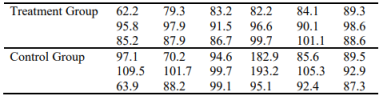 3. A cable TV company was interested in making its operation more efficient by cutting down
on the distance between service calls while still maintaining at least the same level of service
quality. A treatment group of 18 repairpersons was assigned to a dispatcher who monitored all the
incoming requests for cable repairs and then provided a service strategy for that day’s work orders.
A control group of 18 repairpersons was to perform their work in a normal fashion—that is,...
3. A cable TV company was interested in making its operation more efficient by cutting down
on the distance between service calls while still maintaining at least the same level of service
quality. A treatment group of 18 repairpersons was assigned to a dispatcher who monitored all the
incoming requests for cable repairs and then provided a service strategy for that day’s work orders.
A control group of 18 repairpersons was to perform their work in a normal fashion—that is,...
The limitations of nonexperimental research were dramatically brought to the attention of the public by the...
The limitations of nonexperimental research were dramatically brought to the attention of the public by the results of an experiment on the effects of postmenopausal hormone replacement therapy (part of a larger study known as the Women’s Health Initiative). An experiment is called a clinical trial in medical research. In the clinical trial, participants were randomly assigned to receive either the hormone replacement therapy or a placebo (no hormones). The hormone replacement therapy consisted of estrogen plus progestin. In 2002,...
 what were the main social issues with ethical implications
involved in this study?....identify and explain your understanding
of the question
ARCH NOTE: TUSKEGEE SYPHILIS STUDY During the late 1920s in the United State United States, syphilis rates were extremely high in some areas. The private Rosenwald Foundation teamed with the United States Public Health Service (USPHS) to begin enorts to control the disease using the drug neosalvarsan, an arsenic compound. Macon County, Alabama, particularly the town of luskegee, was targeted...
what were the main social issues with ethical implications
involved in this study?....identify and explain your understanding
of the question
ARCH NOTE: TUSKEGEE SYPHILIS STUDY During the late 1920s in the United State United States, syphilis rates were extremely high in some areas. The private Rosenwald Foundation teamed with the United States Public Health Service (USPHS) to begin enorts to control the disease using the drug neosalvarsan, an arsenic compound. Macon County, Alabama, particularly the town of luskegee, was targeted...
 Tuskegee Study Syphilis is a chronic, contagious bacterial disease that is most often sexually transmitted but is sometimes congenital. Since about 1946, the disease has been successfully treated with antibiotics. Prior to 1946, individuals with the disease had an inevitable progress through its Ш sequelae, from the primary lesion and chancre to rash, fever, and swollen lymph nodes to the final stage of nervous system and circulatory problems, and finally death. The progress of the disease is often 30-40 years....
 About 870 men took part in a study to study the effectiveness of a hormone therapy. Half of the men were selected randomly to come in and receive the hormone therapy while the other half were told to stay home and thus did not receive the therapy. After about a year, blood tests were conducted on each subject by a lab technician who was aware of which group (treatment or those given nothing) the blood samples originated from. In presenting...
Most questions answered within 3 hours.
-
Where is the error in this code sequence?
String s1 = "Hello";
String s2 = "ello";...
asked 11 months ago -
Financial data for Joel de Paris, Inc., for last year
follow:
Joel de Paris, Inc.
Balance...
asked 11 months ago -
Consider this reaction:
Al2(SO4)3 (aq)+ BaCl3
(aq) Al2Cl6 (aq)- +
3BaSO4(s) . What is the...
asked 11 months ago -
Suppose that Savneet is considering increasing her
recent random sample from 20 car rentals to 40...
asked 11 months ago -
Trucks arrive at an unloading terminal at an average rate of 120
per hour.
Trucks arrive...
asked 11 months ago -
Why are methanol and ethanol completely soluble in water while
octanol is not very little soluble....
asked 11 months ago -
A facilities manager at a university reads in a research report
that the mean amount of...
asked 11 months ago -
When the CuSO4 is rehydrated by adding water to the anhydrous
compound, is this an endothermic...
asked 11 months ago -
A ray of sunlight is passing from diamond into crown glass; the
angle of incidence is...
asked 11 months ago -
A block of mass 0.249 kg is placed on top of a light, vertical
spring of...
asked 11 months ago -
how do the kidneys compensate in the presences of acidosis
a) trigger hyperventilate
b) reserve acid...
asked 11 months ago -
Question 501 pts
The rental rate of capital to the firm increases. Which of the
following...
asked 11 months ago