

Homework Answers
Question 12 : Answer
A- overstate is correct answer.
changes in the producer price index not considering understate changes the actual producer cost also not consider lag behind
Question 13:Answer
C - the GDP Deflector are shown considerabily higher inflation than the other two measures
Question 14: Answer
A - CPI correct answer .
PCE- personal consumption expenditures (PCEs) are imputed household expenditures defined for a period of time
PPI The producer price index, or PPI, is a group of indexes that calculates and represents the average movement in selling prices from domestic production over time
GDP Deflector -also called implicit price deflator, is a measure of inflation. It is the ratio of the value of goods and services an economy produces in a particular year at current prices to that of prices that prevailed during the base year.
Question 15 : Answer.
C - correct answer
Add Answer to:
Question 12 0.25 pts 12. Changes in the producer price index tend to ___changes in actual...
QUESTION 25 Which of the following price indices best measures the prices of the market basket...
 QUESTION 25 Which of the following price indices best measures the prices of the market basket of goods and services bought by typical households? CPI O PPI GDP deflator PCE index
22. Use your knowledge of price indexes to answer the following three-part question 22a. An index...
22. Use your knowledge of price indexes to answer the following three-part question 22a. An index of prices of all domestically produced goods in the economy is the a. Consumer Price Index. b. GDP Chain Price Index. c. Producer Price Index. d. Wholesale Price Index. 22b. The most comprehensive (inclusive of goods) measure of the rate at which prices are changing is: a. the CPI b. the balance-of-payments index. c. the GDP Chain Price Index....
32.) Suppose that in 2010, the producer price index increases by 1.5 percent. As a result,...
32.) Suppose that in 2010, the producer price index increases by 1.5 percent. As a result, economists most likely will predict that A GDP will increase in 2011. B the producer price index will increase by more than 1.5 percent in 2011. C interest rates will decrease in the future. D the consumer price index will increase in the future. 34.) Assume that consumers consider rice and potatoes to be substitutes, but they buy rice more regularly and so rice...
Question 4 0.25 pts 4. The consumer price index (CPI) is 150 in year 1, 156...
 Question 4 0.25 pts 4. The consumer price index (CPI) is 150 in year 1, 156 in year 2, and 160 in year 3. What is the inflation rate for year 2? Round to nearest whole percentage. a. 3% b.4% O c.6% O d. 7% Question 5 0.25 pts 5. Which of the following is NOT a cost of inflation? a. unexpected redistribution of wealth and income b. reduction in the value of cash that is held c. higher real...
Question 1 1 pts Which of the following is not a price index? the Consumer Price...
 Question 1 1 pts Which of the following is not a price index? the Consumer Price Index the Producer Price Index the GDP deflator o all of these are price indices Question 2 1 pts In the Specter article, Deli $ could be considered money O They served as a store of value. They served as a means of payment. They served as a unit of account. They paid interest Question 3 1 pts Use statements I and Il to...
Question 10 (5 points) Which price index comprises the prices of all final goods and services...
 Question 10 (5 points) Which price index comprises the prices of all final goods and services produced within the economy? a) the consumer price index Ob) the GDP inflator O C) the GDP deflator d) the producer price index Question 11 (5 points) ✓ Saved What do we call an increase in the average level of prices in an economy?
The broadest-based price index available is the A) GDP deflator. B) producer price index. C) consumer price index....
 The broadest-based price index available is the A) GDP deflator. B) producer price index. C) consumer price index. D) wholesale price index. The MPC is A) the change in consumption divided by the change in income. B) consumption divided by income. C) the change in consumption divided by the change in saving. D) the change in saving divided by the change in income. The MPS is A) the change in saving divided by the change in income. B) 1 +...
Question 3 0.25 pts Table 5: Price Index for Macroland Year 1 Price index 140 Year...
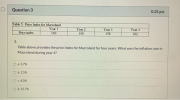 Question 3 0.25 pts Table 5: Price Index for Macroland Year 1 Price index 140 Year 2 150 Year 3 158 Year 4 162 Table above provides the price index for Macroland for four years. What was the inflation rate in Macroland during year 4? a. 5.7% b.2.5% O c. 4.0% d. 15.7%
please answer all question below 16. Suppose your annual income was $32,000 in 1998, and 33000...
 please answer all question below
16. Suppose your annual income was $32,000 in 1998, and 33000 in 1999. If the 1998 CPI is 160 and 1999 CPI is 165, then you real income has: G. Gone up by 3% H. Not changed I. Declined by 5% J. Increased by 10% 13. If the CPI ignores product quality improvements, then the CPI tends to: C. Understand the inflation rate D. Overstate the inflation rate E. Understate economic growth F. Be artificially...
please answer all question below
16. Suppose your annual income was $32,000 in 1998, and 33000 in 1999. If the 1998 CPI is 160 and 1999 CPI is 165, then you real income has: G. Gone up by 3% H. Not changed I. Declined by 5% J. Increased by 10% 13. If the CPI ignores product quality improvements, then the CPI tends to: C. Understand the inflation rate D. Overstate the inflation rate E. Understate economic growth F. Be artificially...
The Census Bureau surveys households for employment status, while the Labor Department focuses on the payrolls...
The Census Bureau surveys households for employment status, while the Labor Department focuses on the payrolls of businesses and government agencies to determine employment totals. Question 1 options: a) False b) True Which of the following statements describes a difference between the consumer price index (CPI) and the producer price index (PPI)? Question 2 options: a) Only the PPI measures net revenues received by firms. b) Only the PPI has a fixed market basket. c) Only the PPI is associated...
 QUESTION 25 Which of the following price indices best measures the prices of the market basket of goods and services bought by typical households? CPI O PPI GDP deflator PCE index
 Question 4 0.25 pts 4. The consumer price index (CPI) is 150 in year 1, 156 in year 2, and 160 in year 3. What is the inflation rate for year 2? Round to nearest whole percentage. a. 3% b.4% O c.6% O d. 7% Question 5 0.25 pts 5. Which of the following is NOT a cost of inflation? a. unexpected redistribution of wealth and income b. reduction in the value of cash that is held c. higher real...
 Question 1 1 pts Which of the following is not a price index? the Consumer Price Index the Producer Price Index the GDP deflator o all of these are price indices Question 2 1 pts In the Specter article, Deli $ could be considered money O They served as a store of value. They served as a means of payment. They served as a unit of account. They paid interest Question 3 1 pts Use statements I and Il to...
 Question 10 (5 points) Which price index comprises the prices of all final goods and services produced within the economy? a) the consumer price index Ob) the GDP inflator O C) the GDP deflator d) the producer price index Question 11 (5 points) ✓ Saved What do we call an increase in the average level of prices in an economy?
 The broadest-based price index available is the A) GDP deflator. B) producer price index. C) consumer price index. D) wholesale price index. The MPC is A) the change in consumption divided by the change in income. B) consumption divided by income. C) the change in consumption divided by the change in saving. D) the change in saving divided by the change in income. The MPS is A) the change in saving divided by the change in income. B) 1 +...
 Question 3 0.25 pts Table 5: Price Index for Macroland Year 1 Price index 140 Year 2 150 Year 3 158 Year 4 162 Table above provides the price index for Macroland for four years. What was the inflation rate in Macroland during year 4? a. 5.7% b.2.5% O c. 4.0% d. 15.7%
 please answer all question below
16. Suppose your annual income was $32,000 in 1998, and 33000 in 1999. If the 1998 CPI is 160 and 1999 CPI is 165, then you real income has: G. Gone up by 3% H. Not changed I. Declined by 5% J. Increased by 10% 13. If the CPI ignores product quality improvements, then the CPI tends to: C. Understand the inflation rate D. Overstate the inflation rate E. Understate economic growth F. Be artificially...
please answer all question below
16. Suppose your annual income was $32,000 in 1998, and 33000 in 1999. If the 1998 CPI is 160 and 1999 CPI is 165, then you real income has: G. Gone up by 3% H. Not changed I. Declined by 5% J. Increased by 10% 13. If the CPI ignores product quality improvements, then the CPI tends to: C. Understand the inflation rate D. Overstate the inflation rate E. Understate economic growth F. Be artificially...
Most questions answered within 3 hours.
-
Where is the error in this code sequence?
String s1 = "Hello";
String s2 = "ello";...
asked 10 months ago -
Financial data for Joel de Paris, Inc., for last year
follow:
Joel de Paris, Inc.
Balance...
asked 10 months ago -
Consider this reaction:
Al2(SO4)3 (aq)+ BaCl3
(aq) Al2Cl6 (aq)- +
3BaSO4(s) . What is the...
asked 10 months ago -
Suppose that Savneet is considering increasing her
recent random sample from 20 car rentals to 40...
asked 10 months ago -
Trucks arrive at an unloading terminal at an average rate of 120
per hour.
Trucks arrive...
asked 10 months ago -
Why are methanol and ethanol completely soluble in water while
octanol is not very little soluble....
asked 10 months ago -
A facilities manager at a university reads in a research report
that the mean amount of...
asked 10 months ago -
When the CuSO4 is rehydrated by adding water to the anhydrous
compound, is this an endothermic...
asked 10 months ago -
A ray of sunlight is passing from diamond into crown glass; the
angle of incidence is...
asked 10 months ago -
A block of mass 0.249 kg is placed on top of a light, vertical
spring of...
asked 10 months ago -
how do the kidneys compensate in the presences of acidosis
a) trigger hyperventilate
b) reserve acid...
asked 10 months ago -
Question 501 pts
The rental rate of capital to the firm increases. Which of the
following...
asked 10 months ago