In 500 words, debate the relative merits of fixed and floating exchange rate regimes. In 500...
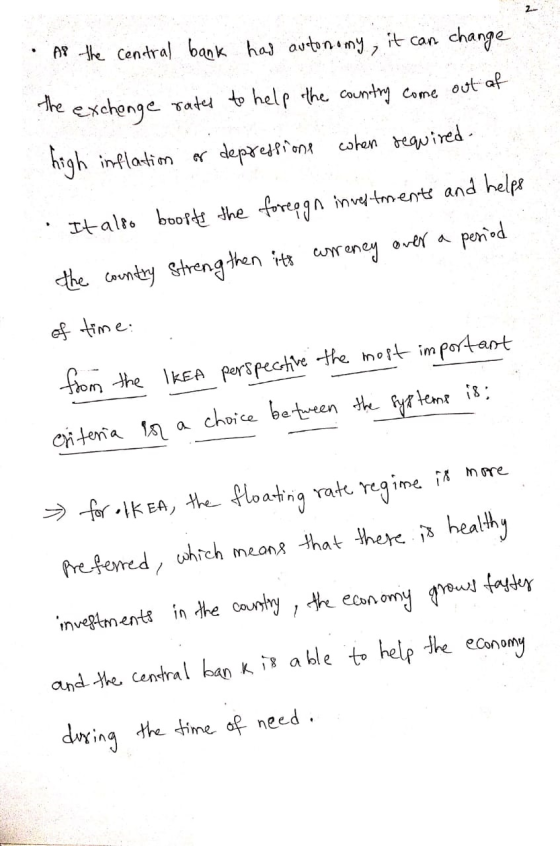
In 500 words, debate the relative merits of fixed and floating exchange rate regimes.
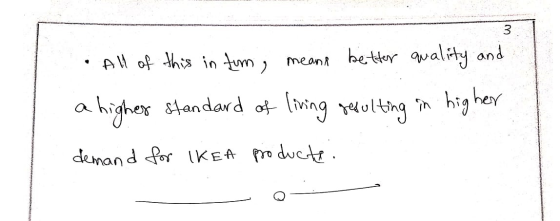
In 500 words, from the perspective of IKEA, critically appraise the most important criteria in a choice between the systems.
Case study reference below
IKEA’s Global Strategy
Walk into an IKEA store anywhere in the world, and you would
recognize it instantly. Global strategy standardization is rampant!
The warehouse-type stores all sell the same broad range of
affordable home furnishings, kitchens, accessories, and food. Most
of the products are instantly recognizable as IKEA merchandise,
with their clean yet tasteful lines and functional design. With a
heritage from Sweden (IKEA was founded in 1943 as a mail-order
company, and the first store opened in Sweden in 1958), the outside
of the store will be wrapped in the blue and yellow colors of the
Swedish flag. IKEA has sales of €34.2 billion euros annually (about
$37 billion U.S. dollars) and more than 150,000 employees.
Interestingly, IKEA is responsible for about 1 percent of the
world’s commercial-product wood consumption.
The IKEA name comes from its founder—the acronym consists of the
founder’s initials from his first and last names (Ingvar Kamprad)
along with the first initials of the farm where he grew up
(Elmtaryd) and his hometown in Sweden (Agunnaryd). Overall, Sweden
has 20 IKEA stores, which are only fewer than in Germany (49 IKEA
stores), the United States (42), France (32), and Italy (21). Spain
also has 20 stores. With 351 stores in 46 countries, IKEA is the
largest furniture retailer in the world. Basically, the furniture
market is one of the least global markets, with local tastes,
needs, and interests much different than for many other products
across industries. The largest IKEA store is in Gwangmyeong, South
Korea, at some 640,000 square feet.
The IKEA store itself will be laid out like a maze that requires
customers to walk through every department before they reach the
checkout stations. The stores are often structured as a one-way
layout, leading customers counterclockwise along what IKEA calls
“the long natural way.” This “way” is designed to encourage
customers to see the store in its entirety. Cut-off points and
shortcuts exist but are not easy to figure out. It is even
difficult to get back out after having a meal in the famous IKEA
restaurant with its Swedish food (meatballs anyone?).
Immediately before the checkout, there is an in-store warehouse
where customers can pick up the items they purchased. The furniture
is all packed flat for ease of transportation and requires assembly
by the customer. Value is stressed to a great extent (the price
customers pay for the quality furniture they get). If you look at
customers in the store, you will see that many of them are in there
20s and 30s. IKEA sells to the same basic customers worldwide:
young, upwardly mobile people who are looking for tasteful yet
inexpensive “disposable” furniture of a certain quality standard
for the price they are willing to pay.
A global network of more than 1,000 suppliers based in more than 50
countries manufactures most of the 12,000 or so products that IKEA
sells. IKEA itself focuses on the design of products and works
closely with suppliers to bring down manufacturing costs.
Developing a new product line can be a painstaking process that
takes years. IKEA’s designers will develop a prototype design
(e.g., a small couch), look at the price that rivals charge for a
similar piece, and then work with suppliers to figure out a way to
cut prices by 40 percent without compromising on quality. IKEA also
manufactures about 10 percent of what it sells in-house and uses
the knowledge gained to help its suppliers improve their
productivity, thereby lowering costs across the entire supply
chain.
Look a little closer, however, and you will see subtle differences
among the IKEA offerings in North America, Europe, and China. In
North America, sizes are different to reflect the American demand
for bigger beds, furnishings, and kitchenware. This adaptation to
local tastes and preferences was the result of a painful learning
experience for IKEA. When the company first entered the United
States in the late 1980s, it thought that consumers would flock to
its stores the same way that they had in western Europe. At first,
they did, but they didn’t buy as much, and sales fell short of
expectations. IKEA discovered that its Europeanstyle sofas were not
big enough, wardrobe drawers were not deep enough, glasses were too
small, and kitchens didn’t fit U.S. appliances. So the company set
about redesigning its offerings to better match American tastes and
was rewarded with accelerating sales growth.
Lesson learned. When IKEA entered China in the 2000s, it made
adaptations to the local market. The store layout reflects the
layout of many Chinese apartments, where most people live, and
because many Chinese apartments have balconies, IKEA’s Chinese
stores include a balcony section. IKEA has also had to shift its
locations in China, where car ownership lags behind that in Europe
and North America. In the West, IKEA stores are located in suburban
areas and have lots of parking space. In China, stores are located
near public transportation, and IKEA offers a delivery service so
that Chinese customers can get their purchases home.
Homework Answers

Add Answer to:
In 500 words, debate the relative merits of fixed and floating
exchange rate regimes.
In 500...
IKEA, a global furniture company based in Sweden, is credited with changing the strategy of furniture...
 IKEA, a global furniture company based in Sweden, is credited
with changing the strategy of furniture retailing.
Describe how IKEA changed the traditional model of furniture
retailing (and marketing). Do you agree with this departure from
the traditional furniture retail sales and marketing strategy? Why
or why not?
What is IKEA’s strategy to enter the U.S. market? Do you agree
with it? What might be a better strategy to bring IKEA to the
U.S.?
IKEA is now moving into China. ...
IKEA, a global furniture company based in Sweden, is credited
with changing the strategy of furniture retailing.
Describe how IKEA changed the traditional model of furniture
retailing (and marketing). Do you agree with this departure from
the traditional furniture retail sales and marketing strategy? Why
or why not?
What is IKEA’s strategy to enter the U.S. market? Do you agree
with it? What might be a better strategy to bring IKEA to the
U.S.?
IKEA is now moving into China. ...
Write a essay by reading this case study article and answer the following 4 questions in...
Write a essay by reading this case study article and answer the following 4 questions in the body paragraph. Forty years ago, Starbucks was a single store in Seattle’s Pike Place Market selling premium roasted coffee. Today, it is a global roaster and retailer of coffee with some 21,536 stores, 43 percent of which are in 63 countries outside the United States. China (1,716 stores), Canada (1,330 stores), Japan (1,079 stores), and the United Kingdom (808 stores) are large markets...
Hi cam you help me make a summary about this short article, and how it affects...
 Hi cam you help me make a summary about this short article, and
how it affects me economically as US citizen?
Trump Has Promised to Bring Jobs Back. His Tariffs
Threaten to Send Them Away.
By Peter S.
Goodman
Jan. 6, 2019
HOLLAND,
Mich. — Plants in every direction shut down and moved their
operations to Mexico, succumbing to the relentless pressure to cut
costs in an age of globalization. Not EBW Electronics. As the
decades passed, the family-owned business...
Hi cam you help me make a summary about this short article, and
how it affects me economically as US citizen?
Trump Has Promised to Bring Jobs Back. His Tariffs
Threaten to Send Them Away.
By Peter S.
Goodman
Jan. 6, 2019
HOLLAND,
Mich. — Plants in every direction shut down and moved their
operations to Mexico, succumbing to the relentless pressure to cut
costs in an age of globalization. Not EBW Electronics. As the
decades passed, the family-owned business...
befor answering the question you have to look at the case. here is the question it...
 befor answering the question you have to look at the
case.
here is the question
it should be 200 words
here is the case
3. Should McDonald's offer healthy alternatives to the same extent in all of the countries in which it operates, or just those where it has been criticized in the pa or is it expecting further regulation? What if customers overseas do not want hea options? Global McEthics: should McDonald's ethics be standardized across the globe? This...
befor answering the question you have to look at the
case.
here is the question
it should be 200 words
here is the case
3. Should McDonald's offer healthy alternatives to the same extent in all of the countries in which it operates, or just those where it has been criticized in the pa or is it expecting further regulation? What if customers overseas do not want hea options? Global McEthics: should McDonald's ethics be standardized across the globe? This...
The Container Store Group Inc International Directory of Company Histories Company Perspectives We are the original...
The Container Store Group Inc International Directory of Company Histories Company Perspectives We are the original storage and organization specialty retailer and the only national retailer solely devoted to the category. Our goal is to help provide order to an increasingly busy and chaotic world. We provide creative, multifunctional, customizable storage and organization solutions that help our customers save time, save space and improve the quality of their lives. The Texas-based The Container Store Group Inc. is a leading specialty...
case study apple iPhone. There are risks and rewards for all in a global economy. The...
case study apple iPhone. There are risks and rewards for all in a global economy. The globalization of human capital results in a range of winners and losers around the world: companies and their stockholders, consumers, contractors, firms up and down the supply chain, employed people, and unemployed people, as well as their economies. In February 2011, President Obama asked Apple's Steve Jobs why Apple could not bring back all the jobs it used to provide in the United States....
I need help with this questions that are highlighter in the article please. CONTINUED (REFER TO...
 I
need help with this questions that are highlighter in the article
please.
CONTINUED (REFER TO PAGE 274) Starbucks Takes Coffee Culture Around the World arbucks has also been successful in other European countries, of the city's heritage and identity. The French prefer dark espresso including the United Kingdom and Ireland. This success comes and the conventional wisdom is that Americans don't know what despite competition from local riva's such as Ireland's Insomnia Coffee good coffee is. As one Frenchman...
I
need help with this questions that are highlighter in the article
please.
CONTINUED (REFER TO PAGE 274) Starbucks Takes Coffee Culture Around the World arbucks has also been successful in other European countries, of the city's heritage and identity. The French prefer dark espresso including the United Kingdom and Ireland. This success comes and the conventional wisdom is that Americans don't know what despite competition from local riva's such as Ireland's Insomnia Coffee good coffee is. As one Frenchman...
Overall, your team will study the case study provided and then conduct additional research on the...
Overall, your team will study the case study provided and then conduct additional research on the country of China in order to get information to address the following questions: How big is the Chinese market? What is the real GDP adjusted for Purchasing Power Parity? What is the current state of the economy that you have chosen? Collect the latest available data on nominal GDP, real GDP, per capita real GDP, unemployment rate, inflation rate, interest rates, exchange rate(s), and...
CASE STUDY Apple's iPhones-Not "Made in America" and most Apple has become one of the best-...
 CASE STUDY Apple's iPhones-Not "Made in America" and most Apple has become one of the best- h, al operation in part ahrough The globalization of human c There are risks and rewards for all in a global economy in a range of contractors, firms winners and losers around the world companies and their stockholders, res · s up and down the supply chain, employed people, and unemployed people tie In February 2011, President Obama asked Apple's Steve Jobs(nowdee why Apple...
As a subsidiary manager, would you consider Regent’s use of the beginning-of-the-year exchange rate for budget...
As a subsidiary manager, would you consider Regent’s use of the beginning-of-the-year exchange rate for budget setting and average-of-the-year rate for budget tracking appropriate? Why? What changes in the budgeting process can Regent make to prepare foreign subsidiary managers to better respond to the effects of inflation and exchange rate changes? It was January 2016, and Lee Morgan, CEO of Regent, Inc., was getting ready to review the financial performance of Regent’s subsidiaries. In recent years, this exercise had become...
 IKEA, a global furniture company based in Sweden, is credited
with changing the strategy of furniture retailing.
Describe how IKEA changed the traditional model of furniture
retailing (and marketing). Do you agree with this departure from
the traditional furniture retail sales and marketing strategy? Why
or why not?
What is IKEA’s strategy to enter the U.S. market? Do you agree
with it? What might be a better strategy to bring IKEA to the
U.S.?
IKEA is now moving into China. ...
IKEA, a global furniture company based in Sweden, is credited
with changing the strategy of furniture retailing.
Describe how IKEA changed the traditional model of furniture
retailing (and marketing). Do you agree with this departure from
the traditional furniture retail sales and marketing strategy? Why
or why not?
What is IKEA’s strategy to enter the U.S. market? Do you agree
with it? What might be a better strategy to bring IKEA to the
U.S.?
IKEA is now moving into China. ...
 Hi cam you help me make a summary about this short article, and
how it affects me economically as US citizen?
Trump Has Promised to Bring Jobs Back. His Tariffs
Threaten to Send Them Away.
By Peter S.
Goodman
Jan. 6, 2019
HOLLAND,
Mich. — Plants in every direction shut down and moved their
operations to Mexico, succumbing to the relentless pressure to cut
costs in an age of globalization. Not EBW Electronics. As the
decades passed, the family-owned business...
Hi cam you help me make a summary about this short article, and
how it affects me economically as US citizen?
Trump Has Promised to Bring Jobs Back. His Tariffs
Threaten to Send Them Away.
By Peter S.
Goodman
Jan. 6, 2019
HOLLAND,
Mich. — Plants in every direction shut down and moved their
operations to Mexico, succumbing to the relentless pressure to cut
costs in an age of globalization. Not EBW Electronics. As the
decades passed, the family-owned business...
 befor answering the question you have to look at the
case.
here is the question
it should be 200 words
here is the case
3. Should McDonald's offer healthy alternatives to the same extent in all of the countries in which it operates, or just those where it has been criticized in the pa or is it expecting further regulation? What if customers overseas do not want hea options? Global McEthics: should McDonald's ethics be standardized across the globe? This...
befor answering the question you have to look at the
case.
here is the question
it should be 200 words
here is the case
3. Should McDonald's offer healthy alternatives to the same extent in all of the countries in which it operates, or just those where it has been criticized in the pa or is it expecting further regulation? What if customers overseas do not want hea options? Global McEthics: should McDonald's ethics be standardized across the globe? This...
 I
need help with this questions that are highlighter in the article
please.
CONTINUED (REFER TO PAGE 274) Starbucks Takes Coffee Culture Around the World arbucks has also been successful in other European countries, of the city's heritage and identity. The French prefer dark espresso including the United Kingdom and Ireland. This success comes and the conventional wisdom is that Americans don't know what despite competition from local riva's such as Ireland's Insomnia Coffee good coffee is. As one Frenchman...
I
need help with this questions that are highlighter in the article
please.
CONTINUED (REFER TO PAGE 274) Starbucks Takes Coffee Culture Around the World arbucks has also been successful in other European countries, of the city's heritage and identity. The French prefer dark espresso including the United Kingdom and Ireland. This success comes and the conventional wisdom is that Americans don't know what despite competition from local riva's such as Ireland's Insomnia Coffee good coffee is. As one Frenchman...
 CASE STUDY Apple's iPhones-Not "Made in America" and most Apple has become one of the best- h, al operation in part ahrough The globalization of human c There are risks and rewards for all in a global economy in a range of contractors, firms winners and losers around the world companies and their stockholders, res · s up and down the supply chain, employed people, and unemployed people tie In February 2011, President Obama asked Apple's Steve Jobs(nowdee why Apple...
Most questions answered within 3 hours.
-
Where is the error in this code sequence?
String s1 = "Hello";
String s2 = "ello";...
asked 11 months ago -
Financial data for Joel de Paris, Inc., for last year
follow:
Joel de Paris, Inc.
Balance...
asked 11 months ago -
Consider this reaction:
Al2(SO4)3 (aq)+ BaCl3
(aq) Al2Cl6 (aq)- +
3BaSO4(s) . What is the...
asked 11 months ago -
Suppose that Savneet is considering increasing her
recent random sample from 20 car rentals to 40...
asked 11 months ago -
Trucks arrive at an unloading terminal at an average rate of 120
per hour.
Trucks arrive...
asked 11 months ago -
Why are methanol and ethanol completely soluble in water while
octanol is not very little soluble....
asked 11 months ago -
A facilities manager at a university reads in a research report
that the mean amount of...
asked 11 months ago -
When the CuSO4 is rehydrated by adding water to the anhydrous
compound, is this an endothermic...
asked 11 months ago -
A ray of sunlight is passing from diamond into crown glass; the
angle of incidence is...
asked 11 months ago -
A block of mass 0.249 kg is placed on top of a light, vertical
spring of...
asked 11 months ago -
how do the kidneys compensate in the presences of acidosis
a) trigger hyperventilate
b) reserve acid...
asked 11 months ago -
Question 501 pts
The rental rate of capital to the firm increases. Which of the
following...
asked 11 months ago