Donald consumes goods x1 and x2. His utility function is U(x1, x2) = x1(x2)3. He is...
Donald consumes goods x1 and x2. His utility function is U(x1, x2) = x1(x2)3. He is endowed with 43 units of x1 and 7 units of x2. The price of x1 is $1 and the price of x2 is $3. Find his net demand for x1.
a)
b)
c)
d)
e)
Homework Answers
a) -27
(e1 = 43, e2 = 7
Value of endowment = P1*e1 + P2*e2 = 1*43 + 3*7 = 43 + 21 = 64
We find the gross demand first.
It is determined where MRS = p1/p2
MRS = MU1/MU2 = 
So, MRS = p1/p2 gives,
x2/3x1 = 1/3
So, x2 = 3x1(1/3) = x1
Budget constraint: P1*x1 + P2*x2 = value of endowment
So, x1 + 3*x1 = 64 (as x2 = x1)
So, 4x1 = 64
So, x1 = 64/4
So, x1 = 16
Net demand for x1 = x1 - e1 = 16 - 43 = -27)
Add Answer to:
Donald consumes goods x1 and x2. His
utility function is U(x1, x2) =
x1(x2)3. He is...
Q1. Sam consumes two goods x1 and x2. Her utility function can be written as U(x1,x2)=x...
Q1. Sam consumes two goods x1 and x2. Her utility function can be written as U(x1,x2)=x 1raised to 2/3 and x 2 raised to 1/5 ⁄. Suppose the price of good x1 is P1, and the price of good x2 is P2. Sam’s income is m. [20 marks] a) [10 marks] Derive Sam’s Marshallian demand for each good. b) [5 marks] Derive her expenditure function using indirect utility function. c) [5 marks] Use part c) to calculate Hicksian demand function...
Edward consumes goods x and y. His utility function is U(x, y) = xły?. He is...
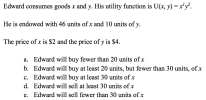 Edward consumes goods x and y. His utility function is U(x, y) = xły?. He is endowed with 46 units of x and 10 units of y. The price of x is $2 and the price of y is $4. a. Edward will buy fewer than 20 units of x b. Edward will buy at least 20 units, but fewer than 30 units, of x c. Edward will buy at least 30 units of x d. Edward will sell at...
EXERCISE 2 Consider a consumer who consumes two goods and has utility function u(x1, x2) =...
 EXERCISE 2 Consider a consumer who consumes two goods and has utility function u(x1, x2) = x, + 1x1 The price of good 2 is 1, the price of good 1 is p, and income is m. Derive the ordinary demand functions of good l and good 2. For what values of p and m is: a. good l normal? b. good 2 normal? c. good 1 an ordinary good? d. good 2 a gross substitute for good 1?
6. Modou has a utility function U(X1,X2) = 2X1 + X2 The prices of X1 &...
6. Modou has a utility function U(X1,X2) = 2X1 + X2 The prices of X1 & X2 are $1 each and Modou has an income of $20 budgeted for this two goods. a. Draw the demand curve for X1 as a function of p1.: b. At a price of p1 = $1, how much X1 and X2 does Modou consume?: c. A per unit tax of $0.60 is placed on X1. How much of good X1 will he consume now?:...
Consider the utility function: u(x1,x2) = x1 +x2.
1. Consider the utility function: u(x1,x2) = x1 +x2. Find the corresponding Hicksian demand function 2. For each of the three utility functions below, find the substitution effect, the income effect, and the total effect that result when prices change from p = (2,1) to p' = (2,4). Assume the consumer has income I = 20. (a) Before doing any calculation, make an educated guess about the relative magnitude of the three substitution effects and the three income effects to be found below. (b)...
The utility function is u = x1½ + x2, and the budget constraint is m =...
The utility function is u = x1½ + x2, and the budget constraint is m = p1x1 + p2x2. Derive the optimal demand curve for good 1, x1(p1, p2), and good 2, x2(m, p1, p2). Looking at the cross price effects (∂x1/∂p2 and ∂x2/∂p1) are goods x1 and x2 substitutes or complements? Looking at income effects (∂x1/∂m and ∂x2/∂m) are goods x1 and x2 inferior, normal or neither? Assume m=100, p1=0.5 and p2=1. Using the demand function you derived in...
Assume that a person's utility over two goods is given by U(x1, x2) = (x1 −...
Assume that a person's utility over two goods is given by U(x1, x2) = (x1 − 10)^1/3 (x2 − 5)^2/3 The price of good x1 is equal to p1 and the price of good x2 is p2. The total income of the individual is given by I. (a) Write down the budget constraint of this person. (b) Calculate the demand for each one of the two goods. (c) Calculate the elasticity of demand for each one of the two goods.
Mort’s utility function is U(x1,x2) = x1x2. His income is $200. The price of good 2...
Mort’s utility function is U(x1,x2) = x1x2. His income is $200. The price of good 2 is $10. Good 1 is priced as follows: The first 12 units cost $10 per unit and any additional units cost $5 per unit. What consumption bundle does Mort choose? 1) x1 =18, x2 = 6 2) x1 =10, x2 = 10 3) x1 =14, x2 = 7 4) x1 =12, x2 = 8
There are two consumer goods, xi and x2. Consumers all have income given by m, and a utility function U(, x2) = aln(x1)...
 There are two consumer goods, xi and x2. Consumers all have income given by m, and a utility function U(, x2) = aln(x1)+In(x2). The price of the two goods are pi and p2 (a) Find the individual demand functions for x1 and r2 (b) The parameter a differs across consumers. Type A consumers have a = 1. Type B consumers have a = 2. If there is one type A person and two type B people, what is market demand...
1. Consider the utility function: u(x1,x2) = x1 + x2. Find the corresponding Hicksian demand function....
 1. Consider the utility function: u(x1,x2) = x1 + x2. Find the corresponding Hicksian demand function. 2. For each of the three utility functions below, find the substitution effect, the income effect, and the total effect that result when prices change from p =(2, 1) to p' = (2,4). Assume the consumer has income I = 20. (a) Before doing any calculation, make an educated guess about the relative magnitude of the three substitution effects and the three income effects...
 Edward consumes goods x and y. His utility function is U(x, y) = xły?. He is endowed with 46 units of x and 10 units of y. The price of x is $2 and the price of y is $4. a. Edward will buy fewer than 20 units of x b. Edward will buy at least 20 units, but fewer than 30 units, of x c. Edward will buy at least 30 units of x d. Edward will sell at...
 EXERCISE 2 Consider a consumer who consumes two goods and has utility function u(x1, x2) = x, + 1x1 The price of good 2 is 1, the price of good 1 is p, and income is m. Derive the ordinary demand functions of good l and good 2. For what values of p and m is: a. good l normal? b. good 2 normal? c. good 1 an ordinary good? d. good 2 a gross substitute for good 1?
 There are two consumer goods, xi and x2. Consumers all have income given by m, and a utility function U(, x2) = aln(x1)+In(x2). The price of the two goods are pi and p2 (a) Find the individual demand functions for x1 and r2 (b) The parameter a differs across consumers. Type A consumers have a = 1. Type B consumers have a = 2. If there is one type A person and two type B people, what is market demand...
 1. Consider the utility function: u(x1,x2) = x1 + x2. Find the corresponding Hicksian demand function. 2. For each of the three utility functions below, find the substitution effect, the income effect, and the total effect that result when prices change from p =(2, 1) to p' = (2,4). Assume the consumer has income I = 20. (a) Before doing any calculation, make an educated guess about the relative magnitude of the three substitution effects and the three income effects...
Most questions answered within 3 hours.
-
Where is the error in this code sequence?
String s1 = "Hello";
String s2 = "ello";...
asked 11 months ago -
Financial data for Joel de Paris, Inc., for last year
follow:
Joel de Paris, Inc.
Balance...
asked 11 months ago -
Consider this reaction:
Al2(SO4)3 (aq)+ BaCl3
(aq) Al2Cl6 (aq)- +
3BaSO4(s) . What is the...
asked 11 months ago -
Suppose that Savneet is considering increasing her
recent random sample from 20 car rentals to 40...
asked 11 months ago -
Trucks arrive at an unloading terminal at an average rate of 120
per hour.
Trucks arrive...
asked 11 months ago -
Why are methanol and ethanol completely soluble in water while
octanol is not very little soluble....
asked 11 months ago -
A facilities manager at a university reads in a research report
that the mean amount of...
asked 11 months ago -
When the CuSO4 is rehydrated by adding water to the anhydrous
compound, is this an endothermic...
asked 11 months ago -
A ray of sunlight is passing from diamond into crown glass; the
angle of incidence is...
asked 11 months ago -
A block of mass 0.249 kg is placed on top of a light, vertical
spring of...
asked 11 months ago -
how do the kidneys compensate in the presences of acidosis
a) trigger hyperventilate
b) reserve acid...
asked 11 months ago -
Question 501 pts
The rental rate of capital to the firm increases. Which of the
following...
asked 11 months ago