
Homework Answers
A perfectly competitive market has the following characteristics:
- Large number of sellers selling homogeneous or identical product
- Price of a product is determined by the forces of market demand and supply.
- All the firms in a perfectly competitive market are price takers and firms do not have market power to alter price of it's product.
- There is free entry and exit of firms in to market.
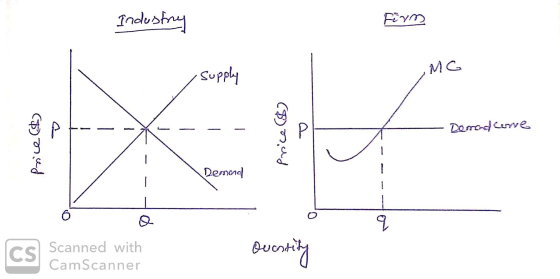
The demand curve faced by the perfectly competitive industry is a downeward sloping curve. The supply curve is a upward sloping curve. The equilibrium price and quantity in the market is determined by the intersection of the market demand and supply curve. All the firms in a competitive market has to accept the price determined by the industry and sell as much quantity they want at this prevailing market price. Since a firm has to sell any additional quantity at the same price, therefore, the demand curve faced by the perfectly competitive firm is a horizontal straight line. The market equilibrium and the demand curve of a firm in a perfectly competitive market is shown in the diagram given below.
Add Answer to:
microeconomics question
Ch 8 In-Class Activity Ch 8 in-class Activity 1. What type of demand curve...
1. What type of demand curve does a perfectly competitive firm face? Why? 2. A perfectly...
1. What type of demand curve does a perfectly competitive firm face? Why? 2. A perfectly competitive firm has the following fixed and variable costs in the short run. The market price for the firm’s product is $150. Output FC VC TC TR Profit/Loss 0 $100 $ 0 ___ ___ ___ 1 100 100 ___ ___ ___ 2 100 180 ___ ___ ___ 3 100 ...
the demand curve faced by a perfectly competitive firm is horizontal yes it a true or...
 the
demand curve faced by a perfectly competitive firm is
horizontal
yes
it a true or false question
Class Name Chapter 8 -Micro Indicate whether the statement is true or false. 1. The behaviour of an individual perfectly competitive firm has a definite influence o a. True b. False Tee e a. True b. False 6. The market demand curve in a perfectly competitive industry is downward sl individual perfectly competitive firm is horizontal a. True b. False 7. To...
the
demand curve faced by a perfectly competitive firm is
horizontal
yes
it a true or false question
Class Name Chapter 8 -Micro Indicate whether the statement is true or false. 1. The behaviour of an individual perfectly competitive firm has a definite influence o a. True b. False Tee e a. True b. False 6. The market demand curve in a perfectly competitive industry is downward sl individual perfectly competitive firm is horizontal a. True b. False 7. To...
Introduction to Microeconomics Deriving the Short-Run Supply Curve for the Perfectly Competitive Firm Cost $ 0...
 Introduction to Microeconomics Deriving the Short-Run Supply Curve for the Perfectly Competitive Firm Cost $ 0 10 20 30 40 50 60 70 80 90 100 110 Outputs tunits) The figure illustrates the costs faced by a perfectly competitive firm. Use the figure to answer the following: 1) Based on the above, indicate on the graph, the short-run market supply curve for the perfectly competitive firm. 2) At what price will the firm shut-down? Will the firm leave the industry?...
Introduction to Microeconomics Deriving the Short-Run Supply Curve for the Perfectly Competitive Firm MC ATC AVC...
 Introduction to Microeconomics Deriving the Short-Run Supply Curve for the Perfectly Competitive Firm MC ATC AVC Cost ($) 0 10 20 30 40 50 60 70 80 90 100 110 Outputs units) The figure illustrates the costs faced by a perfectly competitive firm. Use the figure to answer the following: 1) If the market price is $20, how much will the firm produce in order to maximize its profits? 2) If the market price is $15, how much will the...
What explains the horizontal demand curve for a Firm in a perfectly competitive market? How does...
What explains the horizontal demand curve for a Firm in a perfectly competitive market? How does this differ from the Market demand curve in a perfectly competitive market? Explain the behavior of marginal revenue in a Market compared to a Firm.
Introduction to Microeconomics Deriving the Short-Run Supply Curve for the Perfectly Competitive Firm Cost (5) 0...
 Introduction to Microeconomics Deriving the Short-Run Supply Curve for the Perfectly Competitive Firm Cost (5) 0 10 20 30 40 50 60 70 80 90 100 110 Outputs tunits) The figure illustrates the costs faced by a perfectly competitive firm. Use the figure to answer the following: 1) Between the prices $10 and $15, what is the goal of the producer? 2) If new firms enter the industry, explain what will happen to the firms already in the industry. Use...
Question 5 (Mandatory) (1 point) In the theory of perfect competition, a) the market demand curve...
 Question 5 (Mandatory) (1 point) In the theory of perfect competition, a) the market demand curve is horizontal. b) the single firm faces a horizontal demand curve. ed c) the single firm faces a downward-sloping demand curve. d) the market demand curve is downward sloping. b and d Question 6 (Mandatory) (1 point) The perfectly competitive firm will seek to produce the level of output for which
Question 3 (32 marks) a The market of popcom is perfectly competitive. The market demand curve...
 Question 3 (32 marks) a The market of popcom is perfectly competitive. The market demand curve and supply curve are as follows: Demand: Qp = 2000-P Supply: 2 = 1400 +2P Firm K is one of the many firms producing popcorn in the market. The total cost function and marginal cost function are as follows: TC(q) =1250 +30 +29 MC(q) - 30 +49 i At what output level (g) would the average total cost be minimized? (6 marks) ii What...
→ XCIO Question 20 1 pts A monopolist's demand curve is the industry demand curve. of...
 → XCIO Question 20 1 pts A monopolist's demand curve is the industry demand curve. of unit elasticity throughout. perfectly inelastic perfectly elastic Question 21 1 pts In perfectly competitive markets the price. every buyer is large enough to influence no buyer or seller is large enough to influence every seller is large enough to influence both buyers and sellers are large enough to influence
The demand curve for the output of a monopolistic firm is equal to: A. the marginal...
The demand curve for the output of a monopolistic firm is equal to: A. the marginal revenue curve for the product in question B. the demand curve for a firm in a perfectly competitive market. C. the market supply curve for the product in question. D. the market demand curve for the product in question.
 the
demand curve faced by a perfectly competitive firm is
horizontal
yes
it a true or false question
Class Name Chapter 8 -Micro Indicate whether the statement is true or false. 1. The behaviour of an individual perfectly competitive firm has a definite influence o a. True b. False Tee e a. True b. False 6. The market demand curve in a perfectly competitive industry is downward sl individual perfectly competitive firm is horizontal a. True b. False 7. To...
the
demand curve faced by a perfectly competitive firm is
horizontal
yes
it a true or false question
Class Name Chapter 8 -Micro Indicate whether the statement is true or false. 1. The behaviour of an individual perfectly competitive firm has a definite influence o a. True b. False Tee e a. True b. False 6. The market demand curve in a perfectly competitive industry is downward sl individual perfectly competitive firm is horizontal a. True b. False 7. To...
 Introduction to Microeconomics Deriving the Short-Run Supply Curve for the Perfectly Competitive Firm Cost $ 0 10 20 30 40 50 60 70 80 90 100 110 Outputs tunits) The figure illustrates the costs faced by a perfectly competitive firm. Use the figure to answer the following: 1) Based on the above, indicate on the graph, the short-run market supply curve for the perfectly competitive firm. 2) At what price will the firm shut-down? Will the firm leave the industry?...
 Introduction to Microeconomics Deriving the Short-Run Supply Curve for the Perfectly Competitive Firm MC ATC AVC Cost ($) 0 10 20 30 40 50 60 70 80 90 100 110 Outputs units) The figure illustrates the costs faced by a perfectly competitive firm. Use the figure to answer the following: 1) If the market price is $20, how much will the firm produce in order to maximize its profits? 2) If the market price is $15, how much will the...
 Introduction to Microeconomics Deriving the Short-Run Supply Curve for the Perfectly Competitive Firm Cost (5) 0 10 20 30 40 50 60 70 80 90 100 110 Outputs tunits) The figure illustrates the costs faced by a perfectly competitive firm. Use the figure to answer the following: 1) Between the prices $10 and $15, what is the goal of the producer? 2) If new firms enter the industry, explain what will happen to the firms already in the industry. Use...
 Question 5 (Mandatory) (1 point) In the theory of perfect competition, a) the market demand curve is horizontal. b) the single firm faces a horizontal demand curve. ed c) the single firm faces a downward-sloping demand curve. d) the market demand curve is downward sloping. b and d Question 6 (Mandatory) (1 point) The perfectly competitive firm will seek to produce the level of output for which
 Question 3 (32 marks) a The market of popcom is perfectly competitive. The market demand curve and supply curve are as follows: Demand: Qp = 2000-P Supply: 2 = 1400 +2P Firm K is one of the many firms producing popcorn in the market. The total cost function and marginal cost function are as follows: TC(q) =1250 +30 +29 MC(q) - 30 +49 i At what output level (g) would the average total cost be minimized? (6 marks) ii What...
 → XCIO Question 20 1 pts A monopolist's demand curve is the industry demand curve. of unit elasticity throughout. perfectly inelastic perfectly elastic Question 21 1 pts In perfectly competitive markets the price. every buyer is large enough to influence no buyer or seller is large enough to influence every seller is large enough to influence both buyers and sellers are large enough to influence
Most questions answered within 3 hours.
-
Where is the error in this code sequence?
String s1 = "Hello";
String s2 = "ello";...
asked 10 months ago -
Financial data for Joel de Paris, Inc., for last year
follow:
Joel de Paris, Inc.
Balance...
asked 10 months ago -
Consider this reaction:
Al2(SO4)3 (aq)+ BaCl3
(aq) Al2Cl6 (aq)- +
3BaSO4(s) . What is the...
asked 10 months ago -
Suppose that Savneet is considering increasing her
recent random sample from 20 car rentals to 40...
asked 10 months ago -
Trucks arrive at an unloading terminal at an average rate of 120
per hour.
Trucks arrive...
asked 10 months ago -
Why are methanol and ethanol completely soluble in water while
octanol is not very little soluble....
asked 10 months ago -
A facilities manager at a university reads in a research report
that the mean amount of...
asked 10 months ago -
When the CuSO4 is rehydrated by adding water to the anhydrous
compound, is this an endothermic...
asked 10 months ago -
A ray of sunlight is passing from diamond into crown glass; the
angle of incidence is...
asked 10 months ago -
A block of mass 0.249 kg is placed on top of a light, vertical
spring of...
asked 10 months ago -
how do the kidneys compensate in the presences of acidosis
a) trigger hyperventilate
b) reserve acid...
asked 10 months ago -
Question 501 pts
The rental rate of capital to the firm increases. Which of the
following...
asked 10 months ago