Please explain the Generalized Model for creating a health promotion program. Be sure to include a...
Please explain the Generalized Model for creating a health promotion program. Be sure to include a brief description of each of the 5 steps and the importance of pre-planning. What is determined during that phase?
Homework Answers
Ans) 1. Assessing needs
The process of collecting and analyzing data
2. Setting goals and objectives
Identifying what will be accomplished
3. Developing interventions
How the goals will be achieved
4. Implementing interventions
process of putting interventions into action
5. Evaluating results
Formative evaluation - quality of program
Summative evaluations - effectiveness of program
*one major benefit=Models provide planners with direction and framework from which to build interventions to improve health.
Fluidity - steps are sequential.
Flexibility - adapt to needs of stakeholders.
Functionality - outcome of planning is improved health conditions,
not production of the plan.
MAPP, MAP-IT, PRECEDE/PROCEED, and SMART are program planning
models. For each, be able to:
(1) identify what each acronym stands for,
(2) give a general description of the model/when it would be used,
and
(3) list/describe the phases.
MAPP- 1) Mobilizing for Action through Planning and
Partnerships
2) -for city or country health departments
-improving health and quality of life through mobilized
partnerships and taking strategic action
3) Phase 1- Organizing for succes and partnership developments:
core planners assess whether the MAPP process is timely,
appropriate, or even possible
Phase2- Visioning: guides community through process that results in
a shared vision and common values
Phase 3-Four MAPP Assessments: defining characteristics of MAPP
model=community themes and strengths assessment, local public
health assessment, community health status assessment, the forces
of change assessment
Phase 4-Identify Strategic Issues: a prioritized list of most
important issues facing health of the community is developed
Phase 5-Formulate Goals and Strategies: creates goals related to
the vision and priority strategic issues
Phase 6-Action Cycle: implementation details are considered,
evaluation plans are developed, and plans for disseminating results
are made
MAP-IT- 1) Mobilize, Assess, Plan, Implement, and Track
2)This was introduced in 2010 as a way to assist communities in
implementing their own adaptations of Healthy People 2020
3) Phase 1-Mobilize: Starts by mobilizing key individuals and
organizations into a coalition that can work together to improve
the health of the community; similar to pre-planning
Phase 2-Assess: Equivalent to a needs assessment
Phase 3-Plan: Develops goals and objectives, measures, baselines,
and targets
Phase 4-Implement: Organizes the coalition so it can put the plan
into action
Phase 5-Track: Equivalent of evaluation
PRECEDE/PROCEED-1)
(Predisposing,
Reinforcing, and
Enabling
Constructs in
Educational/ecological
Diagnosis and
Evaluation) (Policy,
Regulatory, and
Organizational
Constructs in
Educational &
Environmental
Development)
2)First four phases are assessment phases; social, epidemiological,
behavioral & environmental; educational & ecological;
administrative & policy; and intervention alignment. Last 4
phases are implementation, process, impact, and outcome
evaluation.
3) Phase 1-Social Assessment and Situational Analysis: seeks to
subjectively define the quality of life (problems & priorities)
of those in the priority population
Phase 2-Epidemiological Assessment: the step in which planners use
data to identify & rank the health goals or problems that may
contribute to or interact with problems identified in Phase 1
Phase 3- Educational & Ecological Assessment: identifies &
classifies factors that have potential to influence behavior or
change the environment
Phase 4- Intervention Alignment & Administration & Policy
Assessment: The intent of intervention alignment is to match
appropriate strategies & interventions with projected changes
and outcomes identified in earlier phases.
In administration & policy assessment, planners determine if
capabilities & resources are available to develop &
implement a program.
*in between where precede ends and proceed begins
Phase 5- Implementation: With appropriate resources in hand,
planners select the interventions and strategies and implementation
begins.
Phases 6, 7, and 8- Evaluation: Process evaluation - measurements
of implementation to control, assure, or improve the quality of the
program,
Impact evaluation - immediate observable effects of program,
Outcome evaluation - long-term effects of the program
SMART-1) Social Marketing Assessment and Response Tool
2) a social marketing planning framework for health promotion
3)Phase 1- Preliminary Planning: includes the elements of
pre-planning
Phase2- Consumer Analysis: formative research (process that
identifies differences among subgroups within a population,
identifies a subgroup, influence wants and needs, and identify
facts that influence its behavior
Phase 3-Market Analysis: examines the fit between the focus of
interest and important maker variables within the priority
population
Phase 4-Channel Analysis: considers which potential partners might
collaborate in sharing responsibility for communication
Phase 5- Develop Interventions, Materials, and Pretesting: analyze
and categorize data appropriately
Phase 6-Implementation: clarify's everyones roles
Phase 7-Evaluation: preliminary evaluation strategies that were
identified in phase 1 take place.
Add Answer to:
Please explain the Generalized Model for creating a health
promotion program. Be sure to include a...
Please explain -How various non-health outcomes are obtained via health promotion programs and lifestyle behavior change...
Please explain -How various non-health outcomes are obtained via health promotion programs and lifestyle behavior change interventions -The importance and impact of non-health outcomes to overall health promotion program goals, including benefits to society
Use Pender’s health promotion model to plan a health promotion campaign for one of the following...
Use Pender’s health promotion model to plan a health promotion campaign for one of the following situation.Immunization program in an urban apartment complex with a high density of families with young children Person affected, Environment, Nursing, Health and Illness please specifying each category
Explain number 5 please How various non-health outcomes are obtained via health promotion programs and lifestyle...
Explain number 5 please How various non-health outcomes are obtained via health promotion programs and lifestyle behavior change interventions The importance and impact of non-health outcomes to overall health promotion program goals, including benefits to society Differentiate the concepts of patient-centeredness and patient empowerment Methods of implementing patient-centeredness and patient empowerment approaches in the clinical setting Intended outcomes (clinical goals) of such implementation
Define the terms public health and health promotion. What are the similarities and differences between the...
Define the terms public health and health promotion. What are the similarities and differences between the two? What specific health promotion activity was provided in your community during the past one year and what was the beneficial result? How did Healthy People 2020 develop and what is the purpose and goals of this program? What current legislation has had the maximum impact on the way health care is provided? What interest group(s) influenced the establishment of this legislation? Mention an...
D Week 5 Essay Assignment 1. Expiain the general foundation of the social ecological approach to...
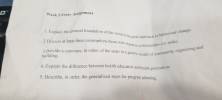 D Week 5 Essay Assignment 1. Expiain the general foundation of the social ecological approach to behaviour change. 2 Discuss at least three assumptions those who organize communities can make. 3 Provide a summary, in order, of the steps in a generic model of community organizing and building. 4. Explain the difference between health education and health promotion. 5. Describe, in order, the generalized steps for program planning.
what is the best health education and promotion theories to implement a smoke-free policy program? explain
what is the best health education and promotion theories to implement a smoke-free policy program? explain
Using the community health-promotion model as a guide, prioritize the following steps in community health promotion
Chapter 20: Promoting Health through Healthy Communities and Cities Student Case Studies Robert T. is a community-oriented nurse and a member of the Jonesville Healthy City Committee. Also on the committee are the mayor, a hospital administrator, several ministers, an epidemiologist, and several other community leaders. Through an initial community assessment, the Jonesville Healthy City Committee identified several areas of need. These areas include lack of health care access for the homeless and uninsured, lack of knowledge about health-promotion behaviors, and substance abuse...
Styles Answer the following: 1. What is the first step in creating a logic model for...
 Styles Answer the following: 1. What is the first step in creating a logic model for a health promotion program? 2. Write down a hypothetical problem statement that includes the following components: -children -obesity -South Bronx -Increase 3. List at least three things to keep in mind when developing a program goal. a. 4. Why is it important to list available resources as part of our logic model? List the six types of resources commonly used in health promotion programs:...
(please type) Explain the pathogenic mechanism of Tetanus. Be sure to include the importance of inhibitory...
(please type) Explain the pathogenic mechanism of Tetanus. Be sure to include the importance of inhibitory neurons, neurotransmitters and lockjaw.
Multiple choice questions: QUESTION 1 The major goals of health promotion include all of the following EXCEPT Opti...
Multiple choice questions: QUESTION 1 The major goals of health promotion include all of the following EXCEPT Optimizing health Focusing on subacute diseases Staying healthy Creating healthy environments 1 points QUESTION 2 Social determinants of health include all of the following EXCEPT Access to local convenience stores Health care accessibility Personal attributes c. Acquired health behaviors 1 points QUESTION 3 Social determinants of health include all of the following EXCEPT Education Neighborhood and the built environment Economic stability...
 D Week 5 Essay Assignment 1. Expiain the general foundation of the social ecological approach to behaviour change. 2 Discuss at least three assumptions those who organize communities can make. 3 Provide a summary, in order, of the steps in a generic model of community organizing and building. 4. Explain the difference between health education and health promotion. 5. Describe, in order, the generalized steps for program planning.
 Styles Answer the following: 1. What is the first step in creating a logic model for a health promotion program? 2. Write down a hypothetical problem statement that includes the following components: -children -obesity -South Bronx -Increase 3. List at least three things to keep in mind when developing a program goal. a. 4. Why is it important to list available resources as part of our logic model? List the six types of resources commonly used in health promotion programs:...
Most questions answered within 3 hours.
-
Where is the error in this code sequence?
String s1 = "Hello";
String s2 = "ello";...
asked 10 months ago -
Financial data for Joel de Paris, Inc., for last year
follow:
Joel de Paris, Inc.
Balance...
asked 10 months ago -
Consider this reaction:
Al2(SO4)3 (aq)+ BaCl3
(aq) Al2Cl6 (aq)- +
3BaSO4(s) . What is the...
asked 10 months ago -
Suppose that Savneet is considering increasing her
recent random sample from 20 car rentals to 40...
asked 10 months ago -
Trucks arrive at an unloading terminal at an average rate of 120
per hour.
Trucks arrive...
asked 10 months ago -
Why are methanol and ethanol completely soluble in water while
octanol is not very little soluble....
asked 10 months ago -
A facilities manager at a university reads in a research report
that the mean amount of...
asked 10 months ago -
When the CuSO4 is rehydrated by adding water to the anhydrous
compound, is this an endothermic...
asked 10 months ago -
A ray of sunlight is passing from diamond into crown glass; the
angle of incidence is...
asked 10 months ago -
A block of mass 0.249 kg is placed on top of a light, vertical
spring of...
asked 10 months ago -
how do the kidneys compensate in the presences of acidosis
a) trigger hyperventilate
b) reserve acid...
asked 10 months ago -
Question 501 pts
The rental rate of capital to the firm increases. Which of the
following...
asked 10 months ago