
Homework Answers
Ni represents Labour used in the production of output of the two cities A and B
Ki represents capital used in the production of output of the two cities A and B.
Add Answer to:
Consider a country with two cities A and B that produce output according to Yi =...
3) [20 points] Consider the Solow growth model without population growth or technological change. The parameters...
 3) [20 points] Consider the Solow growth model without population growth or technological change. The parameters of the model are given by s = 0.2 (savings rate) and d=0.05 (depreciation rate). Let k denote capital per worker; y output per worker; c consumption per worker; i investment per worker. a. Rewrite production function below in per worker terms: 1 2 Y = K3L3 b. Find the steady-state level of the capital stock, c. What is the golden rule level of...
Consider the case of a firm that produces output x (sold at price p) using a...
Consider the case of a firm that produces output x (sold at price p) using a production function x = A*l^(α)*k^(1‐α‐β)*e^β, where l is labor, k is capital, and e is energy (for example, oil or electricity). a) What is the interpretation of A? b) Under what condition(s) does the production function exhibit constant returns to scale? Is it homogeneous? Are the marginal products of inputs increasing, constant, or decreasing? c) Set up the profit maximization problem for the firm....
Problem 3 - Profit Maximization Consider the case of a firm that produces output x (sold...
 Problem 3 - Profit Maximization Consider the case of a firm that produces output x (sold at price p) using a production function x = A*/*k1-a8eß, where Iis labor, k is capital, and e is energy (for example, oil or electricity). a) What is the interpretation of A? b) Under what condition(s) does the production function exhibit constant returns to scale? Is it homogeneous? Are the marginal products of inputs increasing, constant, or decreasing? c) Set up the profit maximization...
12. In a certain country, only two cities, A and B, exist, and only dates are...
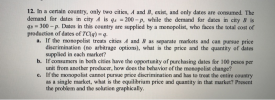 12. In a certain country, only two cities, A and B, exist, and only dates are consumed. The demand for dates in city A is qu = 200 -p, while the demand for dates in city B is 9B = 300 - p. Dates in this country are supplied by a monopolist, who faces the total cost of production of dates of TC(q) = 9. a. If the monopolist treats cities A and B as separate markets and can pursue...
Consider the case of a firm that produces output x (sold at price p) using a...
 Consider the case of a firm that produces output x (sold at price p) using a production function x = A*/*klaße, where / is labor, kis capital, and e is energy (for example, oil or electricity). a) What is the interpretation of A? b) Under what condition(s) does the production function exhibit constant returns to scale? Is it homogeneous? Are the marginal products of inputs increasing, constant, or decreasing? c) Set up the profit maximization problem for the firm. d)...
1. Country A and country B both have the production function Y = F(K,L)= VKL. (5...
 1. Country A and country B both have the production function Y = F(K,L)= VKL. (5 Points) Does this production function have constant returns to scale? Explain. (5 Points) What is the per-worker production function, y=f(k)? (10 Points) Assume that neither country experiences population growth or technological progress and that 5 percent of capital depreciates each year. Assume further that country A saves 10 percent of output each year and country B saves 20 percent of output each year. Using...
3 Exercise 3 - Basic OLG model Consider the following two-period OLG model. People consume in...
 3 Exercise 3 - Basic OLG model Consider the following two-period OLG model. People consume in both periods but work only in period two. The inter-temporal utility of the representative individual in the first period is where c and c2 are consumption and kı (which is given) and k2 are the stocks of capital in periods one and two. ns is work and is government expenditure in period two which is funded by a lump-sum tax in period two, T2....
A firm uses two types of inputs, labor (L) and capital (K), to produce an output,...
A firm uses two types of inputs, labor (L) and capital (K), to produce an output, which is sold in a perfectly competitive market. The production function is given by y = f(L, K) = L 1 6 K 1 6 for all L, K ≥ 0. The price of labor is w > 0 and the price of capital is 1. Each unit of the output is sold at price p > 0. First, we consider the short-run decision...
Consider a world with two countries, Home and Foreign, both able to produce two goods: cloth and tablet computers. The p...
Consider a world with two countries, Home and Foreign, both able to produce two goods: cloth and tablet computers. The production of both goods uses capital and labor in fixed proportions, with the tablets industry using more capital per worker than the cloth industry. The units of each input needed to produce one unit output are given by: capital Labor Cloth 1 2 Tablets 2 1 Both countries have 150 units of capital available for production, but the Home country...
Q1. As you have learned in the course, two main forces that lead to spatial concentration...
 Q1. As you have learned in the course, two main forces that lead to spatial concentration of jobs are scale economics and agglomeration economics. This question is a reminder of economics of scale from your Mi- croeconomics course. Please note this question has 3 parts. Part A: Suppose a firm at the first stage has employed 4 labors and 16 capitals. At the second stage, the manager cannot hire or fire any of the labors and cannot buy or sell...
 3) [20 points] Consider the Solow growth model without population growth or technological change. The parameters of the model are given by s = 0.2 (savings rate) and d=0.05 (depreciation rate). Let k denote capital per worker; y output per worker; c consumption per worker; i investment per worker. a. Rewrite production function below in per worker terms: 1 2 Y = K3L3 b. Find the steady-state level of the capital stock, c. What is the golden rule level of...
 Problem 3 - Profit Maximization Consider the case of a firm that produces output x (sold at price p) using a production function x = A*/*k1-a8eß, where Iis labor, k is capital, and e is energy (for example, oil or electricity). a) What is the interpretation of A? b) Under what condition(s) does the production function exhibit constant returns to scale? Is it homogeneous? Are the marginal products of inputs increasing, constant, or decreasing? c) Set up the profit maximization...
 12. In a certain country, only two cities, A and B, exist, and only dates are consumed. The demand for dates in city A is qu = 200 -p, while the demand for dates in city B is 9B = 300 - p. Dates in this country are supplied by a monopolist, who faces the total cost of production of dates of TC(q) = 9. a. If the monopolist treats cities A and B as separate markets and can pursue...
 Consider the case of a firm that produces output x (sold at price p) using a production function x = A*/*klaße, where / is labor, kis capital, and e is energy (for example, oil or electricity). a) What is the interpretation of A? b) Under what condition(s) does the production function exhibit constant returns to scale? Is it homogeneous? Are the marginal products of inputs increasing, constant, or decreasing? c) Set up the profit maximization problem for the firm. d)...
 1. Country A and country B both have the production function Y = F(K,L)= VKL. (5 Points) Does this production function have constant returns to scale? Explain. (5 Points) What is the per-worker production function, y=f(k)? (10 Points) Assume that neither country experiences population growth or technological progress and that 5 percent of capital depreciates each year. Assume further that country A saves 10 percent of output each year and country B saves 20 percent of output each year. Using...
 3 Exercise 3 - Basic OLG model Consider the following two-period OLG model. People consume in both periods but work only in period two. The inter-temporal utility of the representative individual in the first period is where c and c2 are consumption and kı (which is given) and k2 are the stocks of capital in periods one and two. ns is work and is government expenditure in period two which is funded by a lump-sum tax in period two, T2....
 Q1. As you have learned in the course, two main forces that lead to spatial concentration of jobs are scale economics and agglomeration economics. This question is a reminder of economics of scale from your Mi- croeconomics course. Please note this question has 3 parts. Part A: Suppose a firm at the first stage has employed 4 labors and 16 capitals. At the second stage, the manager cannot hire or fire any of the labors and cannot buy or sell...
Most questions answered within 3 hours.
-
Where is the error in this code sequence?
String s1 = "Hello";
String s2 = "ello";...
asked 11 months ago -
Financial data for Joel de Paris, Inc., for last year
follow:
Joel de Paris, Inc.
Balance...
asked 11 months ago -
Consider this reaction:
Al2(SO4)3 (aq)+ BaCl3
(aq) Al2Cl6 (aq)- +
3BaSO4(s) . What is the...
asked 11 months ago -
Suppose that Savneet is considering increasing her
recent random sample from 20 car rentals to 40...
asked 11 months ago -
Trucks arrive at an unloading terminal at an average rate of 120
per hour.
Trucks arrive...
asked 11 months ago -
Why are methanol and ethanol completely soluble in water while
octanol is not very little soluble....
asked 11 months ago -
A facilities manager at a university reads in a research report
that the mean amount of...
asked 11 months ago -
When the CuSO4 is rehydrated by adding water to the anhydrous
compound, is this an endothermic...
asked 11 months ago -
A ray of sunlight is passing from diamond into crown glass; the
angle of incidence is...
asked 11 months ago -
A block of mass 0.249 kg is placed on top of a light, vertical
spring of...
asked 11 months ago -
how do the kidneys compensate in the presences of acidosis
a) trigger hyperventilate
b) reserve acid...
asked 11 months ago -
Question 501 pts
The rental rate of capital to the firm increases. Which of the
following...
asked 11 months ago