


Homework Answers
Question 1)
Demand :
P = 150 - 0.5Q 0<= Q <= 50
P = 200 - 1.5Q Q > 50
Total Revenue = PQ :
150Q - 0.5Q2 0<= Q <= 50
200Q -1.5Q2 Q > 50
Marginal Revenue ( Differentiating Total Revenue with respect to Q):
150 - Q 0<= Q <= 50
200 - 3Q Q > 50
Put Q = 50
Marginal Revenue :
1) 150 - 50 = 100
2 ) 200 - 3(50) = 50
So the firm produces output where marginal revenue equals marginal cost . It can produce Q = 50 till marginal cost of 100 which is maximum.
Questionn 2 )
This is a kinked demand curve. This is linked with Sweezy Oligopoly compeitition
Question 3)
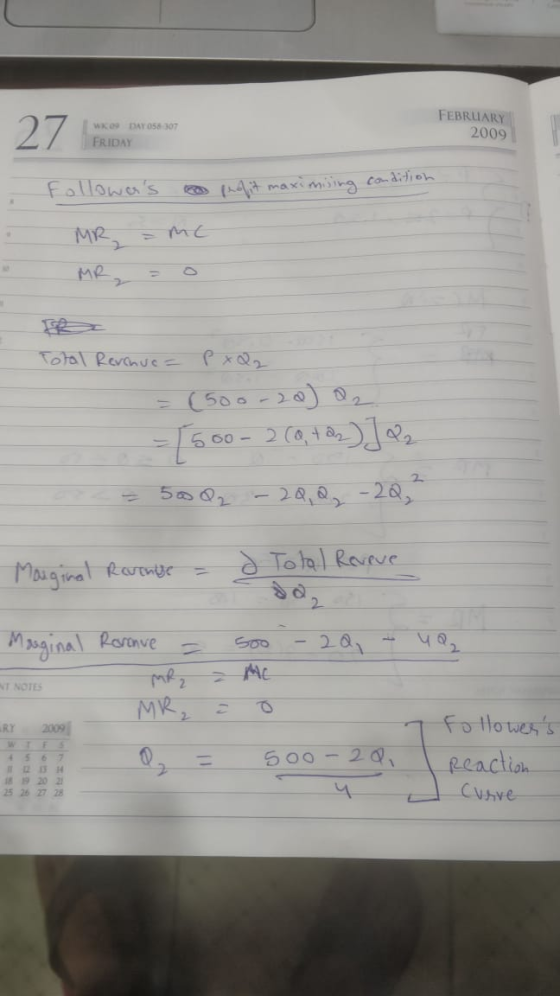
![FEBRUARY | 2009 DAY 059-306 WK 09 SATURDAY DAY 059306 wkog 28. MR, IMC Total Revenus = pa, (soo-2 (9,722)] Q, = p sood, -2Q?](http://img.homeworklib.com/questions/b6def4a0-7a84-11ea-a202-9380bc407498.png?x-oss-process=image/resize,w_560)
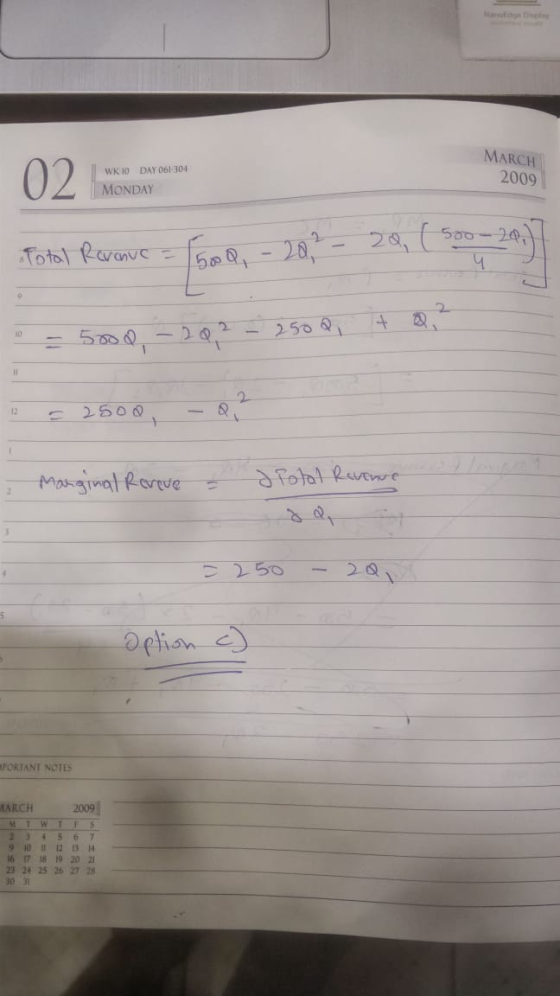
Question 4)
c) None of the options are correct
Equating marginal revenue to marginal cost is the profit maximising condition same for all compeitition types
Add Answer to:
ilman can incur before they are required to Chillman Motors, Inc., believes it faces P-150-0.5Q when...
Predatory Pricing Which of the followings is not the purpose of predatory pricing? A To drive...
 Predatory Pricing Which of the followings is not the purpose of predatory pricing? A To drive competitors out of a market B To prevent entry by potential rivals C To increase its own market power O D to increase output and lower prices Economies and Diseconomies of Scale When a firm gets so large that coordination and management of workers and other inputs becomes costly and difficult, it is experiencing which of the following? O A Diseconomies of scale O...
 Predatory Pricing Which of the followings is not the purpose of predatory pricing? A To drive competitors out of a market B To prevent entry by potential rivals C To increase its own market power O D to increase output and lower prices Economies and Diseconomies of Scale When a firm gets so large that coordination and management of workers and other inputs becomes costly and difficult, it is experiencing which of the following? O A Diseconomies of scale O...
Most questions answered within 3 hours.
-
Where is the error in this code sequence?
String s1 = "Hello";
String s2 = "ello";...
asked 10 months ago -
Financial data for Joel de Paris, Inc., for last year
follow:
Joel de Paris, Inc.
Balance...
asked 10 months ago -
Consider this reaction:
Al2(SO4)3 (aq)+ BaCl3
(aq) Al2Cl6 (aq)- +
3BaSO4(s) . What is the...
asked 10 months ago -
Suppose that Savneet is considering increasing her
recent random sample from 20 car rentals to 40...
asked 10 months ago -
Trucks arrive at an unloading terminal at an average rate of 120
per hour.
Trucks arrive...
asked 10 months ago -
Why are methanol and ethanol completely soluble in water while
octanol is not very little soluble....
asked 10 months ago -
A facilities manager at a university reads in a research report
that the mean amount of...
asked 10 months ago -
When the CuSO4 is rehydrated by adding water to the anhydrous
compound, is this an endothermic...
asked 10 months ago -
A ray of sunlight is passing from diamond into crown glass; the
angle of incidence is...
asked 10 months ago -
A block of mass 0.249 kg is placed on top of a light, vertical
spring of...
asked 10 months ago -
how do the kidneys compensate in the presences of acidosis
a) trigger hyperventilate
b) reserve acid...
asked 10 months ago -
Question 501 pts
The rental rate of capital to the firm increases. Which of the
following...
asked 10 months ago