
Homework Answers
1)The nurse priority is to ensure the child is provided with safe environment and laying the child and the airway of the child is clear and he is able to intake adequate oxygen.And his circulation is seen.And further anticonvulsant should be administered to stop seizures.
2)Hard objects should be removed from vacinity.
Oxygen and suctioning equipment should be near the patient to be used if necessary.
Raising the side rails if the child is in bed.
The child should be supervised.And medical alert bracelet should be placed on his arm.
Add Answer to:
1- Ricky is a 2 year old, has been brought to the emergency room by his...
STORY: Kelly, a 21-year old college student has been brought to the emergency room in status...
STORY: Kelly, a 21-year old college student has been brought to the emergency room in status epilepticus. Measures are taken to ensure here safety and prevent injury, and an IV line is started. The emergency department physician has ordered diazepam (Valium) 8mg IV push, STAT. The seizure has stopped and she is admitted to the medical-surgical floor. The admitting orders call for an initial IV dose of phenytoin, followed by oral dose of phenytoin twice a day. Please Answer the...
A 3-year-old male is brought to the emergency room with hypoglycemia following a brief seizure. His...
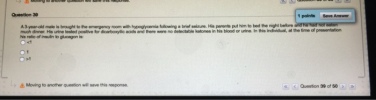 A 3-year-old male is brought to the emergency room with hypoglycemia following a brief seizure. His parents put him to bed the night before and he had not eaten much dinner. His urine tested positive for dicarboxylic acids and there were no delectable ketones in his blood or urine. In this individual, at the time of presentation his ratio of insulin to glucagon is: < 1 1 > 1
Jason, age 10, was brought to the emergency room by his mother. He had been stung...
Jason, age 10, was brought to the emergency room by his mother. He had been stung by a bee and was having some difficulty in breathing. She thought he might be having an anaphylactic reaction. 1. What are the symptoms of a localized anaphylactic reaction? ( Name 3) 2. What are the symptoms of a systemic anaphylactic reaction? ( Name 4) 3. What is the treatment? ( Name 1)
. Six-month-old Joshua is brought to the acute care center by his parents. The parents tell...
. Six-month-old Joshua is brought to the acute care center by his parents. The parents tell the nurse that Joshua has become “very fussy,” seems to be pulling at his right ear, and is running a fever. The nurse finds the infant’s temperature to be 100.2°F axillary. His weight is 7.7 kg and he is crying inconsolably. Joshua’s anterior fontanel is flat when he is crying and his skin feels hot to the touch and dry. Joshua’s mother tells the...
A 15-year-old male is recovering from chicken pox when his mother notices he has been acting...
A 15-year-old male is recovering from chicken pox when his mother notices he has been acting confused. The teenager was brought to the emergency department when he his mother witnessed him having a seizure. A CT scan was done and showed the patient’s liver was enlarged. What syndrome does the patient likely have, what catabolite over production causes the syndrome, and how does the catabolite over production impact the urea cycle and pyrimidine synthesis?
ohn Moore, a 22-year-old patient weighing in at 150 pounds, arrived at the emergency department (ED)...
ohn Moore, a 22-year-old patient weighing in at 150 pounds, arrived at the emergency department (ED) after being thrown from his horse and passing out for a few minutes; later he regained consciousness. The friend who was also riding a horse called the squad. The patient presented with a GCS of 15, and the neuro exam was within normal limits (WNL). The ED physician wrote the orders for a CT scan without contrast of the head, CBC, renal and metabolic...
John Moore, a 22-year-old patient weighing in at 150 pounds, arrived at the emergency department (ED)...
John Moore, a 22-year-old patient weighing in at 150 pounds, arrived at the emergency department (ED) after being thrown from his horse and passing out for a few minutes; later he regained consciousness. The friend who was also riding a horse called the squad. The patient presented with a GCS of 15, and the neuro exam was within normal limits (WNL). The ED physician wrote the orders for a CT scan without contrast of the head, CBC, renal and metabolic...
M.G. is an 8-year-old boy who has been brought to the emergency department by his parents...
M.G. is an 8-year-old boy who has been brought to the emergency department by his parents with a fever of 104 degrees, lethargy, headache, and stiff neck. Laboratory analysis of a spinal tap demonstrates increased white blood cells in the cerebral spinal fluid (CSF). question#1 What is the most likely cause of M.G.'s signs and symptoms? What is the origin and pathogenesis? What other laboratory findings would be consistent with this etiology? question #2 What are common complications of this...
John is a 37-year-old patient who has recently attempted suicide. The nurse has brought John bath...
John is a 37-year-old patient who has recently attempted suicide. The nurse has brought John bath linens for his bath. The psychiatric nurse’s cell phone rings, and she answers and speaks to a friend. John is telling the nurse that his mother is visiting him this afternoon and he does not want her to know why he has been admitted to the psychiatric unit. The nurse asks, “What did you say?” John repeats his request to the nurse. The nurse...
1. A patient has been brought to the emergency room complaining of dyspnea after sustaining a...
1. A patient has been brought to the emergency room complaining of dyspnea after sustaining a bee sting to the right arm. a). Describe the types of hypersensitivity b). What measures are taken to manage anaphylaxis? 2. The nurse is teaching a patient how to use an EpiPen in the event of an anaphylactic reaction. a). What are the priority management concerns of the patient with the allergic disorder? b)What are the key measures for the use of an EpiPen...
 A 3-year-old male is brought to the emergency room with hypoglycemia following a brief seizure. His parents put him to bed the night before and he had not eaten much dinner. His urine tested positive for dicarboxylic acids and there were no delectable ketones in his blood or urine. In this individual, at the time of presentation his ratio of insulin to glucagon is: < 1 1 > 1
Most questions answered within 3 hours.
-
Where is the error in this code sequence?
String s1 = "Hello";
String s2 = "ello";...
asked 11 months ago -
Financial data for Joel de Paris, Inc., for last year
follow:
Joel de Paris, Inc.
Balance...
asked 11 months ago -
Consider this reaction:
Al2(SO4)3 (aq)+ BaCl3
(aq) Al2Cl6 (aq)- +
3BaSO4(s) . What is the...
asked 11 months ago -
Suppose that Savneet is considering increasing her
recent random sample from 20 car rentals to 40...
asked 11 months ago -
Trucks arrive at an unloading terminal at an average rate of 120
per hour.
Trucks arrive...
asked 11 months ago -
Why are methanol and ethanol completely soluble in water while
octanol is not very little soluble....
asked 11 months ago -
A facilities manager at a university reads in a research report
that the mean amount of...
asked 11 months ago -
When the CuSO4 is rehydrated by adding water to the anhydrous
compound, is this an endothermic...
asked 11 months ago -
A ray of sunlight is passing from diamond into crown glass; the
angle of incidence is...
asked 11 months ago -
A block of mass 0.249 kg is placed on top of a light, vertical
spring of...
asked 11 months ago -
how do the kidneys compensate in the presences of acidosis
a) trigger hyperventilate
b) reserve acid...
asked 11 months ago -
Question 501 pts
The rental rate of capital to the firm increases. Which of the
following...
asked 11 months ago