Suppose the world real interest rate is r* = 3%, the gdp growth rates in the...
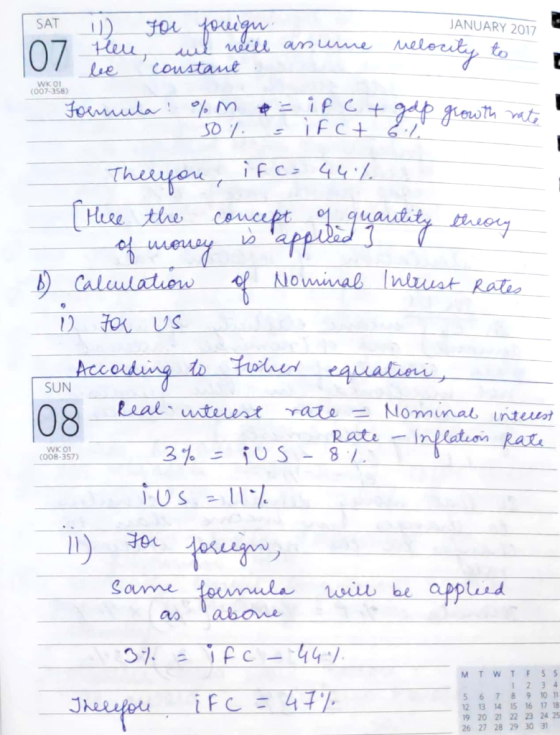
Suppose the world real interest rate is r* = 3%, the gdp growth rates in the US and the foreign country are 6%, US monetary growth is μUS = 10%, and foreign monetary growth is μFC = 50%. Find inflation rates in both countries, πUS and πFC, nominal interest rates in both countries, iUS and iFC, and the rate of change in the foreign currency value of the $, ΔE/E. Assume the money demand parameter L is constant in both countries, expected inflation equals actual inflation, exchange rates are determined by purchasing power parity, and interest parity holds.
Homework Answers

Add Answer to:
Suppose the world real interest rate is r* = 3%, the gdp growth
rates in the...
The International Fisher Effect (IFE), Purchasing Power Parity (PPP) and Interest Rate Parity (IRP) are three...
 The International Fisher Effect (IFE), Purchasing Power Parity (PPP) and Interest Rate Parity (IRP) are three very important theories in international finance, each with its own predictions and implication. Which of the following is correct? IRP suggests that a change in interest rate differential will not change the currency's forward premium/discount. According to purchasing power parity (PPP), if a foreign country's inflation rate is below the inflation rate at home, home country consumers will increase their imports from the foreign...
How do the calculated values for inflation, the real GDP growth rate and nominal GDP growth...
How do the calculated values for inflation, the real GDP growth rate and nominal GDP growth rate relate to each other? A. They are related in that the growth rate in real GDP plus inflation rate equals (approximately) the growth rate in nominal GDP. B.They are related in that the growth rate in real GDP minus inflation rate equals (approximately) the growth rate in nominal GDP. C.They are related in that the growth rate in nominal GDP plus inflation rate...
5. Interest rate parity Aa Aa The rise of globalization is due to the many companies that have become multinational cor...
 5. Interest rate parity Aa Aa The rise of globalization is due to the many companies that have become multinational corporations for various reasons-for example, to access better technology, to enter new markets, to obtain more raw materials, to find funding resources, to minimize production costs, or to diversify business risk. This multimarket presence exposes companies to different kinds of risk as well-for example, political risk and exchange rate risk. Several factors affect the exchange rate of a currency with...
If the rate of growth in labor productivity in China increases relative to the rate of...
If the rate of growth in labor productivity in China increases relative to the rate of productivity in other countries, then a. the RMB’s exchange value depreciates against other currencies. b. the RMB’s exchange value remains constant against other currencies. c. Chinese citizens are willing to pay more RMB per unit of foreign currency. d. Chinese citizens are willing to pay fewer RMB per unit of foreign currency. Which statement is true about the relative PPP? a. If domestic inflation...
9. A problem using the general monetary model Suppose we use the general model, in which...
 9. A problem using the general monetary model Suppose we use the general model, in which real money demand is L(i)rand we assume that both relative PPP (RPPP) and uncovered interest parity (UIP) hold. Consider two countries, Australia (A) and New Zealand (NZ). Imagine in a particular year that Australia had slower real income growth (2%) and NZ had higher real income growth (5%). Suppose the central bank of A permitted the nominal money supply to grow by 4% per...
5. Interest rate parity Aa Aa E The rise of globalization is due to the many...
 5. Interest rate parity Aa Aa E The rise of globalization is due to the many companies that have become multinational corporations for various reasons-for example, to access better technology, to enter new markets, to obtain more raw materials, to find funding resources, to minimize production costs, or to diversify business risk. This multimarket presence exposes companies to different kinds of risk as well-for example, political risk and exchange rate risk. Several factors affect the exchange rate of a currency...
Suppose that when converting to the same currency values, the nominal GDP per capita in the...
 Suppose that when converting to the same currency values, the nominal GDP per capita in the fictional country of Islandia is 25 percent higher than the nominal GDP per capita in the fictional country of Mountainia. However, the purchasing power for the same amount of Islandia currency is about 40 percent lower in Islandia than in Mountainia. If we use Islandia as the base country for comparison, the PPP-adjusted GDP per capita in Mountainia i(Click to select) ts nominal GDP....
Which of the following is true about relative purchasing power parity? If two countries have a...
Which of the following is true about relative purchasing power parity? If two countries have a fixed exchange rate, inflation rates tend to be the same. This means that the two countries’ economies will tend to be closely intertwined. Changes in expected inflation rates will be reflected in the nominal interest rates on bonds. The higher the expected inflation, the higher the interest rates. This means that countries with higher inflation will tend to see strong demand for domestic bonds....
QUESTION 3 Select all of the following that are true regarding interest rates and foreign exchange...
 QUESTION 3 Select all of the following that are true regarding interest rates and foreign exchange rates: When domestic interest rates rise the domestic currency depreciates When a domestic currency depreciates, domestic interest rates rise Interest rate parity between countries is a reasonable assumption due to arbitrage and floating exchange rates When domestic interest rates rise due to monetary policy, the domestic currency appreciates solely because of the decreased supply of the domestic currency QUESTION 4 Select all that are...
1a. In the foreign exchange market, a decrease in the world demand for Japanese exports a....
1a. In the foreign exchange market, a decrease in the world demand for Japanese exports a. shifts the demand curve for yen leftward, which causes the yen to appreciate. b. shifts the demand curve for yen rightward, which causes the yen to appreciate. c. shifts the demand curve for yen rightward, which causes the yen to depreciate. d. shifts the demand curve for yen leftward, which causes the yen to depreciate. 1b. A relatively high rate of inflation in the...
 The International Fisher Effect (IFE), Purchasing Power Parity (PPP) and Interest Rate Parity (IRP) are three very important theories in international finance, each with its own predictions and implication. Which of the following is correct? IRP suggests that a change in interest rate differential will not change the currency's forward premium/discount. According to purchasing power parity (PPP), if a foreign country's inflation rate is below the inflation rate at home, home country consumers will increase their imports from the foreign...
 5. Interest rate parity Aa Aa The rise of globalization is due to the many companies that have become multinational corporations for various reasons-for example, to access better technology, to enter new markets, to obtain more raw materials, to find funding resources, to minimize production costs, or to diversify business risk. This multimarket presence exposes companies to different kinds of risk as well-for example, political risk and exchange rate risk. Several factors affect the exchange rate of a currency with...
 9. A problem using the general monetary model Suppose we use the general model, in which real money demand is L(i)rand we assume that both relative PPP (RPPP) and uncovered interest parity (UIP) hold. Consider two countries, Australia (A) and New Zealand (NZ). Imagine in a particular year that Australia had slower real income growth (2%) and NZ had higher real income growth (5%). Suppose the central bank of A permitted the nominal money supply to grow by 4% per...
 5. Interest rate parity Aa Aa E The rise of globalization is due to the many companies that have become multinational corporations for various reasons-for example, to access better technology, to enter new markets, to obtain more raw materials, to find funding resources, to minimize production costs, or to diversify business risk. This multimarket presence exposes companies to different kinds of risk as well-for example, political risk and exchange rate risk. Several factors affect the exchange rate of a currency...
 Suppose that when converting to the same currency values, the nominal GDP per capita in the fictional country of Islandia is 25 percent higher than the nominal GDP per capita in the fictional country of Mountainia. However, the purchasing power for the same amount of Islandia currency is about 40 percent lower in Islandia than in Mountainia. If we use Islandia as the base country for comparison, the PPP-adjusted GDP per capita in Mountainia i(Click to select) ts nominal GDP....
 QUESTION 3 Select all of the following that are true regarding interest rates and foreign exchange rates: When domestic interest rates rise the domestic currency depreciates When a domestic currency depreciates, domestic interest rates rise Interest rate parity between countries is a reasonable assumption due to arbitrage and floating exchange rates When domestic interest rates rise due to monetary policy, the domestic currency appreciates solely because of the decreased supply of the domestic currency QUESTION 4 Select all that are...
Most questions answered within 3 hours.
-
Where is the error in this code sequence?
String s1 = "Hello";
String s2 = "ello";...
asked 11 months ago -
Financial data for Joel de Paris, Inc., for last year
follow:
Joel de Paris, Inc.
Balance...
asked 11 months ago -
Consider this reaction:
Al2(SO4)3 (aq)+ BaCl3
(aq) Al2Cl6 (aq)- +
3BaSO4(s) . What is the...
asked 11 months ago -
Suppose that Savneet is considering increasing her
recent random sample from 20 car rentals to 40...
asked 11 months ago -
Trucks arrive at an unloading terminal at an average rate of 120
per hour.
Trucks arrive...
asked 11 months ago -
Why are methanol and ethanol completely soluble in water while
octanol is not very little soluble....
asked 11 months ago -
A facilities manager at a university reads in a research report
that the mean amount of...
asked 11 months ago -
When the CuSO4 is rehydrated by adding water to the anhydrous
compound, is this an endothermic...
asked 11 months ago -
A ray of sunlight is passing from diamond into crown glass; the
angle of incidence is...
asked 11 months ago -
A block of mass 0.249 kg is placed on top of a light, vertical
spring of...
asked 11 months ago -
how do the kidneys compensate in the presences of acidosis
a) trigger hyperventilate
b) reserve acid...
asked 11 months ago -
Question 501 pts
The rental rate of capital to the firm increases. Which of the
following...
asked 11 months ago