
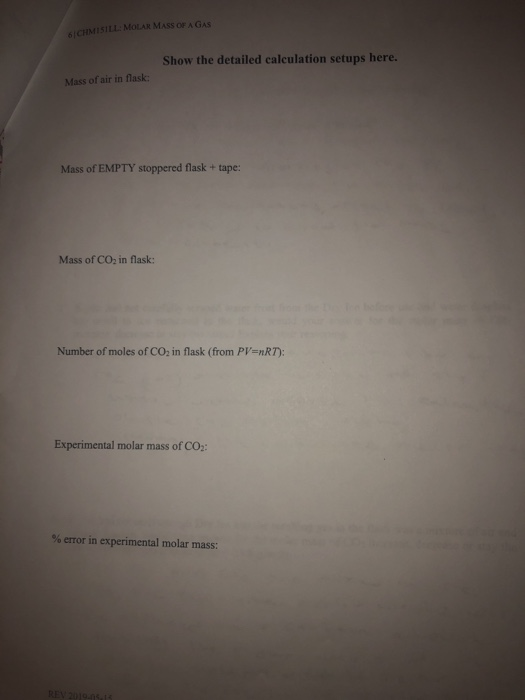
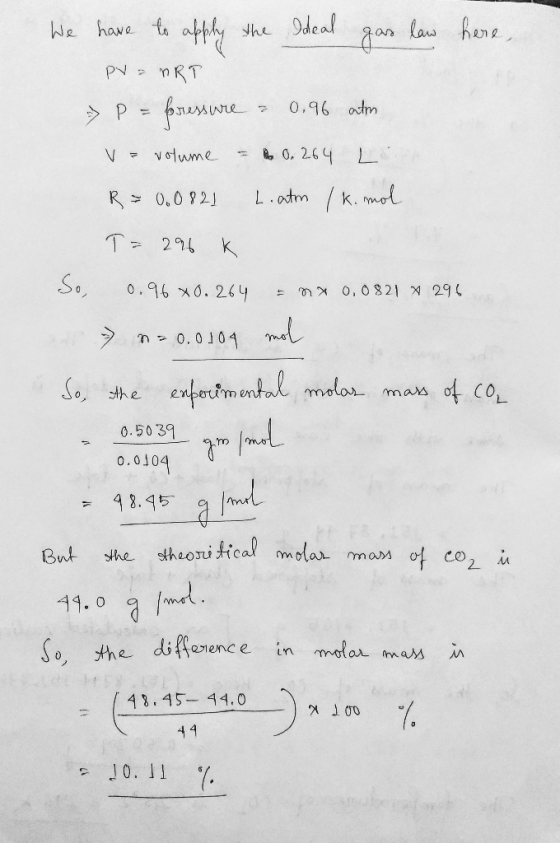
6ICHMISILL: MOLAR MASS OF A GAS Show the detailed calculation setups here. Mass of air in flask Mass of EMPTY stoppered flask + tape: Mass of CO2 in flask: Number of moles of CO2 in flask (from PV=nRT): Experimental molar mass of CO: % error in experimental molar mass: REV2019-051s
Homework Answers
Add Answer to:
Mass of stoppered flask + air + tape (record all digits from balance) ISLcBS 22 C...
Barometric Pressure 0.992 atm Mass of Flask + Foil 56 g Mass of Flask + Foil...
Barometric Pressure 0.992 atm Mass of Flask + Foil 56 g Mass of Flask + Foil + Condensed Liquid 59 g Mass of Condensed Liquid 3 g Volume of Flask 300 ml Temperature of Water Bath when Vaporization Begins 333 K Temperature of Water Bath when Water Begins to Boil 363 K Molar Mass 46 g mol Ideal gas law PV=nRT P=pressure V=volume of gas n=number of moles R=gas constant T=temperature Molar volume V=RT/P Density of gas D=PM x RT Molar mass M=(mRT)/(PV) I...
Data: Mass of flask filled with air - 150.9425 g Mass of flask filled with CO2...
Data: Mass of flask filled with air - 150.9425 g Mass of flask filled with CO2 Trial 1 - 150.9775 g Mass of flask filled with CO2 Trial 2 - 150.9805 g Average mass flask filled with CO2 - 150.979 g Temperature of CO2 - 296.15 K Barometer reading - 1.0 atm Density of water at room temp - 0.9978g/mL Density of dry air in flask at room temp - 1.201g/L Calculations: Mass of water in flask - 392.85 mL...
please show steps. thanks ! Experiment 19 Gas Stoichiometry and the Gas Laws The relationship between...
 please show steps. thanks !
Experiment 19 Gas Stoichiometry and the Gas Laws The relationship between the physical properties of a gas, and the moles, is given by the “Ideal Gas Law:" PV=nRT where n-number of moles R=the ideal gas constant: 0.0821 atm L mole 'Kor 62.4 L torr molek In this experiment, the theoretical yield of gas, will be compared to the experimental yield. The reaction of aluminum with hydrochloric acid produces hydrogen according to the balanced equation below....
please show steps. thanks !
Experiment 19 Gas Stoichiometry and the Gas Laws The relationship between the physical properties of a gas, and the moles, is given by the “Ideal Gas Law:" PV=nRT where n-number of moles R=the ideal gas constant: 0.0821 atm L mole 'Kor 62.4 L torr molek In this experiment, the theoretical yield of gas, will be compared to the experimental yield. The reaction of aluminum with hydrochloric acid produces hydrogen according to the balanced equation below....
DATA TABLE Trial 1 Trial 2 Mass of Erlenmeyer flask, rubber band and foil cover (g) 90.560 90.10 Temperature of wat...
 DATA TABLE Trial 1 Trial 2 Mass of Erlenmeyer flask, rubber band and foil cover (g) 90.560 90.10 Temperature of water bath (°C) 100t 99.1 Mass of Erlenmeyer flask, rubber band, foil cover and condensed 0819 gas sample (9) Mass of the condensed gas sample (9) 251.59 Barometric (atmospheric) pressure (mmHg) 128.96 28.93 Volume of the Erlenmeyer flask (mL) 170 170 Molar mass of the unknown sample (g/mole) Average molar mass (g/mol): DATA ANALYSIS (Show your calculations) 1. Determine the...
1) Given the following data, calculate the temperature of the gas in Kelvin, the pressure of the ...
 1) Given the following data, calculate the temperature of the gas in Kelvin, the pressure of the gas in atm, the mass of the condensed liquid, the volume of the gas in L, the moles of gas in the flask and then calculate the molar mass of the unknown liquid Mass of empty flask and foil 78.639g 99.3°C 14.4 psi 79.118g Temperature of hot water atm Pressure in lab Mass of flask, foil and condensed unknown liquid AFTER heating and...
Unknown sample no. C Trial I Trial 2 1. Mass of 2. Mass of generator + sample before reaction () ...
 help
with remaining calculations please
Unknown sample no. C Trial I Trial 2 1. Mass of 2. Mass of generator + sample before reaction () 3. Inst s approval of apparatus C. Determination of Vol ume, Temperature, and Pressure of the Carbon Dioxide Gas 1. Initial reading of volume of water in CO.-collecting graduated cylinder (mL) 2. Final reading of volume of water in CO-collecting graduated cylinder (mL) 3. Volume of CO,(g) collected (L) 4. Temperature of water C) 5....
help
with remaining calculations please
Unknown sample no. C Trial I Trial 2 1. Mass of 2. Mass of generator + sample before reaction () 3. Inst s approval of apparatus C. Determination of Vol ume, Temperature, and Pressure of the Carbon Dioxide Gas 1. Initial reading of volume of water in CO.-collecting graduated cylinder (mL) 2. Final reading of volume of water in CO-collecting graduated cylinder (mL) 3. Volume of CO,(g) collected (L) 4. Temperature of water C) 5....
132 PROPOS22: Determining the Molar Mass of Co2 e) Determine the mass of air displaced by...
 132 PROPOS22: Determining the Molar Mass of Co2 e) Determine the mass of air displaced by the inflated balloorn (0 Determine the measured mass of the CO2 in the balloon. (g) Determine the actual mass of the CO2 in the balloon. (h) Determine the molar mass of Co, () Determine the percent error in your calculated molar mass for CO2, based on the theoretical value of 44.01 g/mol. eriment, except following data: e mass of a CO2 gas sample collected...
Prelab Questions: Apparent Molar Mass of Air 1. What is a molar mass (of a compound)?...
 Prelab Questions: Apparent Molar Mass of Air 1. What is a molar mass (of a compound)? What are its units? 2. What is the equation for the ideal gas la? What units are typically used? Hint: pressures are typically measured as atmospheres or torr.] 3. Rearrange the ideal gas law to solve for moles (n) flask assembly containi air has a mass of 138.562 g at 25 138.541 g when submerged in boiling water at 99.7°C, calculate the molar mass...
name Prelaboratory Assignment: Gas Laws Technical objective: A flask with a sample of gas at room...
 name Prelaboratory Assignment: Gas Laws Technical objective: A flask with a sample of gas at room temperature and pressure weighs 97.4842 g. The same flask with air (density 1.17 g/L) weighs 96.8848 g. The same flask filled with water ( 0.998 g/mL) weighs 345.86 g. The pressure in the room is 0.989 atm and the temperature is 22.2°C. 1. Calculate the volume of the flask. 2. Calculate the mass of the air that the flask can hold. 3. Calculate the...
The steps just refer to the lab procedure and the ones present are where data is...
 The steps just refer to the lab procedure and the ones present
are where data is actually recorded. The rest, like step 5, are
things like fill the flask with water and wipe away any excess. All
needed info for the calculations is there. I'm trying to
double-check my work.
DATA & CALCULATIONS: Measured quantities that were the same for all three runs: 138.5 mL Volume of flask Laboratory temperature Atmospheric pressure Density of air 29.82 inches Hg 1.189 g/L...
The steps just refer to the lab procedure and the ones present
are where data is actually recorded. The rest, like step 5, are
things like fill the flask with water and wipe away any excess. All
needed info for the calculations is there. I'm trying to
double-check my work.
DATA & CALCULATIONS: Measured quantities that were the same for all three runs: 138.5 mL Volume of flask Laboratory temperature Atmospheric pressure Density of air 29.82 inches Hg 1.189 g/L...
 please show steps. thanks !
Experiment 19 Gas Stoichiometry and the Gas Laws The relationship between the physical properties of a gas, and the moles, is given by the “Ideal Gas Law:" PV=nRT where n-number of moles R=the ideal gas constant: 0.0821 atm L mole 'Kor 62.4 L torr molek In this experiment, the theoretical yield of gas, will be compared to the experimental yield. The reaction of aluminum with hydrochloric acid produces hydrogen according to the balanced equation below....
please show steps. thanks !
Experiment 19 Gas Stoichiometry and the Gas Laws The relationship between the physical properties of a gas, and the moles, is given by the “Ideal Gas Law:" PV=nRT where n-number of moles R=the ideal gas constant: 0.0821 atm L mole 'Kor 62.4 L torr molek In this experiment, the theoretical yield of gas, will be compared to the experimental yield. The reaction of aluminum with hydrochloric acid produces hydrogen according to the balanced equation below....
 DATA TABLE Trial 1 Trial 2 Mass of Erlenmeyer flask, rubber band and foil cover (g) 90.560 90.10 Temperature of water bath (°C) 100t 99.1 Mass of Erlenmeyer flask, rubber band, foil cover and condensed 0819 gas sample (9) Mass of the condensed gas sample (9) 251.59 Barometric (atmospheric) pressure (mmHg) 128.96 28.93 Volume of the Erlenmeyer flask (mL) 170 170 Molar mass of the unknown sample (g/mole) Average molar mass (g/mol): DATA ANALYSIS (Show your calculations) 1. Determine the...
 1) Given the following data, calculate the temperature of the gas in Kelvin, the pressure of the gas in atm, the mass of the condensed liquid, the volume of the gas in L, the moles of gas in the flask and then calculate the molar mass of the unknown liquid Mass of empty flask and foil 78.639g 99.3°C 14.4 psi 79.118g Temperature of hot water atm Pressure in lab Mass of flask, foil and condensed unknown liquid AFTER heating and...
 help
with remaining calculations please
Unknown sample no. C Trial I Trial 2 1. Mass of 2. Mass of generator + sample before reaction () 3. Inst s approval of apparatus C. Determination of Vol ume, Temperature, and Pressure of the Carbon Dioxide Gas 1. Initial reading of volume of water in CO.-collecting graduated cylinder (mL) 2. Final reading of volume of water in CO-collecting graduated cylinder (mL) 3. Volume of CO,(g) collected (L) 4. Temperature of water C) 5....
help
with remaining calculations please
Unknown sample no. C Trial I Trial 2 1. Mass of 2. Mass of generator + sample before reaction () 3. Inst s approval of apparatus C. Determination of Vol ume, Temperature, and Pressure of the Carbon Dioxide Gas 1. Initial reading of volume of water in CO.-collecting graduated cylinder (mL) 2. Final reading of volume of water in CO-collecting graduated cylinder (mL) 3. Volume of CO,(g) collected (L) 4. Temperature of water C) 5....
 132 PROPOS22: Determining the Molar Mass of Co2 e) Determine the mass of air displaced by the inflated balloorn (0 Determine the measured mass of the CO2 in the balloon. (g) Determine the actual mass of the CO2 in the balloon. (h) Determine the molar mass of Co, () Determine the percent error in your calculated molar mass for CO2, based on the theoretical value of 44.01 g/mol. eriment, except following data: e mass of a CO2 gas sample collected...
 Prelab Questions: Apparent Molar Mass of Air 1. What is a molar mass (of a compound)? What are its units? 2. What is the equation for the ideal gas la? What units are typically used? Hint: pressures are typically measured as atmospheres or torr.] 3. Rearrange the ideal gas law to solve for moles (n) flask assembly containi air has a mass of 138.562 g at 25 138.541 g when submerged in boiling water at 99.7°C, calculate the molar mass...
 name Prelaboratory Assignment: Gas Laws Technical objective: A flask with a sample of gas at room temperature and pressure weighs 97.4842 g. The same flask with air (density 1.17 g/L) weighs 96.8848 g. The same flask filled with water ( 0.998 g/mL) weighs 345.86 g. The pressure in the room is 0.989 atm and the temperature is 22.2°C. 1. Calculate the volume of the flask. 2. Calculate the mass of the air that the flask can hold. 3. Calculate the...
 The steps just refer to the lab procedure and the ones present
are where data is actually recorded. The rest, like step 5, are
things like fill the flask with water and wipe away any excess. All
needed info for the calculations is there. I'm trying to
double-check my work.
DATA & CALCULATIONS: Measured quantities that were the same for all three runs: 138.5 mL Volume of flask Laboratory temperature Atmospheric pressure Density of air 29.82 inches Hg 1.189 g/L...
The steps just refer to the lab procedure and the ones present
are where data is actually recorded. The rest, like step 5, are
things like fill the flask with water and wipe away any excess. All
needed info for the calculations is there. I'm trying to
double-check my work.
DATA & CALCULATIONS: Measured quantities that were the same for all three runs: 138.5 mL Volume of flask Laboratory temperature Atmospheric pressure Density of air 29.82 inches Hg 1.189 g/L...
Most questions answered within 3 hours.
-
Where is the error in this code sequence?
String s1 = "Hello";
String s2 = "ello";...
asked 11 months ago -
Financial data for Joel de Paris, Inc., for last year
follow:
Joel de Paris, Inc.
Balance...
asked 11 months ago -
Consider this reaction:
Al2(SO4)3 (aq)+ BaCl3
(aq) Al2Cl6 (aq)- +
3BaSO4(s) . What is the...
asked 11 months ago -
Suppose that Savneet is considering increasing her
recent random sample from 20 car rentals to 40...
asked 11 months ago -
Trucks arrive at an unloading terminal at an average rate of 120
per hour.
Trucks arrive...
asked 11 months ago -
Why are methanol and ethanol completely soluble in water while
octanol is not very little soluble....
asked 11 months ago -
A facilities manager at a university reads in a research report
that the mean amount of...
asked 11 months ago -
When the CuSO4 is rehydrated by adding water to the anhydrous
compound, is this an endothermic...
asked 11 months ago -
A ray of sunlight is passing from diamond into crown glass; the
angle of incidence is...
asked 11 months ago -
A block of mass 0.249 kg is placed on top of a light, vertical
spring of...
asked 11 months ago -
how do the kidneys compensate in the presences of acidosis
a) trigger hyperventilate
b) reserve acid...
asked 11 months ago -
Question 501 pts
The rental rate of capital to the firm increases. Which of the
following...
asked 11 months ago