![Iwo experiments were performed to determine the rate law for the reaction shown below. In both experiments [A] was measured a](http://img.homeworklib.com/images/d98ded1f-53ff-4781-b126-8196bb673b02.png?x-oss-process=image/resize,w_560)
Homework Answers
Add Answer to:
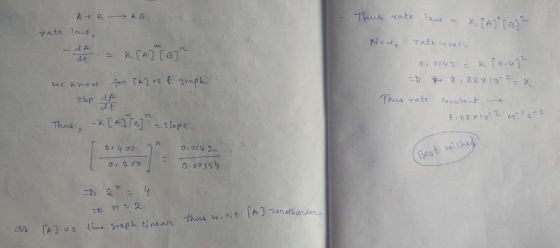
Iwo experiments were performed to determine the rate law for the reaction shown below. In both...
6. Consider the overall reaction A+B+C. Three experiments were performed at 325°C to determine the rate...
 6. Consider the overall reaction A+B+C. Three experiments were performed at 325°C to determine the rate law by changing the initial concentrations of A and B. The results are tabulated below: Experiment # [A]. (M) [B]. (M) Initial Rate (M/s) 1 1.20 3.00 0.403 2 1.20 6.00 0.285 3 3.60 3.00 1.21 A. Determine the order of the reaction for A and B. You must explain your reasoning or show your work. (12 points) Reaction order of A = Reaction...
Use the observations made from the four experiments shown in the table below to determine the...
Use the observations made from the four experiments shown in the table below to determine the rate law for the reaction 2 NO2(g) + F2(g) 2NO2F(g). Find the exponents, x and y, and the rate constant, k, and its units (you only need to use Experiment 1 values to find k). Rate = k [NO2]x [F2]y (6 points) ______ ______ ___________________________ ________________ x y Rate Law k, and its units Experiment Initial Rate (mole/L.s) Initial [NO2] (mole/L) Initial [F2] (mole/L) 1 0.0255 0.100 0.100 2 0.0510 0.200 0.100...
The reaction B ➔ products follows the rate law Rate = k [B]2. If the initial...
The reaction B ➔ products follows the rate law Rate = k [B]2. If the initial concentration of B is 0.400 M, it requires 100 seconds for [B] to fall to 0.200 M. The additional reaction time (in seconds) that is required for [B] to reach 0.100 M is A. 125 B. 175 C. 100 D. 150 E. 200
1) A + B C Some experiments were run to measure the initial rate of reaction...
1) A + B C Some experiments were run to measure the initial rate of reaction vs. starting concentration of A and B. Here are the results. Experiment number [A], M [B], M initial rate, M/s 1 0.230 0.170 0.330 2 0.460 0.170 2.640 4 0.230 0.510 0.330 If we start with 0.197 M A and 0.330 M B, what will be the initial rate? hint, you must find order, and k. 2) For the reaction A + B +...
Question 17 1 pts A student performs several kinetic experiments and believes the rate law for...
 Question 17 1 pts A student performs several kinetic experiments and believes the rate law for her reaction is Rate k[Z12. Which of the following graphs would confirm this rate law and allow her to determine the value of k? O IZ] vs. time In[Z] vs. time O 1/[Z] vs time In[Z] vs. T InZ] vs. 1/1 InZ] vs. 1/time
Wkst #13 CHEM& 162 Name 1. Several experiments were run on the chemical reaction A +...
 Wkst #13 CHEM& 162 Name 1. Several experiments were run on the chemical reaction A + B + 2C → products, giving the following results: Reaction 1 2 Rate (M.s-1) 4.998x10² 1.767x10² 1.767x10² 3.534x10² [A] (M) 0.100 0.200 0.200 0.200 [B] (M) 0.500 0.500 0.250 0.250 [C] (M) 0.100 0.100 0.100 0.200 ديا 4 What is the rate law for this reaction? Be sure to include a numerical value for the rate constant and units!. B. What is the overall...
Using the data shown below, What is the Rate Constant for the reaction: A + B...
Using the data shown below, What is the Rate Constant for the reaction: A + B + C → products Exp. [A] (M) [B] (M) [C] (M) Init. Rate #1 0.100 0.100 0.100 0.00582 #2 0.100 0.100 0.200 0.00582 #3 0.100 0.100 0.300 0.00582 #4 0.300 0.100 0.100 0.01746 #5 0.300 0.400 0.100 0.27936
Consider the following reaction at 327 K. 2 A + 2 B + C + D...
 Consider the following reaction at 327 K. 2 A + 2 B + C + D where rate = rate=k[A]?[B]. An experiment was performed for a certain number of seconds where [A]. = 1.91 M and [B]. = 0.000683 M. A plot of In[B] vs time had a slope of -8.87. What will the rate of this reaction be if a new experiment is preformed when [A] = [B] = 0.979 M? rate (M/s)=
3. For the reaction C3H3(g) + 5 O2(g) ----> 3 CO2(g) + 4H20(1) the following rate...
 3. For the reaction C3H3(g) + 5 O2(g) ----> 3 CO2(g) + 4H20(1) the following rate data were determined at 30°C. Experiment Initial C3H8 Initial O2 id. Rate 0.200M 0.200 M 3.00 x 101 0.400 M 0.200 M 6.00 x 101 0.200 MO 0.400 M 1 .20 x 102 a) Determine the reaction order with respect to C3H8. b) Determine the reaction order with respect to 02. c) Calculate the rate constant at this temperature. d) Write the rate law...
The reaction below was monitored as a function of time at 25 °C: AB ----> A...
The reaction below was monitored as a function of time at 25 °C: AB ----> A + B A plot of ln[AB] vs. time yields a straight line with slope = -0.0025 sec-1. What is the value of the rate constant (k) for this reaction at this temperature? Write the rate law for this reaction. What is the half-life (t1/2)? If the initial concentration of AB is 0.500 M, what is the concentration after 300 sec? If the reaction is...
 6. Consider the overall reaction A+B+C. Three experiments were performed at 325°C to determine the rate law by changing the initial concentrations of A and B. The results are tabulated below: Experiment # [A]. (M) [B]. (M) Initial Rate (M/s) 1 1.20 3.00 0.403 2 1.20 6.00 0.285 3 3.60 3.00 1.21 A. Determine the order of the reaction for A and B. You must explain your reasoning or show your work. (12 points) Reaction order of A = Reaction...
 Question 17 1 pts A student performs several kinetic experiments and believes the rate law for her reaction is Rate k[Z12. Which of the following graphs would confirm this rate law and allow her to determine the value of k? O IZ] vs. time In[Z] vs. time O 1/[Z] vs time In[Z] vs. T InZ] vs. 1/1 InZ] vs. 1/time
 Wkst #13 CHEM& 162 Name 1. Several experiments were run on the chemical reaction A + B + 2C → products, giving the following results: Reaction 1 2 Rate (M.s-1) 4.998x10² 1.767x10² 1.767x10² 3.534x10² [A] (M) 0.100 0.200 0.200 0.200 [B] (M) 0.500 0.500 0.250 0.250 [C] (M) 0.100 0.100 0.100 0.200 ديا 4 What is the rate law for this reaction? Be sure to include a numerical value for the rate constant and units!. B. What is the overall...
 Consider the following reaction at 327 K. 2 A + 2 B + C + D where rate = rate=k[A]?[B]. An experiment was performed for a certain number of seconds where [A]. = 1.91 M and [B]. = 0.000683 M. A plot of In[B] vs time had a slope of -8.87. What will the rate of this reaction be if a new experiment is preformed when [A] = [B] = 0.979 M? rate (M/s)=
 3. For the reaction C3H3(g) + 5 O2(g) ----> 3 CO2(g) + 4H20(1) the following rate data were determined at 30°C. Experiment Initial C3H8 Initial O2 id. Rate 0.200M 0.200 M 3.00 x 101 0.400 M 0.200 M 6.00 x 101 0.200 MO 0.400 M 1 .20 x 102 a) Determine the reaction order with respect to C3H8. b) Determine the reaction order with respect to 02. c) Calculate the rate constant at this temperature. d) Write the rate law...
Most questions answered within 3 hours.
-
Where is the error in this code sequence?
String s1 = "Hello";
String s2 = "ello";...
asked 10 months ago -
Financial data for Joel de Paris, Inc., for last year
follow:
Joel de Paris, Inc.
Balance...
asked 10 months ago -
Consider this reaction:
Al2(SO4)3 (aq)+ BaCl3
(aq) Al2Cl6 (aq)- +
3BaSO4(s) . What is the...
asked 10 months ago -
Suppose that Savneet is considering increasing her
recent random sample from 20 car rentals to 40...
asked 10 months ago -
Trucks arrive at an unloading terminal at an average rate of 120
per hour.
Trucks arrive...
asked 10 months ago -
Why are methanol and ethanol completely soluble in water while
octanol is not very little soluble....
asked 10 months ago -
A facilities manager at a university reads in a research report
that the mean amount of...
asked 10 months ago -
When the CuSO4 is rehydrated by adding water to the anhydrous
compound, is this an endothermic...
asked 10 months ago -
A ray of sunlight is passing from diamond into crown glass; the
angle of incidence is...
asked 10 months ago -
A block of mass 0.249 kg is placed on top of a light, vertical
spring of...
asked 10 months ago -
how do the kidneys compensate in the presences of acidosis
a) trigger hyperventilate
b) reserve acid...
asked 10 months ago -
Question 501 pts
The rental rate of capital to the firm increases. Which of the
following...
asked 10 months ago