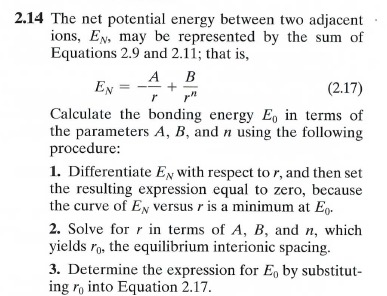

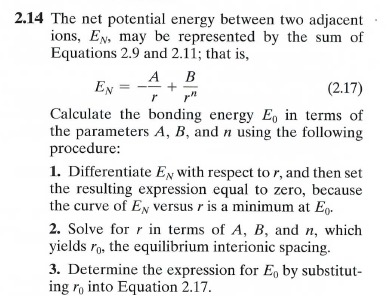
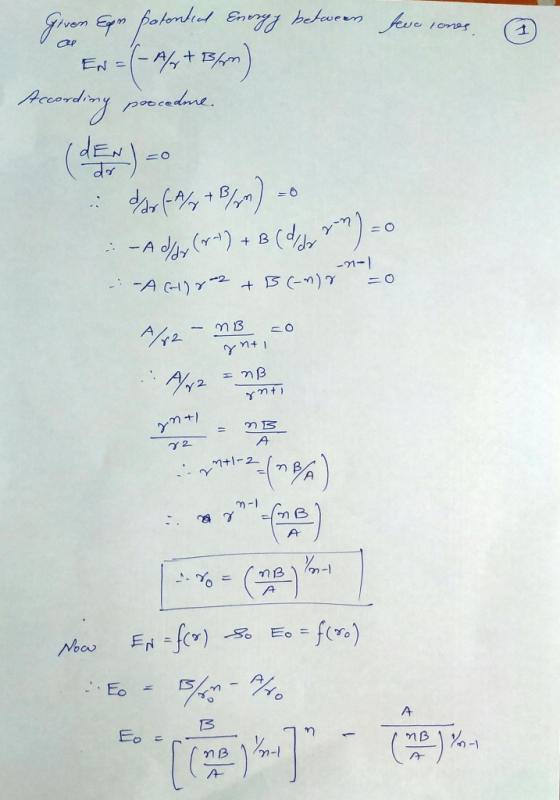
2.14 The net potential energy between two adjacent ions, EN, may be represented by the sum of Equations 2.9 and 2.11; that is, B EN= (2.17) r Calculate the bonding energy Eo in terms of the parameters A, B, and n using the following procedure: 1. Differentiate EN with respect to r, and then set the resulting expression equal to zero, because the curve of EN versus r is a minimum at Eo 2. Solve for in terms of A, B, and n, which yields Fo the equilibrium interionic spacing Determine the expression for Eo by substitut ing ro into Equation 2.17.
A 9d oats rsth sSH EA (2.9
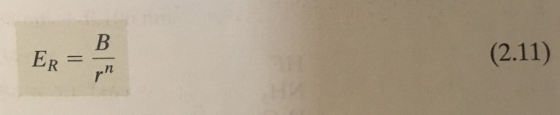
B ER r' (2.11) n
2.14 The net potential energy between two adjacent ions, EN, may be represented by the sum of Equations 2.9 and 2.11; that is, B EN= (2.17) r Calculate the bonding energy Eo in terms of the parameters A, B, and n using the following procedure: 1. Differentiate EN with respect to r, and then set the resulting expression equal to zero, because the curve of EN versus r is a minimum at Eo 2. Solve for in terms of A, B, and n, which yields Fo the equilibrium interionic spacing Determine the expression for Eo by substitut ing ro into Equation 2.17.
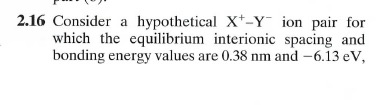
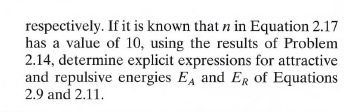
respectively. If it is known that n in Equation 2.17 has a value of 10, using the results of Problem 2.14, determine explicit expressions for attractive and repulsive energies EA and ER of Equations 2.9 and 2.11
Homework Answers
Add Answer to:
2.16 Consider a hypothetical X-Y ion pair for which the equilibrium interionic spacing and bonding energy...
Answer to Problem 2.19 Bonding Forces and Energies 2.13 Calculate the force of attraction between a...
 Answer to Problem 2.19
Bonding Forces and Energies 2.13 Calculate the force of attraction between a Ca2+ and an O on the centers of which are separated by a distance of 1.25 nm. 2.14 The net potential energy between two adja- cent ions, EN, may be represented by the sum of Equations 2.8 and 2.9; that is, A B Calculate the bonding energy Eo in terms of the parameters A, B, and n using the follow ing procedure: 1. Differentiate...
Answer to Problem 2.19
Bonding Forces and Energies 2.13 Calculate the force of attraction between a Ca2+ and an O on the centers of which are separated by a distance of 1.25 nm. 2.14 The net potential energy between two adja- cent ions, EN, may be represented by the sum of Equations 2.8 and 2.9; that is, A B Calculate the bonding energy Eo in terms of the parameters A, B, and n using the follow ing procedure: 1. Differentiate...
Problem 2.18 The net potential energy between two adjacent ions, EN, may be represented by Where...
 Problem 2.18 The net potential energy between two adjacent ions, EN, may be represented by Where A, B, and n are constants whose values depend on the particular ionic system Calculate the bonding energy Eo in terms of the parameters A, B, and n using the following procedure: (1) Differentiate EN with respect to r, and then set the resulting expression equal to zero, since the curve of Ev versus r is a minimum at Eg. (2) Solve for r...
16 Consider a hypothetical X*-Y ion pair for which the equilibrium interionic spacing and bonding energy...
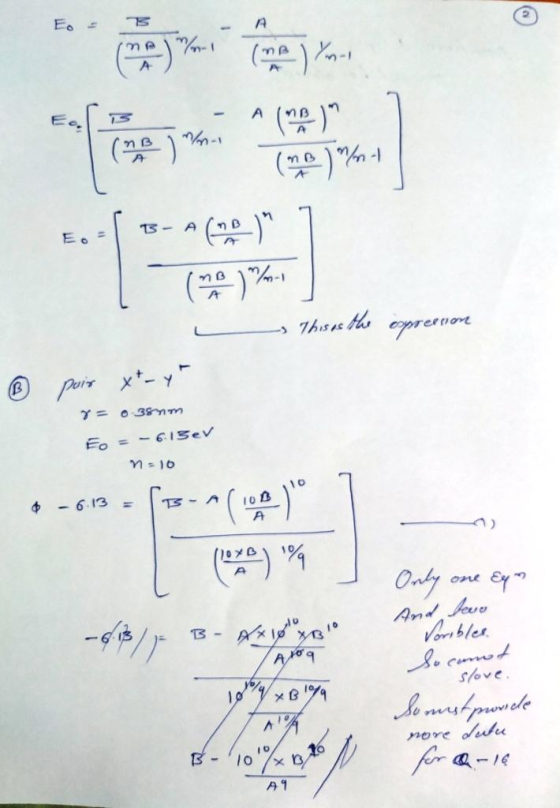
 16 Consider a hypothetical X*-Y ion pair for which the equilibrium interionic spacing and bonding energy values are 0.38 nm and-6.13 eV,
Consider a hypothetical X+-Y' ion pair for which the equilibrium interionic spacing and bonding energy values...
 Consider a hypothetical X+-Y' ion pair for which the equilibrium interionic spacing and bonding energy values are 0.35 nm and -6.13 eV, respectively. If it is known that n in E_nhas a value of 10, using r_0 = (a/nb)and E_o = determine explicit expressions for attractive and repulsive energies E_a and E_r of and The answers to Problem 2.18 were expressions for the equilibrium separation r_0 and the bonding energy, which are as follows: If n has a value of...
1) The net potential energy between two adjacent ions, EN, may be represented by: En =...
1) The net potential energy between two adjacent ions, EN, may be represented by: En = Ea + Er, where Ea = (-A/r) and Er = (b/r^n) a) Provide a brief explanation as to why the interionic separation, r0, is obtained when dEN/dr = 0. b) Using the condition discussed in part (a), differentiate EN with regards to r in order to derive the following expression for the interionic separation: r0 = (A/nB)^(1/(1-n)) c) Using the expression, you derived in...
please answered highlighted part very detailed, thank you. onsider a hypothetical X-Y-ion pair for which the...
 please answered highlighted part very detailed, thank
you.
onsider a hypothetical X-Y-ion pair for which the equilibrium interionic spacing and bonding nergy values are 0.38 nm and -5.37 eV, respectively. If it is known that exponent of the Born epulsion is n-8. The interatomic potential energy functional is given by AB E(r) = -+ r r (a) Determine the values A and B in the equation above; (b) Sketch E vs. r and on the sketch clearly mark the bond...
please answered highlighted part very detailed, thank
you.
onsider a hypothetical X-Y-ion pair for which the equilibrium interionic spacing and bonding nergy values are 0.38 nm and -5.37 eV, respectively. If it is known that exponent of the Born epulsion is n-8. The interatomic potential energy functional is given by AB E(r) = -+ r r (a) Determine the values A and B in the equation above; (b) Sketch E vs. r and on the sketch clearly mark the bond...
For a K+–Cl– ion pair, attractive and repulsive energies EA and ER, respectively, depend on the...
 For a K+–Cl– ion pair, attractive and repulsive energies EA and
ER, respectively, depend on the distance between the ions r,
according to EA = − 1.436 r ER = 5.8 × 10⁻⁶ r 9 For these
expressions, energies are expressed in electron volts (eV) per
K+–Cl– pair, and r is the distance in nanometers (nm). The net
energy EN is just the sum of the two expressions above (EN = EA +
ER). (a) Superimpose on a single plot...
For a K+–Cl– ion pair, attractive and repulsive energies EA and
ER, respectively, depend on the distance between the ions r,
according to EA = − 1.436 r ER = 5.8 × 10⁻⁶ r 9 For these
expressions, energies are expressed in electron volts (eV) per
K+–Cl– pair, and r is the distance in nanometers (nm). The net
energy EN is just the sum of the two expressions above (EN = EA +
ER). (a) Superimpose on a single plot...
Problems 1-3, which ask you to explore expressions for the interatomic bonding energy, are confusing as...
 Problems 1-3, which ask you to explore expressions for
the interatomic bonding energy, are confusing as you need the
answer to problem 3 to answer problem 2 - they are a bit inverted.
Please work you way through problems 1 and 2, and the answer to
problem 3 is already contained in the earlier problems. Sorry for
the confusion!
For the first 3 questions, refer to the following information: The net potential energy between two adjacent A B ions, EN,...
Problems 1-3, which ask you to explore expressions for
the interatomic bonding energy, are confusing as you need the
answer to problem 3 to answer problem 2 - they are a bit inverted.
Please work you way through problems 1 and 2, and the answer to
problem 3 is already contained in the earlier problems. Sorry for
the confusion!
For the first 3 questions, refer to the following information: The net potential energy between two adjacent A B ions, EN,...
10. For a Na +Cl-ion pair, attractive and repulsive energies Ea and ER, respectively depend on...
 10. For a Na +Cl-ion pair, attractive and repulsive energies Ea and ER, respectively depend on the distance between the ions r, according to 7.32 × 10⁻⁶ EA 1.436 For these expressions, energies are expressed in electron volts per Na+ Cl- pair, and ance in nanometers. The net energy Ev is just the sum of the preceding two expressions. (a) Superimpose on a single plot EN,FR, and EA versus r up to 1.0 nm. (b) On the basis of this...
For an Na+Cl- ion pair, attractive and repulsive energies EA and ER, respectively, depend on the...
For an Na+Cl- ion pair, attractive and repulsive energies EA and ER, respectively, depend on the distance between the ions (r), according to EA = - 1.436/r ER = 7.32 * (10^-6 / r^8) For these expressions, energies are expressed in electron volts (eV) / Na+Cl- ion pair, and r is the distance in nanometers (nm). The net energy, EN, is the sum of the EA and ER. a) Using graphical software (e.g. Matlab or Excel), create a single plot...
 Answer to Problem 2.19
Bonding Forces and Energies 2.13 Calculate the force of attraction between a Ca2+ and an O on the centers of which are separated by a distance of 1.25 nm. 2.14 The net potential energy between two adja- cent ions, EN, may be represented by the sum of Equations 2.8 and 2.9; that is, A B Calculate the bonding energy Eo in terms of the parameters A, B, and n using the follow ing procedure: 1. Differentiate...
Answer to Problem 2.19
Bonding Forces and Energies 2.13 Calculate the force of attraction between a Ca2+ and an O on the centers of which are separated by a distance of 1.25 nm. 2.14 The net potential energy between two adja- cent ions, EN, may be represented by the sum of Equations 2.8 and 2.9; that is, A B Calculate the bonding energy Eo in terms of the parameters A, B, and n using the follow ing procedure: 1. Differentiate...
 Problem 2.18 The net potential energy between two adjacent ions, EN, may be represented by Where A, B, and n are constants whose values depend on the particular ionic system Calculate the bonding energy Eo in terms of the parameters A, B, and n using the following procedure: (1) Differentiate EN with respect to r, and then set the resulting expression equal to zero, since the curve of Ev versus r is a minimum at Eg. (2) Solve for r...
 16 Consider a hypothetical X*-Y ion pair for which the equilibrium interionic spacing and bonding energy values are 0.38 nm and-6.13 eV,
 Consider a hypothetical X+-Y' ion pair for which the equilibrium interionic spacing and bonding energy values are 0.35 nm and -6.13 eV, respectively. If it is known that n in E_nhas a value of 10, using r_0 = (a/nb)and E_o = determine explicit expressions for attractive and repulsive energies E_a and E_r of and The answers to Problem 2.18 were expressions for the equilibrium separation r_0 and the bonding energy, which are as follows: If n has a value of...
 please answered highlighted part very detailed, thank
you.
onsider a hypothetical X-Y-ion pair for which the equilibrium interionic spacing and bonding nergy values are 0.38 nm and -5.37 eV, respectively. If it is known that exponent of the Born epulsion is n-8. The interatomic potential energy functional is given by AB E(r) = -+ r r (a) Determine the values A and B in the equation above; (b) Sketch E vs. r and on the sketch clearly mark the bond...
please answered highlighted part very detailed, thank
you.
onsider a hypothetical X-Y-ion pair for which the equilibrium interionic spacing and bonding nergy values are 0.38 nm and -5.37 eV, respectively. If it is known that exponent of the Born epulsion is n-8. The interatomic potential energy functional is given by AB E(r) = -+ r r (a) Determine the values A and B in the equation above; (b) Sketch E vs. r and on the sketch clearly mark the bond...
 For a K+–Cl– ion pair, attractive and repulsive energies EA and
ER, respectively, depend on the distance between the ions r,
according to EA = − 1.436 r ER = 5.8 × 10⁻⁶ r 9 For these
expressions, energies are expressed in electron volts (eV) per
K+–Cl– pair, and r is the distance in nanometers (nm). The net
energy EN is just the sum of the two expressions above (EN = EA +
ER). (a) Superimpose on a single plot...
For a K+–Cl– ion pair, attractive and repulsive energies EA and
ER, respectively, depend on the distance between the ions r,
according to EA = − 1.436 r ER = 5.8 × 10⁻⁶ r 9 For these
expressions, energies are expressed in electron volts (eV) per
K+–Cl– pair, and r is the distance in nanometers (nm). The net
energy EN is just the sum of the two expressions above (EN = EA +
ER). (a) Superimpose on a single plot...
 Problems 1-3, which ask you to explore expressions for
the interatomic bonding energy, are confusing as you need the
answer to problem 3 to answer problem 2 - they are a bit inverted.
Please work you way through problems 1 and 2, and the answer to
problem 3 is already contained in the earlier problems. Sorry for
the confusion!
For the first 3 questions, refer to the following information: The net potential energy between two adjacent A B ions, EN,...
Problems 1-3, which ask you to explore expressions for
the interatomic bonding energy, are confusing as you need the
answer to problem 3 to answer problem 2 - they are a bit inverted.
Please work you way through problems 1 and 2, and the answer to
problem 3 is already contained in the earlier problems. Sorry for
the confusion!
For the first 3 questions, refer to the following information: The net potential energy between two adjacent A B ions, EN,...
 10. For a Na +Cl-ion pair, attractive and repulsive energies Ea and ER, respectively depend on the distance between the ions r, according to 7.32 × 10⁻⁶ EA 1.436 For these expressions, energies are expressed in electron volts per Na+ Cl- pair, and ance in nanometers. The net energy Ev is just the sum of the preceding two expressions. (a) Superimpose on a single plot EN,FR, and EA versus r up to 1.0 nm. (b) On the basis of this...
Most questions answered within 3 hours.
-
Where is the error in this code sequence?
String s1 = "Hello";
String s2 = "ello";...
asked 10 months ago -
Financial data for Joel de Paris, Inc., for last year
follow:
Joel de Paris, Inc.
Balance...
asked 10 months ago -
Consider this reaction:
Al2(SO4)3 (aq)+ BaCl3
(aq) Al2Cl6 (aq)- +
3BaSO4(s) . What is the...
asked 10 months ago -
Suppose that Savneet is considering increasing her
recent random sample from 20 car rentals to 40...
asked 10 months ago -
Trucks arrive at an unloading terminal at an average rate of 120
per hour.
Trucks arrive...
asked 10 months ago -
Why are methanol and ethanol completely soluble in water while
octanol is not very little soluble....
asked 10 months ago -
A facilities manager at a university reads in a research report
that the mean amount of...
asked 10 months ago -
When the CuSO4 is rehydrated by adding water to the anhydrous
compound, is this an endothermic...
asked 10 months ago -
A ray of sunlight is passing from diamond into crown glass; the
angle of incidence is...
asked 10 months ago -
A block of mass 0.249 kg is placed on top of a light, vertical
spring of...
asked 10 months ago -
how do the kidneys compensate in the presences of acidosis
a) trigger hyperventilate
b) reserve acid...
asked 10 months ago -
Question 501 pts
The rental rate of capital to the firm increases. Which of the
following...
asked 10 months ago