
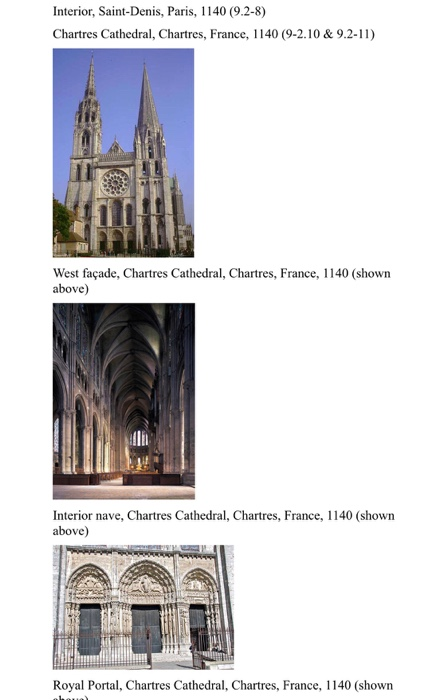
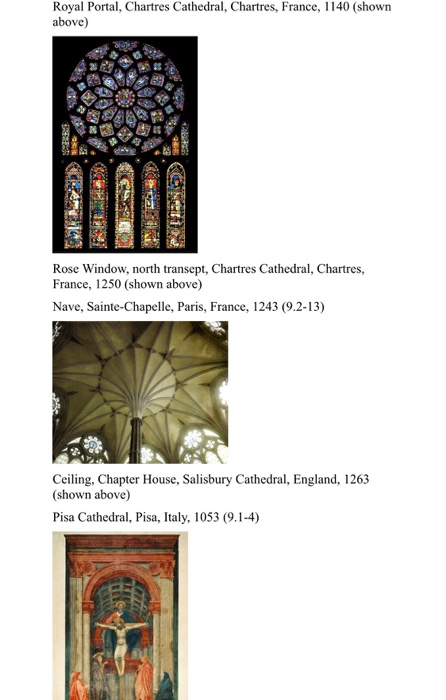
Interior, Saint-Denis, Paris, 1140 (9.2-8) Chartres Cathedral, Chartres, France, 1140 (9-2.10 & 9.2-11) West façade, Chartres Cathedral, Chartres, France, 1140 (shown above) Interior nave, Chartres Cathedral, Chartres, France, 1140 (shown above) Royal Portal, Chartres Cathedral, Chartres, France, 1140 (shown lsaua)
Royal Portal, Chartres Cathedral, Chartres, France, 140 (shown above) Rose Window, north transept, Chartres Cathedral, Chartres, France, 1250 (shown above) Nave, Sainte-Chapelle, Paris, France, 1243 (9.2-13) Ceiling, Chapter House, Salisbury Cathedral, England, 1263 (shown above) Pisa Cathedral, Pisa, Italy, 1053 (9.1-4)
Masaccio, The Holy Trinity, Santa Maria Novella, Florence, 1428 (shown above) Anonymous, The Ideal City, ca. 1450 (10.1-19) Brunelleschi, Santa Maria del Fiore Cathedral (St. Mary of the Flowers, a.k.a. The Duomo), Florence, Italy, 1420 (10.1-3, 10.1-4, 10.1-5, and Construction & Technology p. 375) Michelozzo, Palazzo Medici, Florence, 1444 (10.1-10) Alberti, Palazzo Rucellai, Florence, 1446 (10.1-13) Alberti, west (10.1-14) façade of Santa Maria Novella, Florence, 1458 Bramante, Tempietto (San Pietro in Montorio), Rome, 1502 (1.3-4) da Sangallo & Michelangelo, Palazzo Farnese, Rome, 1530 (1.3-25) Michelangelo, St. Peter's, Vatican City, Rome, 1546 (11.3-27, 11.3-28) Michelangelo, Laurentian Library Steps, Florence, 1523 (11.3- 24) Palladio, Palazzo Chiericati, Vicenza, 1550 (11.3-17)
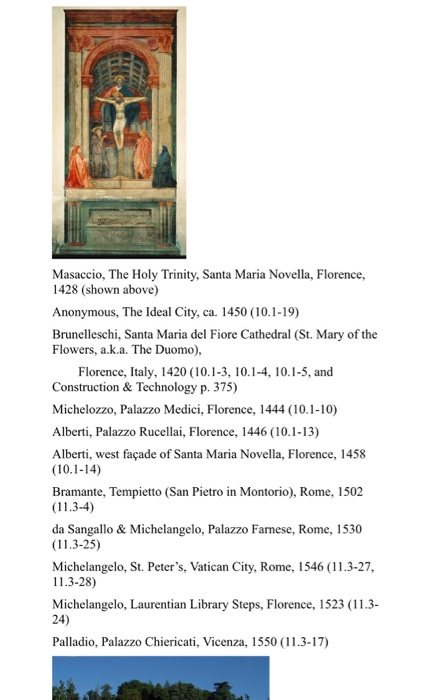
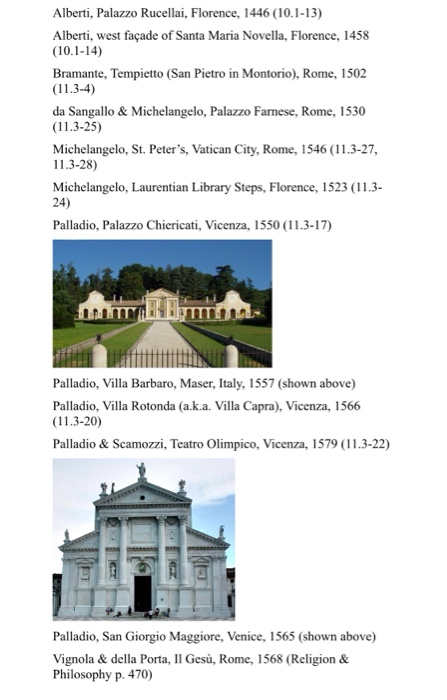
Alberti, Palazzo Rucellai, Florence, 1446 (10.1-13) Alberti, west façade of Santa Maria Novella, Florence, 1458 (10.1-14) Bramante, Tempietto (San Pietro in Montorio), Rome, 1502 (11.3-4) da Sangallo & Michelangelo, Palazzo Farnese, Rome, 1530 (11.3-25) Michelangelo, St. Peter's, Vatican City, Rome, 1546 (11.3-27, 11.3-28) Michelangelo, Laurentian Library Steps, Florence, 1523 (11.3- 24) Palladio, Palazzo Chiericati, Vicenza, 1550 (11.3-17) Palladio, Villa Barbaro, Maser, Italy, 1557 (shown above) Palladio, Villa Rotonda (a.k.a. Villa Capra), Vicenza, 1566 (11.3-20) Palladio & Scamozzi, Teatro Olimpico, Vicenza, 1579 (11.3-22) Palladio, San Giorgio Maggiore, Venice, 1565 (shown above) Vignola & della Porta, Il Gesu, Rome, 1568 (Religion & Philosophy p. 470)
Homework Answers
Palladio in San Giorgio Maggiore located at Venice is the most inspirational construction. The Originality in the architectural work for this construction in an ancient period i.e., at 1565 is absolutely a mind lavishing work and it depicted the intelligence of engineering.
Here, Columns are behaving as floating columns and direct columns , as some of them do not have uniform contact with the earth surface or adjoining connecting members. Construction of small domes and arch works in small fittings indicate the workmen ship of architectural and construction engineers in those days. Projections of the observed structure acts as an attractive model for the construction along with the increased strength.
The surface plans of a rectangular projection will produce free flow for environmental conditions. The enriched whiteness overloaded with greyish over coating indicate the use of durable and ductile construction materials.Moreover, it makes the appearance in aesthetic way with pleasant surrounding conditions.
Structural execution indicates the architectural evolution and revolution at 16th century.Moreover, As their is no reinforcement at that period, definitely structure is a blend of composite strengthened materials. Construction of such a massive structure is an pride for that locality. These aspects has attracted to visit and walk around that locality with keen observation and scrutiny on such an engineering acheivments.
Add Answer to:
simple: of all the buildings we have looked at, which one inspired you the most? One...
Most questions answered within 3 hours.
-
Where is the error in this code sequence?
String s1 = "Hello";
String s2 = "ello";...
asked 11 months ago -
Financial data for Joel de Paris, Inc., for last year
follow:
Joel de Paris, Inc.
Balance...
asked 11 months ago -
Consider this reaction:
Al2(SO4)3 (aq)+ BaCl3
(aq) Al2Cl6 (aq)- +
3BaSO4(s) . What is the...
asked 11 months ago -
Suppose that Savneet is considering increasing her
recent random sample from 20 car rentals to 40...
asked 11 months ago -
Trucks arrive at an unloading terminal at an average rate of 120
per hour.
Trucks arrive...
asked 11 months ago -
Why are methanol and ethanol completely soluble in water while
octanol is not very little soluble....
asked 11 months ago -
A facilities manager at a university reads in a research report
that the mean amount of...
asked 11 months ago -
When the CuSO4 is rehydrated by adding water to the anhydrous
compound, is this an endothermic...
asked 11 months ago -
A ray of sunlight is passing from diamond into crown glass; the
angle of incidence is...
asked 11 months ago -
A block of mass 0.249 kg is placed on top of a light, vertical
spring of...
asked 11 months ago -
how do the kidneys compensate in the presences of acidosis
a) trigger hyperventilate
b) reserve acid...
asked 11 months ago -
Question 501 pts
The rental rate of capital to the firm increases. Which of the
following...
asked 11 months ago