
Homework Answers
Add Answer to:
Problem 3 Suppose that you have a set of n large, orderable, objects, each of size...
For the set of keys [37, 24, 29, 66, 17, 82, 43], draw binary search trees...
For the set of keys [37, 24, 29, 66, 17, 82, 43], draw binary search trees of height 2, 4, and 6. Argue that since sorting n elements takes Ω(n log n) time in the worst case in the comparison model, any comparison‐based algorithm for constructing a binary search tree from an arbitrary list of n elements takes Ω(n log n) time in the worst case. When node z in TREE‐DELETE has two children, we could choose node y as...
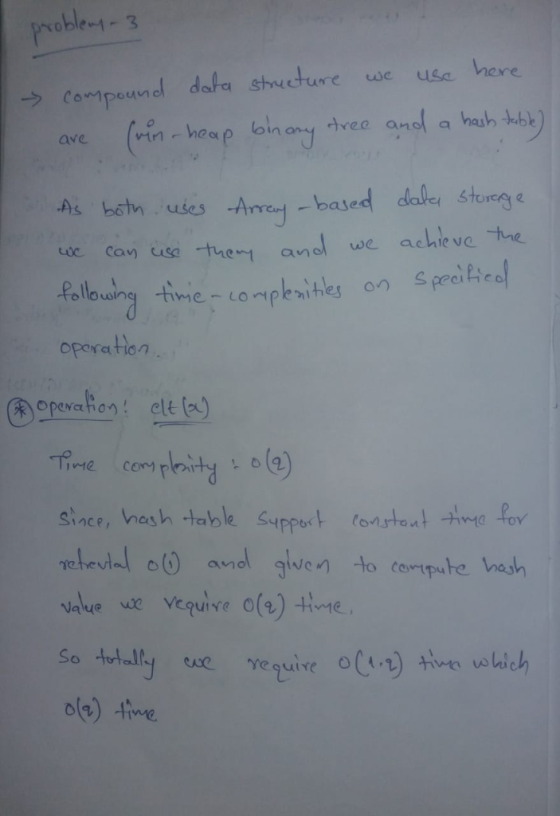
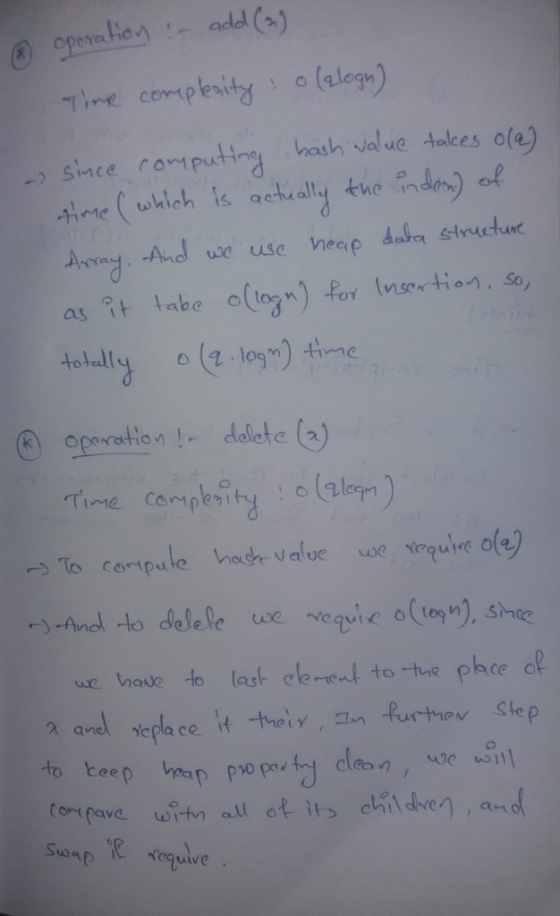
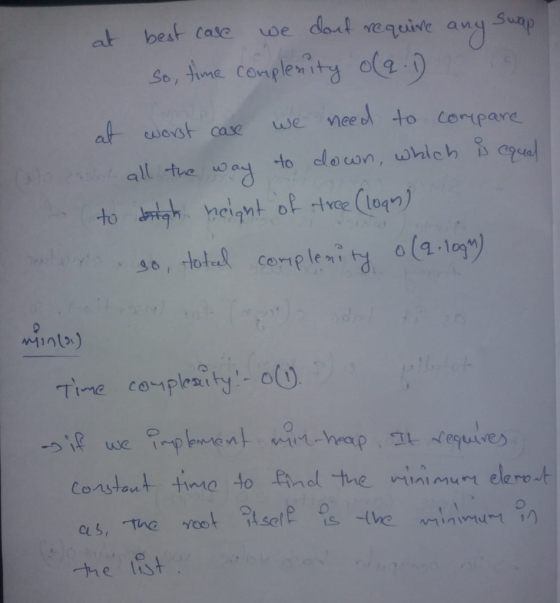
Show steps. Please. 3. Design a data structure D that can store integers. The data structure...
 Show steps. Please.
3. Design a data structure D that can store integers. The data structure should be ale to store nent can appear multiple times. The da the following operations in O(log n) time, where n is the number of distinct integers stored in D . add(x): Adds/inserts integer a into D. Even if belongs to D, z should still be added .frequencyx) Nuber of times r appears in D search(x): Returns true if is in D order (y):...
Show steps. Please.
3. Design a data structure D that can store integers. The data structure should be ale to store nent can appear multiple times. The da the following operations in O(log n) time, where n is the number of distinct integers stored in D . add(x): Adds/inserts integer a into D. Even if belongs to D, z should still be added .frequencyx) Nuber of times r appears in D search(x): Returns true if is in D order (y):...
Which of the following terms is NOT associated with a stack? push top get bottom Flag...
Which of the following terms is NOT associated with a stack? push top get bottom Flag this Question Question 21 pts Which of the following terms is NOT associated with a queue? add front FIFO enqueue pop Flag this Question Question 31 pts A stack exhibits what kind of behavior? Last In, First Out (LIFO) First In, First Out (FIFO) Last In, Last Out (LILO) Read-Only Write-Only Flag this Question Question 41 pts What are the final contents of myQueue...
Assume you are given two linear lists of size n each; consider the problem of determining...
Assume you are given two linear lists of size n each; consider the problem of determining whether any element of one list is an element of the other (not value, element). Derive a lower bound for this problem and design an algorithm for this problem. Derive its time complexity. It should be as close the lower bound as possible. My work so far: //Copy list n1 into n3 int n3[n]; for(int I = 0; I < n; i++)n3[i] = n1[i];...
Suppose you have two data sets, each of which contain n comparable elements. As an basic...
Suppose you have two data sets, each of which contain n comparable elements. As an basic operation, you may ask one set to tell you the kth largest element of that set, for a value k you choose. Give an algorithm that, with O(log n) queries, determines the median value of the union of the two sets.
Exercise 1 Use Top-Down Design to “design” a set of instructions to write an algorithm for...
Exercise 1 Use Top-Down Design to “design” a set of instructions to write an algorithm for “travel arrangement”. For example, at a high level of abstraction, the algorithm for “travel arrangement” is: book a hotel buy a plane ticket rent a car Using the principle of stepwise refinement, write more detailed pseudocode for each of these three steps at a lower level of abstraction. Exercise 2 Asymptotic Complexity (3 pts) Determine the Big-O notation for the following growth functions: 1....
Problem 1 (5+15 points) Consider the set P of n points and suppose we are given...
Problem 1 (5+15 points) Consider the set P of n points and suppose we are given the points of P one point at a time. After receiving each point, we compute the convex hull of the points seen so far. (a) As a naive approach, we could run Graham’s scan once for each point, with a total running time of O(n2 log n). Write down the pesuedocode for this algorithm. (b) Develop an O(n2) algorithm to solve the problem. Write...
3. (20 pts.) You are given two sorted lists of numbers with size m and n....
 3. (20 pts.) You are given two sorted lists of numbers with size m and n. Give an O(logn+ logm) time algorithm for computing the k-th smallest element in the union of the two lists. 4. (20 pts.) Solve the following recurrence relations and give a bound for each of them. CMPSC 465, Fall 2019, HW 2 (a) T(n) = 117(n/5)+13n!.3 (b) T(n) = 2T (n/4)+nlogn (c) T(n) = 5T (n/3) +log-n (d) T(n) = T(n/2) +1.5" (e) T(n) =...
problem 2 can use Det-Selection(A, p, q, r) as a sub-routine (i.e, you don't need to...
 problem 2
can use Det-Selection(A, p, q, r) as a sub-routine (i.e, you don't need to write its pseudo-code). To sort an array A, you will then call Det-QuickSort(A, 1, n). You also need to provide the worst case time complexity analysis of your algorithm. 2. (20 points) Given a set of n distinct numbers, we wish to find the k largest in sorted order using a comparison-based algorithm. Give an algorithm that implements each of the following methods, and...
problem 2
can use Det-Selection(A, p, q, r) as a sub-routine (i.e, you don't need to write its pseudo-code). To sort an array A, you will then call Det-QuickSort(A, 1, n). You also need to provide the worst case time complexity analysis of your algorithm. 2. (20 points) Given a set of n distinct numbers, we wish to find the k largest in sorted order using a comparison-based algorithm. Give an algorithm that implements each of the following methods, and...
In c# So far, you have created object-oriented code for individual classes. You have built objects...
 In c# So far, you
have created object-oriented code for individual classes. You have
built objects from these classes. Last week, you created a UML for
new inherited classes and objects. Finally, you have used
polymorphism. When you add abstraction to this mix, you have the “4
Pillars of OOP.” Now, you begin putting the pieces together to
create larger object-oriented programs.
Objectives for the
project are:
Create OO classes that contain
inherited and polymorphic members
Create abstracted classes and...
In c# So far, you
have created object-oriented code for individual classes. You have
built objects from these classes. Last week, you created a UML for
new inherited classes and objects. Finally, you have used
polymorphism. When you add abstraction to this mix, you have the “4
Pillars of OOP.” Now, you begin putting the pieces together to
create larger object-oriented programs.
Objectives for the
project are:
Create OO classes that contain
inherited and polymorphic members
Create abstracted classes and...
 Show steps. Please.
3. Design a data structure D that can store integers. The data structure should be ale to store nent can appear multiple times. The da the following operations in O(log n) time, where n is the number of distinct integers stored in D . add(x): Adds/inserts integer a into D. Even if belongs to D, z should still be added .frequencyx) Nuber of times r appears in D search(x): Returns true if is in D order (y):...
Show steps. Please.
3. Design a data structure D that can store integers. The data structure should be ale to store nent can appear multiple times. The da the following operations in O(log n) time, where n is the number of distinct integers stored in D . add(x): Adds/inserts integer a into D. Even if belongs to D, z should still be added .frequencyx) Nuber of times r appears in D search(x): Returns true if is in D order (y):...
 3. (20 pts.) You are given two sorted lists of numbers with size m and n. Give an O(logn+ logm) time algorithm for computing the k-th smallest element in the union of the two lists. 4. (20 pts.) Solve the following recurrence relations and give a bound for each of them. CMPSC 465, Fall 2019, HW 2 (a) T(n) = 117(n/5)+13n!.3 (b) T(n) = 2T (n/4)+nlogn (c) T(n) = 5T (n/3) +log-n (d) T(n) = T(n/2) +1.5" (e) T(n) =...
 problem 2
can use Det-Selection(A, p, q, r) as a sub-routine (i.e, you don't need to write its pseudo-code). To sort an array A, you will then call Det-QuickSort(A, 1, n). You also need to provide the worst case time complexity analysis of your algorithm. 2. (20 points) Given a set of n distinct numbers, we wish to find the k largest in sorted order using a comparison-based algorithm. Give an algorithm that implements each of the following methods, and...
problem 2
can use Det-Selection(A, p, q, r) as a sub-routine (i.e, you don't need to write its pseudo-code). To sort an array A, you will then call Det-QuickSort(A, 1, n). You also need to provide the worst case time complexity analysis of your algorithm. 2. (20 points) Given a set of n distinct numbers, we wish to find the k largest in sorted order using a comparison-based algorithm. Give an algorithm that implements each of the following methods, and...
 In c# So far, you
have created object-oriented code for individual classes. You have
built objects from these classes. Last week, you created a UML for
new inherited classes and objects. Finally, you have used
polymorphism. When you add abstraction to this mix, you have the “4
Pillars of OOP.” Now, you begin putting the pieces together to
create larger object-oriented programs.
Objectives for the
project are:
Create OO classes that contain
inherited and polymorphic members
Create abstracted classes and...
In c# So far, you
have created object-oriented code for individual classes. You have
built objects from these classes. Last week, you created a UML for
new inherited classes and objects. Finally, you have used
polymorphism. When you add abstraction to this mix, you have the “4
Pillars of OOP.” Now, you begin putting the pieces together to
create larger object-oriented programs.
Objectives for the
project are:
Create OO classes that contain
inherited and polymorphic members
Create abstracted classes and...
Most questions answered within 3 hours.
-
Where is the error in this code sequence?
String s1 = "Hello";
String s2 = "ello";...
asked 11 months ago -
Financial data for Joel de Paris, Inc., for last year
follow:
Joel de Paris, Inc.
Balance...
asked 11 months ago -
Consider this reaction:
Al2(SO4)3 (aq)+ BaCl3
(aq) Al2Cl6 (aq)- +
3BaSO4(s) . What is the...
asked 11 months ago -
Suppose that Savneet is considering increasing her
recent random sample from 20 car rentals to 40...
asked 11 months ago -
Trucks arrive at an unloading terminal at an average rate of 120
per hour.
Trucks arrive...
asked 11 months ago -
Why are methanol and ethanol completely soluble in water while
octanol is not very little soluble....
asked 11 months ago -
A facilities manager at a university reads in a research report
that the mean amount of...
asked 11 months ago -
When the CuSO4 is rehydrated by adding water to the anhydrous
compound, is this an endothermic...
asked 11 months ago -
A ray of sunlight is passing from diamond into crown glass; the
angle of incidence is...
asked 11 months ago -
A block of mass 0.249 kg is placed on top of a light, vertical
spring of...
asked 11 months ago -
how do the kidneys compensate in the presences of acidosis
a) trigger hyperventilate
b) reserve acid...
asked 11 months ago -
Question 501 pts
The rental rate of capital to the firm increases. Which of the
following...
asked 11 months ago