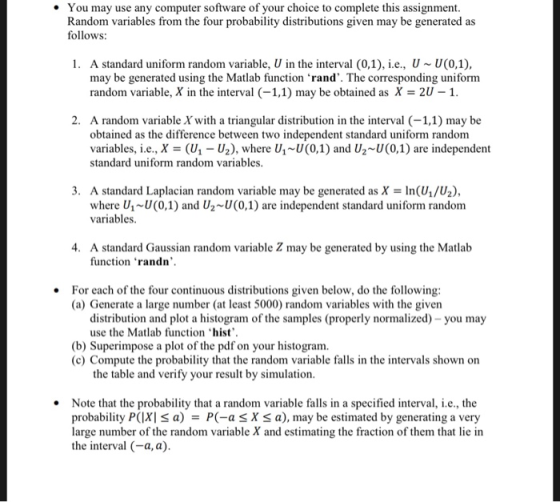
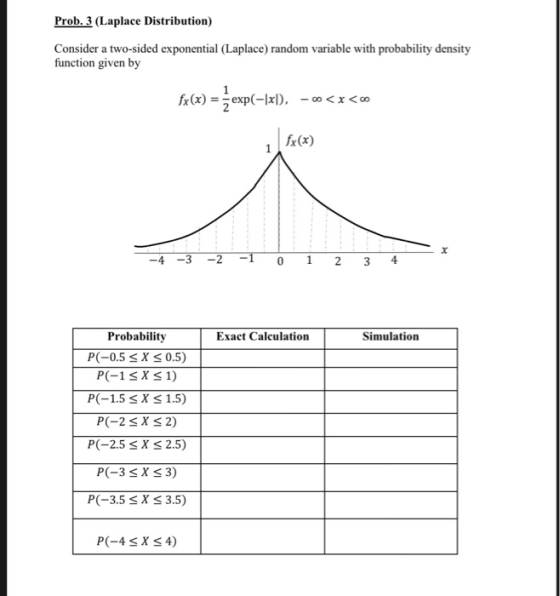

Prob.3 (Laplace Distribution) Consider a two-sided exponential (Laplace) random variable with probability density function given by fx(x) =exp-xl), -o
Homework Answers
Solution :
Given the distribution :

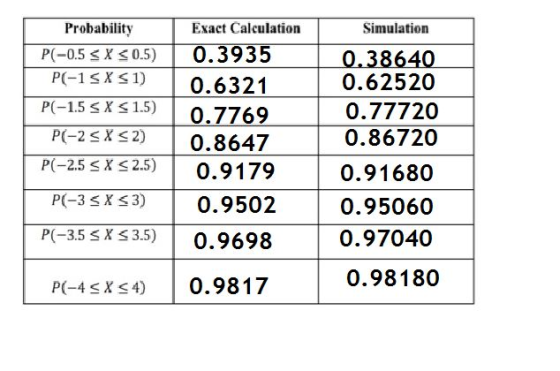
we compute all the probabilities theoretically as shown below :
=========================================================================
Note we will use the integral :

=========================================================================


==================================================================================
simulation based computations :
%*********************
clear all;
clc;
close all;
len = 5000;
X1 = rand(1,len);
X2 = rand(1,len);
X = log(X1./X2);
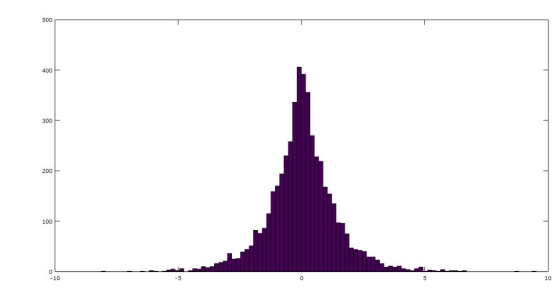
hist(X,100);
p1 = sum( X>=(-0.5) & X<=(0.5))/len
p2 = sum( X>=(-1) & X<=(1))/len
p3 = sum( X>=(-1.5) & X<=(1.5))/len
p4 = sum( X>=(-2) & X<=(2))/len
p5 = sum( X>=(-2.5) & X<=(2.5))/len
p6 = sum( X>=(-3) & X<=(3))/len
p7 = sum( X>=(-3.5) & X<=(3.5))/len
p8 = sum( X>=(-4) & X<=(4))/len
%*******************
this gives output :
p1 = 0.38640
p2 = 0.62520
p3 = 0.77720
p4 = 0.86720
p5 = 0.91680
p6 = 0.95060
p7 = 0.97040
p8 = 0.98180
so we have :
==================================================================
similarly for gaussian distribution :
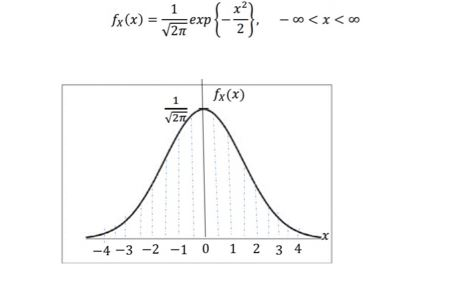
we compute all the probabilities theoretically as shown below :


=========================
Matlab based simulation :
clear all;
clc;
close all;
len = 5000;
X = randn(1,len);
hist(X,100);
p1 = sum( X>=(-0.5) & X<=(0.5))/len
p2 = sum( X>=(-1) & X<=(1))/len
p3 = sum( X>=(-1.5) & X<=(1.5))/len
p4 = sum( X>=(-2) & X<=(2))/len
p5 = sum( X>=(-2.5) & X<=(2.5))/len
p6 = sum( X>=(-3) & X<=(3))/len
p7 = sum( X>=(-3.5) & X<=(3.5))/len
p8 = sum( X>=(-4) & X<=(4))/len
%**************
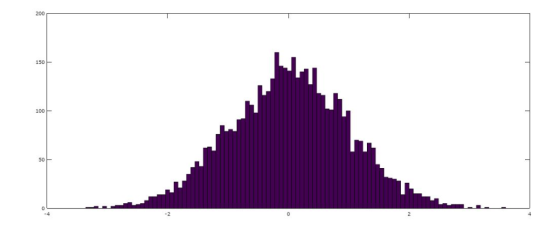
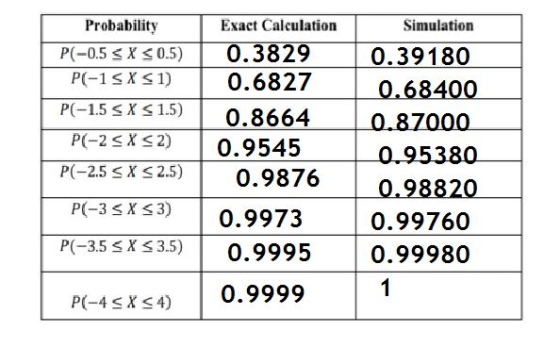
p1 = 0.39180
p2 = 0.68400
p3 = 0.87000
p4 = 0.95380
p5 = 0.98820
p6 = 0.99760
p7 = 0.99980
p8 = 1
So we have :
Add Answer to:
info here is given to help solve #3 below this photo:
You may use any computer...
I must use R Program to solve them. Please help! Thank you ünif uniform random variable...
 I must use R Program to solve
them. Please help! Thank you
ünif uniform random variable 1) Draw the graphs of the p.d.f. of the following distributions (a) The standard normal p.d.f (b) The normal pdf with ? = 50, ? = 10 (c) The uniform p.d.f. over interval [10, 20] (d) The exponential P.d.f with parameter ? 4. 2) Illustrating the central limit theorem. Let X be a random variable having the uniform distribution over the interval [6, 12]...
I must use R Program to solve
them. Please help! Thank you
ünif uniform random variable 1) Draw the graphs of the p.d.f. of the following distributions (a) The standard normal p.d.f (b) The normal pdf with ? = 50, ? = 10 (c) The uniform p.d.f. over interval [10, 20] (d) The exponential P.d.f with parameter ? 4. 2) Illustrating the central limit theorem. Let X be a random variable having the uniform distribution over the interval [6, 12]...
2. Suppose that you can draw independent samples (U,, U2,U. from uniform distribution on [0,1]. (a) Suggest a method to generate a standard normal random variable using (U, U2,Us...) Justify your...
 2. Suppose that you can draw independent samples (U,, U2,U. from uniform distribution on [0,1]. (a) Suggest a method to generate a standard normal random variable using (U, U2,Us...) Justify your answer. b) How can you generate a bivariate standard normal random variable? (Note that a bivariate standard normal distribution is a 2-dimensional normal with zero mean and identity covariance matrix.) (c) What can you suggest if you want to generate correlated normal random variables with covariance matrix Σ= of...
12. Let X and Y be independent random variables, where X has a uniform distribution on...
 12. Let X and Y be independent random variables, where X has a uniform distribution on the interval (0,1/2), and Y has an exponential distribution with parameter = 1. (Remember to justify all of your answers.) (a) What is the joint distribution of X and Y? (b) What is P{(x > 0.25) U (Y > 0.25)}? (c) What is the conditional distribution of X. given that Y - 3? (d) What is Var(Y - E[2X] + 3)? (e) What is...
[Probability] Let N be a geometric random variable with parameter p. Given N,generate N many i.i.d....
[Probability] Let N be a geometric random variable with parameter p. Given N,generate N many i.i.d. random numbers U1, U2, . . . , UN uniformly from [0,1]. Let M= max 1≤i≤N Ui. Find the cdf of M, i.e., find P(M≤x).
1 Expectation, Co-variance and Independence [25pts] Suppose X, Y and Z are three different random variables....
 1 Expectation, Co-variance and Independence [25pts] Suppose X, Y and Z are three different random variables. Let X obeys Bernouli Distribution. The probability disbribution function is 0.5 x=1 0.5 x=-1 Let Y obeys the standard Normal (Gaussian) distribution, which can be written as Y are independent. Meanwhile, let Z = XY. N(0,1). X and Y (a) What is the Expectation (mean value) of X? 3pts (b) Are Y and Z independent? (Just clarify, do not need to prove) [2pts c)...
All the steps/working of the answers need to be shown for all subquestions. Thank you! Problem...
 All the steps/working of the answers need to be shown for all
subquestions. Thank you!
Problem 5: Let X be a random variable with probability density function fx (r) = crm-l < z < 1} (1) Find the value of c (2) Find the cumulative probability distribution function of X (3) Assuming that U~U(0,1), transform this random variable to obtain a random variable with the same distribution as X.
All the steps/working of the answers need to be shown for all
subquestions. Thank you!
Problem 5: Let X be a random variable with probability density function fx (r) = crm-l < z < 1} (1) Find the value of c (2) Find the cumulative probability distribution function of X (3) Assuming that U~U(0,1), transform this random variable to obtain a random variable with the same distribution as X.
12. Let X and Y be independent random variables, where X has a uniform distribution on the interval (0,1/2), and Y...
 12. Let X and Y be independent random variables, where X has a uniform distribution on the interval (0,1/2), and Y has an exponential distribution with parameter A= 1. (Remember to justify all of your answers.) (a) What is the joint distribution of X and Y? (b) What is P{(X > 0.25) U (Y> 0.25)}? nd (c) What is the conditional distribution of X, given that Y =3? ur worl mple with oumbers vour nal to complet the ovaluato all...
Problem 5. (5 pts) Expectation Trick, Strong Law and the CLT (a) (2 pts) Let X...
 Problem 5. (5 pts) Expectation Trick, Strong Law and the CLT (a) (2 pts) Let X be the number of fixed points in a random permutation of n elements. We know that EX = 1. Compute EX? and EX3. Hint : Write X as a sum of indicator random variables. The number of fixed points in a random permutation is also known as the matching problem. (b) (1pt) For the same X as in part (a), give Markov and Chebyshev...
P7 continuous random variable X has the probability density function fx(x) = 2/9 if P.5 The...
 P7
continuous random variable X has the probability density function fx(x) = 2/9 if P.5 The absolutely continuous random 0<r<3 and 0 elsewhere). Let (1 - if 0<x< 1, g(x) = (- 1)3 if 1<x<3, elsewhere. Calculate the pdf of Y = 9(X). P. 6 The absolutely continuous random variables X and Y have the joint probability density function fx.ya, y) = 1/(x?y?) if x > 1,y > 1 (and 0 elsewhere). Calculate the joint pdf of U = XY...
P7
continuous random variable X has the probability density function fx(x) = 2/9 if P.5 The absolutely continuous random 0<r<3 and 0 elsewhere). Let (1 - if 0<x< 1, g(x) = (- 1)3 if 1<x<3, elsewhere. Calculate the pdf of Y = 9(X). P. 6 The absolutely continuous random variables X and Y have the joint probability density function fx.ya, y) = 1/(x?y?) if x > 1,y > 1 (and 0 elsewhere). Calculate the joint pdf of U = XY...
Suppose X, Y and Z are three different random variables. Let X obey Bernoulli Distribution. The...
Suppose X, Y and Z are three different random variables. Let X obey Bernoulli Distribution. The probability distribution function is p(x) = Let Y obeys the standard Normal (Gaussian) distribution, which can be written as Y ∼ N(0, 1). X and Y are independent. Meanwhile, let Z = XY . (a) What is the Expectation (mean value) of X? (b) Are Y and Z independent? (Just clarify, do not need to prove) (c) Show that Z is also a standard...
 I must use R Program to solve
them. Please help! Thank you
ünif uniform random variable 1) Draw the graphs of the p.d.f. of the following distributions (a) The standard normal p.d.f (b) The normal pdf with ? = 50, ? = 10 (c) The uniform p.d.f. over interval [10, 20] (d) The exponential P.d.f with parameter ? 4. 2) Illustrating the central limit theorem. Let X be a random variable having the uniform distribution over the interval [6, 12]...
I must use R Program to solve
them. Please help! Thank you
ünif uniform random variable 1) Draw the graphs of the p.d.f. of the following distributions (a) The standard normal p.d.f (b) The normal pdf with ? = 50, ? = 10 (c) The uniform p.d.f. over interval [10, 20] (d) The exponential P.d.f with parameter ? 4. 2) Illustrating the central limit theorem. Let X be a random variable having the uniform distribution over the interval [6, 12]...
 2. Suppose that you can draw independent samples (U,, U2,U. from uniform distribution on [0,1]. (a) Suggest a method to generate a standard normal random variable using (U, U2,Us...) Justify your answer. b) How can you generate a bivariate standard normal random variable? (Note that a bivariate standard normal distribution is a 2-dimensional normal with zero mean and identity covariance matrix.) (c) What can you suggest if you want to generate correlated normal random variables with covariance matrix Σ= of...
 12. Let X and Y be independent random variables, where X has a uniform distribution on the interval (0,1/2), and Y has an exponential distribution with parameter = 1. (Remember to justify all of your answers.) (a) What is the joint distribution of X and Y? (b) What is P{(x > 0.25) U (Y > 0.25)}? (c) What is the conditional distribution of X. given that Y - 3? (d) What is Var(Y - E[2X] + 3)? (e) What is...
 1 Expectation, Co-variance and Independence [25pts] Suppose X, Y and Z are three different random variables. Let X obeys Bernouli Distribution. The probability disbribution function is 0.5 x=1 0.5 x=-1 Let Y obeys the standard Normal (Gaussian) distribution, which can be written as Y are independent. Meanwhile, let Z = XY. N(0,1). X and Y (a) What is the Expectation (mean value) of X? 3pts (b) Are Y and Z independent? (Just clarify, do not need to prove) [2pts c)...
 All the steps/working of the answers need to be shown for all
subquestions. Thank you!
Problem 5: Let X be a random variable with probability density function fx (r) = crm-l < z < 1} (1) Find the value of c (2) Find the cumulative probability distribution function of X (3) Assuming that U~U(0,1), transform this random variable to obtain a random variable with the same distribution as X.
All the steps/working of the answers need to be shown for all
subquestions. Thank you!
Problem 5: Let X be a random variable with probability density function fx (r) = crm-l < z < 1} (1) Find the value of c (2) Find the cumulative probability distribution function of X (3) Assuming that U~U(0,1), transform this random variable to obtain a random variable with the same distribution as X.
 12. Let X and Y be independent random variables, where X has a uniform distribution on the interval (0,1/2), and Y has an exponential distribution with parameter A= 1. (Remember to justify all of your answers.) (a) What is the joint distribution of X and Y? (b) What is P{(X > 0.25) U (Y> 0.25)}? nd (c) What is the conditional distribution of X, given that Y =3? ur worl mple with oumbers vour nal to complet the ovaluato all...
 Problem 5. (5 pts) Expectation Trick, Strong Law and the CLT (a) (2 pts) Let X be the number of fixed points in a random permutation of n elements. We know that EX = 1. Compute EX? and EX3. Hint : Write X as a sum of indicator random variables. The number of fixed points in a random permutation is also known as the matching problem. (b) (1pt) For the same X as in part (a), give Markov and Chebyshev...
 P7
continuous random variable X has the probability density function fx(x) = 2/9 if P.5 The absolutely continuous random 0<r<3 and 0 elsewhere). Let (1 - if 0<x< 1, g(x) = (- 1)3 if 1<x<3, elsewhere. Calculate the pdf of Y = 9(X). P. 6 The absolutely continuous random variables X and Y have the joint probability density function fx.ya, y) = 1/(x?y?) if x > 1,y > 1 (and 0 elsewhere). Calculate the joint pdf of U = XY...
P7
continuous random variable X has the probability density function fx(x) = 2/9 if P.5 The absolutely continuous random 0<r<3 and 0 elsewhere). Let (1 - if 0<x< 1, g(x) = (- 1)3 if 1<x<3, elsewhere. Calculate the pdf of Y = 9(X). P. 6 The absolutely continuous random variables X and Y have the joint probability density function fx.ya, y) = 1/(x?y?) if x > 1,y > 1 (and 0 elsewhere). Calculate the joint pdf of U = XY...
Most questions answered within 3 hours.
-
Where is the error in this code sequence?
String s1 = "Hello";
String s2 = "ello";...
asked 11 months ago -
Financial data for Joel de Paris, Inc., for last year
follow:
Joel de Paris, Inc.
Balance...
asked 11 months ago -
Consider this reaction:
Al2(SO4)3 (aq)+ BaCl3
(aq) Al2Cl6 (aq)- +
3BaSO4(s) . What is the...
asked 11 months ago -
Suppose that Savneet is considering increasing her
recent random sample from 20 car rentals to 40...
asked 11 months ago -
Trucks arrive at an unloading terminal at an average rate of 120
per hour.
Trucks arrive...
asked 11 months ago -
Why are methanol and ethanol completely soluble in water while
octanol is not very little soluble....
asked 11 months ago -
A facilities manager at a university reads in a research report
that the mean amount of...
asked 11 months ago -
When the CuSO4 is rehydrated by adding water to the anhydrous
compound, is this an endothermic...
asked 11 months ago -
A ray of sunlight is passing from diamond into crown glass; the
angle of incidence is...
asked 11 months ago -
A block of mass 0.249 kg is placed on top of a light, vertical
spring of...
asked 11 months ago -
how do the kidneys compensate in the presences of acidosis
a) trigger hyperventilate
b) reserve acid...
asked 11 months ago -
Question 501 pts
The rental rate of capital to the firm increases. Which of the
following...
asked 11 months ago