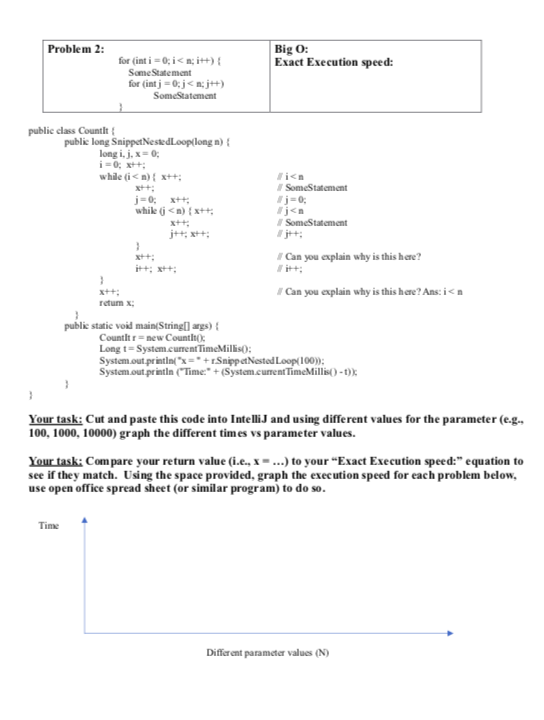
Determine the Big 0 provide the order (Big O) of the execution speed also determine the exact execution speed.
public class CountIt {
public long SnippetNestedLoop(long n) {
long i, j, x = 0; i=0; x++; while(i<n){ x++;
//i<n
// SomeStatement // j = 0;
// j < n
// SomeStatement // j++;
// Can you explain why is this here? // i++;
// Can you explain why is this here? Ans: i < n
} }
}
x++; return x;
x++;
j = 0; x++; while (j < n) { x++;
x++; j++; x++;
}
x++;
i++; x++;
}
public static void main(String[] args) {
CountIt r = new CountIt();
Long t = System.currentTimeMillis();
System.out.println("x = " + r.SnippetNestedLoop(100));
System.out.println ("Time:" + (System.currentTimeMillis() -
t));
Homework Answers
Problem 2)
The outer loop for i runs n times and the inner loop for j runs n times for each i.
Hence, the total time complexity of this code snippet is O(n2).
Similarly, the time taken by the class CountIt is given as:
T(n) = n2 + C where C is a positive constant
Hence, T(n) = O(n2)
The execution speed of this code is given as:
x = 30502
Time:1
Add Answer to:
Determine the Big 0 provide the order (Big O) of the execution
speed also determine the...
What is the runtime of each method? Give answer in Θ(big Theta) notation as a function...
What is the runtime of each method? Give answer in Θ(big Theta) notation as a function of n, give a brief explanation. A. public static int method1(int n){ int mid = n/2; for (int i = mid; i >= 0; i--) System.out.println(i); for (int i = mid + 1; i <= n; i++) System.out.println(i); return mid; } B. public static int method2(int n){ for (int i = n; i >= 0; i / 3){ System.out.println(i ); } return mid; }...
Make the Sudoku algorithm for checking for duplicates to be Big -O of N, instead of...
Make the Sudoku algorithm for checking for duplicates to be Big -O of N, instead of N-squared. I.E. No nested for loops in rowIsLatin and colIsLatin. Only nested loop allowed in goodSubsquare. public class Sudoku { public String[][] makeSudoku(String s) { int SIZE = 9; int k = 0; String[][] x = new String[SIZE][SIZE]; for (int i = 0; i < SIZE; i++) { for (int j = 0; j < SIZE; j++)...
What is the big o cost of this method? int count = 0; int i =...
What is the big o cost of this method? int count = 0; int i = 1; while(i < n){ for (j = 1; j < n*n; j *= n) { count++; } i *= 2; } System.out.println(count);
I need to program 3 and add to program 2 bellows: Add the merge sort and...
I need to program 3 and add to program 2 bellows: Add the merge sort and quick sort to program 2 and do the same timings, now with all 5 sorts and a 100,000 element array. Display the timing results from the sorts. DO NOT display the array. ____________________>>>>>>>>>>>>>>>>>>>>___________________________ (This is program 2 code that I did : ) ---->>>>>> code bellow from program 2 java program - Algorithms Write a program that randomly generates 100,000 integers into an array....
Give a big-Oh characterization, in terms of n,of the running time for each of the following...
 Give a big-Oh characterization, in terms of n,of the running time for each of the following code segments (use the drop-down): - public void func1(int n) { A. @(1). for (int i = n; i > 0; i--) { System.out.println(i); B. follogn). for (int j = 0; j <i; j++) System.out.println(j); c.e(n). System.out.println("Goodbye!"); D.@(nlogn). E.e(n). F.ein). public void func2 (int n) { for (int m=1; m <= n; m++) { system.out.println (m); i = n; while (i >0){ system.out.println(i); i...
This java code won't run and I can't figure out the problem with it. Please help...
This java code won't run and I can't figure out the problem with it. Please help import java.io.*; import java.util.*; import java.math.*; import java.util.Scanner; public class Fibonacci { // Returns n-th Fibonacci number static BigInteger fib(int n) { BigInteger[] Fibo = new BigInteger[n+2]; Fibo[0] = BigInteger.ZERO; Fibo[1] = BigInteger.ONE; for (int j=2 ; j<=n ; j++) { Fibo[j] = Fibo[j-1].add(Fibo[j-2]); } return (Fibo[n]); }...
Draw a picture of array A, Showing the values stored in it after execution of each...
Draw a picture of array A, Showing the values stored in it after execution of each code segment below. Use the following data: 0 1 2 3 4 5 6 7 8 9. Please explain in detail the procedure so I can understand whats going on. import java.util.Scanner; public class ProblemFive { public static void main(String[] args) { int [][] A = new int[4][2]; int k; Scanner keyboard = new...
public class Test { private static int i =0; private static int j =0; public static...
public class Test { private static int i =0; private static int j =0; public static void main(String[] args) { int i = 2; int k = 3; { int j =3; System.out.println("i + j is : " + i + j); } k = i + j; System.out.println("K is " + k ); System.out.println("K is " + j); } } why is the output i + j = 23 K =2 K =0 Please explain a step by step...
1. Order following function by growth rate: N, √N, N1.5, N log (N), log (log (N)),...
1. Order following function by growth rate: N, √N, N1.5, N log (N), log (log (N)), log (N) log (N), N2, 2N, 200, NN 2. Give a useful Θ (big Theta) estimation for each of following function t(n). a. t(n) = 122 * 212 b. t(n) = 2log2(n2) + log4(n ) + (log2 n) 2 + (log2 (202)) 2 c. t(n) = 3t(n/2) + n d. t(n) = 3t(n/2) + (n+1)(n-1) e. t(n) = 4t(n/2) + (n2 + n-1) f....
b) Consider the following code. public static int f(int n) if (n == 1) return 0;...
 b) Consider the following code. public static int f(int n) if (n == 1) return 0; else if (n % 2 == 0). return g(n/2); else return g(n+1); public static int g(int n) int r = n % 3; if (r == 0) return f(n/3); else if (r == 1) return f(n+2); else return f(2 * n); // (HERE) public static void main(String[] args) { int x = 3; System.out.println(f(x)); (1) (5 points) Draw the call stack as it would...
 Give a big-Oh characterization, in terms of n,of the running time for each of the following code segments (use the drop-down): - public void func1(int n) { A. @(1). for (int i = n; i > 0; i--) { System.out.println(i); B. follogn). for (int j = 0; j <i; j++) System.out.println(j); c.e(n). System.out.println("Goodbye!"); D.@(nlogn). E.e(n). F.ein). public void func2 (int n) { for (int m=1; m <= n; m++) { system.out.println (m); i = n; while (i >0){ system.out.println(i); i...
 b) Consider the following code. public static int f(int n) if (n == 1) return 0; else if (n % 2 == 0). return g(n/2); else return g(n+1); public static int g(int n) int r = n % 3; if (r == 0) return f(n/3); else if (r == 1) return f(n+2); else return f(2 * n); // (HERE) public static void main(String[] args) { int x = 3; System.out.println(f(x)); (1) (5 points) Draw the call stack as it would...
Most questions answered within 3 hours.
-
Where is the error in this code sequence?
String s1 = "Hello";
String s2 = "ello";...
asked 10 months ago -
Financial data for Joel de Paris, Inc., for last year
follow:
Joel de Paris, Inc.
Balance...
asked 10 months ago -
Consider this reaction:
Al2(SO4)3 (aq)+ BaCl3
(aq) Al2Cl6 (aq)- +
3BaSO4(s) . What is the...
asked 10 months ago -
Suppose that Savneet is considering increasing her
recent random sample from 20 car rentals to 40...
asked 10 months ago -
Trucks arrive at an unloading terminal at an average rate of 120
per hour.
Trucks arrive...
asked 10 months ago -
Why are methanol and ethanol completely soluble in water while
octanol is not very little soluble....
asked 10 months ago -
A facilities manager at a university reads in a research report
that the mean amount of...
asked 10 months ago -
When the CuSO4 is rehydrated by adding water to the anhydrous
compound, is this an endothermic...
asked 10 months ago -
A ray of sunlight is passing from diamond into crown glass; the
angle of incidence is...
asked 10 months ago -
A block of mass 0.249 kg is placed on top of a light, vertical
spring of...
asked 10 months ago -
how do the kidneys compensate in the presences of acidosis
a) trigger hyperventilate
b) reserve acid...
asked 10 months ago -
Question 501 pts
The rental rate of capital to the firm increases. Which of the
following...
asked 10 months ago