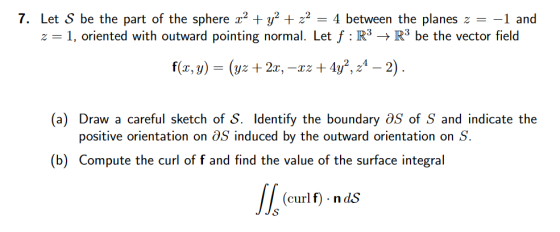
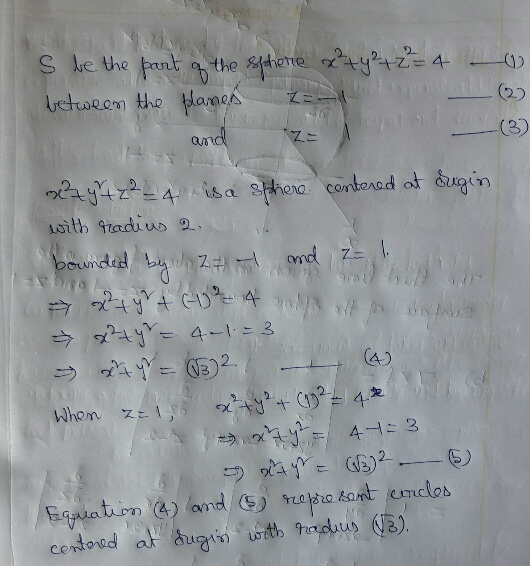
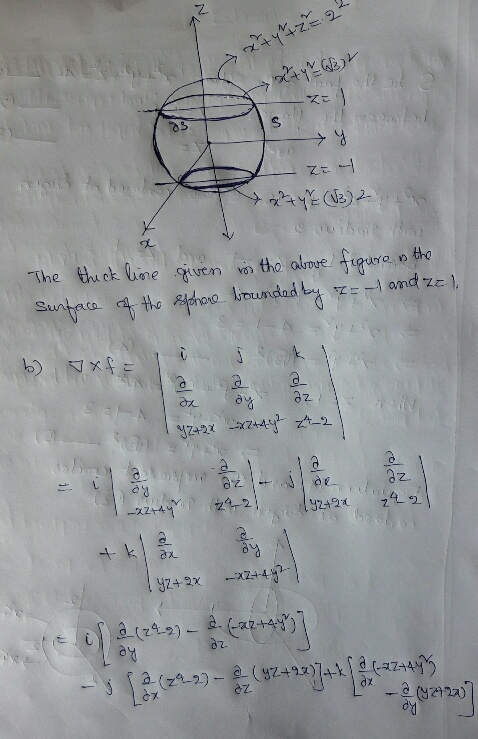
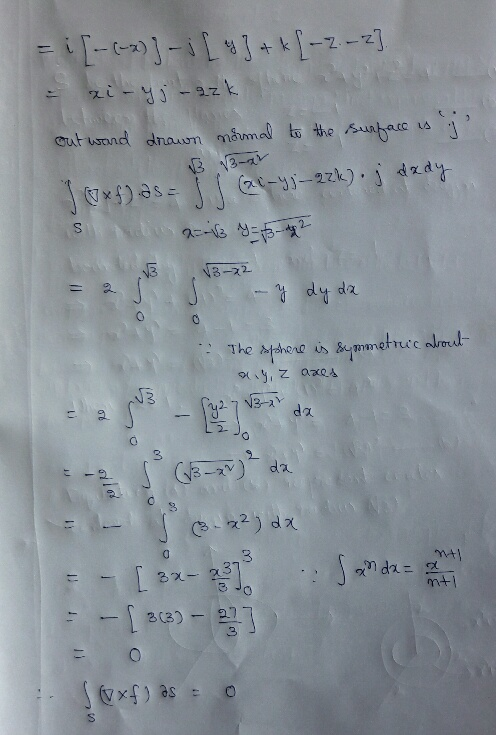
I asked this question earlier but the answer I received was not correct. I am especially having a problem with part (a). Please help!
Homework Answers
Add Answer to:
I asked this question earlier but the answer I received was not
correct. I am especially...
(c) Let F be the vector field on R given by F(x, y, z) = (2x...
 (c) Let F be the vector field on R given by F(x, y, z) = (2x +3y, z, 3y + z). (i) Calculate the divergence of F and the curl of F (ii) Let V be the region in IR enclosed by the plane I +2y +z S denote the closed surface that is the boundary of this region V. Sketch a picture of V and S. Then, using the Divergence Theorem, or otherwise, calculate 3 and the XY, YZ...
Evaluate the surface integral F dS for the given vector field F and the oriented surface S. In other words, find the flux of F across S. For closed surfaces, use the positive (outward) orientation. F...
 Evaluate the surface integral F dS for the given vector field F and the oriented surface S. In other words, find the flux of F across S. For closed surfaces, use the positive (outward) orientation. F(x, y, z) -xi yj+3 k S is the boundary of the region enclosed by the cylinder x2 + z2-1 and the planes y 0 and x y 2
Evaluate the surface integral F dS for the given vector field F and the oriented surface...
Evaluate the surface integral F dS for the given vector field F and the oriented surface S. In other words, find the flux of F across S. For closed surfaces, use the positive (outward) orientation. F(x, y, z) -xi yj+3 k S is the boundary of the region enclosed by the cylinder x2 + z2-1 and the planes y 0 and x y 2
Evaluate the surface integral F dS for the given vector field F and the oriented surface...
Evaluate the surface integral S F · dS for the given vector field F and...
Evaluate the surface integral S F · dS for the given vector field F and the oriented surface S. In other words, find the flux of F across S. For closed surfaces, use the positive (outward) orientation. F(x, y, z) = x i − z j + y k S is the part of the sphere x2 + y2 + z2 = 36 in the first octant, with orientation toward the origin
please just the final answer for both Evaluate the surface Integral || 5. ds for the...
 please just the final answer for both
Evaluate the surface Integral || 5. ds for the given vector fleld F and the oriented surface S. In other words, find the flux of F across S. For closed surfaces, use the positive (outward) orientation. F(x, y, z) = yi - xj + Szk, S is the hemisphere x2 + y2 + y2 = 4, 220, oriented downward 26.677 X Evaluate the surface integral llo F.ds for the given vector field F...
please just the final answer for both
Evaluate the surface Integral || 5. ds for the given vector fleld F and the oriented surface S. In other words, find the flux of F across S. For closed surfaces, use the positive (outward) orientation. F(x, y, z) = yi - xj + Szk, S is the hemisphere x2 + y2 + y2 = 4, 220, oriented downward 26.677 X Evaluate the surface integral llo F.ds for the given vector field F...
1. Suppose F = (-y,x,z) and S is the part of the sphere x2 + y2...
 1. Suppose F = (-y,x,z) and S is the part of the sphere x2 + y2 + z = 25 below the plane z = 4, oriented with the outward-pointing normal (so that the normal at (5,0,0) is 1). Compute the flux integral curl F.ds using Stoke's theorem.
Evaluate the surface integral F dot dS for the given vector field F and the oriented...
 Evaluate the surface integral F dot dS for the given
vector field F and the oriented surface S. In other words,
find
the flux of F across S. For closed surfaces, use the positive
(outward) orientation.
24. F(x, y, z) = -xi - yj + z’k, S is the part of the cone z = x2 + y2 between the planes z 1 and 2 3 with downward orientation
Evaluate the surface integral F dot dS for the given
vector field F and the oriented surface S. In other words,
find
the flux of F across S. For closed surfaces, use the positive
(outward) orientation.
24. F(x, y, z) = -xi - yj + z’k, S is the part of the cone z = x2 + y2 between the planes z 1 and 2 3 with downward orientation
Show all work and use correct notation for full credit. Stokes' Theorem: Let S be an...
 Show all work and use correct notation for full credit. Stokes' Theorem: Let S be an orientable, piecewise smooth surface, bounded by a simple closed piecewise smooth curve C with positive orientation. Let F be a vector field with component functions that have continuous partial derivatives on an open region in R3 that contains S. Then | | curl(F) . ds F-dr = where curl(F) = ▽ × F. (2 Credits) Let S be the cone given by {(z, y,...
Evaluate the surface integral ∫∫sF·ds for the given vector field F and the oriented surface S.
Evaluate the surface integral ∫∫sF·ds for the given vector field F and the oriented surface S. In other words, find the flux of F across S. For closed surfaces, use the positive (outward) orientation. F(x, y,z) = xi - zj +yk S is the part of the sphere x2 + y2 + z2 = 16 in the first octant, with orientation toward the origin.
Evaluate the surface integral | Fds for the given vector field F and the oriented surface...
 Evaluate the surface integral | Fds for the given vector field F and the oriented surface S. In other words, find the flux of F across S. For closed surfaces, use the positive (outward) orientation. JJS F(x, y, z) = xi - z j + y k S is the part of the sphere x2 + y2 + z2 = 49 in the first octant, with orientation toward the origin
Il Evaluate the surface integral F.ds for the given vector field F and the oriented surface...
 Il Evaluate the surface integral F.ds for the given vector field F and the oriented surface S. In other words, find the flux of F across S. For closed surfaces, use the positive (outward) orientation. F(x, y, z) = y) - zk, S consists of the paraboloid y = x2 + 22,0 Sys1, and the disk x2 + z2 s 1, y = 1. Evaluate the surface integral F.ds for the given vector field F and the oriented surface S....
 (c) Let F be the vector field on R given by F(x, y, z) = (2x +3y, z, 3y + z). (i) Calculate the divergence of F and the curl of F (ii) Let V be the region in IR enclosed by the plane I +2y +z S denote the closed surface that is the boundary of this region V. Sketch a picture of V and S. Then, using the Divergence Theorem, or otherwise, calculate 3 and the XY, YZ...
 Evaluate the surface integral F dS for the given vector field F and the oriented surface S. In other words, find the flux of F across S. For closed surfaces, use the positive (outward) orientation. F(x, y, z) -xi yj+3 k S is the boundary of the region enclosed by the cylinder x2 + z2-1 and the planes y 0 and x y 2
Evaluate the surface integral F dS for the given vector field F and the oriented surface...
Evaluate the surface integral F dS for the given vector field F and the oriented surface S. In other words, find the flux of F across S. For closed surfaces, use the positive (outward) orientation. F(x, y, z) -xi yj+3 k S is the boundary of the region enclosed by the cylinder x2 + z2-1 and the planes y 0 and x y 2
Evaluate the surface integral F dS for the given vector field F and the oriented surface...
 please just the final answer for both
Evaluate the surface Integral || 5. ds for the given vector fleld F and the oriented surface S. In other words, find the flux of F across S. For closed surfaces, use the positive (outward) orientation. F(x, y, z) = yi - xj + Szk, S is the hemisphere x2 + y2 + y2 = 4, 220, oriented downward 26.677 X Evaluate the surface integral llo F.ds for the given vector field F...
please just the final answer for both
Evaluate the surface Integral || 5. ds for the given vector fleld F and the oriented surface S. In other words, find the flux of F across S. For closed surfaces, use the positive (outward) orientation. F(x, y, z) = yi - xj + Szk, S is the hemisphere x2 + y2 + y2 = 4, 220, oriented downward 26.677 X Evaluate the surface integral llo F.ds for the given vector field F...
 1. Suppose F = (-y,x,z) and S is the part of the sphere x2 + y2 + z = 25 below the plane z = 4, oriented with the outward-pointing normal (so that the normal at (5,0,0) is 1). Compute the flux integral curl F.ds using Stoke's theorem.
 Evaluate the surface integral F dot dS for the given
vector field F and the oriented surface S. In other words,
find
the flux of F across S. For closed surfaces, use the positive
(outward) orientation.
24. F(x, y, z) = -xi - yj + z’k, S is the part of the cone z = x2 + y2 between the planes z 1 and 2 3 with downward orientation
Evaluate the surface integral F dot dS for the given
vector field F and the oriented surface S. In other words,
find
the flux of F across S. For closed surfaces, use the positive
(outward) orientation.
24. F(x, y, z) = -xi - yj + z’k, S is the part of the cone z = x2 + y2 between the planes z 1 and 2 3 with downward orientation
 Show all work and use correct notation for full credit. Stokes' Theorem: Let S be an orientable, piecewise smooth surface, bounded by a simple closed piecewise smooth curve C with positive orientation. Let F be a vector field with component functions that have continuous partial derivatives on an open region in R3 that contains S. Then | | curl(F) . ds F-dr = where curl(F) = ▽ × F. (2 Credits) Let S be the cone given by {(z, y,...
 Evaluate the surface integral | Fds for the given vector field F and the oriented surface S. In other words, find the flux of F across S. For closed surfaces, use the positive (outward) orientation. JJS F(x, y, z) = xi - z j + y k S is the part of the sphere x2 + y2 + z2 = 49 in the first octant, with orientation toward the origin
 Il Evaluate the surface integral F.ds for the given vector field F and the oriented surface S. In other words, find the flux of F across S. For closed surfaces, use the positive (outward) orientation. F(x, y, z) = y) - zk, S consists of the paraboloid y = x2 + 22,0 Sys1, and the disk x2 + z2 s 1, y = 1. Evaluate the surface integral F.ds for the given vector field F and the oriented surface S....
Most questions answered within 3 hours.
-
Where is the error in this code sequence?
String s1 = "Hello";
String s2 = "ello";...
asked 10 months ago -
Financial data for Joel de Paris, Inc., for last year
follow:
Joel de Paris, Inc.
Balance...
asked 10 months ago -
Consider this reaction:
Al2(SO4)3 (aq)+ BaCl3
(aq) Al2Cl6 (aq)- +
3BaSO4(s) . What is the...
asked 10 months ago -
Suppose that Savneet is considering increasing her
recent random sample from 20 car rentals to 40...
asked 10 months ago -
Trucks arrive at an unloading terminal at an average rate of 120
per hour.
Trucks arrive...
asked 10 months ago -
Why are methanol and ethanol completely soluble in water while
octanol is not very little soluble....
asked 10 months ago -
A facilities manager at a university reads in a research report
that the mean amount of...
asked 10 months ago -
When the CuSO4 is rehydrated by adding water to the anhydrous
compound, is this an endothermic...
asked 10 months ago -
A ray of sunlight is passing from diamond into crown glass; the
angle of incidence is...
asked 10 months ago -
A block of mass 0.249 kg is placed on top of a light, vertical
spring of...
asked 10 months ago -
how do the kidneys compensate in the presences of acidosis
a) trigger hyperventilate
b) reserve acid...
asked 10 months ago -
Question 501 pts
The rental rate of capital to the firm increases. Which of the
following...
asked 10 months ago