
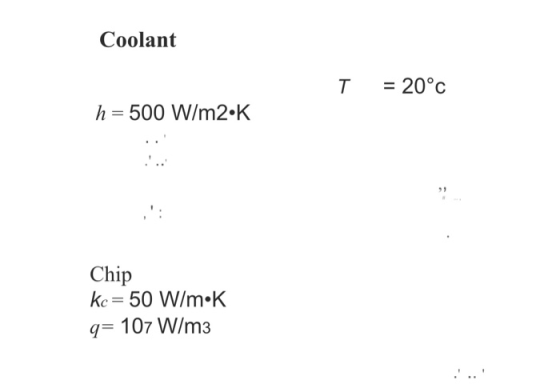

Coolant = 20°c T h 500 W/m2 K Chip ke=50 W/m K q=107 W/m3
Coolant Chip k-50W/m.K q=10 W/m2 T 20°c oo h=500 W/m2 K HI4 3 Substrate, k5.Wm-K H= 12 mm L-27 mm
Homework Answers
SOLUTION:

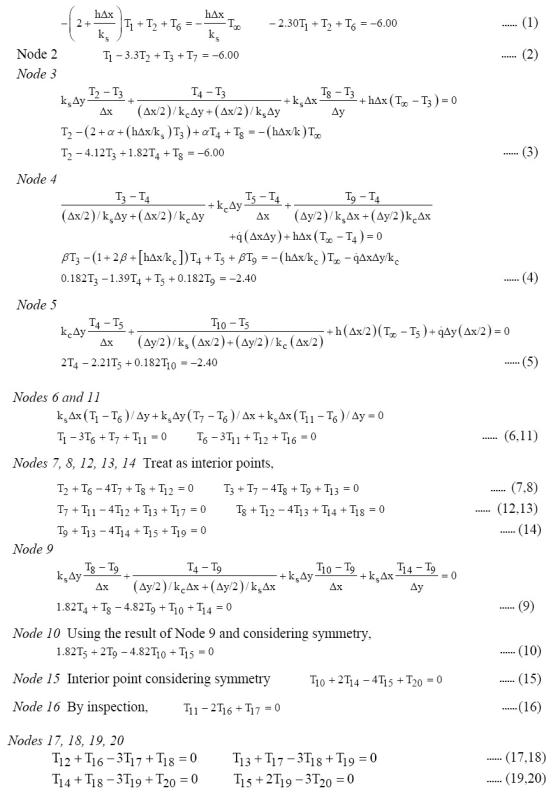
![matrix inversion method, finite-difference equations is written in matrix notation, [A][T] = [C] 10 0 0 0 0 0 0 0 0 0 0 0 0 -](http://img.homeworklib.com/images/984f240a-2a8e-4e0b-a5b4-5ddab1ac70b4.png?x-oss-process=image/resize,w_560)
Add Answer to:
A simplified representation for cooling in very large- scale integration (VLSI) of microelectronics is shown in...
Two-Dimensional Steady and Transient Conduction - Cooling a very large scale microelectronic chip, A simplified representation...
 Two-Dimensional Steady and Transient Conduction - Cooling a very
large scale microelectronic chip,
A simplified
representation for cooling in very large-scale integration (VLSI)
of microelectronics is shown in the sketch below. A silicon chip is
mounted in a dielectric substrate, and one surface of the system is
convectively cooled, while the reminding surfaces are well
insulated from the surrounding. The problem is rendered two
dimensional by assuming the system to be very large in the
direction perpendicular to the paper....
Two-Dimensional Steady and Transient Conduction - Cooling a very
large scale microelectronic chip,
A simplified
representation for cooling in very large-scale integration (VLSI)
of microelectronics is shown in the sketch below. A silicon chip is
mounted in a dielectric substrate, and one surface of the system is
convectively cooled, while the reminding surfaces are well
insulated from the surrounding. The problem is rendered two
dimensional by assuming the system to be very large in the
direction perpendicular to the paper....
(2) In a manufacturing process, a transparent film is being bonded to a substrate as shown...
 (2) In a manufacturing process, a transparent film is being bonded to a substrate as shown in the sketch. To cure the bond at a temperature To, a radiant source is used to provide a heat flux q"o (W/m?), all of which is absorbed at the bonded surface. The back of the substrate is maintained at T, while the free surface of the film is exposed to air at Too and a convection heat transfer coefficient h. 9 ky =...
Electronic chips generate heat and thus they need to be cooled to prevent failure Microchannel he...
 Electronic chips generate heat and thus they need to be cooled to prevent failure Microchannel heatsinks that use liquid coolants are an option for cooling of electronic chips; the figure below shows a typical microchannel heatsink. It is desired to design a microchannel heatsink for cooling of an electronic chip with planar dimensions of 2.54 cm by 2.54 cm and generating 70 W (Q) of heat; the maximum temperature of the electronic chip cannot be greater than 45°C (During operation,...
Problem 4: Heat Exchangers Analysis (25 points) A counterflow plate-type heat exchanger as shown in the...
 Problem 4: Heat Exchangers Analysis (25 points) A counterflow plate-type heat exchanger as shown in the figure below is used to cool propane fuel W 50 mm H 25 mm Saturated Vapor propane Thickness t =5 mm H 25 mm Cooling water Length L The flow rate of the cooling water is 0.2 kg/s, while the flow of the propane is 0.1 kg/s. The water enters the heat exchanger at a temperature of 20°C while the propane enters at its...
Steady-State Conduction 3.25 Approximately 10° discrete electrical components can single integrated circuit (chip), with 30,000 W/m...
 Steady-State Conduction 3.25 Approximately 10° discrete electrical components can single integrated circuit (chip), with 30,000 W/m 27 abe- be placed electrical heat dissipation The chip, which is very thin, is exposed to a tric liquid at its outer surface, with h, = 1000 W/m2 K and T inner surface. The thermal contact resistance between the chip and the board is 10 m K/W, and the board thickness and thermal conductivity are L and kp 1 W/m K, respectively. The other...
An array of electronic chips is mounted within a sealed rectangular enclosure, and cooling is implemented...
 An array of electronic chips is mounted within a sealed rectangular enclosure, and cooling is implemented by attaching an aluminum heat sink (k = 180 W/m-K). The base of the heat sink has dimensions of wi = wº = 100 mm, while the 6 fins are of thickness: = 10 mm and pitch S = 18 mm. The fin length is 1; = 50 mm, and the base of the heat sink has a thickness of Ls = 15 mm....
Please post with matlab code asap! 1- Temperature distribution in a part of a heat exchanger...
 Please post with matlab code asap!
1- Temperature distribution in a part of a heat exchanger in the steady state condition should be determined. The part is shown in Figure-l has a thermal conductivity of k-25W/m.K and dimensions and boundary conditions are specified in Figure-1 and Figure-2 respectively Develop a computer code to find the temperature distribution in the part (use Δ-Δ-1 mm). Under operating conditions for which ho-1000 W/m2K, T-o-1 700 K. h= 200 W/m2 K, and T 400...
Please post with matlab code asap!
1- Temperature distribution in a part of a heat exchanger in the steady state condition should be determined. The part is shown in Figure-l has a thermal conductivity of k-25W/m.K and dimensions and boundary conditions are specified in Figure-1 and Figure-2 respectively Develop a computer code to find the temperature distribution in the part (use Δ-Δ-1 mm). Under operating conditions for which ho-1000 W/m2K, T-o-1 700 K. h= 200 W/m2 K, and T 400...
A square, thin electronic chip is mounted to a substrate that is installed in a computer box whose interior walls a...
 A square, thin electronic chip is mounted to a substrate that is installed in a computer box whose interior walls are maintained at Tr as shown. The chip is heated by an electrical circuit with power input Pelec and cooled by convection and radiation to the surrounding air and walls. The maximum allowable chip surface temperature is 85 °C. Tsur 25°C Substrate Air rad Chip, Pelec T 85°C, E 0.60 L-15 mm T=25°c h-4.2(T,-Ta)4 or qconv h=250 W/m2-K a) Write...
blem 4 (20 pts) A square chip that is 12.7mm on a side has a maximum allowable chip operating temperature -75°C. To dissipate heat produced in the chip, a 4 x 4 array of copper (k-400 W/m.K) pin fins...
 blem 4 (20 pts) A square chip that is 12.7mm on a side has a maximum allowable chip operating temperature -75°C. To dissipate heat produced in the chip, a 4 x 4 array of copper (k-400 W/m.K) pin fins is proposed to be etallurgically joined to the outer surface of the chip. The convection coefficient is h-250 W/m'K and ambient air mperature isTo-20°C. The pin fin dimeter is D,-1.5mm and length is L,-16mm. Assuming steady-state uniform chip temperature Te-75°C and...
I know this is a lot, i just need an outline and an example or two...
 I know this is a lot, i just need an outline and an example or
two to show me how to get started.
rectangular channels are machined. The blade, which has a thermal conductivity of k= 100 W/m-K, is 6mm thick, and each channel has a 2mm x 6mm rectangular cross section, with a 4-mm spacing between adjoining channels. Combustion gases Tooho Air channel Tojshi 2 mm 6 mm 6 mm 4 mm Turbine blade, k Combustion gases iii Taanho...
I know this is a lot, i just need an outline and an example or
two to show me how to get started.
rectangular channels are machined. The blade, which has a thermal conductivity of k= 100 W/m-K, is 6mm thick, and each channel has a 2mm x 6mm rectangular cross section, with a 4-mm spacing between adjoining channels. Combustion gases Tooho Air channel Tojshi 2 mm 6 mm 6 mm 4 mm Turbine blade, k Combustion gases iii Taanho...
 Two-Dimensional Steady and Transient Conduction - Cooling a very
large scale microelectronic chip,
A simplified
representation for cooling in very large-scale integration (VLSI)
of microelectronics is shown in the sketch below. A silicon chip is
mounted in a dielectric substrate, and one surface of the system is
convectively cooled, while the reminding surfaces are well
insulated from the surrounding. The problem is rendered two
dimensional by assuming the system to be very large in the
direction perpendicular to the paper....
Two-Dimensional Steady and Transient Conduction - Cooling a very
large scale microelectronic chip,
A simplified
representation for cooling in very large-scale integration (VLSI)
of microelectronics is shown in the sketch below. A silicon chip is
mounted in a dielectric substrate, and one surface of the system is
convectively cooled, while the reminding surfaces are well
insulated from the surrounding. The problem is rendered two
dimensional by assuming the system to be very large in the
direction perpendicular to the paper....
 (2) In a manufacturing process, a transparent film is being bonded to a substrate as shown in the sketch. To cure the bond at a temperature To, a radiant source is used to provide a heat flux q"o (W/m?), all of which is absorbed at the bonded surface. The back of the substrate is maintained at T, while the free surface of the film is exposed to air at Too and a convection heat transfer coefficient h. 9 ky =...
 Electronic chips generate heat and thus they need to be cooled to prevent failure Microchannel heatsinks that use liquid coolants are an option for cooling of electronic chips; the figure below shows a typical microchannel heatsink. It is desired to design a microchannel heatsink for cooling of an electronic chip with planar dimensions of 2.54 cm by 2.54 cm and generating 70 W (Q) of heat; the maximum temperature of the electronic chip cannot be greater than 45°C (During operation,...
 Problem 4: Heat Exchangers Analysis (25 points) A counterflow plate-type heat exchanger as shown in the figure below is used to cool propane fuel W 50 mm H 25 mm Saturated Vapor propane Thickness t =5 mm H 25 mm Cooling water Length L The flow rate of the cooling water is 0.2 kg/s, while the flow of the propane is 0.1 kg/s. The water enters the heat exchanger at a temperature of 20°C while the propane enters at its...
 Steady-State Conduction 3.25 Approximately 10° discrete electrical components can single integrated circuit (chip), with 30,000 W/m 27 abe- be placed electrical heat dissipation The chip, which is very thin, is exposed to a tric liquid at its outer surface, with h, = 1000 W/m2 K and T inner surface. The thermal contact resistance between the chip and the board is 10 m K/W, and the board thickness and thermal conductivity are L and kp 1 W/m K, respectively. The other...
 An array of electronic chips is mounted within a sealed rectangular enclosure, and cooling is implemented by attaching an aluminum heat sink (k = 180 W/m-K). The base of the heat sink has dimensions of wi = wº = 100 mm, while the 6 fins are of thickness: = 10 mm and pitch S = 18 mm. The fin length is 1; = 50 mm, and the base of the heat sink has a thickness of Ls = 15 mm....
 Please post with matlab code asap!
1- Temperature distribution in a part of a heat exchanger in the steady state condition should be determined. The part is shown in Figure-l has a thermal conductivity of k-25W/m.K and dimensions and boundary conditions are specified in Figure-1 and Figure-2 respectively Develop a computer code to find the temperature distribution in the part (use Δ-Δ-1 mm). Under operating conditions for which ho-1000 W/m2K, T-o-1 700 K. h= 200 W/m2 K, and T 400...
Please post with matlab code asap!
1- Temperature distribution in a part of a heat exchanger in the steady state condition should be determined. The part is shown in Figure-l has a thermal conductivity of k-25W/m.K and dimensions and boundary conditions are specified in Figure-1 and Figure-2 respectively Develop a computer code to find the temperature distribution in the part (use Δ-Δ-1 mm). Under operating conditions for which ho-1000 W/m2K, T-o-1 700 K. h= 200 W/m2 K, and T 400...
 A square, thin electronic chip is mounted to a substrate that is installed in a computer box whose interior walls are maintained at Tr as shown. The chip is heated by an electrical circuit with power input Pelec and cooled by convection and radiation to the surrounding air and walls. The maximum allowable chip surface temperature is 85 °C. Tsur 25°C Substrate Air rad Chip, Pelec T 85°C, E 0.60 L-15 mm T=25°c h-4.2(T,-Ta)4 or qconv h=250 W/m2-K a) Write...
 blem 4 (20 pts) A square chip that is 12.7mm on a side has a maximum allowable chip operating temperature -75°C. To dissipate heat produced in the chip, a 4 x 4 array of copper (k-400 W/m.K) pin fins is proposed to be etallurgically joined to the outer surface of the chip. The convection coefficient is h-250 W/m'K and ambient air mperature isTo-20°C. The pin fin dimeter is D,-1.5mm and length is L,-16mm. Assuming steady-state uniform chip temperature Te-75°C and...
 I know this is a lot, i just need an outline and an example or
two to show me how to get started.
rectangular channels are machined. The blade, which has a thermal conductivity of k= 100 W/m-K, is 6mm thick, and each channel has a 2mm x 6mm rectangular cross section, with a 4-mm spacing between adjoining channels. Combustion gases Tooho Air channel Tojshi 2 mm 6 mm 6 mm 4 mm Turbine blade, k Combustion gases iii Taanho...
I know this is a lot, i just need an outline and an example or
two to show me how to get started.
rectangular channels are machined. The blade, which has a thermal conductivity of k= 100 W/m-K, is 6mm thick, and each channel has a 2mm x 6mm rectangular cross section, with a 4-mm spacing between adjoining channels. Combustion gases Tooho Air channel Tojshi 2 mm 6 mm 6 mm 4 mm Turbine blade, k Combustion gases iii Taanho...
Most questions answered within 3 hours.
-
Where is the error in this code sequence?
String s1 = "Hello";
String s2 = "ello";...
asked 11 months ago -
Financial data for Joel de Paris, Inc., for last year
follow:
Joel de Paris, Inc.
Balance...
asked 11 months ago -
Consider this reaction:
Al2(SO4)3 (aq)+ BaCl3
(aq) Al2Cl6 (aq)- +
3BaSO4(s) . What is the...
asked 11 months ago -
Suppose that Savneet is considering increasing her
recent random sample from 20 car rentals to 40...
asked 11 months ago -
Trucks arrive at an unloading terminal at an average rate of 120
per hour.
Trucks arrive...
asked 11 months ago -
Why are methanol and ethanol completely soluble in water while
octanol is not very little soluble....
asked 11 months ago -
A facilities manager at a university reads in a research report
that the mean amount of...
asked 11 months ago -
When the CuSO4 is rehydrated by adding water to the anhydrous
compound, is this an endothermic...
asked 11 months ago -
A ray of sunlight is passing from diamond into crown glass; the
angle of incidence is...
asked 11 months ago -
A block of mass 0.249 kg is placed on top of a light, vertical
spring of...
asked 11 months ago -
how do the kidneys compensate in the presences of acidosis
a) trigger hyperventilate
b) reserve acid...
asked 11 months ago -
Question 501 pts
The rental rate of capital to the firm increases. Which of the
following...
asked 11 months ago