

Please, read this paragraph these simple and mutually exclusive projects: to answer questions 11, 12 and 13: R+C Inc, is going to invest in one of Project B Project A NPV (at discount rate 0%)- NPV (at discount rate 20% ) - 594.37 IRR- 41.04 % 1,480 NPV (at discount rate 0%) NPV (at discount rate 20% ) - 800.93 IRR- 78.22% 1,800 Fisher's rate (crossover rate)- 9.39 % 11. In case the minimum required return for these investments is 15% , what is the best project for R+C? a) Project A. b) Project B c) Both projects are equally good for R+C d) We do not have enough information to answer this question. In case the opportunity cost of capital for these investments is 7%, what is the best project for R+C? 12 a) Project A b) Project B c) Both projects are equally good for R+C. d) We do not have enough information to answer this question. 13. A Fisher's rate (crossover rate) of 9.39% represents: a) The discount rate that makes NPVA=NPVB b) The IRR of the incremental investment B-A c) The discount rate that makes projects A and B equally valuable for R+A d) All of the above.
Homework Answers
Only one questions will be answered and multiple questions cant be answered as per the instructions.
Answer
Q.10
c) Plot the NPV as the function of a discount rate
Explanationa:
A conduct sensitive analysis take a certain variable involved in a potential investment and change it in order to see how that change would effect the overall investment.
Scenario analysis can be thought of as performing multiple sensitivity analysis at the same time
Add Answer to:
This is an old test we took and I would just like some
clarification on what...
This is an old test we took and I would just like some clarification on what...
 This is an old test we took and I would just like some
clarification on what the answers were and why. thanks! (Also to
eliminate comfusion its a study abroad course so questions are
asking in euros)
14. Financial break-even analysis: a) Examines how sensitive a particular NPV calculation is to changes in underlying assumptions. b) Deals with risk that comes from the project opportunity cost of capital. c) Plots the NPV as a function of the discount rate. d)...
This is an old test we took and I would just like some
clarification on what the answers were and why. thanks! (Also to
eliminate comfusion its a study abroad course so questions are
asking in euros)
14. Financial break-even analysis: a) Examines how sensitive a particular NPV calculation is to changes in underlying assumptions. b) Deals with risk that comes from the project opportunity cost of capital. c) Plots the NPV as a function of the discount rate. d)...
Intro You've estimated the following cash flows (in $ million) for two mutually exclusive projects: Year...
Intro You've estimated the following cash flows (in $ million) for two mutually exclusive projects: Year Project A Project B 0 -28 -43 1 30 45 2 40 50 Attempt 1/5 for 10 pts. Part 1 What is the crossover rate, i.e., the discount rate at which both projects have the same NPV? The crossover rate is the discount rate at which both projects have the same NPV: NPV(A) = NPV(B) ⇔ NPV(A) - NPV(B) = 0 ⇔ NPV(A-B) =...
, A firm is evaluating the following two mutually exclusive, but quite profitable 2-year projects...
 , A firm is evaluating the following two mutually exclusive, but quite profitable 2-year projects I and II, with cash flows at t0,1 and 2 as follows: Year t Project I Project II - $10,000 +20,000 +10,000 $10,000 +$40,000 Compute each project's NPV for r=0% and r=10%, where r= discount rate or required rate Based on the cash flow patterns for the two projects and the answer to part a), can we Using the analytical formulation of the intersection of...
ONLY SHOW HOW TO DO IN EXCEL. please no hard coded formulas A. If the appropriate...
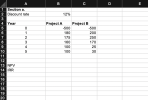 ONLY SHOW HOW TO DO IN EXCEL.
please no hard coded formulas
A. If the appropriate discount rate is 12%, rank the two
projects.
B. Which project is preferred if you rank by IRR?
C. Calculate the crossover rate, namely, the discount rate r at
which the NPVs of both projects are equal. D. Should you use NPV or
IRR to choose between the projects? Give a brief description.
1 Section a. 2 Discount rate 12% 3 4 Year 5...
ONLY SHOW HOW TO DO IN EXCEL.
please no hard coded formulas
A. If the appropriate discount rate is 12%, rank the two
projects.
B. Which project is preferred if you rank by IRR?
C. Calculate the crossover rate, namely, the discount rate r at
which the NPVs of both projects are equal. D. Should you use NPV or
IRR to choose between the projects? Give a brief description.
1 Section a. 2 Discount rate 12% 3 4 Year 5...
this is really though for me someone please answer (16.67 points-Each question is equally weighted for the entire test to sum to 100%) The large miture retailer "Sofa So Good" is evaluatin...
 this is really though for me someone please answer
(16.67 points-Each question is equally weighted for the entire test to sum to 100%) The large miture retailer "Sofa So Good" is evaluating two mutually exclusive projects: NPV versus IRR. Consider the following projects, where the firms may only ch The firm's cost of capital/required return equals 9% PLEASE NOTE: The firm's cost of capital, K, acts as a hurdle rate, and is based on the costs involved in financing other...
this is really though for me someone please answer
(16.67 points-Each question is equally weighted for the entire test to sum to 100%) The large miture retailer "Sofa So Good" is evaluating two mutually exclusive projects: NPV versus IRR. Consider the following projects, where the firms may only ch The firm's cost of capital/required return equals 9% PLEASE NOTE: The firm's cost of capital, K, acts as a hurdle rate, and is based on the costs involved in financing other...
Which of the followin is correct? A. Because discounted payback takes account of the required rate...
Which of the followin is correct? A. Because discounted payback takes account of the required rate of return, a projects discounted payback is normally shorter than its regular payback. B. The npv and irr methods use the same basic equation, but in the npv method the discount rate is specified and the equation is solved for npv, while in the irr method the npv is set equal zero and the discount rate is found. C. If the required rate of...
We have two mutually exclusive investments with the following cash flows: &n
We have two mutually exclusive investments with the following cash flows: (13 marks total) Year Investment A Investment B 0 –$100 –$100 1 10 50 2 30 40 3 50 30 4 70 20 a. Using a financial calculator, calculate the IRR for each of the investments. State your answers in percentages rounded to two decimal places. (2 marks) b. Calculate the NPV profile for each investment, using the discount rates of 0%, 5%, 10%, 15%, 20%, and 25%. Perform this task in an...
Case Study 3--Capital Budgeting (Comprehensive Spreadsheet Problem 11-23, page 408) Your division is considering two projects....
Case Study 3--Capital Budgeting (Comprehensive Spreadsheet Problem 11-23, page 408) Your division is considering two projects. Its WACC is 10%, and the projects' after-tax cash flows (in millions of dollars) would be as follows: Expected Cash Flows Time Project A Project B 0 ($30) ($30) 1 $5 $20 2 $10 $10 3 $15 $8 4 $20 $6 a. Calculate the projects' NPVs, IRRs, MIRRs, regular paybacks, and discounted paybacks. WACC = 10% Use Excel's NPV function as explained in NPVA...
18. Which of the following is NOT true about the internal rate of return: A) A...
 18. Which of the following is NOT true about the internal rate of return: A) A good project is one with IRR greater than the required return. B) IRR is the discount rate that results in a zero net present value for the project. C) Crossover rate for two projects is the IRR of the project with the difference of the cash flows of the two projects.. D) For two projects of the same size, IRR will usually choose the...
You have been presented with 6 projects. All projects are 7-year projects. NPV Net present value....
 You have been presented with 6 projects. All projects are 7-year projects. NPV Net present value. IRR = internal rate of return. MIRR = modified internal rate of return. PI profitability index. Project F ($18,539) Project G $23,725 Project C $3,327 Project D $8,876 Project B $11,041 Project A $52,715 NPV 18.13% 11.77% 15.24% 43.46% 30.18% 21.71% IRR= 15.84% 12.97% 24.83% 20.12% 14.36% 17.16% MIRR= 0.94 1.12 1.02 1.89 1.44 1.21 Pl- If all projects are independent, which project or...
 This is an old test we took and I would just like some
clarification on what the answers were and why. thanks! (Also to
eliminate comfusion its a study abroad course so questions are
asking in euros)
14. Financial break-even analysis: a) Examines how sensitive a particular NPV calculation is to changes in underlying assumptions. b) Deals with risk that comes from the project opportunity cost of capital. c) Plots the NPV as a function of the discount rate. d)...
This is an old test we took and I would just like some
clarification on what the answers were and why. thanks! (Also to
eliminate comfusion its a study abroad course so questions are
asking in euros)
14. Financial break-even analysis: a) Examines how sensitive a particular NPV calculation is to changes in underlying assumptions. b) Deals with risk that comes from the project opportunity cost of capital. c) Plots the NPV as a function of the discount rate. d)...
 , A firm is evaluating the following two mutually exclusive, but quite profitable 2-year projects I and II, with cash flows at t0,1 and 2 as follows: Year t Project I Project II - $10,000 +20,000 +10,000 $10,000 +$40,000 Compute each project's NPV for r=0% and r=10%, where r= discount rate or required rate Based on the cash flow patterns for the two projects and the answer to part a), can we Using the analytical formulation of the intersection of...
 ONLY SHOW HOW TO DO IN EXCEL.
please no hard coded formulas
A. If the appropriate discount rate is 12%, rank the two
projects.
B. Which project is preferred if you rank by IRR?
C. Calculate the crossover rate, namely, the discount rate r at
which the NPVs of both projects are equal. D. Should you use NPV or
IRR to choose between the projects? Give a brief description.
1 Section a. 2 Discount rate 12% 3 4 Year 5...
ONLY SHOW HOW TO DO IN EXCEL.
please no hard coded formulas
A. If the appropriate discount rate is 12%, rank the two
projects.
B. Which project is preferred if you rank by IRR?
C. Calculate the crossover rate, namely, the discount rate r at
which the NPVs of both projects are equal. D. Should you use NPV or
IRR to choose between the projects? Give a brief description.
1 Section a. 2 Discount rate 12% 3 4 Year 5...
 this is really though for me someone please answer
(16.67 points-Each question is equally weighted for the entire test to sum to 100%) The large miture retailer "Sofa So Good" is evaluating two mutually exclusive projects: NPV versus IRR. Consider the following projects, where the firms may only ch The firm's cost of capital/required return equals 9% PLEASE NOTE: The firm's cost of capital, K, acts as a hurdle rate, and is based on the costs involved in financing other...
this is really though for me someone please answer
(16.67 points-Each question is equally weighted for the entire test to sum to 100%) The large miture retailer "Sofa So Good" is evaluating two mutually exclusive projects: NPV versus IRR. Consider the following projects, where the firms may only ch The firm's cost of capital/required return equals 9% PLEASE NOTE: The firm's cost of capital, K, acts as a hurdle rate, and is based on the costs involved in financing other...
 18. Which of the following is NOT true about the internal rate of return: A) A good project is one with IRR greater than the required return. B) IRR is the discount rate that results in a zero net present value for the project. C) Crossover rate for two projects is the IRR of the project with the difference of the cash flows of the two projects.. D) For two projects of the same size, IRR will usually choose the...
 You have been presented with 6 projects. All projects are 7-year projects. NPV Net present value. IRR = internal rate of return. MIRR = modified internal rate of return. PI profitability index. Project F ($18,539) Project G $23,725 Project C $3,327 Project D $8,876 Project B $11,041 Project A $52,715 NPV 18.13% 11.77% 15.24% 43.46% 30.18% 21.71% IRR= 15.84% 12.97% 24.83% 20.12% 14.36% 17.16% MIRR= 0.94 1.12 1.02 1.89 1.44 1.21 Pl- If all projects are independent, which project or...
Most questions answered within 3 hours.
-
Where is the error in this code sequence?
String s1 = "Hello";
String s2 = "ello";...
asked 10 months ago -
Financial data for Joel de Paris, Inc., for last year
follow:
Joel de Paris, Inc.
Balance...
asked 10 months ago -
Consider this reaction:
Al2(SO4)3 (aq)+ BaCl3
(aq) Al2Cl6 (aq)- +
3BaSO4(s) . What is the...
asked 10 months ago -
Suppose that Savneet is considering increasing her
recent random sample from 20 car rentals to 40...
asked 10 months ago -
Trucks arrive at an unloading terminal at an average rate of 120
per hour.
Trucks arrive...
asked 10 months ago -
Why are methanol and ethanol completely soluble in water while
octanol is not very little soluble....
asked 10 months ago -
A facilities manager at a university reads in a research report
that the mean amount of...
asked 10 months ago -
When the CuSO4 is rehydrated by adding water to the anhydrous
compound, is this an endothermic...
asked 10 months ago -
A ray of sunlight is passing from diamond into crown glass; the
angle of incidence is...
asked 10 months ago -
A block of mass 0.249 kg is placed on top of a light, vertical
spring of...
asked 10 months ago -
how do the kidneys compensate in the presences of acidosis
a) trigger hyperventilate
b) reserve acid...
asked 10 months ago -
Question 501 pts
The rental rate of capital to the firm increases. Which of the
following...
asked 10 months ago