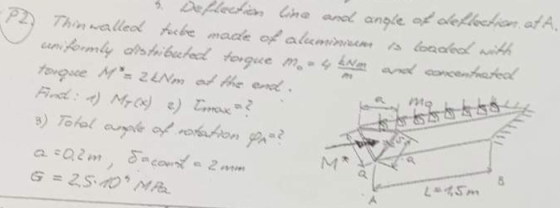
Thin walled tube made of aluminum is loaded with uniformly distributed torque M_0 = 4 kNm/m and concentrated torque M_o^* = 2 kNm at the end Find: M_T(x), tau_max, total angle of rotation phi_A a = 0.2 m, delta = 2 mm, G = 2.5 times 10^4 Mpa
Homework Answers
Solution: In the problem statement a thin-walled triangular shaped tube is given which is under the loading of a uniformly distributed torque and concentrated torqued at the free end. The dimensions and the material properties required are given and we have to find the net moment as a function of distance x from the free end, the maximum shear stress in the whole bar and also the total angle of rotation.
Given:


Analysis:
The given bar is subjected to two kinds of torsional loads: (1) concentrated torque at the left end and (2) uniformly distributed torque over the horizontal length of the tube.
Cut the section at a distance x from the free (left) end of the tube. And applying the equilibrium equation in this cut section we can see that there are three torques acting on the element:


Sign convention: We know that generally, an internal torque is positive when its vector points away from the cut section and negative when its vector points towards the section.
Let us assume the internal torque Mx points away in the cut section of the element under consideration. Then applying the equilibrium condition:


Now we will calculate the polar moment of inertia for the cross-section of the thin tube. We know that the standard-derived formula for the triangular cross-section of equal sides of length 'a' is given by-

To calculate the polar moment of inertia of the thin tube we will simply subtract the polar moment of inertia of the inner triangular area from that of the outer triangular area. Hence, it is given by:


Now we know the function of Mx as well as the polar moment of inertia of the cross-section. To find the maximum shear stress, we will use the torsion formula.

where,
T= applied torque at any cross-section,
r= radial distance of the most distant element in the cross-section from the center
Ip= polar moment of inertia of the cross-section
Here, in this problem, we have calculated above the torque at any section at a distance x given by Mx. To find the value of r we have to calculate the distance of the centroid of the cross-sectional triangle to its vertices. We already know the formula to calculate that. It is given by:


From the formula given below, we can see that Mx varies from -2 kNm at x=0 to 4 kNm at x=L.

So, the maximum value of the torque is 4 kN-m at the right-hand side of the thin tube. It can be calculated by putting the value of x=L in the above formula.
Now, the maximum shear stress is given by


Now we will calculate the total angle of rotation. For a homogeneous material with the constant G, we use the following formula:

Here, the polar moment of inertia is constant.
Hence, after modifying the above equation we have


Add Answer to:
Thin walled tube made of aluminum is loaded with
uniformly distributed torque M_0 = 4 kNm/m...
Most questions answered within 3 hours.
-
Where is the error in this code sequence?
String s1 = "Hello";
String s2 = "ello";...
asked 11 months ago -
Financial data for Joel de Paris, Inc., for last year
follow:
Joel de Paris, Inc.
Balance...
asked 11 months ago -
Consider this reaction:
Al2(SO4)3 (aq)+ BaCl3
(aq) Al2Cl6 (aq)- +
3BaSO4(s) . What is the...
asked 11 months ago -
Suppose that Savneet is considering increasing her
recent random sample from 20 car rentals to 40...
asked 11 months ago -
Trucks arrive at an unloading terminal at an average rate of 120
per hour.
Trucks arrive...
asked 11 months ago -
Why are methanol and ethanol completely soluble in water while
octanol is not very little soluble....
asked 11 months ago -
A facilities manager at a university reads in a research report
that the mean amount of...
asked 11 months ago -
When the CuSO4 is rehydrated by adding water to the anhydrous
compound, is this an endothermic...
asked 11 months ago -
A ray of sunlight is passing from diamond into crown glass; the
angle of incidence is...
asked 11 months ago -
A block of mass 0.249 kg is placed on top of a light, vertical
spring of...
asked 11 months ago -
how do the kidneys compensate in the presences of acidosis
a) trigger hyperventilate
b) reserve acid...
asked 11 months ago -
Question 501 pts
The rental rate of capital to the firm increases. Which of the
following...
asked 11 months ago