
Homework Answers
Add Answer to:
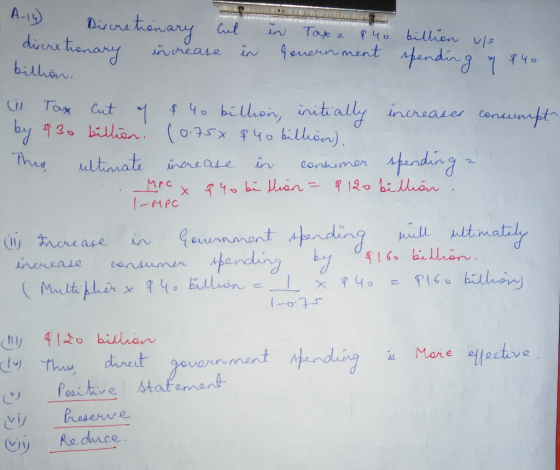
14. (2 pt) Explain the effect of a discretionary cut in taxes of $40 billion on...
Say the MPC is .6 and suppose taxes are cut by $300 billion and government spending...
Say the MPC is .6 and suppose taxes are cut by $300 billion and government spending is increased by $200 billion. Use the multipliers to figure the effect of that change in fiscal policy on spending. The increase due to the tax cut =______. The increase due to the increase in government spending =_______. The total increase=_________. (Government spending multiplier = 1/(1-mpc) Tax multiplier = mpc/(1-mpc))
1,2,3,4,5,6,7,8,9,10 1.Explain the effect of a discretionary cut in taxes of $40 billion on the economy when the economy’s marginal propensity to consume is .75. How does this discretionary fiscal po...
1,2,3,4,5,6,7,8,9,10 1.Explain the effect of a discretionary cut in taxes of $40 billion on the economy when the economy’s marginal propensity to consume is .75. How does this discretionary fiscal policy differ from a discretionary increase in government spending of $40 billion? 2.Explain what is meant by a built-in stabilizer and give two examples. 3.Differentiate between discretionary fiscal policy and nondiscretionary or built-in stabilization policy. 4.What does the “standardized budget” measure and of what significance is this concept? 6.What are...
1. Suppose the MPC is 0.8 and the crowding out effect is $30 billion. The government...
1. Suppose the MPC is 0.8 and the crowding out effect is $30 billion. The government aims to increase GDP by $250 billion. a) Calculate the fiscal multiplier b) how much the government needs to increase spending to increase GDP by $250 billion c) Calculate the tax cut multiplier, d) How much the government needs to cut taxes to increase GDP by $250 billion? e) Explain why the tax multiplier is smaller than the fiscal multiplier. f) If you were...
#6 Consider an economy that is operating at the full-employment level of real GDP with MPC=0.7...
#6 Consider an economy that is operating at the full-employment level of real GDP with MPC=0.7 MPC=0.7 . The short-run effect on equilibrium real GDP of a $50 billion increase in government spending ( G G ), balanced by a $50 billion increase in taxes, is...…………. abillion (Increase or Decrease) in real GDP. #7 Suppose that the MPC in a country is 0.9. Complete the following table by calculating the change in GDP predicted by the multiplier process given each...
Explain the effect of discretionary increase in government spending of $60 billion on the economy when...
Explain the effect of discretionary increase in government spending of $60 billion on the economy when the economy's marginal propensity to consume is 0.8.
1. Expain the effect of a discretionary cut in taxes of $40 billion on the economy when the economy’s marginal propensity to consume is .75. How does this discretionary fiscal policy differ from a...
1. Expain the effect of a discretionary cut in taxes of $40 billion on the economy when the economy’s marginal propensity to consume is .75. How does this discretionary fiscal policy differ from a discretionary increase in government spending of $40 billion? 2.Explain what is meant by a built-in stabilizer and give two examples. 3.Differentiate between discretionary fiscal policy and nondiscretionary or built-in stabilization policy. 4.What does the “standardized budget” measure and of what significance is this concept? 5.What are...
Which of the following expansionary fiscal policy changes would be most favored by those economists who think that the government is too large and inefficient? Multiple Choice a $40 billion tax c...
 Which of the following expansionary fiscal policy changes would be most favored by those economists who think that the government is too large and inefficient? Multiple Choice a $40 billion tax cut o $10 billion tax cut and $30 billion Increase in government spending o $20 billion tax cut and $20 billion increase in government spending o $40 bilion incresse in government spending
Which of the following expansionary fiscal policy changes would be most favored by those economists who think...
Which of the following expansionary fiscal policy changes would be most favored by those economists who think that the government is too large and inefficient? Multiple Choice a $40 billion tax cut o $10 billion tax cut and $30 billion Increase in government spending o $20 billion tax cut and $20 billion increase in government spending o $40 bilion incresse in government spending
Which of the following expansionary fiscal policy changes would be most favored by those economists who think...
Multiple Choice: 1) Assume the MPC is 0.75 and lump sum taxes are collected by the government. What is the governm...
 Multiple Choice: 1) Assume the MPC is 0.75 and lump sum taxes are collected by the government. What is the government tax multiplier? A)-1.33 B) - 25 C) - 75 D) -4 E) -3 , which the recessionary gap. 2) During a Recession, the MPC tends to a) Increase, increases b) Decrease, decreases c Decrease, increases d) Increase, decreases 3) Suppose that the MPC is.75 and the US Federal Government reduces taxes by 10 million dollars. After 3 rounds of...
QUESTION 26 In any country the multiplier effect tells us that: O A. If investments increase...
 QUESTION 26 In any country the multiplier effect tells us that: O A. If investments increase Tax revenue will increase B. if investments increase savings will increase C. if investments increases GDP will increase OD. If investments increase consumption will increase QUESTION 27 Which of the following statements is true? A. In Pasadena if government spending is $ 1000 billion and tax revenue is $ 800 billion then Pasadena has a budget surplus OB. in Pasadena if government spending is...
Question 14 6 pts Assume the government cuts taxes by $250 billion. If the MPC is...
 Question 14 6 pts Assume the government cuts taxes by $250 billion. If the MPC is 0.8, what is the maximum potential impact on real GDP according to the simple Keynesian model? Real GDP decreases by $1,000 billion Real GDP decreases by $1.250 billion Real GDP increases by $1,000 billion Real GDP increases by $1.250 billion D Question 15 6 pts in Keynesian theory, if the marginal propensity to consume is 0.90 and government spending is increased by $40 billion,...
 Which of the following expansionary fiscal policy changes would be most favored by those economists who think that the government is too large and inefficient? Multiple Choice a $40 billion tax cut o $10 billion tax cut and $30 billion Increase in government spending o $20 billion tax cut and $20 billion increase in government spending o $40 bilion incresse in government spending
Which of the following expansionary fiscal policy changes would be most favored by those economists who think...
Which of the following expansionary fiscal policy changes would be most favored by those economists who think that the government is too large and inefficient? Multiple Choice a $40 billion tax cut o $10 billion tax cut and $30 billion Increase in government spending o $20 billion tax cut and $20 billion increase in government spending o $40 bilion incresse in government spending
Which of the following expansionary fiscal policy changes would be most favored by those economists who think...
 Multiple Choice: 1) Assume the MPC is 0.75 and lump sum taxes are collected by the government. What is the government tax multiplier? A)-1.33 B) - 25 C) - 75 D) -4 E) -3 , which the recessionary gap. 2) During a Recession, the MPC tends to a) Increase, increases b) Decrease, decreases c Decrease, increases d) Increase, decreases 3) Suppose that the MPC is.75 and the US Federal Government reduces taxes by 10 million dollars. After 3 rounds of...
 QUESTION 26 In any country the multiplier effect tells us that: O A. If investments increase Tax revenue will increase B. if investments increase savings will increase C. if investments increases GDP will increase OD. If investments increase consumption will increase QUESTION 27 Which of the following statements is true? A. In Pasadena if government spending is $ 1000 billion and tax revenue is $ 800 billion then Pasadena has a budget surplus OB. in Pasadena if government spending is...
 Question 14 6 pts Assume the government cuts taxes by $250 billion. If the MPC is 0.8, what is the maximum potential impact on real GDP according to the simple Keynesian model? Real GDP decreases by $1,000 billion Real GDP decreases by $1.250 billion Real GDP increases by $1,000 billion Real GDP increases by $1.250 billion D Question 15 6 pts in Keynesian theory, if the marginal propensity to consume is 0.90 and government spending is increased by $40 billion,...
Most questions answered within 3 hours.
-
Where is the error in this code sequence?
String s1 = "Hello";
String s2 = "ello";...
asked 11 months ago -
Financial data for Joel de Paris, Inc., for last year
follow:
Joel de Paris, Inc.
Balance...
asked 11 months ago -
Consider this reaction:
Al2(SO4)3 (aq)+ BaCl3
(aq) Al2Cl6 (aq)- +
3BaSO4(s) . What is the...
asked 11 months ago -
Suppose that Savneet is considering increasing her
recent random sample from 20 car rentals to 40...
asked 11 months ago -
Trucks arrive at an unloading terminal at an average rate of 120
per hour.
Trucks arrive...
asked 11 months ago -
Why are methanol and ethanol completely soluble in water while
octanol is not very little soluble....
asked 11 months ago -
A facilities manager at a university reads in a research report
that the mean amount of...
asked 11 months ago -
When the CuSO4 is rehydrated by adding water to the anhydrous
compound, is this an endothermic...
asked 11 months ago -
A ray of sunlight is passing from diamond into crown glass; the
angle of incidence is...
asked 11 months ago -
A block of mass 0.249 kg is placed on top of a light, vertical
spring of...
asked 11 months ago -
how do the kidneys compensate in the presences of acidosis
a) trigger hyperventilate
b) reserve acid...
asked 11 months ago -
Question 501 pts
The rental rate of capital to the firm increases. Which of the
following...
asked 11 months ago