

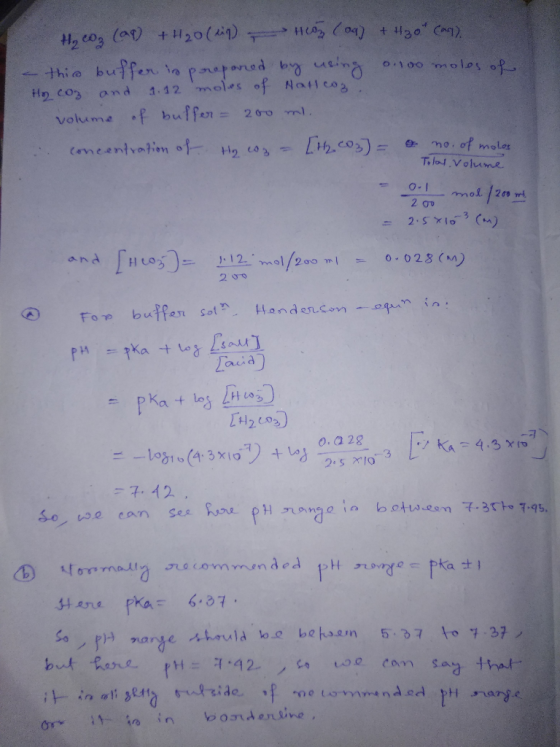
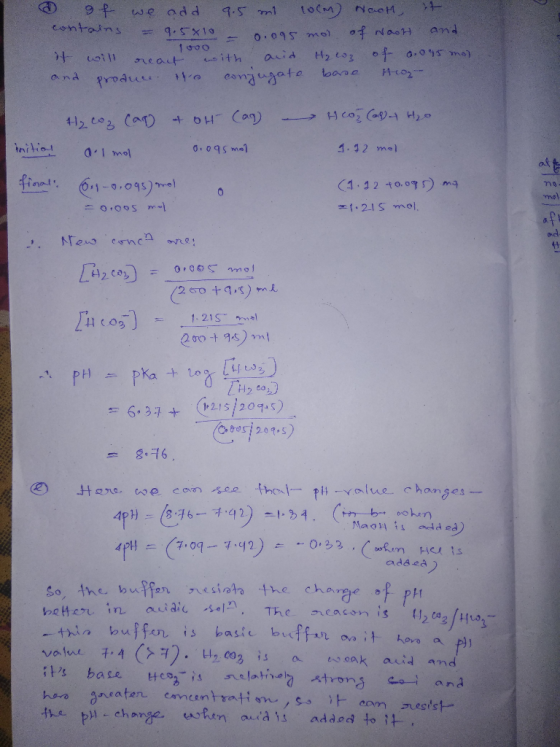
Does this data show that a buffer resists changes in pH caused by (compared to an "unbuffered" solution)? 5.A carbonic acid (H;CO)/bicarbonate (HCO, ) buffer system is a major factor keeping human blood pH in the range of 7.35 to 7.45. This is an interesting buffer system, and we will represent it here as the following equilibrium: Module 6-Lecture 2 H&O' (aq) HCO, (aq) H2O () H2CO, (aq) + Suppose 200.0 mL of a carbonic acid/bicarbonate buffer solution is prepared using 0.100 moles H2CO3 and 1.12 moles of sodium bicarbonate (NaHCO). a) Use the Henderson-Hasselbalch Equation to calculate the pH of this buffer. (It should be somewhere between 7.35 and 7.45.) (Ka of H2CO3 4.3 x 10) (3) b) Is the pH of this buffer system outside of the normally recommended range (pK, + 1) for a buffer? (1)
Homework Answers
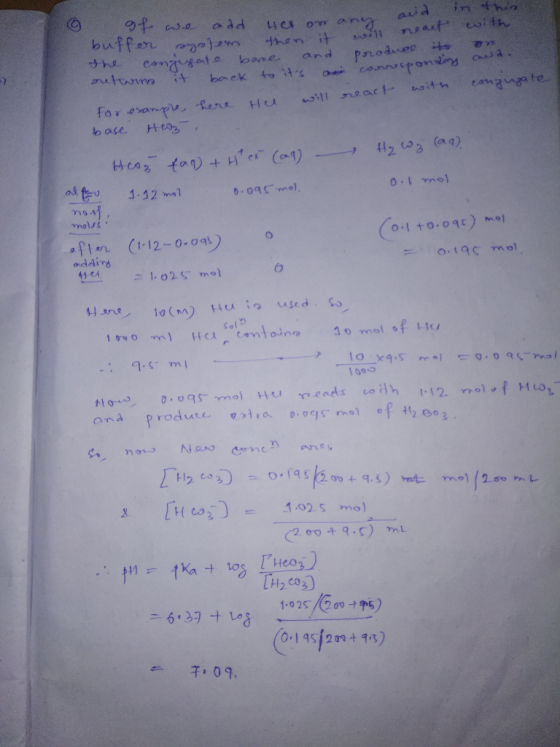
Here all pH values are calculated using Henderson's equation for buffer solution. If there is any problem plz let me know.
Add Answer to:
c) Calculate the pH if 95 ml of 10.0M HC (ag) is added to 200.0 ml...
Post Lab Activity Acids, Bases, pH, and Buffers 1. Calculate the pH of a 0.08 M NaOH solution. 2. Hydrochloric acid...
 Post Lab Activity Acids, Bases, pH, and Buffers 1. Calculate the pH of a 0.08 M NaOH solution. 2. Hydrochloric acid is a strong acid and dissociate almost 100% in aqueous solution. If two drops (0.1 mL) of 1.0 MHCI are added to pure water to make 1.0 L solution. What is the pH of this solution? 3. M. What will be the A dilute solution of hydrochloric acid (HCI) has a concentration of 0.1 pH of this solution? 4....
Human blood contains a buffer of carbonic acid (H 2CO 3) and bicarbonate anion (HCO 3-)...
Human blood contains a buffer of carbonic acid (H 2CO 3) and bicarbonate anion (HCO 3-) in order to maintain blood pH between 7.35 and 7.45, as a value higher than 7.8 or lower than 6.8 can lead to death. Carbonic acid is about 0.108 percent and the density is 1.67 g/mL. Determine the molarity of carbonic acid in blood.
Calculate the pH of a solution that is prepared by mixing 20.00 mL 0.50 M carbonic...
 Calculate the pH of a solution that is prepared by mixing 20.00 mL 0.50 M carbonic acid H.COs and 30.00 mL 0.50 M sodium bicarbonate NaHCO, solutions. Acid dissociation constant Kof H2CO3 is 4.5 x 10?
1. 50.0 mL of a pH 6.00 carbonic acid buffer is titrated with 0.2857 M NaOH,...
 1. 50.0 mL of a pH 6.00 carbonic acid buffer is titrated with 0.2857 M NaOH, requiring 17.47 mL to reach the second equivalence point. a. Calculate the molarity of carbonic acid and bicarbonate in the original buffer. (10 pts) Carbonic acid Bicarbonate: b. Calculate the pH of the solution after a total of 100.0 mL of 0.2857 M NaOH is added to the buffer and equilibrium is established. (10 pts) c. 7.833 g of solid lead(II) carbonate is added...
Calculate pH of a weak acid/conjugate base buffer solution. 1. a) Calculate the pH of 650....
Calculate pH of a weak acid/conjugate base buffer solution. 1. a) Calculate the pH of 650. mL of a 0.211-M solution of acetic acid before and after the addition of 0.123 mol of potassium acetate. pH befor addition = pH after addition = 1 b) Calculate pH of a weak base/conjugate acid buffer solution. A 0.190-M aqueous solution of C2H5NH2 (ethylamine) has a pH of 11.9. Calculate the pH of a buffer solution that is 0.190 M in C2H5NH2 and...
please explain how you got these answers!! and me 17) (5 pts) Calculate the pH of...
 please explain how you got these answers!!
and me 17) (5 pts) Calculate the pH of a solution that is 0.15 Min ammonia (NH3) and 0.40 ammonium chloride, given the ionization constant of the base, kb, NH3 = 1.76 X 10 equilibrium reaction: NH3(aq) + H20 (1) 2 NH4(aq) + OH' (aq) A) 5.18 B) 8.82 C) 9.25 D) 9.50 E) 9.63 18) (5 pts) By far the most important buffer for maintaining acid-base balance in the blood is the...
please explain how you got these answers!!
and me 17) (5 pts) Calculate the pH of a solution that is 0.15 Min ammonia (NH3) and 0.40 ammonium chloride, given the ionization constant of the base, kb, NH3 = 1.76 X 10 equilibrium reaction: NH3(aq) + H20 (1) 2 NH4(aq) + OH' (aq) A) 5.18 B) 8.82 C) 9.25 D) 9.50 E) 9.63 18) (5 pts) By far the most important buffer for maintaining acid-base balance in the blood is the...
8. (4 pts) The biological catalyst carbonic anhydrase converts carbon dioxide to carbonic acid, an essential...
 8. (4 pts) The biological catalyst carbonic anhydrase converts carbon dioxide to carbonic acid, an essential component of the bicarbonate buffer system regulating our blood pH. What mass (in me) of sodium carbonate (NaHCO, MM: 84.006 g/mol) must be added to 500.0 ml of 0.029 M carbonic acid (K. 1 4.3 x 10⁻⁷, K., 4.8 x 10⁻¹¹) to produce a solution with pH = 7.40? Assume no volume change after the addition of sodium carbonate. H2CO3 + H2O=HCO3 + H20...
* 2. Calculate the pH of a buffer solution that is 0.050 M in benzoic acid...
 * 2. Calculate the pH of a buffer solution that is 0.050 M in benzoic acid (HC,H,O,) and 0.150 M in sodium benzoate (NaC,H,O,). For benzoic acid, K = 6.5 X10. Use the Henderson-Hasselbalch approach. (6 points) Equation: HC,H,02(aq) + H20(1) = H,0*(aq) + C,H,O, (aq) Hint: pH = pKa + log base] (acid]
CHomework Chapter 17 Plotting a Titration Curve for a Carbonate-Bicarbonate System 9 of 24> Carbo...
 CHomework Chapter 17 Plotting a Titration Curve for a Carbonate-Bicarbonate System 9 of 24> Carbonic acid (H2COa) is a weak diprotic acid with K4.43 x 10-7 and K 4.73 x 10⁻¹¹ change, and equilibrium values for each species and plugging these into the equlibrium constant expression. The expression HCO as shown in the equation using the equation Salts of the bicarbonate ion, such as sodium During the titration before the equivalence point, provided that the concentration of acid is significantly...
A 100.00 mL buffer solution at pH 7.80 is prepared such that the [H2CO3] + [HCO3]...
A 100.00 mL buffer solution at pH 7.80 is prepared such that the [H2CO3] + [HCO3] = 1.000 M. Determine how much strong acid 1.00M HCI or strong base 1.000 M NaOH must be added to change the pH to 7.40. The step-wise acid dissociation constants for carbonic acid are Ka1= 4.2*10^-7 ; Ka2= 4.8*10^-11.
 Post Lab Activity Acids, Bases, pH, and Buffers 1. Calculate the pH of a 0.08 M NaOH solution. 2. Hydrochloric acid is a strong acid and dissociate almost 100% in aqueous solution. If two drops (0.1 mL) of 1.0 MHCI are added to pure water to make 1.0 L solution. What is the pH of this solution? 3. M. What will be the A dilute solution of hydrochloric acid (HCI) has a concentration of 0.1 pH of this solution? 4....
 Calculate the pH of a solution that is prepared by mixing 20.00 mL 0.50 M carbonic acid H.COs and 30.00 mL 0.50 M sodium bicarbonate NaHCO, solutions. Acid dissociation constant Kof H2CO3 is 4.5 x 10?
 1. 50.0 mL of a pH 6.00 carbonic acid buffer is titrated with 0.2857 M NaOH, requiring 17.47 mL to reach the second equivalence point. a. Calculate the molarity of carbonic acid and bicarbonate in the original buffer. (10 pts) Carbonic acid Bicarbonate: b. Calculate the pH of the solution after a total of 100.0 mL of 0.2857 M NaOH is added to the buffer and equilibrium is established. (10 pts) c. 7.833 g of solid lead(II) carbonate is added...
 please explain how you got these answers!!
and me 17) (5 pts) Calculate the pH of a solution that is 0.15 Min ammonia (NH3) and 0.40 ammonium chloride, given the ionization constant of the base, kb, NH3 = 1.76 X 10 equilibrium reaction: NH3(aq) + H20 (1) 2 NH4(aq) + OH' (aq) A) 5.18 B) 8.82 C) 9.25 D) 9.50 E) 9.63 18) (5 pts) By far the most important buffer for maintaining acid-base balance in the blood is the...
please explain how you got these answers!!
and me 17) (5 pts) Calculate the pH of a solution that is 0.15 Min ammonia (NH3) and 0.40 ammonium chloride, given the ionization constant of the base, kb, NH3 = 1.76 X 10 equilibrium reaction: NH3(aq) + H20 (1) 2 NH4(aq) + OH' (aq) A) 5.18 B) 8.82 C) 9.25 D) 9.50 E) 9.63 18) (5 pts) By far the most important buffer for maintaining acid-base balance in the blood is the...
 8. (4 pts) The biological catalyst carbonic anhydrase converts carbon dioxide to carbonic acid, an essential component of the bicarbonate buffer system regulating our blood pH. What mass (in me) of sodium carbonate (NaHCO, MM: 84.006 g/mol) must be added to 500.0 ml of 0.029 M carbonic acid (K. 1 4.3 x 10⁻⁷, K., 4.8 x 10⁻¹¹) to produce a solution with pH = 7.40? Assume no volume change after the addition of sodium carbonate. H2CO3 + H2O=HCO3 + H20...
 * 2. Calculate the pH of a buffer solution that is 0.050 M in benzoic acid (HC,H,O,) and 0.150 M in sodium benzoate (NaC,H,O,). For benzoic acid, K = 6.5 X10. Use the Henderson-Hasselbalch approach. (6 points) Equation: HC,H,02(aq) + H20(1) = H,0*(aq) + C,H,O, (aq) Hint: pH = pKa + log base] (acid]
 CHomework Chapter 17 Plotting a Titration Curve for a Carbonate-Bicarbonate System 9 of 24> Carbonic acid (H2COa) is a weak diprotic acid with K4.43 x 10-7 and K 4.73 x 10⁻¹¹ change, and equilibrium values for each species and plugging these into the equlibrium constant expression. The expression HCO as shown in the equation using the equation Salts of the bicarbonate ion, such as sodium During the titration before the equivalence point, provided that the concentration of acid is significantly...
Most questions answered within 3 hours.
-
Where is the error in this code sequence?
String s1 = "Hello";
String s2 = "ello";...
asked 11 months ago -
Financial data for Joel de Paris, Inc., for last year
follow:
Joel de Paris, Inc.
Balance...
asked 11 months ago -
Consider this reaction:
Al2(SO4)3 (aq)+ BaCl3
(aq) Al2Cl6 (aq)- +
3BaSO4(s) . What is the...
asked 11 months ago -
Suppose that Savneet is considering increasing her
recent random sample from 20 car rentals to 40...
asked 11 months ago -
Trucks arrive at an unloading terminal at an average rate of 120
per hour.
Trucks arrive...
asked 11 months ago -
Why are methanol and ethanol completely soluble in water while
octanol is not very little soluble....
asked 11 months ago -
A facilities manager at a university reads in a research report
that the mean amount of...
asked 11 months ago -
When the CuSO4 is rehydrated by adding water to the anhydrous
compound, is this an endothermic...
asked 11 months ago -
A ray of sunlight is passing from diamond into crown glass; the
angle of incidence is...
asked 11 months ago -
A block of mass 0.249 kg is placed on top of a light, vertical
spring of...
asked 11 months ago -
how do the kidneys compensate in the presences of acidosis
a) trigger hyperventilate
b) reserve acid...
asked 11 months ago -
Question 501 pts
The rental rate of capital to the firm increases. Which of the
following...
asked 11 months ago