
Homework Answers
ANSWER:
Add Answer to:
can
you post the answer in matlab and code
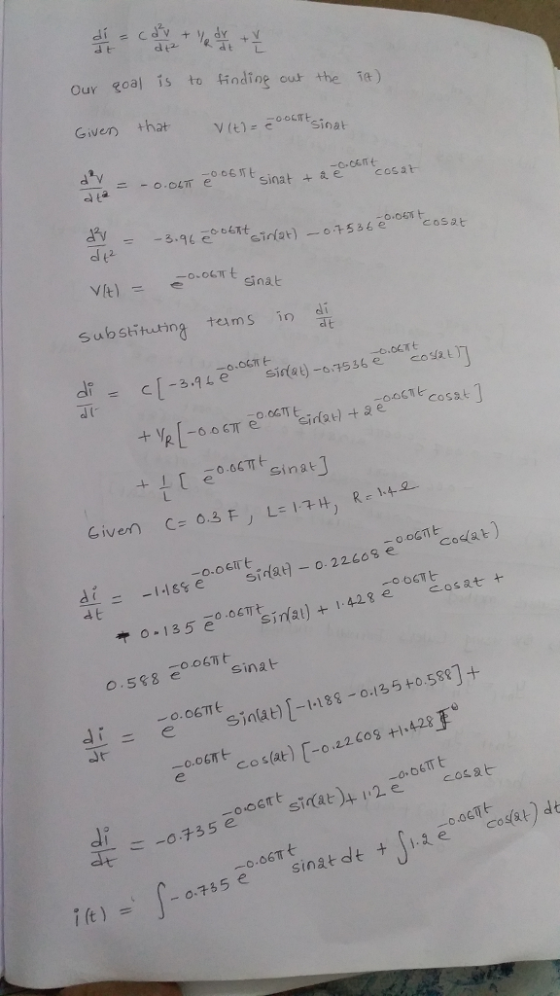
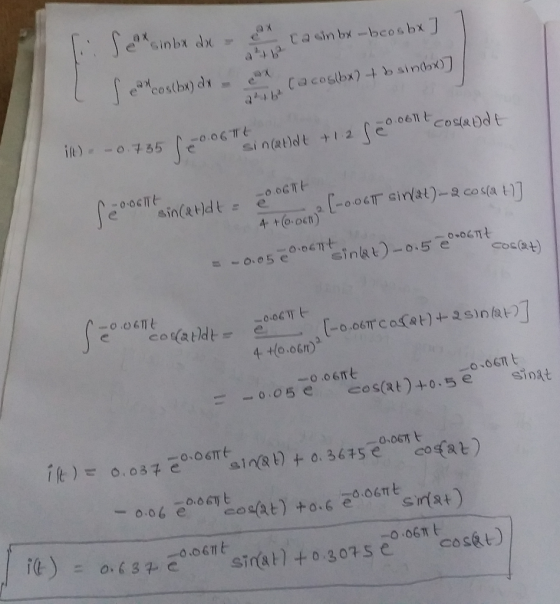
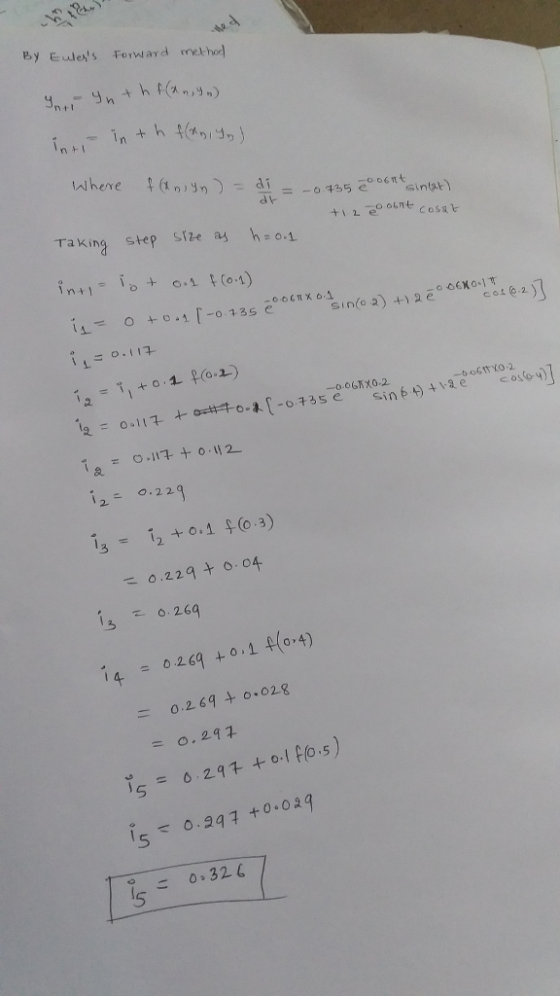
Question 1: Euler's Method. A simple circuit...
1. Use Laplace Transforms to determine the function modeling the current in an RLC circuit with L 10 Henries, R 20 ohms...
 1. Use Laplace Transforms to determine the function modeling the current in an RLC circuit with L 10 Henries, R 20 ohms, C = 0.02 Farads, the initial charge is Q(0) = 0, the initial current is I(0) = 0, there is an electromotive force forcing the RLC circuit via the voltage function E(t) letting the current alternate naturally through the circuit. Use the fact the differential 10 sin (t), nd then, at t = 2T seconds, the battery is...
9. (12) Given the LRC circuit with L henries, R-10 ohms, C- farads and E(t) =...
 9. (12) Given the LRC circuit with L henries, R-10 ohms, C- farads and E(t) = 50 cos t 30 volts, the charge q(t) satisfies the linear second order ordinary differential equation 2 dq1 dt2 (a) Find the charge q(t) if q(0) 100 coulombs and '(0)0 amperes. (b) Identify in q(t) the transient terms and, respectively, the steady state terms. Is the circuit overdamped, underdamped, or critically damped? E(t) Figure 1: Problem9.
1 2 9. The diagram below is an RCL circuit with R = 10 ohms, C...
 1 2 9. The diagram below is an RCL circuit with R = 10 ohms, C = 10-2farad, L henry, and V = 12 volts. The switch is closed at time t = 0. Assume that the initial current i(0) = 0 and the initial charge on the capacitor Q(0) = 0 . Find the current i = i(t) in the circuit if i satisfies the equation and, according to Kirchhoff's law, ai lezo = R di d2i dt2 +...
1 2 9. The diagram below is an RCL circuit with R = 10 ohms, C...
 1 2 9. The diagram below is an RCL circuit with R = 10 ohms, C = 10-2farad, L henry, and V = 12 volts. The switch is closed at time t = 0. Assume that the initial current i(0) = 0 and the initial charge on the capacitor Q(0) = 0 . Find the current i = i(t) in the circuit if i satisfies the equation and, according to Kirchhoff's law, ai lezo = R di d2i dt2 +...
problem 7 Problem-4 [10 Points] Find the Laplace transforms of the functions in Figure. 2 Figure....
 problem 7
Problem-4 [10 Points] Find the Laplace transforms of the functions in Figure. 2 Figure. 2: Triangular Function Problem-5 [10 Pointsl A system has the transfer function h(s) = (s1)(s +2) a) Find the impulse response of the system b) Determine the output y(t), given that the input is x(t) u(t) Problem-6 [10 Pointsl Use the Laplace transform to solve the differential equation +22+10v(t) 3 cos(2t) dt2 dt subject to v(0)-1, dv(O) Problem-7 [10 Points] Solve the integrodifferential equation...
problem 7
Problem-4 [10 Points] Find the Laplace transforms of the functions in Figure. 2 Figure. 2: Triangular Function Problem-5 [10 Pointsl A system has the transfer function h(s) = (s1)(s +2) a) Find the impulse response of the system b) Determine the output y(t), given that the input is x(t) u(t) Problem-6 [10 Pointsl Use the Laplace transform to solve the differential equation +22+10v(t) 3 cos(2t) dt2 dt subject to v(0)-1, dv(O) Problem-7 [10 Points] Solve the integrodifferential equation...
Please do the problem if you can do ALL parts. t-0 a SW1 SW2 0.5 Ω 2 1Ω V. R3 20 A T v(t) 0.5 F 0.5 H 0 Find the initial current i(0) through the inductor and the initial voltage v(0) across the capa...
 Please do the problem if you can do ALL parts.
t-0 a SW1 SW2 0.5 Ω 2 1Ω V. R3 20 A T v(t) 0.5 F 0.5 H 0 Find the initial current i(0) through the inductor and the initial voltage v(0) across the capacitor at t 0. b. Write a node equation at node a fort2 0. c. Represent v(t) as a function of i(t) on the series connection of R2 and L. Find dv(t)/dt. Derive a second-order differential...
Please do the problem if you can do ALL parts.
t-0 a SW1 SW2 0.5 Ω 2 1Ω V. R3 20 A T v(t) 0.5 F 0.5 H 0 Find the initial current i(0) through the inductor and the initial voltage v(0) across the capacitor at t 0. b. Write a node equation at node a fort2 0. c. Represent v(t) as a function of i(t) on the series connection of R2 and L. Find dv(t)/dt. Derive a second-order differential...
MATLAB CODE: Task 2 8y dt Solve the above ordinary differential equation (ODE) using Euler's method with step sizes of: 2. h 0.75 3. h 0.5 4. h 0.001 a) For each step size, plot the results at eac...
 MATLAB CODE:
Task 2 8y dt Solve the above ordinary differential equation (ODE) using Euler's method with step sizes of: 2. h 0.75 3. h 0.5 4. h 0.001 a) For each step size, plot the results at each step starting from y(0) 3 to y(3). b) Plot on the same figure as part a) the analytical solution which is given by: 9 24 -8t c) Calculate and print the percentage error between the Euler's method and the analytical result...
MATLAB CODE:
Task 2 8y dt Solve the above ordinary differential equation (ODE) using Euler's method with step sizes of: 2. h 0.75 3. h 0.5 4. h 0.001 a) For each step size, plot the results at each step starting from y(0) 3 to y(3). b) Plot on the same figure as part a) the analytical solution which is given by: 9 24 -8t c) Calculate and print the percentage error between the Euler's method and the analytical result...
Answer: Please help! Electrical series circuits never make sence to me. I included the answer so that you can check your work. Hope that helps. 19. An electrical series circuit contains a resi...
 Answer:
Please help! Electrical series circuits never make
sence to me. I included the answer so that you can check your
work.
Hope that helps.
19. An electrical series circuit contains a resistor with a resistance of R- 20 ohms, a capacitor with a capacitance of C 0.01 farads, and an inductor with an inductance of L 1 henry. The initial current in the circuit is 0 amperes. A variable voltage of E(t) 120 sin volts of is applied to...
Answer:
Please help! Electrical series circuits never make
sence to me. I included the answer so that you can check your
work.
Hope that helps.
19. An electrical series circuit contains a resistor with a resistance of R- 20 ohms, a capacitor with a capacitance of C 0.01 farads, and an inductor with an inductance of L 1 henry. The initial current in the circuit is 0 amperes. A variable voltage of E(t) 120 sin volts of is applied to...
Problem 1 An RLC circuit (as shown in page 79 in the textbook) has a resistor...
 Problem 1 An RLC circuit (as shown in page 79 in the textbook) has a resistor of Rohms, an inductor with an inductance of 2 henries, and a capacitor with a capacitance of 0.5 farads. A battery is connected to the circuit giving a voltage V(1) = 2 cos(31) in volts) where 1 is given in seconds. 1) Write the differential equation satisfied by the charge Q(1) (in Coulombs) on the capacitor at time t. Answer: ii) Let $R=1$. Use...
Problem Thre: 125 points) Consider the following initial value problem: dy-2y+ t The y(0) -1 ea dt ical solution of the differential equation is: y(O)(2-2t+3e-2+1)y fr exoc the differential equat...
 Problem Thre: 125 points) Consider the following initial value problem: dy-2y+ t The y(0) -1 ea dt ical solution of the differential equation is: y(O)(2-2t+3e-2+1)y fr exoc the differential equation numerically over the interval 0 s i s 2.0 and a step size h At 0.5.A Apply the following Runge-Kutta methods for each of the step. (show your calculations) i. [0.0 0.5: Euler method ii. [0.5 1.0]: Heun method. ii. [1.0 1.5): Midpoint method. iv. [1.5 2.0): 4h RK method...
 1. Use Laplace Transforms to determine the function modeling the current in an RLC circuit with L 10 Henries, R 20 ohms, C = 0.02 Farads, the initial charge is Q(0) = 0, the initial current is I(0) = 0, there is an electromotive force forcing the RLC circuit via the voltage function E(t) letting the current alternate naturally through the circuit. Use the fact the differential 10 sin (t), nd then, at t = 2T seconds, the battery is...
 9. (12) Given the LRC circuit with L henries, R-10 ohms, C- farads and E(t) = 50 cos t 30 volts, the charge q(t) satisfies the linear second order ordinary differential equation 2 dq1 dt2 (a) Find the charge q(t) if q(0) 100 coulombs and '(0)0 amperes. (b) Identify in q(t) the transient terms and, respectively, the steady state terms. Is the circuit overdamped, underdamped, or critically damped? E(t) Figure 1: Problem9.
 1 2 9. The diagram below is an RCL circuit with R = 10 ohms, C = 10-2farad, L henry, and V = 12 volts. The switch is closed at time t = 0. Assume that the initial current i(0) = 0 and the initial charge on the capacitor Q(0) = 0 . Find the current i = i(t) in the circuit if i satisfies the equation and, according to Kirchhoff's law, ai lezo = R di d2i dt2 +...
 1 2 9. The diagram below is an RCL circuit with R = 10 ohms, C = 10-2farad, L henry, and V = 12 volts. The switch is closed at time t = 0. Assume that the initial current i(0) = 0 and the initial charge on the capacitor Q(0) = 0 . Find the current i = i(t) in the circuit if i satisfies the equation and, according to Kirchhoff's law, ai lezo = R di d2i dt2 +...
 problem 7
Problem-4 [10 Points] Find the Laplace transforms of the functions in Figure. 2 Figure. 2: Triangular Function Problem-5 [10 Pointsl A system has the transfer function h(s) = (s1)(s +2) a) Find the impulse response of the system b) Determine the output y(t), given that the input is x(t) u(t) Problem-6 [10 Pointsl Use the Laplace transform to solve the differential equation +22+10v(t) 3 cos(2t) dt2 dt subject to v(0)-1, dv(O) Problem-7 [10 Points] Solve the integrodifferential equation...
problem 7
Problem-4 [10 Points] Find the Laplace transforms of the functions in Figure. 2 Figure. 2: Triangular Function Problem-5 [10 Pointsl A system has the transfer function h(s) = (s1)(s +2) a) Find the impulse response of the system b) Determine the output y(t), given that the input is x(t) u(t) Problem-6 [10 Pointsl Use the Laplace transform to solve the differential equation +22+10v(t) 3 cos(2t) dt2 dt subject to v(0)-1, dv(O) Problem-7 [10 Points] Solve the integrodifferential equation...
 Please do the problem if you can do ALL parts.
t-0 a SW1 SW2 0.5 Ω 2 1Ω V. R3 20 A T v(t) 0.5 F 0.5 H 0 Find the initial current i(0) through the inductor and the initial voltage v(0) across the capacitor at t 0. b. Write a node equation at node a fort2 0. c. Represent v(t) as a function of i(t) on the series connection of R2 and L. Find dv(t)/dt. Derive a second-order differential...
Please do the problem if you can do ALL parts.
t-0 a SW1 SW2 0.5 Ω 2 1Ω V. R3 20 A T v(t) 0.5 F 0.5 H 0 Find the initial current i(0) through the inductor and the initial voltage v(0) across the capacitor at t 0. b. Write a node equation at node a fort2 0. c. Represent v(t) as a function of i(t) on the series connection of R2 and L. Find dv(t)/dt. Derive a second-order differential...
 MATLAB CODE:
Task 2 8y dt Solve the above ordinary differential equation (ODE) using Euler's method with step sizes of: 2. h 0.75 3. h 0.5 4. h 0.001 a) For each step size, plot the results at each step starting from y(0) 3 to y(3). b) Plot on the same figure as part a) the analytical solution which is given by: 9 24 -8t c) Calculate and print the percentage error between the Euler's method and the analytical result...
MATLAB CODE:
Task 2 8y dt Solve the above ordinary differential equation (ODE) using Euler's method with step sizes of: 2. h 0.75 3. h 0.5 4. h 0.001 a) For each step size, plot the results at each step starting from y(0) 3 to y(3). b) Plot on the same figure as part a) the analytical solution which is given by: 9 24 -8t c) Calculate and print the percentage error between the Euler's method and the analytical result...
 Answer:
Please help! Electrical series circuits never make
sence to me. I included the answer so that you can check your
work.
Hope that helps.
19. An electrical series circuit contains a resistor with a resistance of R- 20 ohms, a capacitor with a capacitance of C 0.01 farads, and an inductor with an inductance of L 1 henry. The initial current in the circuit is 0 amperes. A variable voltage of E(t) 120 sin volts of is applied to...
Answer:
Please help! Electrical series circuits never make
sence to me. I included the answer so that you can check your
work.
Hope that helps.
19. An electrical series circuit contains a resistor with a resistance of R- 20 ohms, a capacitor with a capacitance of C 0.01 farads, and an inductor with an inductance of L 1 henry. The initial current in the circuit is 0 amperes. A variable voltage of E(t) 120 sin volts of is applied to...
 Problem 1 An RLC circuit (as shown in page 79 in the textbook) has a resistor of Rohms, an inductor with an inductance of 2 henries, and a capacitor with a capacitance of 0.5 farads. A battery is connected to the circuit giving a voltage V(1) = 2 cos(31) in volts) where 1 is given in seconds. 1) Write the differential equation satisfied by the charge Q(1) (in Coulombs) on the capacitor at time t. Answer: ii) Let $R=1$. Use...
 Problem Thre: 125 points) Consider the following initial value problem: dy-2y+ t The y(0) -1 ea dt ical solution of the differential equation is: y(O)(2-2t+3e-2+1)y fr exoc the differential equation numerically over the interval 0 s i s 2.0 and a step size h At 0.5.A Apply the following Runge-Kutta methods for each of the step. (show your calculations) i. [0.0 0.5: Euler method ii. [0.5 1.0]: Heun method. ii. [1.0 1.5): Midpoint method. iv. [1.5 2.0): 4h RK method...
Most questions answered within 3 hours.
-
Where is the error in this code sequence?
String s1 = "Hello";
String s2 = "ello";...
asked 11 months ago -
Financial data for Joel de Paris, Inc., for last year
follow:
Joel de Paris, Inc.
Balance...
asked 11 months ago -
Consider this reaction:
Al2(SO4)3 (aq)+ BaCl3
(aq) Al2Cl6 (aq)- +
3BaSO4(s) . What is the...
asked 11 months ago -
Suppose that Savneet is considering increasing her
recent random sample from 20 car rentals to 40...
asked 11 months ago -
Trucks arrive at an unloading terminal at an average rate of 120
per hour.
Trucks arrive...
asked 11 months ago -
Why are methanol and ethanol completely soluble in water while
octanol is not very little soluble....
asked 11 months ago -
A facilities manager at a university reads in a research report
that the mean amount of...
asked 11 months ago -
When the CuSO4 is rehydrated by adding water to the anhydrous
compound, is this an endothermic...
asked 11 months ago -
A ray of sunlight is passing from diamond into crown glass; the
angle of incidence is...
asked 11 months ago -
A block of mass 0.249 kg is placed on top of a light, vertical
spring of...
asked 11 months ago -
how do the kidneys compensate in the presences of acidosis
a) trigger hyperventilate
b) reserve acid...
asked 11 months ago -
Question 501 pts
The rental rate of capital to the firm increases. Which of the
following...
asked 11 months ago