Lithium nitride reacts with water to produce ammonia and lithium hydroxide according to the equation Li3N(s)+3H2O(l)⟶NH3(g)+3LiOH(aq)...
Lithium nitride reacts with water to produce ammonia and lithium hydroxide according to the equation Li3N(s)+3H2O(l)⟶NH3(g)+3LiOH(aq) Heavy water is water with the isotope deuterium in place of ordinary hydrogen, and its formula is D2O. The same reaction can be used to produce heavy ammonia, ND3(g), according to the equation Li3N(s)+3D2O(l)⟶ND3(g)+3LiOD(aq) Calculate how many grams of heavy water are required to produce 135.0 mg ND3(g). The mass of deuterium, D, is 2.014 g/mol.
mass: g D2O ?
Homework Answers
![ADEwer GRuer reaction ND (913Lioola molecular eigul Lis Nes 3() the first calcu lat NDS h| = h]X - total O = x0Iu = 4.o 8 to](http://img.homeworklib.com/images/3560cb7a-ac5e-4d6d-ac4c-646a389e428c.png?x-oss-process=image/resize,w_560)

Add Answer to:
Lithium nitride reacts with water to produce ammonia and lithium
hydroxide according to the equation
Li3N(s)+3H2O(l)⟶NH3(g)+3LiOH(aq)...
32. (3) Determine the mass of lithium hydroxide produced when 1.26 g of lithium nitride reacts...
 32. (3) Determine the mass of lithium hydroxide produced when 1.26 g of lithium nitride reacts with water. LisN + 3 H2O → 3 LiOH + NH3 a. 0.871 g b. 2.60 g c. 0.62 g d. 2.40 L
Lithium metal reacts with water to produce aqueous lithium hydroxide and hydrogen gas. The balanced equation...
Lithium metal reacts with water to produce aqueous lithium hydroxide and hydrogen gas. The balanced equation for this reaction is shown below. 2Li(s) + 2H 2 O(l) → 2LiOH(aq) + H 2 (g) a) Calculate the mass of H 2 (molar mass 2.016 g mol –1 ) gas that can form in the reaction of 80.6 g of Li (molar mass 6.940 g mol –1 ) with excess H 2 O.
AP Chemistry Number of Moles Practice: Part A) Lithium and nitrogen react to produce lithium nitride:6Li(s)+N2(g)→2Li3N(s)....
AP Chemistry Number of Moles Practice: Part A) Lithium and nitrogen react to produce lithium nitride:6Li(s)+N2(g)→2Li3N(s). How many moles of lithium nitride are produced when 0.630 mol of lithium react in this fashion? Part B) How many moles of BCl3 are needed to produce 10.0 g of HCl(aq) in the following reaction? BCl3(g) + 3 H2O(l) → 3 HCl(aq) + B(OH)3(aq) Part C) How many moles of nitrogen are formed when 58.6 g of KNO3 decomposes according to the...
Ammonia, NH3 , reacts with oxygen to form nitrogen gas and water. 4NH3(aq)+3O2(g)⟶2N2(g)+6H2O(l) If 3.15 g...
Ammonia, NH3 , reacts with oxygen to form nitrogen gas and water. 4NH3(aq)+3O2(g)⟶2N2(g)+6H2O(l) If 3.15 g of NH3 reacts with 4.73 g of O2 and produces 0.750 L of N2 at 295 K and 1.00 atm , which reactant is limiting? a. O2(g) b. NH3(aq) What is the percent yield of the reaction? percent yield: %
Consider the balanced equation for the following reaction: 3H2O(l) + Mg3N2(aq) → 3MgO(s) + 2NH3(g) If...
Consider the balanced equation for the following reaction: 3H2O(l) + Mg3N2(aq) → 3MgO(s) + 2NH3(g) If 6.60 moles of H2O(l) reacts with an excess of Mg3N2(aq), determine the theoretical yield of NH3(g).
Aluminum reacts with aqueous sodium hydroxide to produce hydrogen gas according to the following equation: 2Al(s)...
 Aluminum reacts with aqueous sodium hydroxide to produce hydrogen gas according to the following equation: 2Al(s) + 2NaOH(aq) + 6H20(1)—2NaAl(OH)4(aq) + 3H2(g) The product gas, H2, is collected over water at a temperature of 20 °C and a pressure of 746 mm Hg. If the wet H2 gas formed occupies a volume of 7.58 L, the number of grams of H2 formed is g. The vapor pressure of water is 17.5 mm Hg at 20 °C. ONLAYN
Consider the following unbalanced chemical equation LiOH(s)+CO2(aq)=LiCO3(s)+H2O(l) If 3.89 moles of lithium hydroxide reacts with excess...
Consider the following unbalanced chemical equation LiOH(s)+CO2(aq)=LiCO3(s)+H2O(l) If 3.89 moles of lithium hydroxide reacts with excess carbon dioxide how many moles of lithium carbonate will be produced
273 Ammonia reacts slowly in air to produce nitrogen monox- ide and water vapor: NH3(g) +...
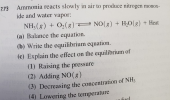 273 Ammonia reacts slowly in air to produce nitrogen monox- ide and water vapor: NH3(g) + O2(8) 2 NO(g) + H2O(g) + Heat (a) Balance the equation. (b) Write the equilibrium equation. (C) Explain the effect on the equilibrium of (1) Raising the pressure (2) Adding NO(g) (3) Decreasing the concentration of NH3 (4) Lowering the temperature fuel
Calcium cyanamide reacts with water to form calcium carbonate and ammonia via the following reaction: CaCN2(s)+3H2O(l)→CaCO3(s)+2NH3(g)...
Calcium cyanamide reacts with water to form calcium carbonate and ammonia via the following reaction: CaCN2(s)+3H2O(l)→CaCO3(s)+2NH3(g) A) How many grams of water are needed to react with 80.0 g CaCN2?
Nitrogen dioxide reacts with water to produce oxygen and ammonia: 4NO2(g)+6H2O(g)→7O2(g)+4NH3(g) How many grams of NH3...
Nitrogen dioxide reacts with water to produce oxygen and ammonia: 4NO2(g)+6H2O(g)→7O2(g)+4NH3(g) How many grams of NH3 can be produced when 4.10 L of NO2 reacts at 385 ∘C and 735 mmHg ?
 32. (3) Determine the mass of lithium hydroxide produced when 1.26 g of lithium nitride reacts with water. LisN + 3 H2O → 3 LiOH + NH3 a. 0.871 g b. 2.60 g c. 0.62 g d. 2.40 L
 Aluminum reacts with aqueous sodium hydroxide to produce hydrogen gas according to the following equation: 2Al(s) + 2NaOH(aq) + 6H20(1)—2NaAl(OH)4(aq) + 3H2(g) The product gas, H2, is collected over water at a temperature of 20 °C and a pressure of 746 mm Hg. If the wet H2 gas formed occupies a volume of 7.58 L, the number of grams of H2 formed is g. The vapor pressure of water is 17.5 mm Hg at 20 °C. ONLAYN
 273 Ammonia reacts slowly in air to produce nitrogen monox- ide and water vapor: NH3(g) + O2(8) 2 NO(g) + H2O(g) + Heat (a) Balance the equation. (b) Write the equilibrium equation. (C) Explain the effect on the equilibrium of (1) Raising the pressure (2) Adding NO(g) (3) Decreasing the concentration of NH3 (4) Lowering the temperature fuel
Most questions answered within 3 hours.
-
Where is the error in this code sequence?
String s1 = "Hello";
String s2 = "ello";...
asked 11 months ago -
Financial data for Joel de Paris, Inc., for last year
follow:
Joel de Paris, Inc.
Balance...
asked 11 months ago -
Consider this reaction:
Al2(SO4)3 (aq)+ BaCl3
(aq) Al2Cl6 (aq)- +
3BaSO4(s) . What is the...
asked 11 months ago -
Suppose that Savneet is considering increasing her
recent random sample from 20 car rentals to 40...
asked 11 months ago -
Trucks arrive at an unloading terminal at an average rate of 120
per hour.
Trucks arrive...
asked 11 months ago -
Why are methanol and ethanol completely soluble in water while
octanol is not very little soluble....
asked 11 months ago -
A facilities manager at a university reads in a research report
that the mean amount of...
asked 11 months ago -
When the CuSO4 is rehydrated by adding water to the anhydrous
compound, is this an endothermic...
asked 11 months ago -
A ray of sunlight is passing from diamond into crown glass; the
angle of incidence is...
asked 11 months ago -
A block of mass 0.249 kg is placed on top of a light, vertical
spring of...
asked 11 months ago -
how do the kidneys compensate in the presences of acidosis
a) trigger hyperventilate
b) reserve acid...
asked 11 months ago -
Question 501 pts
The rental rate of capital to the firm increases. Which of the
following...
asked 11 months ago