
Homework Answers
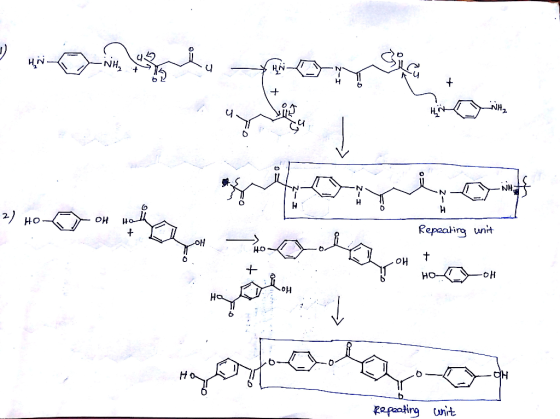
1) In the first and third reaction acid chloride and amine, functional groups will react to form polyamide.
In the second and fourth reaction, acid and alcohol functional groups will react to form polyester.
In the fifth reaction, acid chloride and alcohol functional groups will react to form polyester.
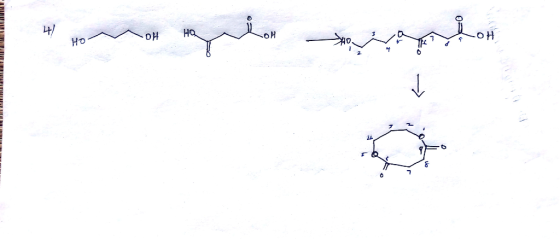
2) In the third and fourth reaction there may be a chance of
intramolecular coupling can take place. This phenomenon reduces the
long chain polymerisation. so the molecular weight of the polymer
will low. Other reactions have less chance for intra-molecular
coupling.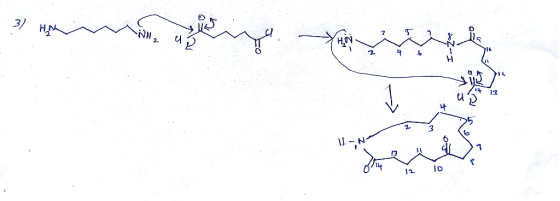
Add Answer to:
Assume you need to make a new linear, high molecular weight, polyamide or polyester Q. 1...
you need to make a new linear, high molecular weight, poly(amide) – Give the structures of the polymers that could be fo...
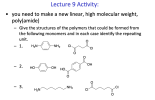 you need to make a new linear, high molecular weight,
poly(amide) –
Give the structures of the polymers that could be formed from
the following monomers and in each case identify the repeating
unit.
Lecture 9 Activity: you need to make a new linear, high molecular weight, poly(amide) Give the structures of the polymers that could be formed fromm the following monomers and in each case identify the repeating unit. - 1.H2N NH2C CI он OH HO Cl Cl
Lecture...
you need to make a new linear, high molecular weight,
poly(amide) –
Give the structures of the polymers that could be formed from
the following monomers and in each case identify the repeating
unit.
Lecture 9 Activity: you need to make a new linear, high molecular weight, poly(amide) Give the structures of the polymers that could be formed fromm the following monomers and in each case identify the repeating unit. - 1.H2N NH2C CI он OH HO Cl Cl
Lecture...
Pre-Laboratory Exercise: Plastics Identification I. List four properties that you will use in lab...
 can
someone help me find this information?
Pre-Laboratory Exercise: Plastics Identification I. List four properties that you will use in lab to determine the identity of the polymer samples 2. Describe the density test. What observation will help you determine the density of each polymer? What precautions should be taken in placing the sample in the solutions? 3. Write the name and abbreviation for the six recyclable polymers 2 huetn deisity polyetayene.HDpz poulene: PP 4. Given the list of wavenumber...
can
someone help me find this information?
Pre-Laboratory Exercise: Plastics Identification I. List four properties that you will use in lab to determine the identity of the polymer samples 2. Describe the density test. What observation will help you determine the density of each polymer? What precautions should be taken in placing the sample in the solutions? 3. Write the name and abbreviation for the six recyclable polymers 2 huetn deisity polyetayene.HDpz poulene: PP 4. Given the list of wavenumber...
 you need to make a new linear, high molecular weight,
poly(amide) –
Give the structures of the polymers that could be formed from
the following monomers and in each case identify the repeating
unit.
Lecture 9 Activity: you need to make a new linear, high molecular weight, poly(amide) Give the structures of the polymers that could be formed fromm the following monomers and in each case identify the repeating unit. - 1.H2N NH2C CI он OH HO Cl Cl
Lecture...
you need to make a new linear, high molecular weight,
poly(amide) –
Give the structures of the polymers that could be formed from
the following monomers and in each case identify the repeating
unit.
Lecture 9 Activity: you need to make a new linear, high molecular weight, poly(amide) Give the structures of the polymers that could be formed fromm the following monomers and in each case identify the repeating unit. - 1.H2N NH2C CI он OH HO Cl Cl
Lecture...
 can
someone help me find this information?
Pre-Laboratory Exercise: Plastics Identification I. List four properties that you will use in lab to determine the identity of the polymer samples 2. Describe the density test. What observation will help you determine the density of each polymer? What precautions should be taken in placing the sample in the solutions? 3. Write the name and abbreviation for the six recyclable polymers 2 huetn deisity polyetayene.HDpz poulene: PP 4. Given the list of wavenumber...
can
someone help me find this information?
Pre-Laboratory Exercise: Plastics Identification I. List four properties that you will use in lab to determine the identity of the polymer samples 2. Describe the density test. What observation will help you determine the density of each polymer? What precautions should be taken in placing the sample in the solutions? 3. Write the name and abbreviation for the six recyclable polymers 2 huetn deisity polyetayene.HDpz poulene: PP 4. Given the list of wavenumber...
Most questions answered within 3 hours.
-
Where is the error in this code sequence?
String s1 = "Hello";
String s2 = "ello";...
asked 10 months ago -
Financial data for Joel de Paris, Inc., for last year
follow:
Joel de Paris, Inc.
Balance...
asked 10 months ago -
Consider this reaction:
Al2(SO4)3 (aq)+ BaCl3
(aq) Al2Cl6 (aq)- +
3BaSO4(s) . What is the...
asked 10 months ago -
Suppose that Savneet is considering increasing her
recent random sample from 20 car rentals to 40...
asked 10 months ago -
Trucks arrive at an unloading terminal at an average rate of 120
per hour.
Trucks arrive...
asked 10 months ago -
Why are methanol and ethanol completely soluble in water while
octanol is not very little soluble....
asked 10 months ago -
A facilities manager at a university reads in a research report
that the mean amount of...
asked 10 months ago -
When the CuSO4 is rehydrated by adding water to the anhydrous
compound, is this an endothermic...
asked 10 months ago -
A ray of sunlight is passing from diamond into crown glass; the
angle of incidence is...
asked 10 months ago -
A block of mass 0.249 kg is placed on top of a light, vertical
spring of...
asked 10 months ago -
how do the kidneys compensate in the presences of acidosis
a) trigger hyperventilate
b) reserve acid...
asked 10 months ago -
Question 501 pts
The rental rate of capital to the firm increases. Which of the
following...
asked 10 months ago