
Homework Answers
Let the concentration of product at equilibrium = x M
i.e. the [anilinium] = 1-x, [benzoate] = 5-x
Now, [aniline]×[benzoic acid]/[anilinium]×[benzoate] = 10-4.5/10-4.2 = 0.5
i.e. x×x/(1-x)(5-x) = 0.5
2x2 = x2-6x+5
i.e x2+6x-5 = 0
By solving the above quadratic equation, you will get
x = [product] = 0.7 M (option C).
Add Answer to:
Given the following pKa's and initial concentration of reactants, to the nearest tenth, how much product...
Please help with 8, 9, and 11 8. 10 g of a compound with logP of...
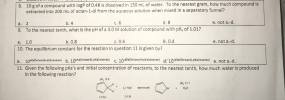 Please help with 8, 9, and
11
8. 10 g of a compound with logP of 0.48 is dissolved in 150 mL of water. To the nearest gram, how much compound is extracted into 200 mL of octan-1-ol from the aqueous solution when mixed in a separatory funnel? a. 2 b. 4 c. 6 d. 8 e. not a.-d. 9. To the nearest tenth, what is the pH of a 3.0 M solution of compound with pk, of 1.01? a....
Please help with 8, 9, and
11
8. 10 g of a compound with logP of 0.48 is dissolved in 150 mL of water. To the nearest gram, how much compound is extracted into 200 mL of octan-1-ol from the aqueous solution when mixed in a separatory funnel? a. 2 b. 4 c. 6 d. 8 e. not a.-d. 9. To the nearest tenth, what is the pH of a 3.0 M solution of compound with pk, of 1.01? a....
2. In the ICE table below, a balanced chemical equation is shown. Initial amounts are given...
 2. In the ICE table below, a balanced chemical equation is shown. Initial amounts are given for the reactants, and a final observed concentration for the product. The volume of the vessel is 1.0 L (a) (0.5 pts) Show by calculation if there is enough Pa s) to permit that amount of the product PH to form, with some P4(s) left over. (Ps has to be present in excess for the equilibirum to be established) (b) (0.5 pts) Complete this...
1. The initial concentrations of reactants and products for this reaction are given below. N2(g) +...
1. The initial concentrations of reactants and products for this reaction are given below. N2(g) + O2(g) ⇄ 2NO(g) Calculate Q for this reaction. Answer this to one decimal place (e.g. 10.2) The initial concentration of N2 is 1.0 M The initial concentration of O2 is 1.0 M The initial concentration of NO is 2.5 M 2. The reaction below is not at equilibria and Q = 1.7. The equilibrium constant is K = 0.230. 2SO3(g) ⇌ 2SO2(g) + O2(g)...
17) Which of the following is TRUE? A) Stoichiometry allows prediction of how much of the reactants are necessary t...
 17) Which of the following is TRUE? A) Stoichiometry allows prediction of how much of the reactants are necessary to form given amount of product B) Stoichiometry shows the numerical relationship between chemical quantities in a balanced chemical equation. C) Stoichiometry allows prediction of the amounts of products that form in a chemical reaction based on the amounts of reactants. D) All of the above are true. E) None of the above are true. 16) 18) Diatomi Oy can react...
17) Which of the following is TRUE? A) Stoichiometry allows prediction of how much of the reactants are necessary t...
 17) Which of the following is TRUE? A) Stoichiometry allows prediction of how much of the reactants are necessary to form a given amount of product. B) Stoichiometry shows the numerical relationship between chemical quantities in a balanced chemical equation. C) Stoichiometry allows prediction of the amounts of products that form in a chemical reaction based on the amounts of reactants D) All of the above are true. E) None of the above are true. 18) Diatomic O2 can react...
The initial concentrations or pressures of reactants and products are given for each of the following...
The initial concentrations or pressures of reactants and products are given for each of the following systems. Calculate the reaction quotient and determine the direction in which each system will proceed to reach equilibrium. (d) 2SO3 (g) ⇌ 2SO2 (g) + O2 (g) KP = 16.5; initial pressures: SO3 = 1.00 atm, SO2 = 1.00 atm, O2 = 1.00 atm (e) 2NO(g) + Cl2 (g) ⇌ 2NOCl(g) Kc = 4.6 × 10⁴ ; [NO] = 1.00 M, [Cl2] = 1.00...
1)How would you synthesize the following product from the assigned reactants? a. You have to show...
 1)How would you synthesize the following product from the
assigned reactants?
a. You have to show the shortest and most effective
reaction schemes using the ONLY given compounds as
carbon sources to make the product. You can use proper reagent(s)
for each step.
b. Only two reactants allowed to build the carbon backbone are
shown below.
c. Explain how you would confirm each step using 1H-NMR,
13C-NMR, IR, and UV-Vis spectroscopie. (no spectrums
needed)
o - and to make Use
1)How would you synthesize the following product from the
assigned reactants?
a. You have to show the shortest and most effective
reaction schemes using the ONLY given compounds as
carbon sources to make the product. You can use proper reagent(s)
for each step.
b. Only two reactants allowed to build the carbon backbone are
shown below.
c. Explain how you would confirm each step using 1H-NMR,
13C-NMR, IR, and UV-Vis spectroscopie. (no spectrums
needed)
o - and to make Use
please answer and explain.. thank you so much!! Consider the following graph, obtained using concentration and...
 please answer and explain.. thank you so much!!
Consider the following graph, obtained using concentration and time data collected in a kinetics experiment, where A is a reactant. Which of the following is not true? 2400 1/[A], L/mol y = 47.0x + 715 0 5 10 15 20 25 30 Time (hr) Answers a. The units of the rate constant are L/mol.hr Doubling the concentration of A would quadruple the reaction rate. The numerical value for the rate constant for...
please answer and explain.. thank you so much!!
Consider the following graph, obtained using concentration and time data collected in a kinetics experiment, where A is a reactant. Which of the following is not true? 2400 1/[A], L/mol y = 47.0x + 715 0 5 10 15 20 25 30 Time (hr) Answers a. The units of the rate constant are L/mol.hr Doubling the concentration of A would quadruple the reaction rate. The numerical value for the rate constant for...
44. Based on the following reaction profile: Ish la) How many intermediates are formed in the...
 44. Based on the following reaction profile: Ish la) How many intermediates are formed in the reaction A-D 1b) How many transition states are there? le) Which step is the slowest? Id) Is the overall reaction - exothermic or endothermic A) 3.2: Axothermic B)2:3. Bendothermic C) 3:4:B-C, exothermis D23C- endothermic 45. Calculate the rate constant kin's using the information in the reaction and Table 14.2 below. Pages NH. + NON +2H0 A) 2.7 x 10'sB) 1.0x10*'4x10* M's D) 2.7x 10*M's"...
help!!! Problem Statement: How can concentration changes affect a chemical reaction? I, Data Collection: EXPERIMENT #...
 help!!!
Problem Statement: How can concentration changes affect a chemical reaction? I, Data Collection: EXPERIMENT # 1 : R BG RG B + + Initial Concentration-I 0.6 0.7 0.8 0.9 - 0.13 Concentration Change-C -0.17 - 0,17 0.17 Ending Concentration-E 0.43 0.53 0.97 1.07 Calculate the change in concentration of each of the substances in the reaction. In the space below, draw a plot of the concentration v. time and label the axes. Identify the chemical substance that corresponds to...
help!!!
Problem Statement: How can concentration changes affect a chemical reaction? I, Data Collection: EXPERIMENT # 1 : R BG RG B + + Initial Concentration-I 0.6 0.7 0.8 0.9 - 0.13 Concentration Change-C -0.17 - 0,17 0.17 Ending Concentration-E 0.43 0.53 0.97 1.07 Calculate the change in concentration of each of the substances in the reaction. In the space below, draw a plot of the concentration v. time and label the axes. Identify the chemical substance that corresponds to...
 Please help with 8, 9, and
11
8. 10 g of a compound with logP of 0.48 is dissolved in 150 mL of water. To the nearest gram, how much compound is extracted into 200 mL of octan-1-ol from the aqueous solution when mixed in a separatory funnel? a. 2 b. 4 c. 6 d. 8 e. not a.-d. 9. To the nearest tenth, what is the pH of a 3.0 M solution of compound with pk, of 1.01? a....
Please help with 8, 9, and
11
8. 10 g of a compound with logP of 0.48 is dissolved in 150 mL of water. To the nearest gram, how much compound is extracted into 200 mL of octan-1-ol from the aqueous solution when mixed in a separatory funnel? a. 2 b. 4 c. 6 d. 8 e. not a.-d. 9. To the nearest tenth, what is the pH of a 3.0 M solution of compound with pk, of 1.01? a....
 2. In the ICE table below, a balanced chemical equation is shown. Initial amounts are given for the reactants, and a final observed concentration for the product. The volume of the vessel is 1.0 L (a) (0.5 pts) Show by calculation if there is enough Pa s) to permit that amount of the product PH to form, with some P4(s) left over. (Ps has to be present in excess for the equilibirum to be established) (b) (0.5 pts) Complete this...
 17) Which of the following is TRUE? A) Stoichiometry allows prediction of how much of the reactants are necessary to form given amount of product B) Stoichiometry shows the numerical relationship between chemical quantities in a balanced chemical equation. C) Stoichiometry allows prediction of the amounts of products that form in a chemical reaction based on the amounts of reactants. D) All of the above are true. E) None of the above are true. 16) 18) Diatomi Oy can react...
 17) Which of the following is TRUE? A) Stoichiometry allows prediction of how much of the reactants are necessary to form a given amount of product. B) Stoichiometry shows the numerical relationship between chemical quantities in a balanced chemical equation. C) Stoichiometry allows prediction of the amounts of products that form in a chemical reaction based on the amounts of reactants D) All of the above are true. E) None of the above are true. 18) Diatomic O2 can react...
 1)How would you synthesize the following product from the
assigned reactants?
a. You have to show the shortest and most effective
reaction schemes using the ONLY given compounds as
carbon sources to make the product. You can use proper reagent(s)
for each step.
b. Only two reactants allowed to build the carbon backbone are
shown below.
c. Explain how you would confirm each step using 1H-NMR,
13C-NMR, IR, and UV-Vis spectroscopie. (no spectrums
needed)
o - and to make Use
1)How would you synthesize the following product from the
assigned reactants?
a. You have to show the shortest and most effective
reaction schemes using the ONLY given compounds as
carbon sources to make the product. You can use proper reagent(s)
for each step.
b. Only two reactants allowed to build the carbon backbone are
shown below.
c. Explain how you would confirm each step using 1H-NMR,
13C-NMR, IR, and UV-Vis spectroscopie. (no spectrums
needed)
o - and to make Use
 please answer and explain.. thank you so much!!
Consider the following graph, obtained using concentration and time data collected in a kinetics experiment, where A is a reactant. Which of the following is not true? 2400 1/[A], L/mol y = 47.0x + 715 0 5 10 15 20 25 30 Time (hr) Answers a. The units of the rate constant are L/mol.hr Doubling the concentration of A would quadruple the reaction rate. The numerical value for the rate constant for...
please answer and explain.. thank you so much!!
Consider the following graph, obtained using concentration and time data collected in a kinetics experiment, where A is a reactant. Which of the following is not true? 2400 1/[A], L/mol y = 47.0x + 715 0 5 10 15 20 25 30 Time (hr) Answers a. The units of the rate constant are L/mol.hr Doubling the concentration of A would quadruple the reaction rate. The numerical value for the rate constant for...
 44. Based on the following reaction profile: Ish la) How many intermediates are formed in the reaction A-D 1b) How many transition states are there? le) Which step is the slowest? Id) Is the overall reaction - exothermic or endothermic A) 3.2: Axothermic B)2:3. Bendothermic C) 3:4:B-C, exothermis D23C- endothermic 45. Calculate the rate constant kin's using the information in the reaction and Table 14.2 below. Pages NH. + NON +2H0 A) 2.7 x 10'sB) 1.0x10*'4x10* M's D) 2.7x 10*M's"...
 help!!!
Problem Statement: How can concentration changes affect a chemical reaction? I, Data Collection: EXPERIMENT # 1 : R BG RG B + + Initial Concentration-I 0.6 0.7 0.8 0.9 - 0.13 Concentration Change-C -0.17 - 0,17 0.17 Ending Concentration-E 0.43 0.53 0.97 1.07 Calculate the change in concentration of each of the substances in the reaction. In the space below, draw a plot of the concentration v. time and label the axes. Identify the chemical substance that corresponds to...
help!!!
Problem Statement: How can concentration changes affect a chemical reaction? I, Data Collection: EXPERIMENT # 1 : R BG RG B + + Initial Concentration-I 0.6 0.7 0.8 0.9 - 0.13 Concentration Change-C -0.17 - 0,17 0.17 Ending Concentration-E 0.43 0.53 0.97 1.07 Calculate the change in concentration of each of the substances in the reaction. In the space below, draw a plot of the concentration v. time and label the axes. Identify the chemical substance that corresponds to...
Most questions answered within 3 hours.
-
Where is the error in this code sequence?
String s1 = "Hello";
String s2 = "ello";...
asked 11 months ago -
Financial data for Joel de Paris, Inc., for last year
follow:
Joel de Paris, Inc.
Balance...
asked 11 months ago -
Consider this reaction:
Al2(SO4)3 (aq)+ BaCl3
(aq) Al2Cl6 (aq)- +
3BaSO4(s) . What is the...
asked 11 months ago -
Suppose that Savneet is considering increasing her
recent random sample from 20 car rentals to 40...
asked 11 months ago -
Trucks arrive at an unloading terminal at an average rate of 120
per hour.
Trucks arrive...
asked 11 months ago -
Why are methanol and ethanol completely soluble in water while
octanol is not very little soluble....
asked 11 months ago -
A facilities manager at a university reads in a research report
that the mean amount of...
asked 11 months ago -
When the CuSO4 is rehydrated by adding water to the anhydrous
compound, is this an endothermic...
asked 11 months ago -
A ray of sunlight is passing from diamond into crown glass; the
angle of incidence is...
asked 11 months ago -
A block of mass 0.249 kg is placed on top of a light, vertical
spring of...
asked 11 months ago -
how do the kidneys compensate in the presences of acidosis
a) trigger hyperventilate
b) reserve acid...
asked 11 months ago -
Question 501 pts
The rental rate of capital to the firm increases. Which of the
following...
asked 11 months ago