
Homework Answers
![Now for T(t) Pr()(s) = Eleia( n-1 (1 P)Pt n-1 =Pte(1-P)e]-1 n=1 Preis 1 - (1-)eis Pt ei-(1 t -is Let Y Tt) Then Pr(s)EleY](http://img.homeworklib.com/images/ae52740c-2905-4f4f-9c6e-358a624f870d.png?x-oss-process=image/resize,w_560)
Add Answer to:
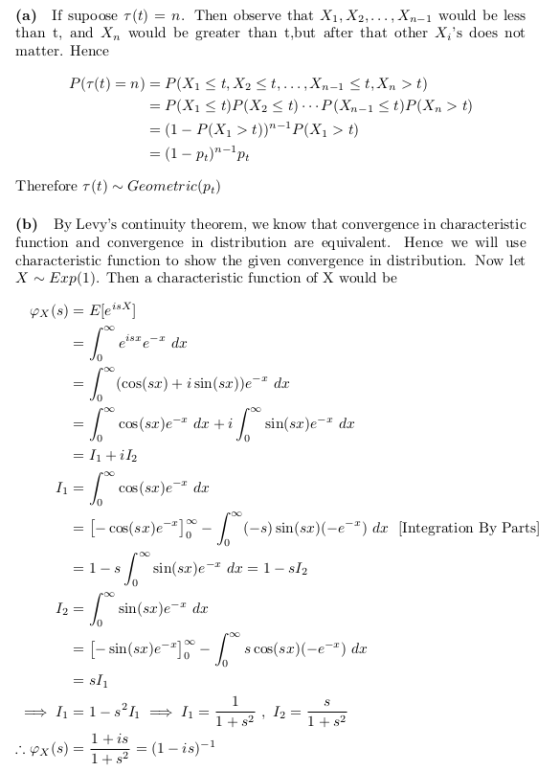
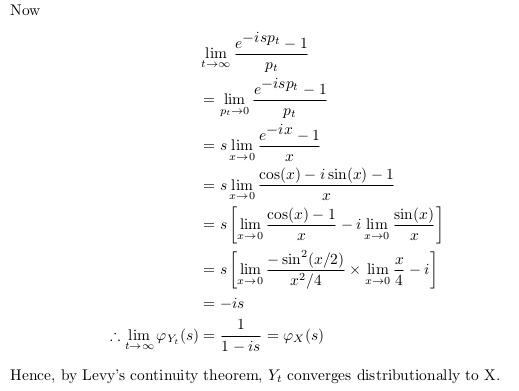
7. Let X1, X2,.. be i.i.d. random variables, and let T(t)minn: X > t, t20. (a)...
7. Let X1, X2, ... be an i.i.d. random variables. (a) Show that max(X1,... , X,n)/n...
 7. Let X1, X2, ... be an i.i.d. random variables. (a) Show that max(X1,... , X,n)/n >0 in probability if nP(Xn > n) -» 0. (b) Find a random variable Y satisfying nP(Y > n) ->0 and E(Y) = Oo
Let X1, X2 · · · X10 be i.i.d. random variables. And all of them have...
Let X1, X2 · · · X10 be i.i.d. random variables. And all of them have the distribution uniform[0, 2]. Please calculate the variance of the 2nd largest number among these X’s.
Let λ >0 and suppose that X1,X2,...,Xn be i.i.d. random variables with Xi∼Exp(λ). Find the PDF...
Let λ >0 and suppose that X1,X2,...,Xn be i.i.d. random variables with Xi∼Exp(λ). Find the PDF of X1+···+Xn. Use convolution formula and prove by induction
Let X1, X2, X3, . be a sequence of i.i.d. Uniform(0,1) random variables. Define the sequence...
 Let X1, X2, X3, . be a sequence of i.i.d. Uniform(0,1) random variables. Define the sequence Yn as Ymin(X1, X2,,Xn) Prove the following convergence results independently (i.e, do not conclude the weaker convergence modes from the stronger ones). d Yn 0. a. P b.Y 0. L 0, for all r 1 Yn C. a.s d. Y 0.
Let X1, X2, X3, . be a sequence of i.i.d. Uniform(0,1) random variables. Define the sequence Yn as Ymin(X1, X2,,Xn) Prove the following...
Let X1, X2, X3, . be a sequence of i.i.d. Uniform(0,1) random variables. Define the sequence Yn as Ymin(X1, X2,,Xn) Prove the following convergence results independently (i.e, do not conclude the weaker convergence modes from the stronger ones). d Yn 0. a. P b.Y 0. L 0, for all r 1 Yn C. a.s d. Y 0.
Let X1, X2, X3, . be a sequence of i.i.d. Uniform(0,1) random variables. Define the sequence Yn as Ymin(X1, X2,,Xn) Prove the following...
1. Let X1, X2 be i.i.d with this distribution: f(x) = 3e cx, x ≥ 0...
1. Let X1, X2 be i.i.d with this distribution: f(x) = 3e cx, x ≥ 0 a. Find the value of c b. Recognize this as a famous distribution that we’ve learned in class. Using your knowledge of this distribution, find the t such that P(X1 > t) = 0.98. c. Let M = max(X1, X2). Find P(M < 10)
8. Let X1, X2,...,X, U(0,1) random variables and let M = max(X1, X2,...,xn). - Show that...
 8. Let X1, X2,...,X, U(0,1) random variables and let M = max(X1, X2,...,xn). - Show that M. 1, that is, M, converges in probability to 1 as n o . - Show that n(1 - M.) Exp(1), that is, n(1 - M.) converges in distribution to an exponential r.v. with mean 1 as n .
5. Let X1, X2,... , X100 be i.i.d. random variables, following the normal distribution N(0, 102)....
 5. Let X1, X2,... , X100 be i.i.d. random variables, following the normal distribution N(0, 102). Let α denote the probability that there are at least 3 variables among them whose absolute value is larger than 19.6. Compute α, and give an approxi- mate value of α with an error less than 0.01 according to the Poisson distribution. 15pts]
5. Let X1, X2,... , X100 be i.i.d. random variables, following the normal distribution N(0, 102). Let α denote the probability...
5. Let X1, X2,... , X100 be i.i.d. random variables, following the normal distribution N(0, 102). Let α denote the probability that there are at least 3 variables among them whose absolute value is larger than 19.6. Compute α, and give an approxi- mate value of α with an error less than 0.01 according to the Poisson distribution. 15pts]
5. Let X1, X2,... , X100 be i.i.d. random variables, following the normal distribution N(0, 102). Let α denote the probability...
Please show step by step solution. 7. Let X1, X2, ..., Xn be i.i.d. random variables...
 Please show step by step solution.
7. Let X1, X2, ..., Xn be i.i.d. random variables drawn from a N(u,0%). Show that the Sample Variance (52) and the Maximum Likelihood Estimator (S) of o2 are both Consistent Estimators for o?. S2 27=2(X-X)2 and S 21-2(X;-) n-1 n (n-1)S Hint: has a Chi-Square Distr. with (n − 1) degrees of freedom. E(x{n-1)) = n-1,V(xin-1)) = 2(n − 1)
Please show step by step solution.
7. Let X1, X2, ..., Xn be i.i.d. random variables drawn from a N(u,0%). Show that the Sample Variance (52) and the Maximum Likelihood Estimator (S) of o2 are both Consistent Estimators for o?. S2 27=2(X-X)2 and S 21-2(X;-) n-1 n (n-1)S Hint: has a Chi-Square Distr. with (n − 1) degrees of freedom. E(x{n-1)) = n-1,V(xin-1)) = 2(n − 1)
8. Let X1...., X, be i.i.d. ~E(1) random variables (i.e., they are independent and identically distributed,...
 8. Let X1...., X, be i.i.d. ~E(1) random variables (i.e., they are independent and identically distributed, all with the exponential distribution of parameter 1 = 1). a) Compute the cdf of Yn = min(X1,...,xn). b) How do P({Y, St}) and P({X1 <t}) compare when n is large and t is such that t<? c) Compute the odf of Zn = max(X1...., X.). d) How do P({Zn2 t}) and P({X1 2 t}) compare when n is large and t is such...
Central Limit Theorem: let x1,x2,...,xn be I.I.D. random variables with E(xi)= U Var(xi)= (sigma)^2 defind Z=...
Central Limit Theorem: let x1,x2,...,xn be I.I.D. random variables with E(xi)= U Var(xi)= (sigma)^2 defind Z= x1+x2+...+xn the distribution of Z converges to a gaussian distribution P(Z<=z)=1-Q((z-Uz)/(sigma)^2) Use MATLAB to prove the central limit theorem. To achieve this, you will need to generate N random variables (I.I.D. with the distribution of your choice) and show that the distribution of the sum approaches a Guassian distribution. Plot the distribution and matlab code. Hint: you may find the hist() function helpful
 7. Let X1, X2, ... be an i.i.d. random variables. (a) Show that max(X1,... , X,n)/n >0 in probability if nP(Xn > n) -» 0. (b) Find a random variable Y satisfying nP(Y > n) ->0 and E(Y) = Oo
 Let X1, X2, X3, . be a sequence of i.i.d. Uniform(0,1) random variables. Define the sequence Yn as Ymin(X1, X2,,Xn) Prove the following convergence results independently (i.e, do not conclude the weaker convergence modes from the stronger ones). d Yn 0. a. P b.Y 0. L 0, for all r 1 Yn C. a.s d. Y 0.
Let X1, X2, X3, . be a sequence of i.i.d. Uniform(0,1) random variables. Define the sequence Yn as Ymin(X1, X2,,Xn) Prove the following...
Let X1, X2, X3, . be a sequence of i.i.d. Uniform(0,1) random variables. Define the sequence Yn as Ymin(X1, X2,,Xn) Prove the following convergence results independently (i.e, do not conclude the weaker convergence modes from the stronger ones). d Yn 0. a. P b.Y 0. L 0, for all r 1 Yn C. a.s d. Y 0.
Let X1, X2, X3, . be a sequence of i.i.d. Uniform(0,1) random variables. Define the sequence Yn as Ymin(X1, X2,,Xn) Prove the following...
 8. Let X1, X2,...,X, U(0,1) random variables and let M = max(X1, X2,...,xn). - Show that M. 1, that is, M, converges in probability to 1 as n o . - Show that n(1 - M.) Exp(1), that is, n(1 - M.) converges in distribution to an exponential r.v. with mean 1 as n .
 5. Let X1, X2,... , X100 be i.i.d. random variables, following the normal distribution N(0, 102). Let α denote the probability that there are at least 3 variables among them whose absolute value is larger than 19.6. Compute α, and give an approxi- mate value of α with an error less than 0.01 according to the Poisson distribution. 15pts]
5. Let X1, X2,... , X100 be i.i.d. random variables, following the normal distribution N(0, 102). Let α denote the probability...
5. Let X1, X2,... , X100 be i.i.d. random variables, following the normal distribution N(0, 102). Let α denote the probability that there are at least 3 variables among them whose absolute value is larger than 19.6. Compute α, and give an approxi- mate value of α with an error less than 0.01 according to the Poisson distribution. 15pts]
5. Let X1, X2,... , X100 be i.i.d. random variables, following the normal distribution N(0, 102). Let α denote the probability...
 Please show step by step solution.
7. Let X1, X2, ..., Xn be i.i.d. random variables drawn from a N(u,0%). Show that the Sample Variance (52) and the Maximum Likelihood Estimator (S) of o2 are both Consistent Estimators for o?. S2 27=2(X-X)2 and S 21-2(X;-) n-1 n (n-1)S Hint: has a Chi-Square Distr. with (n − 1) degrees of freedom. E(x{n-1)) = n-1,V(xin-1)) = 2(n − 1)
Please show step by step solution.
7. Let X1, X2, ..., Xn be i.i.d. random variables drawn from a N(u,0%). Show that the Sample Variance (52) and the Maximum Likelihood Estimator (S) of o2 are both Consistent Estimators for o?. S2 27=2(X-X)2 and S 21-2(X;-) n-1 n (n-1)S Hint: has a Chi-Square Distr. with (n − 1) degrees of freedom. E(x{n-1)) = n-1,V(xin-1)) = 2(n − 1)
 8. Let X1...., X, be i.i.d. ~E(1) random variables (i.e., they are independent and identically distributed, all with the exponential distribution of parameter 1 = 1). a) Compute the cdf of Yn = min(X1,...,xn). b) How do P({Y, St}) and P({X1 <t}) compare when n is large and t is such that t<? c) Compute the odf of Zn = max(X1...., X.). d) How do P({Zn2 t}) and P({X1 2 t}) compare when n is large and t is such...
Most questions answered within 3 hours.
-
Where is the error in this code sequence?
String s1 = "Hello";
String s2 = "ello";...
asked 10 months ago -
Financial data for Joel de Paris, Inc., for last year
follow:
Joel de Paris, Inc.
Balance...
asked 10 months ago -
Consider this reaction:
Al2(SO4)3 (aq)+ BaCl3
(aq) Al2Cl6 (aq)- +
3BaSO4(s) . What is the...
asked 10 months ago -
Suppose that Savneet is considering increasing her
recent random sample from 20 car rentals to 40...
asked 10 months ago -
Trucks arrive at an unloading terminal at an average rate of 120
per hour.
Trucks arrive...
asked 10 months ago -
Why are methanol and ethanol completely soluble in water while
octanol is not very little soluble....
asked 10 months ago -
A facilities manager at a university reads in a research report
that the mean amount of...
asked 10 months ago -
When the CuSO4 is rehydrated by adding water to the anhydrous
compound, is this an endothermic...
asked 10 months ago -
A ray of sunlight is passing from diamond into crown glass; the
angle of incidence is...
asked 10 months ago -
A block of mass 0.249 kg is placed on top of a light, vertical
spring of...
asked 10 months ago -
how do the kidneys compensate in the presences of acidosis
a) trigger hyperventilate
b) reserve acid...
asked 10 months ago -
Question 501 pts
The rental rate of capital to the firm increases. Which of the
following...
asked 10 months ago