
please answer Question 7:
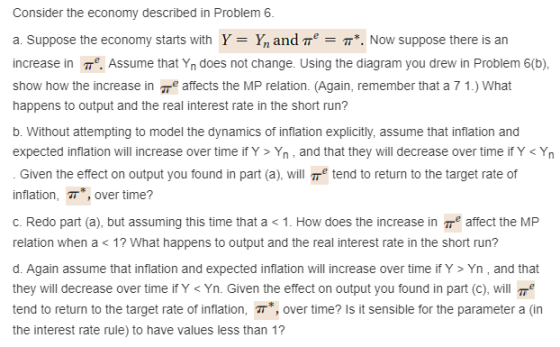
Consider the economy described in Problem 6 T a. Suppose the economy starts with Y = Y and e Now suppose there is an Assume that Yn does not change. Using the diagram you drew in Problem 6(b) increase in show how the increase in e affects the MP relation. (Again, remember that a 7 1.) What happens to output and the real interest rate in the short run? b. Without attempting to model the dynamics of inflation explicitly, assume that inflation and expected inflation will increase over time if Y> Yn and that they will decrease over time if Y
Homework Answers


Add Answer to:
please answer Question 7:
Inflation targeting and the Taylor rule in the IS-LM model Consider a...
6. 7. Inflation targeting and the Taylor rule in the IS-LM model Consider a closed economy...
 6.
7.
Inflation targeting and the Taylor rule in the IS-LM model Consider a closed economy in which the central bank follows an interest rate rule. The IS relation is given by Y C(Y- T) I(Y,r) G Where r is the real interest rate. The central bank sets the nominal interest rate according to the rule i = i* + a(n° =- T*) + b(Y- Y1) Where T is expected inflation, T* is the target rate of inflation, and Yn...
6.
7.
Inflation targeting and the Taylor rule in the IS-LM model Consider a closed economy in which the central bank follows an interest rate rule. The IS relation is given by Y C(Y- T) I(Y,r) G Where r is the real interest rate. The central bank sets the nominal interest rate according to the rule i = i* + a(n° =- T*) + b(Y- Y1) Where T is expected inflation, T* is the target rate of inflation, and Yn...
6. 7. Inflation targeting and the Taylor rule in the IS-LM model Consider a closed economy...
 6.
7.
Inflation targeting and the Taylor rule in the IS-LM model Consider a closed economy in which the central bank follows an interest rate rule. The IS relation is given by Y C(Y- T) I(Y,r) G Where r is the real interest rate. The central bank sets the nominal interest rate according to the rule i = i* + a(n° =- T*) + b(Y- Y1) Where T is expected inflation, T* is the target rate of inflation, and Yn...
6.
7.
Inflation targeting and the Taylor rule in the IS-LM model Consider a closed economy in which the central bank follows an interest rate rule. The IS relation is given by Y C(Y- T) I(Y,r) G Where r is the real interest rate. The central bank sets the nominal interest rate according to the rule i = i* + a(n° =- T*) + b(Y- Y1) Where T is expected inflation, T* is the target rate of inflation, and Yn...
1. (The IS-LM-PC model): Assume the following relations characterize the goods market: (i) 1128 +...
 1. (The IS-LM-PC model): Assume the following relations characterize the goods market: (i) 1128 +0.2Y 300(rt + xt) (iii)G,-215 :T t = 200 (iv)st= 0.15 or 15% e) Derive the IS curve (as a relation between Y and r). (b) Assume the LM curve is given by r 0.16 (ie. in period t, the central bank sets the real interest rate at 16%). What is the short-run equilibrium level of output (Yt )? (c) Suppose that L = 2000 and...
10. The Taylor rule. Using the Taylor rule, for an inflation target of 2%, an equilibrium...
 10. The Taylor rule. Using the Taylor rule, for an inflation target of 2%, an equilibrium real interest rate of 2%, m-1, and inflation of 5%, what is the nominal interest rate according to the policy rule.
Suppose the central bank, instead of following the rule r = r(Y,π), has a target level...
 Suppose the central bank, instead of following the rule r =
r(Y,π), has a target level of inflation. Specifically, it sets r
according to r = rLR + b[π − π*]. Here rLR is the real interest
rate when the economy is in long-run equilibrium; that is, it is
the real interest rate that causes the loan market to be in
equilibrium when Y = �Y. In addition, π* is the central bank’s
target level of inflation, and b is...
Suppose the central bank, instead of following the rule r =
r(Y,π), has a target level of inflation. Specifically, it sets r
according to r = rLR + b[π − π*]. Here rLR is the real interest
rate when the economy is in long-run equilibrium; that is, it is
the real interest rate that causes the loan market to be in
equilibrium when Y = �Y. In addition, π* is the central bank’s
target level of inflation, and b is...
Use the following Taylor rule to calculate what would happen to the real interest rate if...
 Use the following Taylor rule to calculate what would happen to
the real interest rate if inflation increased by 7 percentage
points.
Target federal funds rate
= Natural rate of interest + Current inflation + 1/2(Inflation gap)
+ 1/2(Output gap)
Use the following Taylor rule to calculate what would happen to the real interest rate if inflation increased by 7 percentage points. Target federal funds rate = Natural rate of interest + Current inflation + 1/2(Inflation gap) + 1/2(Output gap)...
Use the following Taylor rule to calculate what would happen to
the real interest rate if inflation increased by 7 percentage
points.
Target federal funds rate
= Natural rate of interest + Current inflation + 1/2(Inflation gap)
+ 1/2(Output gap)
Use the following Taylor rule to calculate what would happen to the real interest rate if inflation increased by 7 percentage points. Target federal funds rate = Natural rate of interest + Current inflation + 1/2(Inflation gap) + 1/2(Output gap)...
14) Suppose the AE curve is mis-measured such that the Central Bank under- estimates the effects...
 14) Suppose the AE curve is mis-measured such that the Central Bank under- estimates the effects of interest rates on expenditure. The economy starts off at Y* and TT and then experiences an adverse supply shock. The Central Bank follows non-accommodative policy using the incorrectly measured AE curve. For simplicity assume there are no lags. This leaves the economy in which of the following states? a) Recession; inflation above target b) Recession; inflation below target c) Expansion; inflation above target...
Given the Taylor Rule, if nominal inflation is 4.3%, the FED target inflation rate is 2%,...
Given the Taylor Rule, if nominal inflation is 4.3%, the FED target inflation rate is 2%, the real Fed Funds rate is 0.7%, the log of real output is 3.0155, and the log of potential output is 3.0445; what should the be the FED’s Fed Funds target rate?
1. Given the Taylor Rule, if nominal inflation is 4.3%, the FED target inflation rate is 2%, the real Fed Funds rate is...
 1. Given the Taylor Rule, if nominal inflation is 4.3%, the FED target inflation rate is 2%, the real Fed Funds rate is 0.7%, the log of real output is 3.0155, and the log of potential output is 3.0445; what should the be the FED's Fed Funds target rate?
Assume that the economy of Cranberry Republic is characterized by the following IS-LM-PC model: Phillips curve:...
 Assume that the economy of Cranberry Republic is characterized by the following IS-LM-PC model: Phillips curve: 7 = The + 0.0006(Yt-Yn) where it is the inflation rate at year t, ze is the level of inflation that people expect at the beginning of yeart, Yt is the actual level of output and Yn is the potential output. IS equation: Y = 1,450 -5,000 rt LM equation: 14 = Suppose that people form their expectation according to: TT = Tt-1 a....
 6.
7.
Inflation targeting and the Taylor rule in the IS-LM model Consider a closed economy in which the central bank follows an interest rate rule. The IS relation is given by Y C(Y- T) I(Y,r) G Where r is the real interest rate. The central bank sets the nominal interest rate according to the rule i = i* + a(n° =- T*) + b(Y- Y1) Where T is expected inflation, T* is the target rate of inflation, and Yn...
6.
7.
Inflation targeting and the Taylor rule in the IS-LM model Consider a closed economy in which the central bank follows an interest rate rule. The IS relation is given by Y C(Y- T) I(Y,r) G Where r is the real interest rate. The central bank sets the nominal interest rate according to the rule i = i* + a(n° =- T*) + b(Y- Y1) Where T is expected inflation, T* is the target rate of inflation, and Yn...
 6.
7.
Inflation targeting and the Taylor rule in the IS-LM model Consider a closed economy in which the central bank follows an interest rate rule. The IS relation is given by Y C(Y- T) I(Y,r) G Where r is the real interest rate. The central bank sets the nominal interest rate according to the rule i = i* + a(n° =- T*) + b(Y- Y1) Where T is expected inflation, T* is the target rate of inflation, and Yn...
6.
7.
Inflation targeting and the Taylor rule in the IS-LM model Consider a closed economy in which the central bank follows an interest rate rule. The IS relation is given by Y C(Y- T) I(Y,r) G Where r is the real interest rate. The central bank sets the nominal interest rate according to the rule i = i* + a(n° =- T*) + b(Y- Y1) Where T is expected inflation, T* is the target rate of inflation, and Yn...
 1. (The IS-LM-PC model): Assume the following relations characterize the goods market: (i) 1128 +0.2Y 300(rt + xt) (iii)G,-215 :T t = 200 (iv)st= 0.15 or 15% e) Derive the IS curve (as a relation between Y and r). (b) Assume the LM curve is given by r 0.16 (ie. in period t, the central bank sets the real interest rate at 16%). What is the short-run equilibrium level of output (Yt )? (c) Suppose that L = 2000 and...
 10. The Taylor rule. Using the Taylor rule, for an inflation target of 2%, an equilibrium real interest rate of 2%, m-1, and inflation of 5%, what is the nominal interest rate according to the policy rule.
 Suppose the central bank, instead of following the rule r =
r(Y,π), has a target level of inflation. Specifically, it sets r
according to r = rLR + b[π − π*]. Here rLR is the real interest
rate when the economy is in long-run equilibrium; that is, it is
the real interest rate that causes the loan market to be in
equilibrium when Y = �Y. In addition, π* is the central bank’s
target level of inflation, and b is...
Suppose the central bank, instead of following the rule r =
r(Y,π), has a target level of inflation. Specifically, it sets r
according to r = rLR + b[π − π*]. Here rLR is the real interest
rate when the economy is in long-run equilibrium; that is, it is
the real interest rate that causes the loan market to be in
equilibrium when Y = �Y. In addition, π* is the central bank’s
target level of inflation, and b is...
 Use the following Taylor rule to calculate what would happen to
the real interest rate if inflation increased by 7 percentage
points.
Target federal funds rate
= Natural rate of interest + Current inflation + 1/2(Inflation gap)
+ 1/2(Output gap)
Use the following Taylor rule to calculate what would happen to the real interest rate if inflation increased by 7 percentage points. Target federal funds rate = Natural rate of interest + Current inflation + 1/2(Inflation gap) + 1/2(Output gap)...
Use the following Taylor rule to calculate what would happen to
the real interest rate if inflation increased by 7 percentage
points.
Target federal funds rate
= Natural rate of interest + Current inflation + 1/2(Inflation gap)
+ 1/2(Output gap)
Use the following Taylor rule to calculate what would happen to the real interest rate if inflation increased by 7 percentage points. Target federal funds rate = Natural rate of interest + Current inflation + 1/2(Inflation gap) + 1/2(Output gap)...
 14) Suppose the AE curve is mis-measured such that the Central Bank under- estimates the effects of interest rates on expenditure. The economy starts off at Y* and TT and then experiences an adverse supply shock. The Central Bank follows non-accommodative policy using the incorrectly measured AE curve. For simplicity assume there are no lags. This leaves the economy in which of the following states? a) Recession; inflation above target b) Recession; inflation below target c) Expansion; inflation above target...
 1. Given the Taylor Rule, if nominal inflation is 4.3%, the FED target inflation rate is 2%, the real Fed Funds rate is 0.7%, the log of real output is 3.0155, and the log of potential output is 3.0445; what should the be the FED's Fed Funds target rate?
 Assume that the economy of Cranberry Republic is characterized by the following IS-LM-PC model: Phillips curve: 7 = The + 0.0006(Yt-Yn) where it is the inflation rate at year t, ze is the level of inflation that people expect at the beginning of yeart, Yt is the actual level of output and Yn is the potential output. IS equation: Y = 1,450 -5,000 rt LM equation: 14 = Suppose that people form their expectation according to: TT = Tt-1 a....
Most questions answered within 3 hours.
-
Where is the error in this code sequence?
String s1 = "Hello";
String s2 = "ello";...
asked 10 months ago -
Financial data for Joel de Paris, Inc., for last year
follow:
Joel de Paris, Inc.
Balance...
asked 10 months ago -
Consider this reaction:
Al2(SO4)3 (aq)+ BaCl3
(aq) Al2Cl6 (aq)- +
3BaSO4(s) . What is the...
asked 10 months ago -
Suppose that Savneet is considering increasing her
recent random sample from 20 car rentals to 40...
asked 10 months ago -
Trucks arrive at an unloading terminal at an average rate of 120
per hour.
Trucks arrive...
asked 10 months ago -
Why are methanol and ethanol completely soluble in water while
octanol is not very little soluble....
asked 10 months ago -
A facilities manager at a university reads in a research report
that the mean amount of...
asked 10 months ago -
When the CuSO4 is rehydrated by adding water to the anhydrous
compound, is this an endothermic...
asked 10 months ago -
A ray of sunlight is passing from diamond into crown glass; the
angle of incidence is...
asked 10 months ago -
A block of mass 0.249 kg is placed on top of a light, vertical
spring of...
asked 10 months ago -
how do the kidneys compensate in the presences of acidosis
a) trigger hyperventilate
b) reserve acid...
asked 10 months ago -
Question 501 pts
The rental rate of capital to the firm increases. Which of the
following...
asked 10 months ago