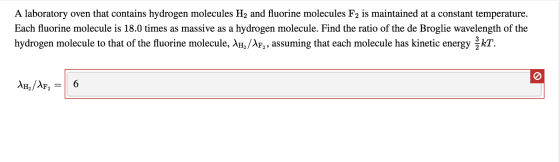
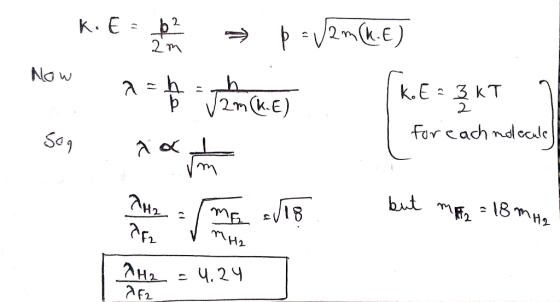
A laboratory oven that contains hydrogen molecules H 2 and fluorine molecules F 2 is maintained at a constant temperature. Each fluorine molecule is 18.0 times as massive as a hydrogen molecule. Find the ratio of the de Broglie wavelength of the hydrogen molecule to that of the fluorine molecule, λ H 2 / λ F 2 , assuming that each molecule has kinetic energy 3 2 k T .
Homework Answers
Add Answer to:
A laboratory oven that contains hydrogen molecules H 2 and
fluorine molecules F 2 is maintained...
A laboratory oven that contains hydrogen molecules H 2 and bromine molecules Br 2 is maintained...
A laboratory oven that contains hydrogen molecules H 2 and bromine molecules Br 2 is maintained at a constant temperature. Each bromine molecule is 70.0 times as massive as a hydrogen molecule. Find the ratio of the de Broglie wavelength of the hydrogen molecule to that of the bromine molecule, λ H 2 / λ Br 2 , assuming that each molecule has kinetic energy 3/2 k T . λ H 2 / λ Br 2 =
A laboratory oven that contains oxygen molecules O2O2 and fluorine molecules F2F2 is maintained at a...
A laboratory oven that contains oxygen molecules O2O2 and fluorine molecules F2F2 is maintained at a constant temperature. Each fluorine molecule is 1.131.13 times as massive as an oxygen molecule. Find the ratio of the de Broglie wavelength of the oxygen molecule to that of the fluorine molecule, λO2/λF2λO2/λF2 , assuming that each molecule has kinetic energy 32kT
SOLVE THE 3RD ONE INCLUDE ALL THE STEPS At a given temperature the rotational states of molecules are distributed according to the Boltzmann distribution. Of the hydrogen molecules in the ground state...
 SOLVE THE 3RD ONE INCLUDE ALL
THE STEPS
At a given temperature the rotational states of molecules are distributed according to the Boltzmann distribution. Of the hydrogen molecules in the ground state estimate the ratio of the number in the ground rotational state to the number in the first excited rotational state at 300 K. Take the interatomic distance as 1.06 Å. Estimate the wavelength of radiation emitted from adjacent vibration energy levels of NO molecule. Assume the force constant...
SOLVE THE 3RD ONE INCLUDE ALL
THE STEPS
At a given temperature the rotational states of molecules are distributed according to the Boltzmann distribution. Of the hydrogen molecules in the ground state estimate the ratio of the number in the ground rotational state to the number in the first excited rotational state at 300 K. Take the interatomic distance as 1.06 Å. Estimate the wavelength of radiation emitted from adjacent vibration energy levels of NO molecule. Assume the force constant...
Solve 1st one asap At a given temperature the rotational states of molecules are distributed according to the Boltzmann distribution. Of the hydrogen molecules in the ground state estimate the ratio o...
 Solve 1st one asap
At a given temperature the rotational states of molecules are distributed according to the Boltzmann distribution. Of the hydrogen molecules in the ground state estimate the ratio of the number in the ground rotational state to the number in the first excited rotational state at 300 K. Take the interatomic distance as 1.06 Å. Estimate the wavelength of radiation emitted from adjacent vibration energy levels of NO molecule. Assume the force constant k-1,550 N m In...
Solve 1st one asap
At a given temperature the rotational states of molecules are distributed according to the Boltzmann distribution. Of the hydrogen molecules in the ground state estimate the ratio of the number in the ground rotational state to the number in the first excited rotational state at 300 K. Take the interatomic distance as 1.06 Å. Estimate the wavelength of radiation emitted from adjacent vibration energy levels of NO molecule. Assume the force constant k-1,550 N m In...
You have two flasks of equal volume. Flask A contains hydrogen gas (H2) at 0°C and...
You have two flasks of equal volume. Flask A contains hydrogen gas (H2) at 0°C and 1 atm of pressure. Flask B contains CO2 gas at 25°C and 2 atm pressure. a) What is the ratio of the average kinetic energy per molecule of H2/CO2? b) What is the ratio of the average kinetic velocity of H2/CO2 molecules? c) What is the ratio of the number of molecules of CO2/H2? d) What is the mass ratio of CO2/H2?
2) Consider two protons colliding in the center of the Sun. The average kinetic energy of...
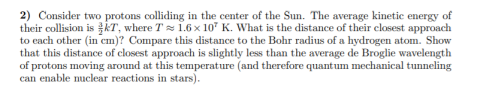 2) Consider two protons colliding in the center of the Sun. The average kinetic energy of their collision is T, where T-1.6 x 10⁷ K. What is the distance of their closest approach to each other (in cm)? Compare this distance to the Bohr radius of a hydrogen atom. Show that this distance of closest approach is slightly less than the average de Broglie wavelength of protons moving around at this temperature and therefore quantum mechanical tunneling can enable nuclear...
11. Consider a sample of hydrogen (H) and another sample of oxygen (O2). Both gases are...
 11. Consider a sample of hydrogen (H) and another sample of oxygen (O2). Both gases are at the same temperature and pressure. The volume of each gas is equal. (5) a) which gas has the greatest number of moles, or are they the same? b) which gas has the greatest number of molecules, or are they the same? c) which gas has the greatest mass, or are they the same? d) Which gas has the highest kinetic energy, or are...
For each of the following situations, you are asked which of two objects or substances has...
 For each of the following situations, you are asked which of two objects or substances has the higher Explain your answer with reference to the capacity of each to do work and say whether the energy that distinguishes them kinetic energy or potential energy. a. (1) A methane molecule, CH_4, in the stratosphere or (2) a CH_3 molecule and a hydrogen atom formed from breaking one of the carbon-hydrogen bonds in a CH_4 molecule. b. (1) A water molecule moving...
Consider a photoelectric effect experiment. Calculate the minimum photon energy needed to produce photoelectrons for the...
 Consider a photoelectric effect experiment. Calculate the minimum photon energy needed to produce photoelectrons for the following metals: Sodium Aluminum Platinum For the photon energies you calculated in problem #1, calculate the wavelength and frequency for each. In what part of the electromagnetic spectrum do these photons belong? Calculate the radii and energies of the first three allowed orbits for the Bohr Model of the hydrogen atom in both joules and electron-volts. Show your work. Calculate the energies of photons...
63. For each of the following situations, you are asked which of two objects or substances...
 63. For each of the following situations, you are asked which of two objects or substances has the higher energy. Explain your answer with reference to the capacity of each to do work and say whether the energy that distinguishes them is kinetic energy or potential energy. a. (1) A methane molecule, CH4, in the stratosphere or (2) a CH3 molecule and a hydrogen atom formed from breaking one of the carbon-hydrogen bonds in a CH4 molecule. b. (1) A...
 SOLVE THE 3RD ONE INCLUDE ALL
THE STEPS
At a given temperature the rotational states of molecules are distributed according to the Boltzmann distribution. Of the hydrogen molecules in the ground state estimate the ratio of the number in the ground rotational state to the number in the first excited rotational state at 300 K. Take the interatomic distance as 1.06 Å. Estimate the wavelength of radiation emitted from adjacent vibration energy levels of NO molecule. Assume the force constant...
SOLVE THE 3RD ONE INCLUDE ALL
THE STEPS
At a given temperature the rotational states of molecules are distributed according to the Boltzmann distribution. Of the hydrogen molecules in the ground state estimate the ratio of the number in the ground rotational state to the number in the first excited rotational state at 300 K. Take the interatomic distance as 1.06 Å. Estimate the wavelength of radiation emitted from adjacent vibration energy levels of NO molecule. Assume the force constant...
 Solve 1st one asap
At a given temperature the rotational states of molecules are distributed according to the Boltzmann distribution. Of the hydrogen molecules in the ground state estimate the ratio of the number in the ground rotational state to the number in the first excited rotational state at 300 K. Take the interatomic distance as 1.06 Å. Estimate the wavelength of radiation emitted from adjacent vibration energy levels of NO molecule. Assume the force constant k-1,550 N m In...
Solve 1st one asap
At a given temperature the rotational states of molecules are distributed according to the Boltzmann distribution. Of the hydrogen molecules in the ground state estimate the ratio of the number in the ground rotational state to the number in the first excited rotational state at 300 K. Take the interatomic distance as 1.06 Å. Estimate the wavelength of radiation emitted from adjacent vibration energy levels of NO molecule. Assume the force constant k-1,550 N m In...
 2) Consider two protons colliding in the center of the Sun. The average kinetic energy of their collision is T, where T-1.6 x 10⁷ K. What is the distance of their closest approach to each other (in cm)? Compare this distance to the Bohr radius of a hydrogen atom. Show that this distance of closest approach is slightly less than the average de Broglie wavelength of protons moving around at this temperature and therefore quantum mechanical tunneling can enable nuclear...
 11. Consider a sample of hydrogen (H) and another sample of oxygen (O2). Both gases are at the same temperature and pressure. The volume of each gas is equal. (5) a) which gas has the greatest number of moles, or are they the same? b) which gas has the greatest number of molecules, or are they the same? c) which gas has the greatest mass, or are they the same? d) Which gas has the highest kinetic energy, or are...
 For each of the following situations, you are asked which of two objects or substances has the higher Explain your answer with reference to the capacity of each to do work and say whether the energy that distinguishes them kinetic energy or potential energy. a. (1) A methane molecule, CH_4, in the stratosphere or (2) a CH_3 molecule and a hydrogen atom formed from breaking one of the carbon-hydrogen bonds in a CH_4 molecule. b. (1) A water molecule moving...
 Consider a photoelectric effect experiment. Calculate the minimum photon energy needed to produce photoelectrons for the following metals: Sodium Aluminum Platinum For the photon energies you calculated in problem #1, calculate the wavelength and frequency for each. In what part of the electromagnetic spectrum do these photons belong? Calculate the radii and energies of the first three allowed orbits for the Bohr Model of the hydrogen atom in both joules and electron-volts. Show your work. Calculate the energies of photons...
 63. For each of the following situations, you are asked which of two objects or substances has the higher energy. Explain your answer with reference to the capacity of each to do work and say whether the energy that distinguishes them is kinetic energy or potential energy. a. (1) A methane molecule, CH4, in the stratosphere or (2) a CH3 molecule and a hydrogen atom formed from breaking one of the carbon-hydrogen bonds in a CH4 molecule. b. (1) A...
Most questions answered within 3 hours.
-
Where is the error in this code sequence?
String s1 = "Hello";
String s2 = "ello";...
asked 10 months ago -
Financial data for Joel de Paris, Inc., for last year
follow:
Joel de Paris, Inc.
Balance...
asked 10 months ago -
Consider this reaction:
Al2(SO4)3 (aq)+ BaCl3
(aq) Al2Cl6 (aq)- +
3BaSO4(s) . What is the...
asked 10 months ago -
Suppose that Savneet is considering increasing her
recent random sample from 20 car rentals to 40...
asked 10 months ago -
Trucks arrive at an unloading terminal at an average rate of 120
per hour.
Trucks arrive...
asked 10 months ago -
Why are methanol and ethanol completely soluble in water while
octanol is not very little soluble....
asked 10 months ago -
A facilities manager at a university reads in a research report
that the mean amount of...
asked 10 months ago -
When the CuSO4 is rehydrated by adding water to the anhydrous
compound, is this an endothermic...
asked 10 months ago -
A ray of sunlight is passing from diamond into crown glass; the
angle of incidence is...
asked 10 months ago -
A block of mass 0.249 kg is placed on top of a light, vertical
spring of...
asked 10 months ago -
how do the kidneys compensate in the presences of acidosis
a) trigger hyperventilate
b) reserve acid...
asked 10 months ago -
Question 501 pts
The rental rate of capital to the firm increases. Which of the
following...
asked 10 months ago