for the figure
a) calculate the magnetic field on the vertical segments of the
closed loop
b) calculates net magnetic force on the closed loop
Homework Answers

Add Answer to:
for the figure
a) calculate the magnetic field on the vertical segments of the
closed loop...
For the figure on the right: a) Draw the magnetic field on the closed loop produced....
 For the figure on the right: a) Draw the magnetic field on the closed loop produced. by the straight wire. b) Draw a magnetic force on each of the closed loop segments. c) Calculate the magnetic field on the vertical segments of the closed loop. d) Calculate the net magnetic force on the closed loop. 0 0
A nonuniform magnetic field exerts a net force on a current loop ofradius R. The figure...
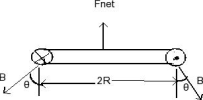 A nonuniform magnetic field exerts a net force on a current loop
ofradius R. The figure shows a magnetic field that is diverging
fromthe end of the bar magnet. The magnetic field at the position
ofthe current loop makes an angle θ with respect to
thevertical.
a) Find an expression for the net magnetic force on
thecurrent.
b)Calculate the force if R=2.0cm, I =0.50A, B=200mT, and
θ=20degrees
A nonuniform magnetic field exerts a net force on a current loop
ofradius R. The figure shows a magnetic field that is diverging
fromthe end of the bar magnet. The magnetic field at the position
ofthe current loop makes an angle θ with respect to
thevertical.
a) Find an expression for the net magnetic force on
thecurrent.
b)Calculate the force if R=2.0cm, I =0.50A, B=200mT, and
θ=20degrees
You know that the net magnetic force on the (closed) current loop in the uniform magnetic...
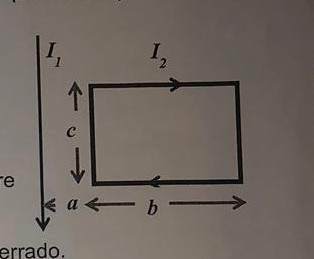
 You know that the net magnetic force on the (closed) current
loop in the uniform magnetic field is zero. As shown in the figure
below, the rectangular thin wire loop running current
I2=8.97 A is, however, in the
non-uniform magnetic field produced by a long straight wire
carrying current I1=13.4 A. The
rectangular loop and the source wire are in the same
(xy)-plane with the geometrical dimensions
illustrated in the figure and equal to a=0.68 cm,
b=1.7 cm and c=53.5...
You know that the net magnetic force on the (closed) current
loop in the uniform magnetic field is zero. As shown in the figure
below, the rectangular thin wire loop running current
I2=8.97 A is, however, in the
non-uniform magnetic field produced by a long straight wire
carrying current I1=13.4 A. The
rectangular loop and the source wire are in the same
(xy)-plane with the geometrical dimensions
illustrated in the figure and equal to a=0.68 cm,
b=1.7 cm and c=53.5...
You know that the net magnetic force on the (closed) current loop in the uniform magnetic...
 You know that the net magnetic force on the (closed) current loop in the uniform magnetic field is zero. As shown in the figure below, the rectangular thin wire loop running current 12=8.45 A is, however, in the non-uniform magnetic field produced by a long straight wire carrying current 11=13.88 A. The rectangular loop and the source wire are in the same (xy)-plane with the geometrical dimensions illustrated in the figure and equal to a=0.96 cm, b=2 cm and c=67...
Problem Show coMplere solutions andm 1. In Figure 1, the wire loop consists of four segments....
 Problem Show coMplere solutions andm 1. In Figure 1, the wire loop consists of four segments. Segments A and B are quarter- circles of radii 10.0 cm and 20.0 cm respectively. Segments C and D are straight. The current in the loop is 10.0 A. The loop is in a uniform magnetic fleld of 0.300 T In the +z direction. Determine the magnetic force on (a) segment A, (7 points) (b) segment B, (7 points) (c) segment C, (4 points)...
Q1. (40 points) The closed loop shown in the figure carries a current of 3.0 A...
 Q1. (40 points) The closed loop shown in the figure carries a current of 3.0 A in the clockwise direction. The radius of the outer arc is 0.40 m and spans over an angle of 320°and radius of inner arc is 0.30 m and spans over an angle of 40°. Point P is at the center of both arcs. a) (10 points) Calculate the magnetic field vector at point P due to outer arc. b) (10 points) Calculate the magnetic...
In the figure, a region with constant (externally produced) magnetic field is shown. A wire loop...
 In the figure, a region with
constant (externally produced) magnetic field is shown. A wire loop
moves into the magnetic field.
//img.homeworklib.com/questions/b9da6130-ca78-11eb-8c71-8b0cea09251c.gif
Which of the following is correct? While the loop is moving into
the region with the constant external magnetic field, the magnetic
field inside the loop due to the induced current in the loop points
...
No magnetic field is induced by the movement of the loop.
... down
... left
... into the page
... right
......
In the figure, a region with
constant (externally produced) magnetic field is shown. A wire loop
moves into the magnetic field.
//img.homeworklib.com/questions/b9da6130-ca78-11eb-8c71-8b0cea09251c.gif
Which of the following is correct? While the loop is moving into
the region with the constant external magnetic field, the magnetic
field inside the loop due to the induced current in the loop points
...
No magnetic field is induced by the movement of the loop.
... down
... left
... into the page
... right
......
The picture shows a rectangular current-carrying loop in a uniform magnetic field that is directed right.
 The picture shows a rectangular current-carrying loop in a uniform magnetic field that is directed right. The loop is free to rotate about the axis shown as the dashed line in the top view. (a) Select all the correct statements about this situation from the list below. As seen from the side view, the initial net torque on the loop is clockwise As seen from the side view, the initial net torque on the loop is counterclockwise As seen in the top view, the...
Q1: Consider a square loop in the yz plane. The corners of the loop are at (0.1.1) (x,y,z (0,2,1);(x.y,z)-(0,2,2); and (x.y,z)-(0,1,2).The current flowing around the perimeter of the loop is 1 mA in...
 Q1: Consider a square loop in the yz plane. The corners of the loop are at (0.1.1) (x,y,z (0,2,1);(x.y,z)-(0,2,2); and (x.y,z)-(0,1,2).The current flowing around the perimeter of the loop is 1 mA in the direction shown in Figure. Calculate the net force acting on the square loop if (a) B 2ax (a uniform magnetic field). (b) The magnetic field is produced by a vertical current filament (I- 100A) coinciding with the z axis.
Q1: Consider a square loop in the...
Q1: Consider a square loop in the yz plane. The corners of the loop are at (0.1.1) (x,y,z (0,2,1);(x.y,z)-(0,2,2); and (x.y,z)-(0,1,2).The current flowing around the perimeter of the loop is 1 mA in the direction shown in Figure. Calculate the net force acting on the square loop if (a) B 2ax (a uniform magnetic field). (b) The magnetic field is produced by a vertical current filament (I- 100A) coinciding with the z axis.
Q1: Consider a square loop in the...
 For the figure on the right: a) Draw the magnetic field on the closed loop produced. by the straight wire. b) Draw a magnetic force on each of the closed loop segments. c) Calculate the magnetic field on the vertical segments of the closed loop. d) Calculate the net magnetic force on the closed loop. 0 0
 A nonuniform magnetic field exerts a net force on a current loop
ofradius R. The figure shows a magnetic field that is diverging
fromthe end of the bar magnet. The magnetic field at the position
ofthe current loop makes an angle θ with respect to
thevertical.
a) Find an expression for the net magnetic force on
thecurrent.
b)Calculate the force if R=2.0cm, I =0.50A, B=200mT, and
θ=20degrees
A nonuniform magnetic field exerts a net force on a current loop
ofradius R. The figure shows a magnetic field that is diverging
fromthe end of the bar magnet. The magnetic field at the position
ofthe current loop makes an angle θ with respect to
thevertical.
a) Find an expression for the net magnetic force on
thecurrent.
b)Calculate the force if R=2.0cm, I =0.50A, B=200mT, and
θ=20degrees
 You know that the net magnetic force on the (closed) current
loop in the uniform magnetic field is zero. As shown in the figure
below, the rectangular thin wire loop running current
I2=8.97 A is, however, in the
non-uniform magnetic field produced by a long straight wire
carrying current I1=13.4 A. The
rectangular loop and the source wire are in the same
(xy)-plane with the geometrical dimensions
illustrated in the figure and equal to a=0.68 cm,
b=1.7 cm and c=53.5...
You know that the net magnetic force on the (closed) current
loop in the uniform magnetic field is zero. As shown in the figure
below, the rectangular thin wire loop running current
I2=8.97 A is, however, in the
non-uniform magnetic field produced by a long straight wire
carrying current I1=13.4 A. The
rectangular loop and the source wire are in the same
(xy)-plane with the geometrical dimensions
illustrated in the figure and equal to a=0.68 cm,
b=1.7 cm and c=53.5...
 You know that the net magnetic force on the (closed) current loop in the uniform magnetic field is zero. As shown in the figure below, the rectangular thin wire loop running current 12=8.45 A is, however, in the non-uniform magnetic field produced by a long straight wire carrying current 11=13.88 A. The rectangular loop and the source wire are in the same (xy)-plane with the geometrical dimensions illustrated in the figure and equal to a=0.96 cm, b=2 cm and c=67...
 Problem Show coMplere solutions andm 1. In Figure 1, the wire loop consists of four segments. Segments A and B are quarter- circles of radii 10.0 cm and 20.0 cm respectively. Segments C and D are straight. The current in the loop is 10.0 A. The loop is in a uniform magnetic fleld of 0.300 T In the +z direction. Determine the magnetic force on (a) segment A, (7 points) (b) segment B, (7 points) (c) segment C, (4 points)...
 Q1. (40 points) The closed loop shown in the figure carries a current of 3.0 A in the clockwise direction. The radius of the outer arc is 0.40 m and spans over an angle of 320°and radius of inner arc is 0.30 m and spans over an angle of 40°. Point P is at the center of both arcs. a) (10 points) Calculate the magnetic field vector at point P due to outer arc. b) (10 points) Calculate the magnetic...
 In the figure, a region with
constant (externally produced) magnetic field is shown. A wire loop
moves into the magnetic field.
//img.homeworklib.com/questions/b9da6130-ca78-11eb-8c71-8b0cea09251c.gif
Which of the following is correct? While the loop is moving into
the region with the constant external magnetic field, the magnetic
field inside the loop due to the induced current in the loop points
...
No magnetic field is induced by the movement of the loop.
... down
... left
... into the page
... right
......
In the figure, a region with
constant (externally produced) magnetic field is shown. A wire loop
moves into the magnetic field.
//img.homeworklib.com/questions/b9da6130-ca78-11eb-8c71-8b0cea09251c.gif
Which of the following is correct? While the loop is moving into
the region with the constant external magnetic field, the magnetic
field inside the loop due to the induced current in the loop points
...
No magnetic field is induced by the movement of the loop.
... down
... left
... into the page
... right
......
 Q1: Consider a square loop in the yz plane. The corners of the loop are at (0.1.1) (x,y,z (0,2,1);(x.y,z)-(0,2,2); and (x.y,z)-(0,1,2).The current flowing around the perimeter of the loop is 1 mA in the direction shown in Figure. Calculate the net force acting on the square loop if (a) B 2ax (a uniform magnetic field). (b) The magnetic field is produced by a vertical current filament (I- 100A) coinciding with the z axis.
Q1: Consider a square loop in the...
Q1: Consider a square loop in the yz plane. The corners of the loop are at (0.1.1) (x,y,z (0,2,1);(x.y,z)-(0,2,2); and (x.y,z)-(0,1,2).The current flowing around the perimeter of the loop is 1 mA in the direction shown in Figure. Calculate the net force acting on the square loop if (a) B 2ax (a uniform magnetic field). (b) The magnetic field is produced by a vertical current filament (I- 100A) coinciding with the z axis.
Q1: Consider a square loop in the...
Most questions answered within 3 hours.
-
Where is the error in this code sequence?
String s1 = "Hello";
String s2 = "ello";...
asked 11 months ago -
Financial data for Joel de Paris, Inc., for last year
follow:
Joel de Paris, Inc.
Balance...
asked 11 months ago -
Consider this reaction:
Al2(SO4)3 (aq)+ BaCl3
(aq) Al2Cl6 (aq)- +
3BaSO4(s) . What is the...
asked 11 months ago -
Suppose that Savneet is considering increasing her
recent random sample from 20 car rentals to 40...
asked 11 months ago -
Trucks arrive at an unloading terminal at an average rate of 120
per hour.
Trucks arrive...
asked 11 months ago -
Why are methanol and ethanol completely soluble in water while
octanol is not very little soluble....
asked 11 months ago -
A facilities manager at a university reads in a research report
that the mean amount of...
asked 11 months ago -
When the CuSO4 is rehydrated by adding water to the anhydrous
compound, is this an endothermic...
asked 11 months ago -
A ray of sunlight is passing from diamond into crown glass; the
angle of incidence is...
asked 11 months ago -
A block of mass 0.249 kg is placed on top of a light, vertical
spring of...
asked 11 months ago -
how do the kidneys compensate in the presences of acidosis
a) trigger hyperventilate
b) reserve acid...
asked 11 months ago -
Question 501 pts
The rental rate of capital to the firm increases. Which of the
following...
asked 11 months ago