If T is a kinetic energy, p is the length of a momentum vector and v...
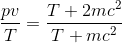
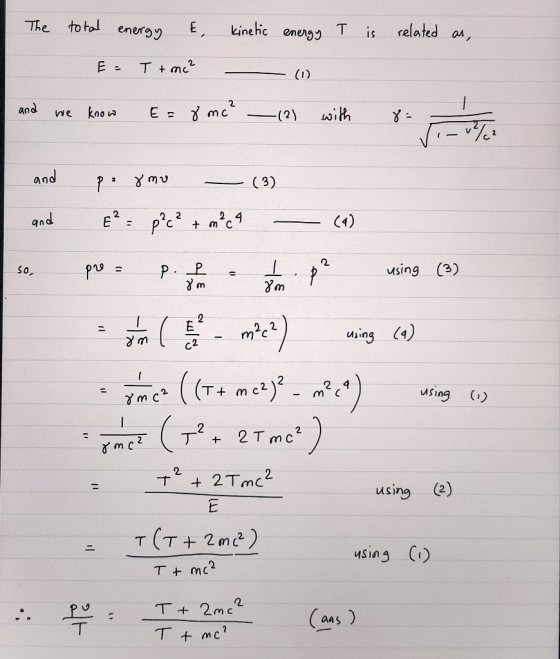
If T is a kinetic energy, p is the length of a momentum vector and v is the length of a velocity vector of a particle with mass m show that:
Homework Answers
Add Answer to:
If T is a kinetic energy, p is the length of a momentum vector
and v...
(a) If the kinetic energy K and the momentum p of a particle can be measured,...
(a) If the kinetic energy K and the momentum p of a particle can be measured, it should be possible to find its mass m and thus identify the particle. Show that m = ((pc)2 - K2) / 2Kc2
Show that if an electron is accelerated through V volts then the deBroglie wave- length in angstr...
 solve last one .include all the steps
Show that if an electron is accelerated through V volts then the deBroglie wave- length in angstroms is given by λ-(1 ) 12 A thermal neutron has a speed v at temperature T 300 K and kinetic energy L. Calculate its deBroglie wavelength. State whether a beam of these neutrons could be diffracted by a crystal, and why? (b) Use Heisenberg's Uncertainty principle to estimate the kinetic energy (in MeV) of a nucleon...
solve last one .include all the steps
Show that if an electron is accelerated through V volts then the deBroglie wave- length in angstroms is given by λ-(1 ) 12 A thermal neutron has a speed v at temperature T 300 K and kinetic energy L. Calculate its deBroglie wavelength. State whether a beam of these neutrons could be diffracted by a crystal, and why? (b) Use Heisenberg's Uncertainty principle to estimate the kinetic energy (in MeV) of a nucleon...
PHYS101 21 . a) Write down expressions for the total energy, E, and the momentum, p,...
 PHYS101 21 . a) Write down expressions for the total energy, E, and the momentum, p, of a particle. Express your answers in terms of the rest mass, m, and velocity, u, of the particle. 4 marks) Using these expressions, show that E2-ap of the momentum. m2ct, where p Ipl is the magnitude (4 marks) b) A photon of frequency v is scattered trough 180° by an electron initially at rest in the laboratory. Show that the frequency of the...
V If two particles of different masses have equal kinetic energy they also have equal momentum....
 V If two particles of different masses have equal kinetic energy they also have equal momentum. The kinetic energy is always conserved both in elastic collisions and inelastic collisions. If the momentum of a single particle is zero, its kinetic energy may not be zero. The linear momentum of an object is proportional to the mass of the object. A large force always produces a larger impulse on a body than a smaller force. If the kinetic energy of a...
Determine the equation of the momentum of a particle of mass m and kinetic energy KE....
Determine the equation of the momentum of a particle of mass m and kinetic energy KE. Express your answer in terms of the variables KE, m and c. (KE/c) +mc is incorrect p=
QUESTION 26 Which of the following is NOT a vector? Kinetic Energy Momentum the Normal Force...
QUESTION 26 Which of the following is NOT a vector? Kinetic Energy Momentum the Normal Force Acceleration Displacement Velocity
The momentum and the kinetic energy of particle A is two times and six times the...
The momentum and the kinetic energy of particle A is two times and six times the momentum and the kinetic energy of particle B, respectively. What is the ratio of the mass of particle A to that of particle B?
Determine the equation of the momentum of a particle of mass m and kinetic energy KE....
Determine the equation of the momentum of a particle of mass m and kinetic energy KE. Express your answer in terms of the variables KE, m and c.
All of the following are vector quantities EXCEPT rotational kinetic energy centripetal acceleration angular momentum torque...
 All of the following are vector quantities EXCEPT rotational kinetic energy centripetal acceleration angular momentum torque angular velocity
 solve last one .include all the steps
Show that if an electron is accelerated through V volts then the deBroglie wave- length in angstroms is given by λ-(1 ) 12 A thermal neutron has a speed v at temperature T 300 K and kinetic energy L. Calculate its deBroglie wavelength. State whether a beam of these neutrons could be diffracted by a crystal, and why? (b) Use Heisenberg's Uncertainty principle to estimate the kinetic energy (in MeV) of a nucleon...
solve last one .include all the steps
Show that if an electron is accelerated through V volts then the deBroglie wave- length in angstroms is given by λ-(1 ) 12 A thermal neutron has a speed v at temperature T 300 K and kinetic energy L. Calculate its deBroglie wavelength. State whether a beam of these neutrons could be diffracted by a crystal, and why? (b) Use Heisenberg's Uncertainty principle to estimate the kinetic energy (in MeV) of a nucleon...
 PHYS101 21 . a) Write down expressions for the total energy, E, and the momentum, p, of a particle. Express your answers in terms of the rest mass, m, and velocity, u, of the particle. 4 marks) Using these expressions, show that E2-ap of the momentum. m2ct, where p Ipl is the magnitude (4 marks) b) A photon of frequency v is scattered trough 180° by an electron initially at rest in the laboratory. Show that the frequency of the...
 V If two particles of different masses have equal kinetic energy they also have equal momentum. The kinetic energy is always conserved both in elastic collisions and inelastic collisions. If the momentum of a single particle is zero, its kinetic energy may not be zero. The linear momentum of an object is proportional to the mass of the object. A large force always produces a larger impulse on a body than a smaller force. If the kinetic energy of a...
 All of the following are vector quantities EXCEPT rotational kinetic energy centripetal acceleration angular momentum torque angular velocity
Most questions answered within 3 hours.
-
Where is the error in this code sequence?
String s1 = "Hello";
String s2 = "ello";...
asked 11 months ago -
Financial data for Joel de Paris, Inc., for last year
follow:
Joel de Paris, Inc.
Balance...
asked 11 months ago -
Consider this reaction:
Al2(SO4)3 (aq)+ BaCl3
(aq) Al2Cl6 (aq)- +
3BaSO4(s) . What is the...
asked 11 months ago -
Suppose that Savneet is considering increasing her
recent random sample from 20 car rentals to 40...
asked 11 months ago -
Trucks arrive at an unloading terminal at an average rate of 120
per hour.
Trucks arrive...
asked 11 months ago -
Why are methanol and ethanol completely soluble in water while
octanol is not very little soluble....
asked 11 months ago -
A facilities manager at a university reads in a research report
that the mean amount of...
asked 11 months ago -
When the CuSO4 is rehydrated by adding water to the anhydrous
compound, is this an endothermic...
asked 11 months ago -
A ray of sunlight is passing from diamond into crown glass; the
angle of incidence is...
asked 11 months ago -
A block of mass 0.249 kg is placed on top of a light, vertical
spring of...
asked 11 months ago -
how do the kidneys compensate in the presences of acidosis
a) trigger hyperventilate
b) reserve acid...
asked 11 months ago -
Question 501 pts
The rental rate of capital to the firm increases. Which of the
following...
asked 11 months ago