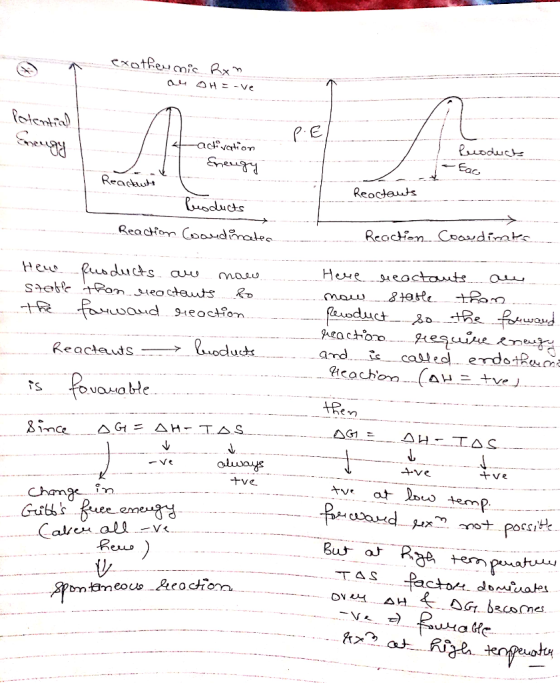
Use a potential energy diagram to determine whether reactants or products are favored during a reaction.
Use a potential energy diagram to determine whether reactants or products are favored during a reaction.
Homework Answers
Add Answer to:
Use a potential energy diagram to determine whether reactants or
products are favored during a reaction.
V Use the potential energy diagram on the left to answer the question on the table...
 V Use the potential energy diagram on the left to answer the question on the table below. AL Polonial Brgy (W) BT . | || || I Reaction Coordinato Questions What is the potential energy of the activated complex? What is the heat of the reaction (AH)? What is the potential energy of the reactants? What is the potential energy of the products? What is the activation energy?
The potential energy surface is shown below: Ea , reactants energy AH products reaction coordinate Is...
 The potential energy surface is shown below: Ea , reactants energy AH products reaction coordinate Is the reaction Endothermic or Exothermic?
Use the following info to sketch a two step potential energy diagram. Determine the missing info...
Use the following info to sketch a two step potential energy diagram. Determine the missing info and completely label the diagrams. Potential ENERGY OF REACTANTS; 500 KJ POTENTIAL ENERGY OF PRODUCTS: 350 KJ POTENTIAL ENERGY OF INTERMEDIATES: ? CHANGE IN H1: ? CHANGE IN H2: 100 KJ CHANGE IN H OVERALL: ? AC#1: ? AC#2: 700 KJ EA1: 200 KJ EA2: ?
Study the following reaction energy diagram: ol. energy reactants products Then answer the following questions about...
 Study the following reaction energy diagram: ol. energy reactants products Then answer the following questions about the chemical reaction. Does this reaction release or absorb energy? release absorb neither How many transition states occur during this reaction? yes Could this be an elementary reaction? no 0 If you said this reaction could not be elementary, then how many steps are in its mechanism? If you said this reaction could not be elementary, then enter the number of the step in...
Given the set of reactants below, complete the acid-base reaction, and indicate whether the equilibrium favors...
Given the set of reactants below, complete the acid-base reaction, and indicate whether the equilibrium favors reactants or products. CH3O- + HCl → ? CH3OH + Cl-, products are favored at equilibrium CH3OH + Cl-, reactants are favored at equilibrium Neither products nor reactants are favored at equilibrium CH3OH + HCl, products are favored at equilibrium
Predict whether the following equilbrium is favored toward products or reactants. Justify your answer. HOT Ho...
 Predict whether the following equilbrium is favored toward products
or reactants. Justify your answer.
HOT Ho La a
Predict whether the following equilbrium is favored toward products
or reactants. Justify your answer.
HOT Ho La a
products B.) ..eaction coordinate D.) 14.) Using the Potential Energy diagram pictured above, and the terms...
 products B.) ..eaction coordinate D.) 14.) Using the Potential Energy diagram pictured above, and the terms listed below write the correct terms next to the corresponding letter(s) on the diagram. (10 pts) TERMS: Transition State Rxn Coordinate Potential Energy Intermediate Reactants Pr oducts Place the correct terms / definitions where they would fit within the Potential Energy Reaction Coordinate pictured above: (A-F (2 pts each)) A.) B.) C.) D.) E.) A.) reactants products B.) -C.) Jeaction coordinate D.)
Energy diagrams 7. Draw an energy diagram for the reaction below. Label the axes, reactants, products,...
 Energy diagrams 7. Draw an energy diagram for the reaction below. Label the axes, reactants, products, intermediates, transition state, AG, AG 5 points D (BC are intermediates!) Step A™B is rate-limiting and A three-reaction where AG®= -13 kJ A B C the energies of the species are C>B> A>D.
Model 1 - Potential Energy Diagrams 1) The energy (enthalpy) change of a reaction can be...
 Model 1 - Potential Energy Diagrams 1) The energy (enthalpy) change of a reaction can be determined by the following expression: Activated Complex Transition State AH = Energy products - Energy reactants Activation Energy, E Reactants Consider the energy change for the reaction in Model 1 (the graph to the left). Potential Energy (kJ/mol) Energy change (AH) Products a) The energy change shown is (positive/negative). b) This reaction is (endothermic / exothermic). c) These (reactants / transition state) has more...
For the following reaction, the products are favored at equilibrium. Classify each of the reactants and...
 For the following reaction, the products are favored at equilibrium. Classify each of the reactants and products based on their strength as Bronsted-Lowry acids or bases. HF+CHEN CH NH+ +F Clear All F Stronger Bronsted-Lowry acid HF Weaker Bronsted-Lowry acid C3H3NH Stronger Bronsted-Lowry base CHEN Weaker Bronsted-Lowry base Previous Next
 V Use the potential energy diagram on the left to answer the question on the table below. AL Polonial Brgy (W) BT . | || || I Reaction Coordinato Questions What is the potential energy of the activated complex? What is the heat of the reaction (AH)? What is the potential energy of the reactants? What is the potential energy of the products? What is the activation energy?
 The potential energy surface is shown below: Ea , reactants energy AH products reaction coordinate Is the reaction Endothermic or Exothermic?
 Study the following reaction energy diagram: ol. energy reactants products Then answer the following questions about the chemical reaction. Does this reaction release or absorb energy? release absorb neither How many transition states occur during this reaction? yes Could this be an elementary reaction? no 0 If you said this reaction could not be elementary, then how many steps are in its mechanism? If you said this reaction could not be elementary, then enter the number of the step in...
 Predict whether the following equilbrium is favored toward products
or reactants. Justify your answer.
HOT Ho La a
Predict whether the following equilbrium is favored toward products
or reactants. Justify your answer.
HOT Ho La a
 products B.) ..eaction coordinate D.) 14.) Using the Potential Energy diagram pictured above, and the terms listed below write the correct terms next to the corresponding letter(s) on the diagram. (10 pts) TERMS: Transition State Rxn Coordinate Potential Energy Intermediate Reactants Pr oducts Place the correct terms / definitions where they would fit within the Potential Energy Reaction Coordinate pictured above: (A-F (2 pts each)) A.) B.) C.) D.) E.) A.) reactants products B.) -C.) Jeaction coordinate D.)
 Energy diagrams 7. Draw an energy diagram for the reaction below. Label the axes, reactants, products, intermediates, transition state, AG, AG 5 points D (BC are intermediates!) Step A™B is rate-limiting and A three-reaction where AG®= -13 kJ A B C the energies of the species are C>B> A>D.
 Model 1 - Potential Energy Diagrams 1) The energy (enthalpy) change of a reaction can be determined by the following expression: Activated Complex Transition State AH = Energy products - Energy reactants Activation Energy, E Reactants Consider the energy change for the reaction in Model 1 (the graph to the left). Potential Energy (kJ/mol) Energy change (AH) Products a) The energy change shown is (positive/negative). b) This reaction is (endothermic / exothermic). c) These (reactants / transition state) has more...
 For the following reaction, the products are favored at equilibrium. Classify each of the reactants and products based on their strength as Bronsted-Lowry acids or bases. HF+CHEN CH NH+ +F Clear All F Stronger Bronsted-Lowry acid HF Weaker Bronsted-Lowry acid C3H3NH Stronger Bronsted-Lowry base CHEN Weaker Bronsted-Lowry base Previous Next
Most questions answered within 3 hours.
-
Where is the error in this code sequence?
String s1 = "Hello";
String s2 = "ello";...
asked 10 months ago -
Financial data for Joel de Paris, Inc., for last year
follow:
Joel de Paris, Inc.
Balance...
asked 10 months ago -
Consider this reaction:
Al2(SO4)3 (aq)+ BaCl3
(aq) Al2Cl6 (aq)- +
3BaSO4(s) . What is the...
asked 10 months ago -
Suppose that Savneet is considering increasing her
recent random sample from 20 car rentals to 40...
asked 10 months ago -
Trucks arrive at an unloading terminal at an average rate of 120
per hour.
Trucks arrive...
asked 10 months ago -
Why are methanol and ethanol completely soluble in water while
octanol is not very little soluble....
asked 10 months ago -
A facilities manager at a university reads in a research report
that the mean amount of...
asked 10 months ago -
When the CuSO4 is rehydrated by adding water to the anhydrous
compound, is this an endothermic...
asked 10 months ago -
A ray of sunlight is passing from diamond into crown glass; the
angle of incidence is...
asked 10 months ago -
A block of mass 0.249 kg is placed on top of a light, vertical
spring of...
asked 10 months ago -
how do the kidneys compensate in the presences of acidosis
a) trigger hyperventilate
b) reserve acid...
asked 10 months ago -
Question 501 pts
The rental rate of capital to the firm increases. Which of the
following...
asked 10 months ago