
Homework Answers
Add Answer to:
just b
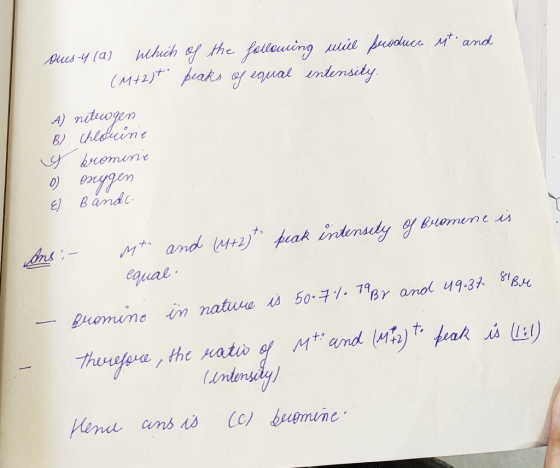
4. a) Which of the following will produce M** and (M+2)** peaks of equal...
1. In a mass spectrum, aldehydes containing a hydrogen atom in the gamma position will likely...
1. In a mass spectrum, aldehydes containing a hydrogen atom in the gamma position will likely exhibit which of the following common fragmentation patterns? Select all that apply. A : McLafferty rearrangement B : dehydration C : beta cleavage D : delta cleavage 2. A molecule containing which of the following atoms will produce M+• and (M+2)+• peaks of equal intensity? A : Nitrogen B : Chlorine C : Oxygen D : Carbon E : Bromine 3. How many rings...
3/26/2020 Name! 1. Which of the m/z values correspond to the molecular ion for the following...
 3/26/2020 Name! 1. Which of the m/z values correspond to the molecular ion for the following compound? a. 18 b. 82 C 102 d. 103 2. Which of the m/z values correspond to the molecular ion peak in the following mass spectrum? 100- Intensity miz a. 45 c. d. 29 15 3. Which of the following will produce an M** and an (M+2)** of the same intensity? a. Nitrogen b. Chlorine c. Bromine d. lodine 4. Which of the following...
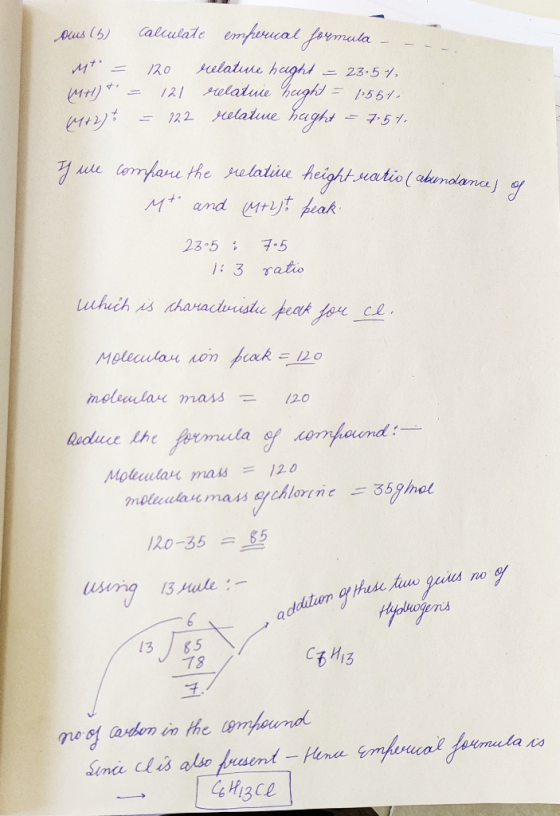
33. Propose a structure for Compound X, which has M -120 and (M+2)-122 of approximately equal...
 33. Propose a structure for Compound X, which has M -120 and (M+2)-122 of approximately equal intensity in its mass spectrum and has the following "C NMR spectral data: (5 points) Broadband decoupled "C NMR: 32.6, 118.8, 134.3 ppm DEPT-90: 134.3 ppm DEPT-135: positive peaks at 134.3 ppm; negative peaks at 32.6, 118.8 ppm
The following is the mass spectrum of Niacin. Can you please interpret each of the peaks...
 The following is the mass spectrum of Niacin. Can you please
interpret each of the peaks seen in the mass spectrum and what they
correspond to on the Niacin compound?
Niacin Mass Spectrum Relative Intensity LES .45 1718 2025262728 No 89 9495 III. 6162366566768 70 60 72757 11,80 80 122| 20 30 40 50 70 100 1 10 120 m/z
The following is the mass spectrum of Niacin. Can you please
interpret each of the peaks seen in the mass spectrum and what they
correspond to on the Niacin compound?
Niacin Mass Spectrum Relative Intensity LES .45 1718 2025262728 No 89 9495 III. 6162366566768 70 60 72757 11,80 80 122| 20 30 40 50 70 100 1 10 120 m/z
1. Show all your work calculating the # of Cs based on the Mand (M+1]' peaks....
 1. Show all your work calculating the # of Cs based on the Mand (M+1]' peaks. 2. Based on the mass spectrum, do you think your compound has a nitrogen atom? Explain. 3. Propose at least two molecular formulas based on the mass spectrum and calculate the exact mass of the parention. Is one of your formula more likely than the other? If so, explain. Compound 14 is a liquid (b.p. 85") which finds its greatest application as an aprotic...
Unknown 315-S20-2 Can someone help me fill out the table on the right side please IR...
 Unknown 315-S20-2
Can someone help me fill out the table on the right side
please
IR Spectrum:
Unknown # 315-S20-2 Mol. Wt. = 181.0 g/mol C-33.17% H=5.01% 0 = 17.68% Molecular Formula Degree of Unsaturation = Mass Spectrum IR spectrum (liquid film) 100- Relative Intensity 150 175 25 50 75 100 125 m/z Based on the M.W., circle & label the molecular ion peak (M). Spectrum Region Frequency (cm ) Peak Shape (sharp, broad) MAVUTO Peak Intensity (strong, med., weak)...
Unknown 315-S20-2
Can someone help me fill out the table on the right side
please
IR Spectrum:
Unknown # 315-S20-2 Mol. Wt. = 181.0 g/mol C-33.17% H=5.01% 0 = 17.68% Molecular Formula Degree of Unsaturation = Mass Spectrum IR spectrum (liquid film) 100- Relative Intensity 150 175 25 50 75 100 125 m/z Based on the M.W., circle & label the molecular ion peak (M). Spectrum Region Frequency (cm ) Peak Shape (sharp, broad) MAVUTO Peak Intensity (strong, med., weak)...
8. The nass spectrum of which compound has M and N+2 peaks of approxinately equal intensity?...
 8. The nass spectrum of which compound has M and N+2 peaks of approxinately equal intensity? A) 3-bromopentane B) 3-pentanol C) pentane D) 3-chloropentane E) 3-iodopentane 9. Consider the structure isomers. 1-bromopropane (A) and 2-bromopropane (B) respectively. How many unique proton peaks are in es H NMR? A) A: 4 types, B: 4 types B) A: 3 types, B: 2 types C) A: 2 types, B: 3 types D) A: 8 types, B: 8 types E A: 4 types, B:...
This is all i was given. No mass just the percentages of the atoms 3) Unknown 311 (56.25% C, 3.91% H, 12.5% 0) 4000 360...
 This is all i was given. No mass just the percentages of the
atoms
3) Unknown 311 (56.25% C, 3.91% H, 12.5% 0) 4000 3600 3200 2800 2400 2000 1800 1600 1400 1200 1000 0 ppm 100 Relative Intensity 25 50 75 m/z 100 125 Chemical Formula: Degrees of Unsaturation: Label Absorbance Max Relative Intensity Shape Functional group/ hybridization Considerations, Comments Signal Label Shift Integration Multiplicity Adjacent protons Hydrogen type Considerations, Comments Molecular Ion mass Special Considerations, Comments (e.g. nitrogen,...
This is all i was given. No mass just the percentages of the
atoms
3) Unknown 311 (56.25% C, 3.91% H, 12.5% 0) 4000 3600 3200 2800 2400 2000 1800 1600 1400 1200 1000 0 ppm 100 Relative Intensity 25 50 75 m/z 100 125 Chemical Formula: Degrees of Unsaturation: Label Absorbance Max Relative Intensity Shape Functional group/ hybridization Considerations, Comments Signal Label Shift Integration Multiplicity Adjacent protons Hydrogen type Considerations, Comments Molecular Ion mass Special Considerations, Comments (e.g. nitrogen,...
4) Unknown 428 (29.30% C,5.74% H) 4000 3600 3200 2800 2400 2000 1800 1800 1400 1200 1000 300 600 100- Relative Intensit...
 4) Unknown 428 (29.30% C,5.74% H) 4000 3600 3200 2800 2400 2000 1800 1800 1400 1200 1000 300 600 100- Relative Intensity 10 20 30 40 50 60 80 90 100 110 120 70 m/z peo ppm 10 ppm Chemical Formula: Degrees of Unsaturation: Label Absorbance Max Relative Intensity Shape Functional group/hybridization Considerations, Comments Signal Label Shift Integration Multiplicity Adjacent protons Hydrogen type Considerations, Comments Molecular Ion mass Special Considerations, Comments (e.g. nitrogen, bromine, or chlorine present?) #4 Final Answer:
help Integrated Problems 16.78 Do you think 'H NMR or 13C NMR spectroscopy would be more...
 help
Integrated Problems 16.78 Do you think 'H NMR or 13C NMR spectroscopy would be more suitable for distinguishing among compounds A, B, and C? Explain. 0 0 m/z 6 For each of the two mass spectra below, determine the formula of a compound that can produce it. 1030000 16.65 1-Chloropropane produced the 13C NMR spectrum shown at right. Match each carbon atom in the molecule to the signal to which it corresponds. 20 150 100 Chemical shift (ppm) 50...
help
Integrated Problems 16.78 Do you think 'H NMR or 13C NMR spectroscopy would be more suitable for distinguishing among compounds A, B, and C? Explain. 0 0 m/z 6 For each of the two mass spectra below, determine the formula of a compound that can produce it. 1030000 16.65 1-Chloropropane produced the 13C NMR spectrum shown at right. Match each carbon atom in the molecule to the signal to which it corresponds. 20 150 100 Chemical shift (ppm) 50...
 3/26/2020 Name! 1. Which of the m/z values correspond to the molecular ion for the following compound? a. 18 b. 82 C 102 d. 103 2. Which of the m/z values correspond to the molecular ion peak in the following mass spectrum? 100- Intensity miz a. 45 c. d. 29 15 3. Which of the following will produce an M** and an (M+2)** of the same intensity? a. Nitrogen b. Chlorine c. Bromine d. lodine 4. Which of the following...
 33. Propose a structure for Compound X, which has M -120 and (M+2)-122 of approximately equal intensity in its mass spectrum and has the following "C NMR spectral data: (5 points) Broadband decoupled "C NMR: 32.6, 118.8, 134.3 ppm DEPT-90: 134.3 ppm DEPT-135: positive peaks at 134.3 ppm; negative peaks at 32.6, 118.8 ppm
 The following is the mass spectrum of Niacin. Can you please
interpret each of the peaks seen in the mass spectrum and what they
correspond to on the Niacin compound?
Niacin Mass Spectrum Relative Intensity LES .45 1718 2025262728 No 89 9495 III. 6162366566768 70 60 72757 11,80 80 122| 20 30 40 50 70 100 1 10 120 m/z
The following is the mass spectrum of Niacin. Can you please
interpret each of the peaks seen in the mass spectrum and what they
correspond to on the Niacin compound?
Niacin Mass Spectrum Relative Intensity LES .45 1718 2025262728 No 89 9495 III. 6162366566768 70 60 72757 11,80 80 122| 20 30 40 50 70 100 1 10 120 m/z
 1. Show all your work calculating the # of Cs based on the Mand (M+1]' peaks. 2. Based on the mass spectrum, do you think your compound has a nitrogen atom? Explain. 3. Propose at least two molecular formulas based on the mass spectrum and calculate the exact mass of the parention. Is one of your formula more likely than the other? If so, explain. Compound 14 is a liquid (b.p. 85") which finds its greatest application as an aprotic...
 Unknown 315-S20-2
Can someone help me fill out the table on the right side
please
IR Spectrum:
Unknown # 315-S20-2 Mol. Wt. = 181.0 g/mol C-33.17% H=5.01% 0 = 17.68% Molecular Formula Degree of Unsaturation = Mass Spectrum IR spectrum (liquid film) 100- Relative Intensity 150 175 25 50 75 100 125 m/z Based on the M.W., circle & label the molecular ion peak (M). Spectrum Region Frequency (cm ) Peak Shape (sharp, broad) MAVUTO Peak Intensity (strong, med., weak)...
Unknown 315-S20-2
Can someone help me fill out the table on the right side
please
IR Spectrum:
Unknown # 315-S20-2 Mol. Wt. = 181.0 g/mol C-33.17% H=5.01% 0 = 17.68% Molecular Formula Degree of Unsaturation = Mass Spectrum IR spectrum (liquid film) 100- Relative Intensity 150 175 25 50 75 100 125 m/z Based on the M.W., circle & label the molecular ion peak (M). Spectrum Region Frequency (cm ) Peak Shape (sharp, broad) MAVUTO Peak Intensity (strong, med., weak)...
 8. The nass spectrum of which compound has M and N+2 peaks of approxinately equal intensity? A) 3-bromopentane B) 3-pentanol C) pentane D) 3-chloropentane E) 3-iodopentane 9. Consider the structure isomers. 1-bromopropane (A) and 2-bromopropane (B) respectively. How many unique proton peaks are in es H NMR? A) A: 4 types, B: 4 types B) A: 3 types, B: 2 types C) A: 2 types, B: 3 types D) A: 8 types, B: 8 types E A: 4 types, B:...
 This is all i was given. No mass just the percentages of the
atoms
3) Unknown 311 (56.25% C, 3.91% H, 12.5% 0) 4000 3600 3200 2800 2400 2000 1800 1600 1400 1200 1000 0 ppm 100 Relative Intensity 25 50 75 m/z 100 125 Chemical Formula: Degrees of Unsaturation: Label Absorbance Max Relative Intensity Shape Functional group/ hybridization Considerations, Comments Signal Label Shift Integration Multiplicity Adjacent protons Hydrogen type Considerations, Comments Molecular Ion mass Special Considerations, Comments (e.g. nitrogen,...
This is all i was given. No mass just the percentages of the
atoms
3) Unknown 311 (56.25% C, 3.91% H, 12.5% 0) 4000 3600 3200 2800 2400 2000 1800 1600 1400 1200 1000 0 ppm 100 Relative Intensity 25 50 75 m/z 100 125 Chemical Formula: Degrees of Unsaturation: Label Absorbance Max Relative Intensity Shape Functional group/ hybridization Considerations, Comments Signal Label Shift Integration Multiplicity Adjacent protons Hydrogen type Considerations, Comments Molecular Ion mass Special Considerations, Comments (e.g. nitrogen,...
 4) Unknown 428 (29.30% C,5.74% H) 4000 3600 3200 2800 2400 2000 1800 1800 1400 1200 1000 300 600 100- Relative Intensity 10 20 30 40 50 60 80 90 100 110 120 70 m/z peo ppm 10 ppm Chemical Formula: Degrees of Unsaturation: Label Absorbance Max Relative Intensity Shape Functional group/hybridization Considerations, Comments Signal Label Shift Integration Multiplicity Adjacent protons Hydrogen type Considerations, Comments Molecular Ion mass Special Considerations, Comments (e.g. nitrogen, bromine, or chlorine present?) #4 Final Answer:
 help
Integrated Problems 16.78 Do you think 'H NMR or 13C NMR spectroscopy would be more suitable for distinguishing among compounds A, B, and C? Explain. 0 0 m/z 6 For each of the two mass spectra below, determine the formula of a compound that can produce it. 1030000 16.65 1-Chloropropane produced the 13C NMR spectrum shown at right. Match each carbon atom in the molecule to the signal to which it corresponds. 20 150 100 Chemical shift (ppm) 50...
help
Integrated Problems 16.78 Do you think 'H NMR or 13C NMR spectroscopy would be more suitable for distinguishing among compounds A, B, and C? Explain. 0 0 m/z 6 For each of the two mass spectra below, determine the formula of a compound that can produce it. 1030000 16.65 1-Chloropropane produced the 13C NMR spectrum shown at right. Match each carbon atom in the molecule to the signal to which it corresponds. 20 150 100 Chemical shift (ppm) 50...
Most questions answered within 3 hours.
-
Where is the error in this code sequence?
String s1 = "Hello";
String s2 = "ello";...
asked 11 months ago -
Financial data for Joel de Paris, Inc., for last year
follow:
Joel de Paris, Inc.
Balance...
asked 11 months ago -
Consider this reaction:
Al2(SO4)3 (aq)+ BaCl3
(aq) Al2Cl6 (aq)- +
3BaSO4(s) . What is the...
asked 11 months ago -
Suppose that Savneet is considering increasing her
recent random sample from 20 car rentals to 40...
asked 11 months ago -
Trucks arrive at an unloading terminal at an average rate of 120
per hour.
Trucks arrive...
asked 11 months ago -
Why are methanol and ethanol completely soluble in water while
octanol is not very little soluble....
asked 11 months ago -
A facilities manager at a university reads in a research report
that the mean amount of...
asked 11 months ago -
When the CuSO4 is rehydrated by adding water to the anhydrous
compound, is this an endothermic...
asked 11 months ago -
A ray of sunlight is passing from diamond into crown glass; the
angle of incidence is...
asked 11 months ago -
A block of mass 0.249 kg is placed on top of a light, vertical
spring of...
asked 11 months ago -
how do the kidneys compensate in the presences of acidosis
a) trigger hyperventilate
b) reserve acid...
asked 11 months ago -
Question 501 pts
The rental rate of capital to the firm increases. Which of the
following...
asked 11 months ago