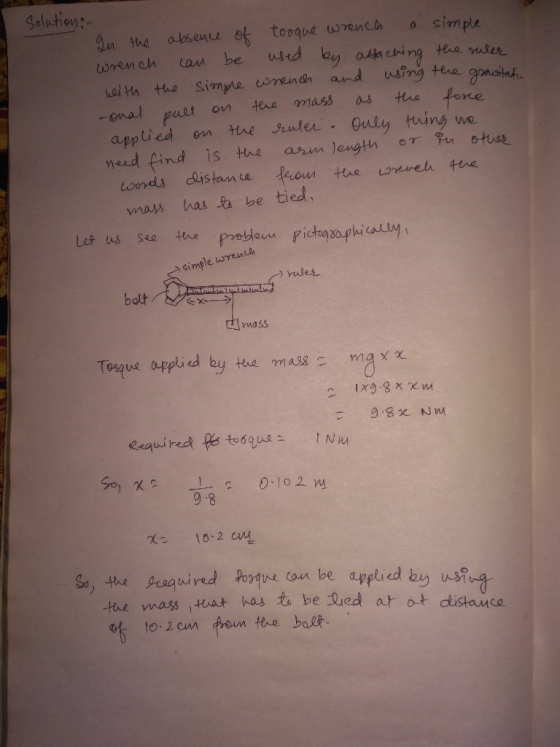
I want to tighten a bolt to a torque of 1.0 newton-meter, but I don't have...
I want to tighten a bolt to a torque of 1.0 newton-meter, but I don't have a torque wrench. I do have an ordinary wrench, a ruler, and a 1.0 kg mass tied to a string. How can I apply the correct torque to the bolt? (Don't forget the factor of g = 9.8 m/s**2.)
Homework Answers
Add Answer to:
I want to tighten a bolt to a torque of 1.0 newton-meter, but I
don't have...
(a) Suppose you have just barely loosened a rusty bolt. Your mass is 78 kg and...
 (a) Suppose you have just barely loosened a rusty bolt. Your mass is 78 kg and you have a wrench of length L = 46 cm placed as shown in the diagram below, and hung off the end so all your weight was applied, in the downward direction, to the end of the wrench. What is the magnitude and direction of the torque? magnitude direction ---Select-- your weight (b) Now suppose you had a bolt that needed to be tightened...
i have the correct answers listed below.. please show the work for how to get those...
 i have the correct answers listed below.. please show the work
for how to get those answers
When tightening a bolt, you push with an angle of 90.0° on a wrench with a force of 165.0N at a distance of 0.137m from the center of the bolt. (a) How much torque are you exerting in newton.meters (relative to the center of the bolt)? (b) Take the average radius of the bolt head to be 17.7mm. What is the average force...
i have the correct answers listed below.. please show the work
for how to get those answers
When tightening a bolt, you push with an angle of 90.0° on a wrench with a force of 165.0N at a distance of 0.137m from the center of the bolt. (a) How much torque are you exerting in newton.meters (relative to the center of the bolt)? (b) Take the average radius of the bolt head to be 17.7mm. What is the average force...
3. I have 2 conducting plates, both weighing mass M, with charges 91 and 92 (that...
 3. I have 2 conducting plates, both weighing mass M, with charges 91 and 92 (that control) on each respectively. I bolt one plate to the ground so it can't move, and I want to levitate the other plate meter above it: what do I need to do to accomplish that? What would change if I wanted to levitate it 3 meters above?
Don't need to compare to slides. I have done the problem already. Want to make sure...
 Don't need to compare to slides. I have done the problem already.
Want to make sure my numbers are correct.
- 1.4D and u=1.2D (D 3.33x 10⁻³⁰ 141pm and 143pm, respectively. Estimate the The dipole moments of the bonds C-F and C-O C m), respectively. The bond lengths percentage ionic character of the bonds. How well do the results correlate with the electronegativity differences of the atoms in the bonds (see slides), Use the following relationship for percentage of ionic...
Don't need to compare to slides. I have done the problem already.
Want to make sure my numbers are correct.
- 1.4D and u=1.2D (D 3.33x 10⁻³⁰ 141pm and 143pm, respectively. Estimate the The dipole moments of the bonds C-F and C-O C m), respectively. The bond lengths percentage ionic character of the bonds. How well do the results correlate with the electronegativity differences of the atoms in the bonds (see slides), Use the following relationship for percentage of ionic...
please I want the right answer If you'er not sure dont do it , Thanks The...
 please I want the right answer If you'er not sure dont do it ,
Thanks
The rotational inertia apparatus has a falling mass M=1kg that falls from a distance h = lm to the ground. The rotating post has a radius of r_Post = 0.01 m and two masses "m" rotating at a distance "R" from the post. The falling mass M achieves a max velocity V_M = .5 m/sec (Just before hitting the ground) which imparts a maximum angular...
please I want the right answer If you'er not sure dont do it ,
Thanks
The rotational inertia apparatus has a falling mass M=1kg that falls from a distance h = lm to the ground. The rotating post has a radius of r_Post = 0.01 m and two masses "m" rotating at a distance "R" from the post. The falling mass M achieves a max velocity V_M = .5 m/sec (Just before hitting the ground) which imparts a maximum angular...
JAVA PROGRAMMING I want to make sure I have learned the compareto statements correct and other...
 JAVA PROGRAMMING
I want to make sure I have learned the compareto statements
correct and other things. This was on my lecture slide today and I
don't understand the compare to regarding how they get values for
the strings. Please answer the following.
Suppose that s1, s2, and s3 are three strings, given as follows String s1 = "Welcome to Java". String s2 = "Programming is fun". String s3- "Welcome to Java" hat are the results of the following expressions?...
JAVA PROGRAMMING
I want to make sure I have learned the compareto statements
correct and other things. This was on my lecture slide today and I
don't understand the compare to regarding how they get values for
the strings. Please answer the following.
Suppose that s1, s2, and s3 are three strings, given as follows String s1 = "Welcome to Java". String s2 = "Programming is fun". String s3- "Welcome to Java" hat are the results of the following expressions?...
Help please, I have to briefly explain how I got my answers! 1. Which one of...
 Help please, I have to briefly explain how I got my
answers!
1. Which one of the following is an intenstve propanty? Mass . Temperature Length D. Volume Amount 2. Which of the items below would be considered the most dense? A. a piece of wood with a volume of 2.5 L and a mass of 12.5 kg B. a ball with a volume of 139 mL and a mass of 93 g C. a tire with a volume of...
Help please, I have to briefly explain how I got my
answers!
1. Which one of the following is an intenstve propanty? Mass . Temperature Length D. Volume Amount 2. Which of the items below would be considered the most dense? A. a piece of wood with a volume of 2.5 L and a mass of 12.5 kg B. a ball with a volume of 139 mL and a mass of 93 g C. a tire with a volume of...
the question is in last picture. i provided the lab content... I need guidance. thank you....
 the question is in last picture. i provided the lab content...
I need guidance. thank you.
INVESTIGATION 10 ROTATIONAL MOTION OBJECTIVE To determine the moment of inertia I of a heavy composite disk by plotting measured values of torque versus angular acceleration. THEORY Newton's second law states that for translational motion (motion in a straight line) an unbalanced force on an object results in an acceleration which is proportional to the mass of the object. This means that the heavier...
the question is in last picture. i provided the lab content...
I need guidance. thank you.
INVESTIGATION 10 ROTATIONAL MOTION OBJECTIVE To determine the moment of inertia I of a heavy composite disk by plotting measured values of torque versus angular acceleration. THEORY Newton's second law states that for translational motion (motion in a straight line) an unbalanced force on an object results in an acceleration which is proportional to the mass of the object. This means that the heavier...
I did part 1 and got 0.0049, which is correct. But I don't know how to...
 I did part 1 and got 0.0049,
which is correct. But I don't know how to do part 2 and 3. Please
help and thanks!
012 (part 1 of 3) 10.0 points A uniform rod, supported and pivoted at its midpoint, but initially at rest, has a mass of 88 g and a length 8 cm. A piece of clay with mass 44 g and velocity 2.8 m/s hits the very top of the rod, gets stuck and causes the...
I did part 1 and got 0.0049,
which is correct. But I don't know how to do part 2 and 3. Please
help and thanks!
012 (part 1 of 3) 10.0 points A uniform rod, supported and pivoted at its midpoint, but initially at rest, has a mass of 88 g and a length 8 cm. A piece of clay with mass 44 g and velocity 2.8 m/s hits the very top of the rod, gets stuck and causes the...
I have the answers to these problems but I don't understand why these are the answers...
I have the answers to these problems but I don't understand why these are the answers and how to do them. 1. Vinegar was titrated with Mg(OH)2 to find the content of acetic acid (HC2H3O2). If 20.0mL of vinegar required 5.00 mL of .800M Mg(OH)2 to reach the end point, what is the concentration of acetic acid? (Answer: .400M) 2. A Student titrates 25.00mL of tap water with 18.2 mL of .100M AgNO3 to completely precipitate the chloride ion. The...
 (a) Suppose you have just barely loosened a rusty bolt. Your mass is 78 kg and you have a wrench of length L = 46 cm placed as shown in the diagram below, and hung off the end so all your weight was applied, in the downward direction, to the end of the wrench. What is the magnitude and direction of the torque? magnitude direction ---Select-- your weight (b) Now suppose you had a bolt that needed to be tightened...
 i have the correct answers listed below.. please show the work
for how to get those answers
When tightening a bolt, you push with an angle of 90.0° on a wrench with a force of 165.0N at a distance of 0.137m from the center of the bolt. (a) How much torque are you exerting in newton.meters (relative to the center of the bolt)? (b) Take the average radius of the bolt head to be 17.7mm. What is the average force...
i have the correct answers listed below.. please show the work
for how to get those answers
When tightening a bolt, you push with an angle of 90.0° on a wrench with a force of 165.0N at a distance of 0.137m from the center of the bolt. (a) How much torque are you exerting in newton.meters (relative to the center of the bolt)? (b) Take the average radius of the bolt head to be 17.7mm. What is the average force...
 3. I have 2 conducting plates, both weighing mass M, with charges 91 and 92 (that control) on each respectively. I bolt one plate to the ground so it can't move, and I want to levitate the other plate meter above it: what do I need to do to accomplish that? What would change if I wanted to levitate it 3 meters above?
 Don't need to compare to slides. I have done the problem already.
Want to make sure my numbers are correct.
- 1.4D and u=1.2D (D 3.33x 10⁻³⁰ 141pm and 143pm, respectively. Estimate the The dipole moments of the bonds C-F and C-O C m), respectively. The bond lengths percentage ionic character of the bonds. How well do the results correlate with the electronegativity differences of the atoms in the bonds (see slides), Use the following relationship for percentage of ionic...
Don't need to compare to slides. I have done the problem already.
Want to make sure my numbers are correct.
- 1.4D and u=1.2D (D 3.33x 10⁻³⁰ 141pm and 143pm, respectively. Estimate the The dipole moments of the bonds C-F and C-O C m), respectively. The bond lengths percentage ionic character of the bonds. How well do the results correlate with the electronegativity differences of the atoms in the bonds (see slides), Use the following relationship for percentage of ionic...
 please I want the right answer If you'er not sure dont do it ,
Thanks
The rotational inertia apparatus has a falling mass M=1kg that falls from a distance h = lm to the ground. The rotating post has a radius of r_Post = 0.01 m and two masses "m" rotating at a distance "R" from the post. The falling mass M achieves a max velocity V_M = .5 m/sec (Just before hitting the ground) which imparts a maximum angular...
please I want the right answer If you'er not sure dont do it ,
Thanks
The rotational inertia apparatus has a falling mass M=1kg that falls from a distance h = lm to the ground. The rotating post has a radius of r_Post = 0.01 m and two masses "m" rotating at a distance "R" from the post. The falling mass M achieves a max velocity V_M = .5 m/sec (Just before hitting the ground) which imparts a maximum angular...
 JAVA PROGRAMMING
I want to make sure I have learned the compareto statements
correct and other things. This was on my lecture slide today and I
don't understand the compare to regarding how they get values for
the strings. Please answer the following.
Suppose that s1, s2, and s3 are three strings, given as follows String s1 = "Welcome to Java". String s2 = "Programming is fun". String s3- "Welcome to Java" hat are the results of the following expressions?...
JAVA PROGRAMMING
I want to make sure I have learned the compareto statements
correct and other things. This was on my lecture slide today and I
don't understand the compare to regarding how they get values for
the strings. Please answer the following.
Suppose that s1, s2, and s3 are three strings, given as follows String s1 = "Welcome to Java". String s2 = "Programming is fun". String s3- "Welcome to Java" hat are the results of the following expressions?...
 Help please, I have to briefly explain how I got my
answers!
1. Which one of the following is an intenstve propanty? Mass . Temperature Length D. Volume Amount 2. Which of the items below would be considered the most dense? A. a piece of wood with a volume of 2.5 L and a mass of 12.5 kg B. a ball with a volume of 139 mL and a mass of 93 g C. a tire with a volume of...
Help please, I have to briefly explain how I got my
answers!
1. Which one of the following is an intenstve propanty? Mass . Temperature Length D. Volume Amount 2. Which of the items below would be considered the most dense? A. a piece of wood with a volume of 2.5 L and a mass of 12.5 kg B. a ball with a volume of 139 mL and a mass of 93 g C. a tire with a volume of...
 the question is in last picture. i provided the lab content...
I need guidance. thank you.
INVESTIGATION 10 ROTATIONAL MOTION OBJECTIVE To determine the moment of inertia I of a heavy composite disk by plotting measured values of torque versus angular acceleration. THEORY Newton's second law states that for translational motion (motion in a straight line) an unbalanced force on an object results in an acceleration which is proportional to the mass of the object. This means that the heavier...
the question is in last picture. i provided the lab content...
I need guidance. thank you.
INVESTIGATION 10 ROTATIONAL MOTION OBJECTIVE To determine the moment of inertia I of a heavy composite disk by plotting measured values of torque versus angular acceleration. THEORY Newton's second law states that for translational motion (motion in a straight line) an unbalanced force on an object results in an acceleration which is proportional to the mass of the object. This means that the heavier...
 I did part 1 and got 0.0049,
which is correct. But I don't know how to do part 2 and 3. Please
help and thanks!
012 (part 1 of 3) 10.0 points A uniform rod, supported and pivoted at its midpoint, but initially at rest, has a mass of 88 g and a length 8 cm. A piece of clay with mass 44 g and velocity 2.8 m/s hits the very top of the rod, gets stuck and causes the...
I did part 1 and got 0.0049,
which is correct. But I don't know how to do part 2 and 3. Please
help and thanks!
012 (part 1 of 3) 10.0 points A uniform rod, supported and pivoted at its midpoint, but initially at rest, has a mass of 88 g and a length 8 cm. A piece of clay with mass 44 g and velocity 2.8 m/s hits the very top of the rod, gets stuck and causes the...
Most questions answered within 3 hours.
-
Where is the error in this code sequence?
String s1 = "Hello";
String s2 = "ello";...
asked 11 months ago -
Financial data for Joel de Paris, Inc., for last year
follow:
Joel de Paris, Inc.
Balance...
asked 11 months ago -
Consider this reaction:
Al2(SO4)3 (aq)+ BaCl3
(aq) Al2Cl6 (aq)- +
3BaSO4(s) . What is the...
asked 11 months ago -
Suppose that Savneet is considering increasing her
recent random sample from 20 car rentals to 40...
asked 11 months ago -
Trucks arrive at an unloading terminal at an average rate of 120
per hour.
Trucks arrive...
asked 11 months ago -
Why are methanol and ethanol completely soluble in water while
octanol is not very little soluble....
asked 11 months ago -
A facilities manager at a university reads in a research report
that the mean amount of...
asked 11 months ago -
When the CuSO4 is rehydrated by adding water to the anhydrous
compound, is this an endothermic...
asked 11 months ago -
A ray of sunlight is passing from diamond into crown glass; the
angle of incidence is...
asked 11 months ago -
A block of mass 0.249 kg is placed on top of a light, vertical
spring of...
asked 11 months ago -
how do the kidneys compensate in the presences of acidosis
a) trigger hyperventilate
b) reserve acid...
asked 11 months ago -
Question 501 pts
The rental rate of capital to the firm increases. Which of the
following...
asked 11 months ago