
Homework Answers
Add Answer to:
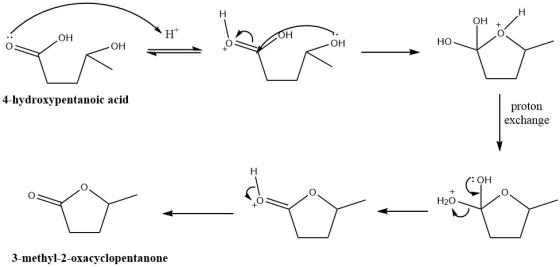
3. Write a detailed mechanism to yield 3-methyl-2-oxacyclopentanone. What is the hydroxy acid (starting material) for...
1. Propose a mechanism: Starting material: butyraldehyde Solvent: water Reagent: Potassium Hydroxide(KOH) Final product: 2-ethyl-3-hydroxy-hexanal 2....
1. Propose a mechanism: Starting material: butyraldehyde Solvent: water Reagent: Potassium Hydroxide(KOH) Final product: 2-ethyl-3-hydroxy-hexanal 2. Propose a mechanism: Starting material: Methyl Propionate Solvent: water Reagent: HCl Final product: propionic acid
What would you expect to see comparing the solubility of 2-hydroxy-3-methoxybenzaldehyde (starting material) and 2-hydroxy-3-methoxybenzoic acid...
What would you expect to see comparing the solubility of 2-hydroxy-3-methoxybenzaldehyde (starting material) and 2-hydroxy-3-methoxybenzoic acid (product) in acidic and basic media (See solubility test 4.1.1)
Write a detailed mechanism for the sulfuric acid-catalyzed dehydration of 4-methyl-2-pentanol that accounts for the formation...
Write a detailed mechanism for the sulfuric acid-catalyzed dehydration of 4-methyl-2-pentanol that accounts for the formation of all 5 of the below alkenes. (Hint: More than one carbocation rearrangement may be necessary to account for the formation of all of the products.) 4-methyl-1-pentene Z and E-4-methyl-2-pentene 2-methyl-1-pentene 2-methyl-2-pentene Unassigned
Show the detailed mechanism of the formation of methyl orange from 4- diazobenzenesulfonic acid and N,N-dimethylaniline....
 Show the detailed mechanism of the formation of methyl orange
from 4- diazobenzenesulfonic acid and N,N-dimethylaniline.
Show the detailed mechanism of the formation of methyl orange from 4-diazobenzenesulfonic acid and N, N dimethy laniline. What is the name of this mechanism? What is the name of the organic functional group formed in this reaction? What is the name of this reaction? Why does the coupling occur at the para position of the N, N-dimethylaniline? What prevents the reaction from occurring...
Show the detailed mechanism of the formation of methyl orange
from 4- diazobenzenesulfonic acid and N,N-dimethylaniline.
Show the detailed mechanism of the formation of methyl orange from 4-diazobenzenesulfonic acid and N, N dimethy laniline. What is the name of this mechanism? What is the name of the organic functional group formed in this reaction? What is the name of this reaction? Why does the coupling occur at the para position of the N, N-dimethylaniline? What prevents the reaction from occurring...
Ethylene oxide is the starting material for the synthesis of 1, 4-dioxane. Write a detailed mechanism...
 Ethylene oxide is the starting material for the synthesis of 1, 4-dioxane. Write a detailed mechanism for this synthesis (shown above). Then draw curved arrows that depict electron reorganization for Step 2 of the mechanism shown below. Unless specified otherwise, do not count proton transfers when counting steps. The starting materials of this step are provided.
Using an aldol reaction, suggest a suitable starting material and reagents for the synthesis of 4-hydroxy-4-methyl-4-phenyl-2-butanone....
Using an aldol reaction, suggest a suitable starting material and reagents for the synthesis of 4-hydroxy-4-methyl-4-phenyl-2-butanone. Select one: a. benzyl alcohol heated with sodium hydroxide, followed by reaction with 4-bromo-2-pentanone b. acetone treated with sodium hydroxide at 5oC, followed by reaction with acetophenone in water c. benzoic acid treated with sodium ethoxide at 5oC, followed by reaction with 4-bromo-2-butanone in water d. acetophenone heated with sodium ethoxide in ethanol, followed by reaction with 2-propanone in the presence of acid e....
Write a detailed reaction mechanism for the reaction between 2-methyl-2-butanol and concentrated HCl. If 2-methyl-2-butanol was...
Write a detailed reaction mechanism for the reaction between 2-methyl-2-butanol and concentrated HCl. If 2-methyl-2-butanol was treated with concentrated H2SO4 instead of concentrated HCl, what product would predominate?
what is the mechanism for 2-ethyl-3-hydroxy-hexanol? please show electron arrows. The starting materials are acetaldehyde, butanol,...
what is the mechanism for 2-ethyl-3-hydroxy-hexanol? please show electron arrows. The starting materials are acetaldehyde, butanol, EtOH, KOH Thank you
Give a detailed synthetic route to B. using starting material with 3 or fewer carbons. Give a det...
 Give a detailed synthetic route to B. using starting material with 3 or fewer carbons. Give a detailed arrow pushing mechanism for each reaction in the route. (12.5pts) Give a detailed synthetic route to A. using starting material with 3 or fewer carbons. Give a detailed arrow pushing mechanism for each reaction in the route. (12.5pts)
Give a detailed synthetic route to B. using starting material with 3 or fewer carbons. Give a detailed arrow pushing mechanism for each reaction...
Give a detailed synthetic route to B. using starting material with 3 or fewer carbons. Give a detailed arrow pushing mechanism for each reaction in the route. (12.5pts) Give a detailed synthetic route to A. using starting material with 3 or fewer carbons. Give a detailed arrow pushing mechanism for each reaction in the route. (12.5pts)
Give a detailed synthetic route to B. using starting material with 3 or fewer carbons. Give a detailed arrow pushing mechanism for each reaction...
What is the IUPAC name of the given molecule? OH Br 1-bromo-2-ethyl-2-hydroxy-3-methylpentanoic acid 2-ethyl-3-methylpentan-2-ol-1-carboxyl bromide 2-ethyl-3-methyl-2-ol-pentanoyl...
 What is the IUPAC name of the given molecule? OH Br 1-bromo-2-ethyl-2-hydroxy-3-methylpentanoic acid 2-ethyl-3-methylpentan-2-ol-1-carboxyl bromide 2-ethyl-3-methyl-2-ol-pentanoyl bromide O2-ethyl-2-hydroxy-3-methylpentanoyl bromide What statement is TRUE about the mechanism for the reaction shown here? CH,(CH)2CO,CH, NaOH CH3(CH12COCH excess heat CH3(CH)2CO,CH2 Water attacks the carbonyl carbon to form a tetrahedral intermediate. The first step of the reaction involves protonation of the ester carbonyl oxygen. One of the products formed is glycerol. The hydroxide deprotonates the alpha carbon. Which bases among the following is/are used...
 Show the detailed mechanism of the formation of methyl orange
from 4- diazobenzenesulfonic acid and N,N-dimethylaniline.
Show the detailed mechanism of the formation of methyl orange from 4-diazobenzenesulfonic acid and N, N dimethy laniline. What is the name of this mechanism? What is the name of the organic functional group formed in this reaction? What is the name of this reaction? Why does the coupling occur at the para position of the N, N-dimethylaniline? What prevents the reaction from occurring...
Show the detailed mechanism of the formation of methyl orange
from 4- diazobenzenesulfonic acid and N,N-dimethylaniline.
Show the detailed mechanism of the formation of methyl orange from 4-diazobenzenesulfonic acid and N, N dimethy laniline. What is the name of this mechanism? What is the name of the organic functional group formed in this reaction? What is the name of this reaction? Why does the coupling occur at the para position of the N, N-dimethylaniline? What prevents the reaction from occurring...
 Ethylene oxide is the starting material for the synthesis of 1, 4-dioxane. Write a detailed mechanism for this synthesis (shown above). Then draw curved arrows that depict electron reorganization for Step 2 of the mechanism shown below. Unless specified otherwise, do not count proton transfers when counting steps. The starting materials of this step are provided.
 Give a detailed synthetic route to B. using starting material with 3 or fewer carbons. Give a detailed arrow pushing mechanism for each reaction in the route. (12.5pts) Give a detailed synthetic route to A. using starting material with 3 or fewer carbons. Give a detailed arrow pushing mechanism for each reaction in the route. (12.5pts)
Give a detailed synthetic route to B. using starting material with 3 or fewer carbons. Give a detailed arrow pushing mechanism for each reaction...
Give a detailed synthetic route to B. using starting material with 3 or fewer carbons. Give a detailed arrow pushing mechanism for each reaction in the route. (12.5pts) Give a detailed synthetic route to A. using starting material with 3 or fewer carbons. Give a detailed arrow pushing mechanism for each reaction in the route. (12.5pts)
Give a detailed synthetic route to B. using starting material with 3 or fewer carbons. Give a detailed arrow pushing mechanism for each reaction...
 What is the IUPAC name of the given molecule? OH Br 1-bromo-2-ethyl-2-hydroxy-3-methylpentanoic acid 2-ethyl-3-methylpentan-2-ol-1-carboxyl bromide 2-ethyl-3-methyl-2-ol-pentanoyl bromide O2-ethyl-2-hydroxy-3-methylpentanoyl bromide What statement is TRUE about the mechanism for the reaction shown here? CH,(CH)2CO,CH, NaOH CH3(CH12COCH excess heat CH3(CH)2CO,CH2 Water attacks the carbonyl carbon to form a tetrahedral intermediate. The first step of the reaction involves protonation of the ester carbonyl oxygen. One of the products formed is glycerol. The hydroxide deprotonates the alpha carbon. Which bases among the following is/are used...
Most questions answered within 3 hours.
-
Where is the error in this code sequence?
String s1 = "Hello";
String s2 = "ello";...
asked 10 months ago -
Financial data for Joel de Paris, Inc., for last year
follow:
Joel de Paris, Inc.
Balance...
asked 10 months ago -
Consider this reaction:
Al2(SO4)3 (aq)+ BaCl3
(aq) Al2Cl6 (aq)- +
3BaSO4(s) . What is the...
asked 10 months ago -
Suppose that Savneet is considering increasing her
recent random sample from 20 car rentals to 40...
asked 10 months ago -
Trucks arrive at an unloading terminal at an average rate of 120
per hour.
Trucks arrive...
asked 10 months ago -
Why are methanol and ethanol completely soluble in water while
octanol is not very little soluble....
asked 10 months ago -
A facilities manager at a university reads in a research report
that the mean amount of...
asked 10 months ago -
When the CuSO4 is rehydrated by adding water to the anhydrous
compound, is this an endothermic...
asked 10 months ago -
A ray of sunlight is passing from diamond into crown glass; the
angle of incidence is...
asked 10 months ago -
A block of mass 0.249 kg is placed on top of a light, vertical
spring of...
asked 10 months ago -
how do the kidneys compensate in the presences of acidosis
a) trigger hyperventilate
b) reserve acid...
asked 10 months ago -
Question 501 pts
The rental rate of capital to the firm increases. Which of the
following...
asked 10 months ago