def _merge(lst: list, start: int, mid: int, end: int) -> None: """Sort the items in lst[start:end]...
def _merge(lst: list,
start: int, mid: int, end: int) -> None:
"""Sort the items in lst[start:end] in non-decreasing order.
Precondition:
lst[start:mid] and lst[mid:end] are sorted.
"""
result = []
left = start
right = mid
while left < mid and right < end:
if lst[left] < lst[right]:
result.append(lst[left])
left += 1
else:
result.append(lst[right])
right += 1
# This replaces
lst[start:end] with the correct sorted version.
lst[start:end] = result + lst[left:mid] + lst[right:end]
def find_runs(lst:
list) -> List[Tuple[int, int]]:
"""Return a list of tuples indexing the runs of lst.
Precondition: lst is non-empty.
>>>
find_runs([1, 4, 7, 10, 2, 5, 3, -1])
[(0, 4), (4, 6), (6, 7), (7, 8)]
>>> find_runs([0, 1, 2, 3, 4, 5])
[(0, 6)]
>>> find_runs([10, 4, -2, 1])
[(0, 1), (1, 2), (2, 4)]
"""
runs = []
# Keep track of the
start and end points of a run.
run_start = 0
run_end = 1
def timsort(lst: list)
-> None:
"""Sort <lst> in place.
>>> lst =
[]
>>> timsort(lst)
>>> lst
[]
>>> lst = [1]
>>> timsort(lst)
>>> lst
[1]
>>> lst = [1, 4, 7, 10, 2, 5, 3, -1]
>>> timsort(lst)
>>> lst
[-1, 1, 2, 3, 4, 5, 7, 10]
"""
runs = find_runs(lst)
help me with timsort plz
Homework Answers
# PLEASE LIKE THE SOLUTION
# FEEL FREE TO DISCUSS IN COMMENT SECTION
# run command import numpy before defining function
# timsort function sort the list in place that means no
extra variable or place is used only lst variable is used
# we use numpy and sort the list
import numpy
def timsort(lst: list) -> None:
"""Sort <lst> in place.
>>> lst = []
>>> timsort(lst)
>>> lst
[]
>>> lst = [1]
>>> timsort(lst)
>>> lst
[1]
>>> lst = [1, 4, 7, 10, 2, 5, 3, -1]
>>> timsort(lst)
>>> lst
[-1, 1, 2, 3, 4, 5, 7, 10]."""
# convert list to array
lst = numpy.array(lst)
# now sort lst using selection
sort
for i in range(0,len(lst)):
for j in range(i+1,len(lst)):
if(lst[i]>lst[j]):
#swap
temp = lst[i]
lst[i] = lst[j]
lst[j] = temp
# now convert back to list
lst = list(lst)
return lst
// SAMPLE OUTPUT
![>>> Ist = [] >>> Ist = timsort(lst) >>> Ist [] >>> Ist = [1] >>> Ist = timsort(lst) >>> Ist [1] >>> lst = [1, 4, 7, 10, 2, 5,](http://img.homeworklib.com/questions/42498bd0-9371-11ea-8719-0f0e983d0c80.png?x-oss-process=image/resize,w_560)
Add Answer to:
def _merge(lst: list,
start: int, mid: int, end: int) -> None:
"""Sort the items in lst[start:end]...
def slice_list(lst: List[Any], n: int) -> List[List[Any]]: """ Return a list containing slices of <lst> in...
def slice_list(lst: List[Any], n: int) -> List[List[Any]]: """ Return a list containing slices of <lst> in order. Each slice is a list of size <n> containing the next <n> elements in <lst>. The last slice may contain fewer than <n> elements in order to make sure that the returned list contains all elements in <lst>. === Precondition === n <= len(lst) >>> slice_list([3, 4, 6, 2, 3], 2) == [[3, 4], [6, 2], [3]] True >>> slice_list(['a', 1, 6.0, False],...
Show that mergesort is a stable algorithm by modifiying the algorithm to sort a list of...
Show that mergesort is a stable algorithm by modifiying the algorithm to sort a list of tuples (first and last names) by their second position. (Modify the merge section to break ties) Modify in python def mergesort(mlist): if len(mlist) < 2: return mlist else: mid = len(mlist)//2 return merge( mergesort(mlist[:mid]), mergesort(mlist[mid:])) # merge two sorted lists def merge(left, right): if left == []: return right elif right == []: return left elif left[0] < right[0]: return [left[0]] + merge(left[1:], right)...
Show that mergesort is a stable algorithm by modifiying the algorithm to sort a list of tuples (first and last names) by...
Show that mergesort is a stable algorithm by modifiying the algorithm to sort a list of tuples (first and last names) by their second position. (Modify the merge section to break ties) Modify in python def mergesort(mlist): if len(mlist) < 2: return mlist else: mid = len(mlist)//2 return merge( mergesort(mlist[:mid]), mergesort(mlist[mid:])) # merge two sorted lists def merge(left, right): if left == []: return right elif right == []: return left elif left[0] < right[0]: return [left[0]] + merge(left[1:], right)...
def get_indices(lst, elm): ''' (list of lists, object) -> tuple of two ints Given a list...
def get_indices(lst, elm): ''' (list of lists, object) -> tuple of two ints Given a list of lists and an element, find the first pair of indices at which that element is found and return this as a tuple of two ints. The first int would be the index of the sublist where the element occurs, and the second int would be the index within this sublist where it occurs. >>> get_indices([[1, 3, 4], [5, 6, 7]], 1) (0, 0)...
3 move_small_joker def move_small_joker(deck: List[int]) -> None: 'Swap the card with one follows it Precondition: card...
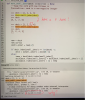 3 move_small_joker def move_small_joker(deck: List[int]) -> None: 'Swap the card with one follows it Precondition: card is a non-negative integer I have a 3 here ! >>> deck = [1, 2, 4, 3] >>> move_small_joker(deck) >>> deck (3, 1, 2, 4 >>> deck = [1, 2, 3, 4] >>> move_small.joker(deck) >>> deck [1, 2, 4, 3] new = deck new.sort small_joker = new[-2] if deck.index(small_joker) == len(deck) -1: deck = [small_joker] + deck[O:-1] else: temp = deck[deck.index(small_joker)] deck[deck. index(small_joker)] =...
Modify the sorts (selection sort, insertion sort, bubble sort, quick sort, and merge sort) by adding code to each to tally the total number of comparisons and total execution time of each algorithm. E...
Modify the sorts (selection sort, insertion sort, bubble sort, quick sort, and merge sort) by adding code to each to tally the total number of comparisons and total execution time of each algorithm. Execute the sort algorithms against the same list, recording information for the total number of comparisons and total execution time for each algorithm. Try several different lists, including at least one that is already in sorted order. ---------------------------------------------------------------------------------------------------------------- /** * Sorting demonstrates sorting and searching on an...
def calculate_total(price_list: List[list]) -> int: """Return the sum of all second elements in the sublists of...
def calculate_total(price_list: List[list]) -> int: """Return the sum of all second elements in the sublists of price_list. Precondition: price_list is a list of lists of length 2, and the second element of it sublist is an int. >>> price_list = [["apple", 1], ["sugar", 5], ["mango", 3], ... ["coffee", 9], ["trail mix", 6]] >>> calculate_total(price_list)
#We've written the function, sort_with_bubbles, below. It takes #in one list parameter, lst. However, there are...
#We've written the function, sort_with_bubbles, below. It takes #in one list parameter, lst. However, there are two problems in #our current code: # - There's a missing line # - There's a semantic error (the code does not raise an # error message, but it does not perform correctly) # #Find and fix these problems! Note that you should only need #to change or add code where explicitly indicated. # #Hint: If you're stuck, use an example input list and...
2. The mergesort is a recursive sort. What is the base case for the merge sort?...
2. The mergesort is a recursive sort. What is the base case for the merge sort? A.There is none. B. When right = left -1 C. When start = end D. When end - start = 1 3. Given the array [ 23, 83, 82, 92, 28, 21, 91, 17, 54, 32, 41, 14], what is the value of mid for the call mergesort (elements, 0, 5, temp) ? A. The value of mid is 3 B. The value of...
When sorting using merge sort, I get confused about what going on. Consider the following array...
When sorting using merge sort, I get confused about what going on. Consider the following array A = [7,5,2,8,9,1] and the following code: -------------------------------------------------------------------------------------------------------------------------- int merge_sort(int *input, int start, int end) { if (start < end) { int middle = (start + end ) / 2; merge_sort(input, start, middle); merge_sort(input, middle+1, end); merge(input, start, middle, end); } return 0; } int merge(int *input, int left, int middle, int right) { // determine lenghts int length1 = middle - left +...
 3 move_small_joker def move_small_joker(deck: List[int]) -> None: 'Swap the card with one follows it Precondition: card is a non-negative integer I have a 3 here ! >>> deck = [1, 2, 4, 3] >>> move_small_joker(deck) >>> deck (3, 1, 2, 4 >>> deck = [1, 2, 3, 4] >>> move_small.joker(deck) >>> deck [1, 2, 4, 3] new = deck new.sort small_joker = new[-2] if deck.index(small_joker) == len(deck) -1: deck = [small_joker] + deck[O:-1] else: temp = deck[deck.index(small_joker)] deck[deck. index(small_joker)] =...
Most questions answered within 3 hours.
-
Where is the error in this code sequence?
String s1 = "Hello";
String s2 = "ello";...
asked 10 months ago -
Financial data for Joel de Paris, Inc., for last year
follow:
Joel de Paris, Inc.
Balance...
asked 10 months ago -
Consider this reaction:
Al2(SO4)3 (aq)+ BaCl3
(aq) Al2Cl6 (aq)- +
3BaSO4(s) . What is the...
asked 10 months ago -
Suppose that Savneet is considering increasing her
recent random sample from 20 car rentals to 40...
asked 10 months ago -
Trucks arrive at an unloading terminal at an average rate of 120
per hour.
Trucks arrive...
asked 10 months ago -
Why are methanol and ethanol completely soluble in water while
octanol is not very little soluble....
asked 10 months ago -
A facilities manager at a university reads in a research report
that the mean amount of...
asked 10 months ago -
When the CuSO4 is rehydrated by adding water to the anhydrous
compound, is this an endothermic...
asked 10 months ago -
A ray of sunlight is passing from diamond into crown glass; the
angle of incidence is...
asked 10 months ago -
A block of mass 0.249 kg is placed on top of a light, vertical
spring of...
asked 10 months ago -
how do the kidneys compensate in the presences of acidosis
a) trigger hyperventilate
b) reserve acid...
asked 10 months ago -
Question 501 pts
The rental rate of capital to the firm increases. Which of the
following...
asked 10 months ago