1.The “per-person” versions of production functions: Write each production functiongiven below in terms of output per...
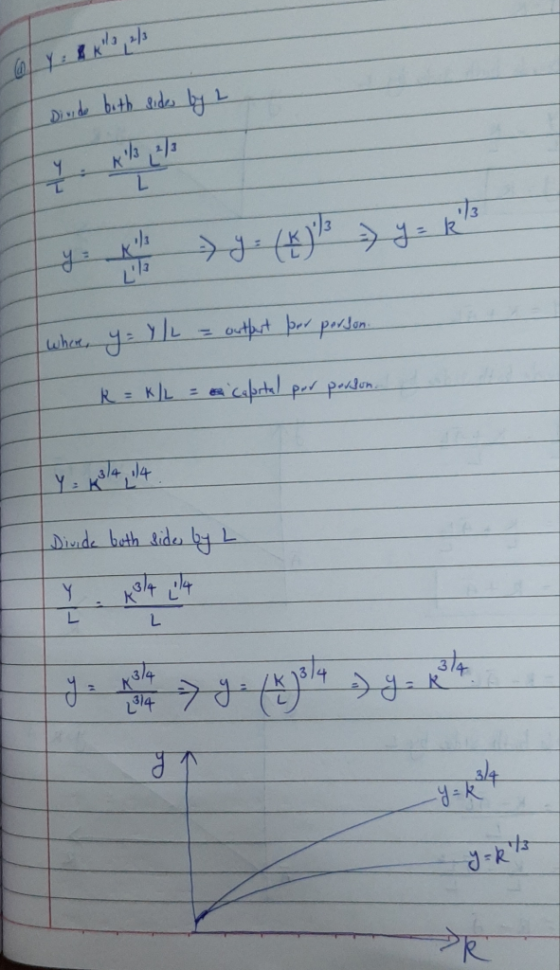
1.The “per-person” versions of production functions: Write each production functiongiven below in terms of output per persony≡Y /Land capital per personk≡K/L.Showwhat these “per person” versions look like in a graph withkon the horizontal axis andyonthe vertical axis. (Assume ̄A is some fixed positive number.)(a)Y=K1/3L2/3andY=K3/4L1/4(on the same graph)
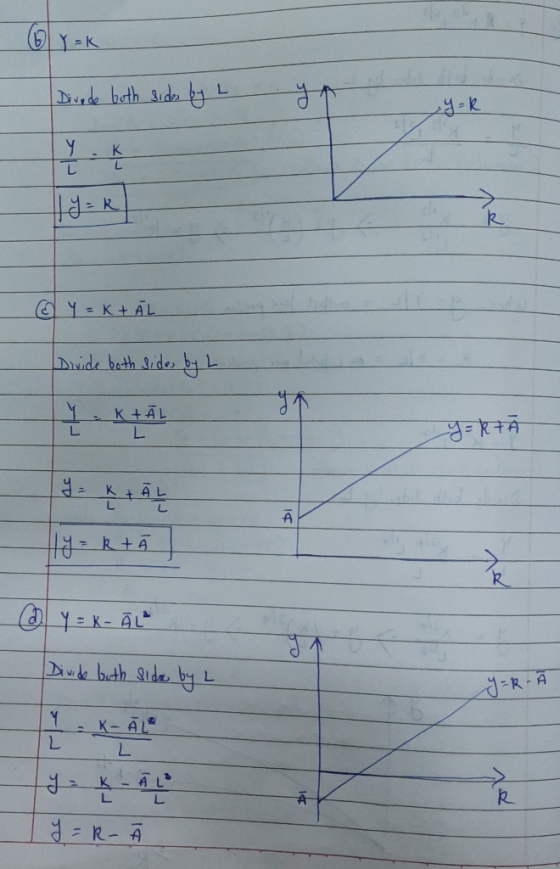
(b)Y=K
(c)Y=K+ ̄AL
(d)Y=K− ̄AL2.
Homework Answers
Add Answer to:
1.The “per-person” versions of production functions: Write each
production functiongiven below in terms of output per...
Problem 3: Write each production function given below in terms of output per person y =...
 Problem 3: Write each production function given below in terms of output per person y = Y/L and capital per person k = k/L. Plot these per person versions in a graph with y on the vertical axis and k on the horizontal axis. (You can assume Āis a constant positive number). (a) Y = ĀK/L2/3 and Y = ĀK3/4z"/4 (plot them on the same graph). (b) Y = K. (c) Y = (d) Y = K - AL Problem...
Suppose the per-capita production function is given by y=\k, where kis capital per person and y is output per person....
 Suppose the per-capita production function is given by y=\k, where kis capital per person and y is output per person. Suppose that the savings rate in this economy is 50% and capital depreciates at the rate of 25% a year. The steady-state capital-to-labor ratio is: k-1 k 2 k-4 cannot be determined from the above information.
Consider the Solow growth model. Output at time t is given by the production function Yt...
Consider the Solow growth model. Output at time t is given by the production function Yt = AK 1 3 t L 2 3 where Kt is total capital at time t, L is the labour force and A is total factor productivity. The labour force and total factor productivity are constant over time and capital evolves according the transition equation Kt+1 = (1 − d) ∗ Kt + It , where d is the depreciation rate. Every person saves...
1). Suppose that a firm uses inputs labour (L, measured in person hours) and capital (K, measured in machine hours) in...
 1). Suppose that a firm uses inputs labour (L, measured in person hours) and capital (K, measured in machine hours) in the production of its output (Q) according to the production function Q min{2L, 3K} (a) Draw the isoquant line associated with 12 units of output. Measure K along the vertical axis and L along the horizontal axis. (b) Suppose that the price of labour is $2/person hour, and the price of capital is $4 / person hour. What is...
Part 1: Graphing Production and Variable Cost Functions 1) Complete this part on the worksheet named...
 Part 1: Graphing Production and Variable Cost Functions 1) Complete this part on the worksheet named Cost Functions. 2) I started a table for you. All the column headings have the same definitions as they do in our notes. IL CAP MPVC 1 0 0 -- -- 2 3) We will use a cubic production function such that: q=xL + yL² + z In this case statistical estimation of the firm's production function reveals the values of the coefficients to...
Specific Output Functions, Q = f(L,K): Below are some specific output functions. For each production function...
 Specific Output Functions, Q = f(L,K): Below are some specific output functions. For each production function (1) Explain how the firm uses the inputs capital (K), and labor (L): (2) Provide an illustration of the corresponding isoquants the preference yield - include three isoquants with unique levels of output; (3) Provide a general form of the production function and create two specific production functions; and (4) Calculate the MRTS Lx for each of your proposed production functions (if possible). (1)...
Consider the Solow growth model. Output at time t is given by the production function Y-AK3...
 Consider the Solow growth model. Output at time t is given by the production function Y-AK3 Lš where K, is total capital at time t, L is the labour force and A is total factor productivity. The labour force and total factor productivity are constant over time and capital evolves according the transition equation KH = (1-d) * Kit It: where d is the depreciation rate. Every person saves share s of his income and, therefore, aggregate saving is St-s...
Given the following production functions: F(L,K) = L + K F(L,K) = (L + K)^2 F(L,K)...
Given the following production functions: F(L,K) = L + K F(L,K) = (L + K)^2 F(L,K) = (L + K)^1/2 1. Determine the returns to scale for each function. 2. For the rest of this exercise assume that the price of labor, w, and the price of capital, r, equal 1: w = r = 1. Find the conditional input demand functions of labor and capital (the cost-minimizing combinations of labor and capital). 3. Now find the cost functions for...
Econ 202 Problems Chapter 12 – Long-run economic growth 1. The production function of an economy...
 Econ 202 Problems Chapter 12 – Long-run economic growth 1. The production function of an economy is: Y= A * K0,3 * H0.7 a. What is real output when K = 10, H = 40 and A = 5? (2 point) b. Does this production function exhibit diminishing marginal productivity of capital? Calculate MPK if K increases from 10 to 20 and from 20 to 30, keeping H and A constant. Assume H = 70, A = 4. (5 points)...
Exercise 1. Production function model Consider an economy "I" with a representative household that consists of...
 Exercise 1. Production function model Consider an economy "I" with a representative household that consists of 1000 workers and owns $100 million of capital (L 1000, K -100). There is a representative firm with a Cobb- Douglas production function that rents capital and hires labor to produce. Assume that the TFP parameter equals one (A-1), we have Y K1/3L2/3. Markets are competitive. 1. Define an equilibrium in this economy. Follow class notes. 2. Solve for the equilibrium. You should get...
 Problem 3: Write each production function given below in terms of output per person y = Y/L and capital per person k = k/L. Plot these per person versions in a graph with y on the vertical axis and k on the horizontal axis. (You can assume Āis a constant positive number). (a) Y = ĀK/L2/3 and Y = ĀK3/4z"/4 (plot them on the same graph). (b) Y = K. (c) Y = (d) Y = K - AL Problem...
 Suppose the per-capita production function is given by y=\k, where kis capital per person and y is output per person. Suppose that the savings rate in this economy is 50% and capital depreciates at the rate of 25% a year. The steady-state capital-to-labor ratio is: k-1 k 2 k-4 cannot be determined from the above information.
 1). Suppose that a firm uses inputs labour (L, measured in person hours) and capital (K, measured in machine hours) in the production of its output (Q) according to the production function Q min{2L, 3K} (a) Draw the isoquant line associated with 12 units of output. Measure K along the vertical axis and L along the horizontal axis. (b) Suppose that the price of labour is $2/person hour, and the price of capital is $4 / person hour. What is...
 Part 1: Graphing Production and Variable Cost Functions 1) Complete this part on the worksheet named Cost Functions. 2) I started a table for you. All the column headings have the same definitions as they do in our notes. IL CAP MPVC 1 0 0 -- -- 2 3) We will use a cubic production function such that: q=xL + yL² + z In this case statistical estimation of the firm's production function reveals the values of the coefficients to...
 Specific Output Functions, Q = f(L,K): Below are some specific output functions. For each production function (1) Explain how the firm uses the inputs capital (K), and labor (L): (2) Provide an illustration of the corresponding isoquants the preference yield - include three isoquants with unique levels of output; (3) Provide a general form of the production function and create two specific production functions; and (4) Calculate the MRTS Lx for each of your proposed production functions (if possible). (1)...
 Consider the Solow growth model. Output at time t is given by the production function Y-AK3 Lš where K, is total capital at time t, L is the labour force and A is total factor productivity. The labour force and total factor productivity are constant over time and capital evolves according the transition equation KH = (1-d) * Kit It: where d is the depreciation rate. Every person saves share s of his income and, therefore, aggregate saving is St-s...
 Econ 202 Problems Chapter 12 – Long-run economic growth 1. The production function of an economy is: Y= A * K0,3 * H0.7 a. What is real output when K = 10, H = 40 and A = 5? (2 point) b. Does this production function exhibit diminishing marginal productivity of capital? Calculate MPK if K increases from 10 to 20 and from 20 to 30, keeping H and A constant. Assume H = 70, A = 4. (5 points)...
 Exercise 1. Production function model Consider an economy "I" with a representative household that consists of 1000 workers and owns $100 million of capital (L 1000, K -100). There is a representative firm with a Cobb- Douglas production function that rents capital and hires labor to produce. Assume that the TFP parameter equals one (A-1), we have Y K1/3L2/3. Markets are competitive. 1. Define an equilibrium in this economy. Follow class notes. 2. Solve for the equilibrium. You should get...
Most questions answered within 3 hours.
-
Where is the error in this code sequence?
String s1 = "Hello";
String s2 = "ello";...
asked 11 months ago -
Financial data for Joel de Paris, Inc., for last year
follow:
Joel de Paris, Inc.
Balance...
asked 11 months ago -
Consider this reaction:
Al2(SO4)3 (aq)+ BaCl3
(aq) Al2Cl6 (aq)- +
3BaSO4(s) . What is the...
asked 11 months ago -
Suppose that Savneet is considering increasing her
recent random sample from 20 car rentals to 40...
asked 11 months ago -
Trucks arrive at an unloading terminal at an average rate of 120
per hour.
Trucks arrive...
asked 11 months ago -
Why are methanol and ethanol completely soluble in water while
octanol is not very little soluble....
asked 11 months ago -
A facilities manager at a university reads in a research report
that the mean amount of...
asked 11 months ago -
When the CuSO4 is rehydrated by adding water to the anhydrous
compound, is this an endothermic...
asked 11 months ago -
A ray of sunlight is passing from diamond into crown glass; the
angle of incidence is...
asked 11 months ago -
A block of mass 0.249 kg is placed on top of a light, vertical
spring of...
asked 11 months ago -
how do the kidneys compensate in the presences of acidosis
a) trigger hyperventilate
b) reserve acid...
asked 11 months ago -
Question 501 pts
The rental rate of capital to the firm increases. Which of the
following...
asked 11 months ago