a lamborghini can accelearate from rest to 28m/s in 2.4 s. assuming constant acceleration l, how...
Homework Answers

Add Answer to:
a
lamborghini can accelearate from rest to 28m/s in 2.4 s. assuming
constant acceleration l, how...
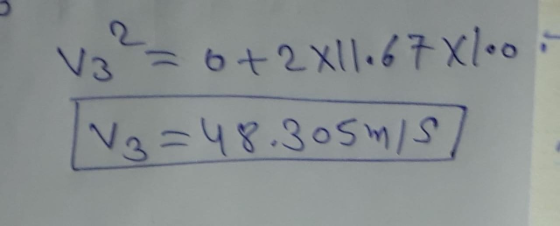
a ball starts from rest and rolls down a hill at a constant acceleration of 3...
a ball starts from rest and rolls down a hill at a constant acceleration of 3 m/s^2. if it travels for 3 m how fast is it going in the end?
Question 30 1 out of 1 points Assuming a constant acceleration of ax 4.3 m/s2 starting from rest, what is the airpl...
 Question 30 1 out of 1 points Assuming a constant acceleration of ax 4.3 m/s2 starting from rest, what is the airplane's takeoff velocity after 18.4 s? How far down the runway has the plane moved by the time it takes off?
Question 30 1 out of 1 points Assuming a constant acceleration of ax 4.3 m/s2 starting from rest, what is the airplane's takeoff velocity after 18.4 s? How far down the runway has the plane moved by the...
Question 30 1 out of 1 points Assuming a constant acceleration of ax 4.3 m/s2 starting from rest, what is the airplane's takeoff velocity after 18.4 s? How far down the runway has the plane moved by the time it takes off?
Question 30 1 out of 1 points Assuming a constant acceleration of ax 4.3 m/s2 starting from rest, what is the airplane's takeoff velocity after 18.4 s? How far down the runway has the plane moved by the...
A car starts from rest and reaches a speed of 22.0 m/s in 2.4 s. If...
A car starts from rest and reaches a speed of 22.0 m/s in 2.4 s. If its acceleration remains the same, how fast will it be moving 3 s later? Round your intermediate step to three decimal places and the final answer to the nearest integer.
A car starts from rest and travels for 10.0 s with a uniform acceleration of +1.8...
 A car starts from rest and travels for 10.0 s with a uniform acceleration of +1.8 m/s2. The driver then applies the brakes, causing a uniform acceleration of -2.5 m/s2. If the brakes are applied for 2.0 s, determine each of the following. (a) How fast is the car going at the end of the braking period? m/s (b) How far has the car gone? Om Need Help? Read It
A jogger accelerates from rest to 3.1 m/s in 2.4 s. A car accelerates from 35.0...
A jogger accelerates from rest to 3.1 m/s in 2.4 s. A car accelerates from 35.0 to 42.0 m/s also in 2.4 s. (a) Find the acceleration (magnitude only) of the jogger. m/s2 (b) Determine the acceleration (magnitude only) of the car. m/s2 c) If so, how much farther?
A car starts from rest and travels for 6.0 s with a uniform acceleration of +1.6 m/s2. The...
A car starts from rest and travels for6.0 s with a uniform acceleration of+1.6m/s2. The driver then applies the brakes, causing auniform acceleration of-1.0 m/s2. If the brakes are applied for2.0 s, determine each of thefollowing.(a) How fast is the car going at the end of thebraking period?1 m/s(b) How far has it gone?2 m
1. A car starts from rest and travels for 8.0 s with a uniform acceleration of...
1. A car starts from rest and travels for 8.0 s with a uniform acceleration of +1.8 m/s2. The driver then applies the brakes, causing a uniform acceleration of −1.5 m/s2. If the brakes are applied for 2.0 s, determine each of the following. (a) How fast is the car going at the end of the braking period? (m/s) (b) How far has the car gone? (m) 2. A ball is hit with a paddle, causing it to travel straight...
The car accelerates from rest v0 =0 m/s with the constant acceleration of a=4 m/s^2 for...
The car accelerates from rest v0 =0 m/s with the constant acceleration of a=4 m/s^2 for 3 seconds how far has the car traveled after three seconds 12 m 36 m 18m 6 m
A rocket, initially at rest on the ground, accelerates straight upward from rest with constant acceleration...
 A rocket, initially at rest on the ground, accelerates straight upward from rest with constant acceleration 53.9 m/s^2. The acceleration period lasts for time 5.00 s until the fuel is exhausted. After that, the rocket is in free fall. Find the maximum height y_max reached by the rocket. Ignore air resistance and assume a constant acceleration due to gravity equal to 9.80 m/s^2. Write your answer numerically in units of meters.
A rocket, initially at rest on the ground, accelerates straight upward from rest with constant acceleration...
A rocket, initially at rest on the ground, accelerates straight upward from rest with constant acceleration 49.0 m/s2 . The acceleration period lasts for time 7.00 s until the fuel is exhausted. After that, the rocket is in free fall. Find the maximum height ymax reached by the rocket. Ignore air resistance and assume a constant acceleration due to gravity equal to 9.80 m/s2 .
 Question 30 1 out of 1 points Assuming a constant acceleration of ax 4.3 m/s2 starting from rest, what is the airplane's takeoff velocity after 18.4 s? How far down the runway has the plane moved by the time it takes off?
Question 30 1 out of 1 points Assuming a constant acceleration of ax 4.3 m/s2 starting from rest, what is the airplane's takeoff velocity after 18.4 s? How far down the runway has the plane moved by the...
Question 30 1 out of 1 points Assuming a constant acceleration of ax 4.3 m/s2 starting from rest, what is the airplane's takeoff velocity after 18.4 s? How far down the runway has the plane moved by the time it takes off?
Question 30 1 out of 1 points Assuming a constant acceleration of ax 4.3 m/s2 starting from rest, what is the airplane's takeoff velocity after 18.4 s? How far down the runway has the plane moved by the...
 A car starts from rest and travels for 10.0 s with a uniform acceleration of +1.8 m/s2. The driver then applies the brakes, causing a uniform acceleration of -2.5 m/s2. If the brakes are applied for 2.0 s, determine each of the following. (a) How fast is the car going at the end of the braking period? m/s (b) How far has the car gone? Om Need Help? Read It
 A rocket, initially at rest on the ground, accelerates straight upward from rest with constant acceleration 53.9 m/s^2. The acceleration period lasts for time 5.00 s until the fuel is exhausted. After that, the rocket is in free fall. Find the maximum height y_max reached by the rocket. Ignore air resistance and assume a constant acceleration due to gravity equal to 9.80 m/s^2. Write your answer numerically in units of meters.
Most questions answered within 3 hours.
-
Where is the error in this code sequence?
String s1 = "Hello";
String s2 = "ello";...
asked 10 months ago -
Financial data for Joel de Paris, Inc., for last year
follow:
Joel de Paris, Inc.
Balance...
asked 10 months ago -
Consider this reaction:
Al2(SO4)3 (aq)+ BaCl3
(aq) Al2Cl6 (aq)- +
3BaSO4(s) . What is the...
asked 10 months ago -
Suppose that Savneet is considering increasing her
recent random sample from 20 car rentals to 40...
asked 10 months ago -
Trucks arrive at an unloading terminal at an average rate of 120
per hour.
Trucks arrive...
asked 10 months ago -
Why are methanol and ethanol completely soluble in water while
octanol is not very little soluble....
asked 10 months ago -
A facilities manager at a university reads in a research report
that the mean amount of...
asked 10 months ago -
When the CuSO4 is rehydrated by adding water to the anhydrous
compound, is this an endothermic...
asked 10 months ago -
A ray of sunlight is passing from diamond into crown glass; the
angle of incidence is...
asked 10 months ago -
A block of mass 0.249 kg is placed on top of a light, vertical
spring of...
asked 10 months ago -
how do the kidneys compensate in the presences of acidosis
a) trigger hyperventilate
b) reserve acid...
asked 10 months ago -
Question 501 pts
The rental rate of capital to the firm increases. Which of the
following...
asked 10 months ago