
Homework Answers
Add Answer to:
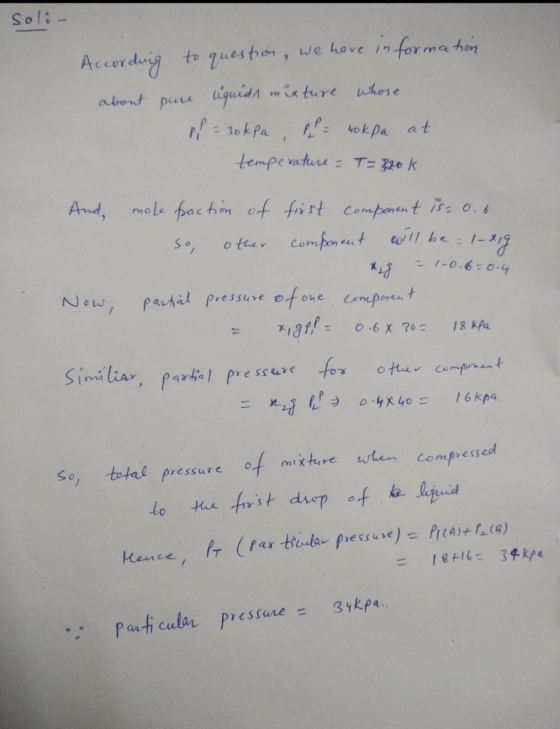
P3.7. A gaseous mixture is made of two gases. The saturated vapour pressures over the pure...
The vapour pressures of the pure components P and Q are 700 Torr and 500 Torr...
The vapour pressures of the pure components P and Q are 700 Torr and 500 Torr respectively. When the two phases are in equilibrium at 1.0 atm, the mole fraction of P in the liquid phase is 0.6 and in the vapour phase 0.4. The activity co-efficient of compound P in the solution on the basis of Raoult’s law is (a) 0.60 (b) 0.72 (c) 0.92 (d) 1.01
Use the vapour pressures (at 0 °C) of the pure substances below to answer the following...
Use the vapour pressures (at 0 °C) of the pure substances below to answer the following questions. Substance P* (kPa) 1-bromo-2-methylpropane (C4H9Br) 2.58 1-iodopropane (C3H7I) 1.48 1. Determine the partial pressure (in kPa) of 1-iodopropane (C3H7I) in the vapour phase (at 0 °C) over a solution for which the mole fraction of 1-bromo-2-methylpropane (C4H9Br) is 0.427. Report your answer to three significant figures in scientific notation. Tries 0/3 2. A solution of 1-bromo-2-methylpropane (C4H9Br) and 1-iodopropane (C3H7I) is prepared by...
3. Consider the hexafluorobenzene(1)-cyclohexane(2) mixture at 50 °C. The vapor pressures for the pure species are...
 3. Consider the hexafluorobenzene(1)-cyclohexane(2) mixture at 50 °C. The vapor pressures for the pure species are psat = 34.10 kPa and Pat = 36.30 kPa. a. (10%) Assuming Raoult's law, calculate the pressure range of the 2-phase region when the mole fraction of hexaflourobenzene is 0.8. b. (10%) Experiments show that this mixture at 50°C has an azeotrope. Show mathematically that Raoult's law is unable to predict an azeotropic behavior. c. (10%) Use the modified Raoult's law with the van...
3. Consider the hexafluorobenzene(1)-cyclohexane(2) mixture at 50°C. The vapor pressures for the pure species are Prat...
 3. Consider the hexafluorobenzene(1)-cyclohexane(2) mixture at 50°C. The vapor pressures for the pure species are Prat = 34.10 kPa and Pat = 36.30 kPa. a. (10%) Assuming Raoult's law, calculate the pressure range of the 2-phase region when the mole fraction of hexaflourobenzene is 0.8. b. (10%) Experiments show that this mixture at 50-C has an azeotrope. Show mathematically that Raoult's law is unable to predict an azeotropic behavior. c. (10%) Use the modified Raoult's law with the van Laar...
Dalton's law states that the total pressure. Patel of a mixture of gases in a container...
 Dalton's law states that the total pressure. Patel of a mixture of gases in a container equals the sum of the pressures of each individual gas: Part A P la P +1 +P: +.. The partial pressure of the first component. P. is equal to the mole fraction of this component, XI. times the total pressure of the mixture: P1= X X X Three gases (8.00 g of methane, CH,. 18.0 y of ethane, C,Hand an unknown amount of propane,...
 3. Consider the hexafluorobenzene(1)-cyclohexane(2) mixture at 50 °C. The vapor pressures for the pure species are psat = 34.10 kPa and Pat = 36.30 kPa. a. (10%) Assuming Raoult's law, calculate the pressure range of the 2-phase region when the mole fraction of hexaflourobenzene is 0.8. b. (10%) Experiments show that this mixture at 50°C has an azeotrope. Show mathematically that Raoult's law is unable to predict an azeotropic behavior. c. (10%) Use the modified Raoult's law with the van...
 3. Consider the hexafluorobenzene(1)-cyclohexane(2) mixture at 50°C. The vapor pressures for the pure species are Prat = 34.10 kPa and Pat = 36.30 kPa. a. (10%) Assuming Raoult's law, calculate the pressure range of the 2-phase region when the mole fraction of hexaflourobenzene is 0.8. b. (10%) Experiments show that this mixture at 50-C has an azeotrope. Show mathematically that Raoult's law is unable to predict an azeotropic behavior. c. (10%) Use the modified Raoult's law with the van Laar...
 Dalton's law states that the total pressure. Patel of a mixture of gases in a container equals the sum of the pressures of each individual gas: Part A P la P +1 +P: +.. The partial pressure of the first component. P. is equal to the mole fraction of this component, XI. times the total pressure of the mixture: P1= X X X Three gases (8.00 g of methane, CH,. 18.0 y of ethane, C,Hand an unknown amount of propane,...
Most questions answered within 3 hours.
-
Where is the error in this code sequence?
String s1 = "Hello";
String s2 = "ello";...
asked 11 months ago -
Financial data for Joel de Paris, Inc., for last year
follow:
Joel de Paris, Inc.
Balance...
asked 11 months ago -
Consider this reaction:
Al2(SO4)3 (aq)+ BaCl3
(aq) Al2Cl6 (aq)- +
3BaSO4(s) . What is the...
asked 11 months ago -
Suppose that Savneet is considering increasing her
recent random sample from 20 car rentals to 40...
asked 11 months ago -
Trucks arrive at an unloading terminal at an average rate of 120
per hour.
Trucks arrive...
asked 11 months ago -
Why are methanol and ethanol completely soluble in water while
octanol is not very little soluble....
asked 11 months ago -
A facilities manager at a university reads in a research report
that the mean amount of...
asked 11 months ago -
When the CuSO4 is rehydrated by adding water to the anhydrous
compound, is this an endothermic...
asked 11 months ago -
A ray of sunlight is passing from diamond into crown glass; the
angle of incidence is...
asked 11 months ago -
A block of mass 0.249 kg is placed on top of a light, vertical
spring of...
asked 11 months ago -
how do the kidneys compensate in the presences of acidosis
a) trigger hyperventilate
b) reserve acid...
asked 11 months ago -
Question 501 pts
The rental rate of capital to the firm increases. Which of the
following...
asked 11 months ago