
Homework Answers
Add Answer to:
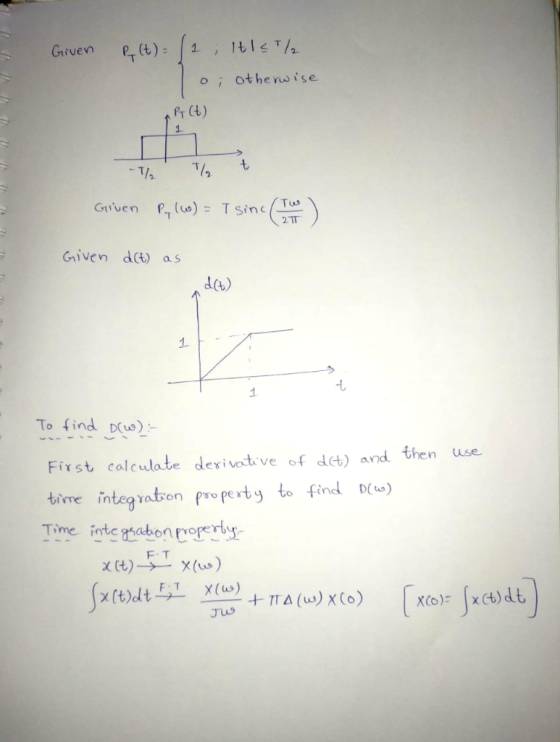
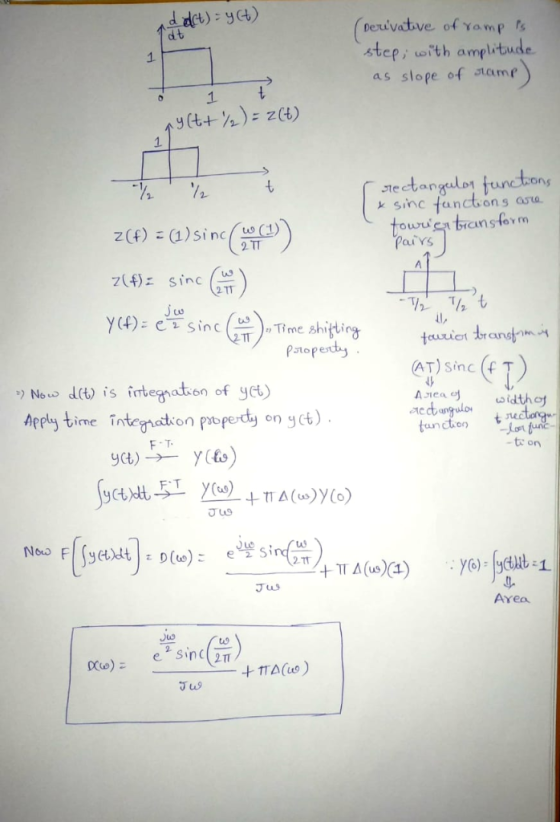
4. The Fourier transform of a rectangular pulse 1 비 r/2 0 otherwise is given by...
For the given rectangular pulse signal shown in figure below, 1 x(1) 1, T 0, T,...
 For the given rectangular pulse signal shown in figure below, 1 x(1) 1, T 0, T, x) T T1 Find the Fourier transform of the signal and sketch it
(a) Show that for any B 〉 0 and any c E R. 3, sinc is a Fourier transform pair. You may assume the Fourier transform pair Pr(t) ←→ τ sine ( (b) An ideal bandpass filter has frequency response w) 0,...
 (a) Show that for any B 〉 0 and any c E R. 3, sinc is a Fourier transform pair. You may assume the Fourier transform pair Pr(t) ←→ τ sine ( (b) An ideal bandpass filter has frequency response w) 0, otherwise 2(t-1 Find the output response y(t) when the input is (t)-sinc 2
(a) Show that for any B 〉 0 and any c E R. 3, sinc is a Fourier transform pair. You may assume the Fourier...
(a) Show that for any B 〉 0 and any c E R. 3, sinc is a Fourier transform pair. You may assume the Fourier transform pair Pr(t) ←→ τ sine ( (b) An ideal bandpass filter has frequency response w) 0, otherwise 2(t-1 Find the output response y(t) when the input is (t)-sinc 2
(a) Show that for any B 〉 0 and any c E R. 3, sinc is a Fourier transform pair. You may assume the Fourier...
3. (a) Let () be the rectangular pulse Il-oa()e-a, a 0 otherwise. Show that la sinc ka where sinc...
 3. (a) Let () be the rectangular pulse Il-oa()e-a, a 0 otherwise. Show that la sinc ka where sincx(note: in Engineering the alternate definition sincis often used). Use the symmetry of Fourier transform process to deduce that the Fourier transform of sinc i:s (b) Show that the' n-translates of sincTI are orthonormal 1 m n sinc π(x-m) sinc π(1-n) dr= 16 m メn. Hint: Use the shifting and scaling properties together with the Plancherel formula.
3. (a) Let () be...
3. (a) Let () be the rectangular pulse Il-oa()e-a, a 0 otherwise. Show that la sinc ka where sincx(note: in Engineering the alternate definition sincis often used). Use the symmetry of Fourier transform process to deduce that the Fourier transform of sinc i:s (b) Show that the' n-translates of sincTI are orthonormal 1 m n sinc π(x-m) sinc π(1-n) dr= 16 m メn. Hint: Use the shifting and scaling properties together with the Plancherel formula.
3. (a) Let () be...
4) The Fourier transform of the triangular pulse x(t) in Fig. P7.3-4 is expressed as Use...
 4) The Fourier transform of the triangular pulse x(t) in Fig. P7.3-4 is expressed as Use this information, and the time-shifting and time-scaling properties, to find the Fourier transforms of the signal shown below ts(t) -1.5-0.50.51.5
(Using the modulation property) (a) Determine the Fourier transform of the sequence 0, otherwise. (b) Consider...
 (Using the modulation property)
(a) Determine the Fourier transform of the sequence 0, otherwise. (b) Consider the sequence win-ı弡ーcos(쮜. 2π n 0 otherwise. Sketch win] and express We), the Fourier transform of win], in terms of R (el, the Fourier transform of In]. (Hint First express win] in terms of In] and the complex exponentials el (2M) and el 2n/M)
(Using the modulation property)
(a) Determine the Fourier transform of the sequence 0, otherwise. (b) Consider the sequence win-ı弡ーcos(쮜. 2π n 0 otherwise. Sketch win] and express We), the Fourier transform of win], in terms of R (el, the Fourier transform of In]. (Hint First express win] in terms of In] and the complex exponentials el (2M) and el 2n/M)
4. (I+1+1* pt) Consider a cosine pulse 0, otherwise. 0.8 The magnitude of its Fourier transform...
 4. (I+1+1* pt) Consider a cosine pulse 0, otherwise. 0.8 The magnitude of its Fourier transform is plotted in Figure 2. Find the following parameters of the pulse from the plot: 0.6 C. A= 4 Note that they are all integers. Figure 2
3) (Fourier Transforms Using Properties) - Given that the Fourier Transform of a signal x(t) is X(f) - rect(f/ 2), find the Fourier Transform of the following signals using properties of the Fourier...
 3) (Fourier Transforms Using Properties) - Given that the Fourier Transform of a signal x(t) is X(f) - rect(f/ 2), find the Fourier Transform of the following signals using properties of the Fourier Transform: (a) d(t) -x(t - 2) (d) h(t) = t x( t ) (e) p(t) = x( 2 t ) (f) g(t)-x( t ) cos(2π) (g) s(t) = x2(t ) (h)p()-x(1)* x(t) (convolution)
3) (Fourier Transforms Using Properties) - Given that the Fourier Transform of a signal...
3) (Fourier Transforms Using Properties) - Given that the Fourier Transform of a signal x(t) is X(f) - rect(f/ 2), find the Fourier Transform of the following signals using properties of the Fourier Transform: (a) d(t) -x(t - 2) (d) h(t) = t x( t ) (e) p(t) = x( 2 t ) (f) g(t)-x( t ) cos(2π) (g) s(t) = x2(t ) (h)p()-x(1)* x(t) (convolution)
3) (Fourier Transforms Using Properties) - Given that the Fourier Transform of a signal...
Write the time domain function r(t) of the graph below as the sum of two rectangular...
 Write the time domain function r(t) of the graph below as the sum of two rectangular pulse functions, then compute the fourier transform X(w) in terms of sinc function. (Reminder: A rectangular pulse centered 50,427 at the origin with width 27 is defined as II(t) = 11, -T<t<+T and it has the fourier transform II(t) sincwr)) 1 0 Amplitude -1 -2 0 2 3 8 9 10 11 5 6 7 Time-
Please finish these questions. Thank you Given find the Fourier transform of the following: (a) e dt 2T(2 1) 4 cos (2t) (Using properties of Fourier Transform to find) a) Suppose a signal m(t) is giv...
 Please finish these questions. Thank you
Given find the Fourier transform of the following: (a) e dt 2T(2 1) 4 cos (2t) (Using properties of Fourier Transform to find) a) Suppose a signal m(t) is given by m()-1+sin(2 fm) where fm-10 Hz. Sketch the signal m(t) in time domain b) Find the Fourier transform M(jo) of m(t) and sketch the magnitude of M(jo) c) If m(t) is amplitude modulated with a carrier signal by x(t)-m(t)cos(27r f,1) (where fe-1000 Hz), sketch...
Please finish these questions. Thank you
Given find the Fourier transform of the following: (a) e dt 2T(2 1) 4 cos (2t) (Using properties of Fourier Transform to find) a) Suppose a signal m(t) is given by m()-1+sin(2 fm) where fm-10 Hz. Sketch the signal m(t) in time domain b) Find the Fourier transform M(jo) of m(t) and sketch the magnitude of M(jo) c) If m(t) is amplitude modulated with a carrier signal by x(t)-m(t)cos(27r f,1) (where fe-1000 Hz), sketch...
Find the Fourier Transform of the triangular pulse _(1 + t for -1<t < 0 x(t)...
 Find the Fourier Transform of the triangular pulse _(1 + t for -1<t < 0 x(t) = (1 - t for 0 <t<1
 For the given rectangular pulse signal shown in figure below, 1 x(1) 1, T 0, T, x) T T1 Find the Fourier transform of the signal and sketch it
 (a) Show that for any B 〉 0 and any c E R. 3, sinc is a Fourier transform pair. You may assume the Fourier transform pair Pr(t) ←→ τ sine ( (b) An ideal bandpass filter has frequency response w) 0, otherwise 2(t-1 Find the output response y(t) when the input is (t)-sinc 2
(a) Show that for any B 〉 0 and any c E R. 3, sinc is a Fourier transform pair. You may assume the Fourier...
(a) Show that for any B 〉 0 and any c E R. 3, sinc is a Fourier transform pair. You may assume the Fourier transform pair Pr(t) ←→ τ sine ( (b) An ideal bandpass filter has frequency response w) 0, otherwise 2(t-1 Find the output response y(t) when the input is (t)-sinc 2
(a) Show that for any B 〉 0 and any c E R. 3, sinc is a Fourier transform pair. You may assume the Fourier...
 3. (a) Let () be the rectangular pulse Il-oa()e-a, a 0 otherwise. Show that la sinc ka where sincx(note: in Engineering the alternate definition sincis often used). Use the symmetry of Fourier transform process to deduce that the Fourier transform of sinc i:s (b) Show that the' n-translates of sincTI are orthonormal 1 m n sinc π(x-m) sinc π(1-n) dr= 16 m メn. Hint: Use the shifting and scaling properties together with the Plancherel formula.
3. (a) Let () be...
3. (a) Let () be the rectangular pulse Il-oa()e-a, a 0 otherwise. Show that la sinc ka where sincx(note: in Engineering the alternate definition sincis often used). Use the symmetry of Fourier transform process to deduce that the Fourier transform of sinc i:s (b) Show that the' n-translates of sincTI are orthonormal 1 m n sinc π(x-m) sinc π(1-n) dr= 16 m メn. Hint: Use the shifting and scaling properties together with the Plancherel formula.
3. (a) Let () be...
 4) The Fourier transform of the triangular pulse x(t) in Fig. P7.3-4 is expressed as Use this information, and the time-shifting and time-scaling properties, to find the Fourier transforms of the signal shown below ts(t) -1.5-0.50.51.5
 (Using the modulation property)
(a) Determine the Fourier transform of the sequence 0, otherwise. (b) Consider the sequence win-ı弡ーcos(쮜. 2π n 0 otherwise. Sketch win] and express We), the Fourier transform of win], in terms of R (el, the Fourier transform of In]. (Hint First express win] in terms of In] and the complex exponentials el (2M) and el 2n/M)
(Using the modulation property)
(a) Determine the Fourier transform of the sequence 0, otherwise. (b) Consider the sequence win-ı弡ーcos(쮜. 2π n 0 otherwise. Sketch win] and express We), the Fourier transform of win], in terms of R (el, the Fourier transform of In]. (Hint First express win] in terms of In] and the complex exponentials el (2M) and el 2n/M)
 4. (I+1+1* pt) Consider a cosine pulse 0, otherwise. 0.8 The magnitude of its Fourier transform is plotted in Figure 2. Find the following parameters of the pulse from the plot: 0.6 C. A= 4 Note that they are all integers. Figure 2
 3) (Fourier Transforms Using Properties) - Given that the Fourier Transform of a signal x(t) is X(f) - rect(f/ 2), find the Fourier Transform of the following signals using properties of the Fourier Transform: (a) d(t) -x(t - 2) (d) h(t) = t x( t ) (e) p(t) = x( 2 t ) (f) g(t)-x( t ) cos(2π) (g) s(t) = x2(t ) (h)p()-x(1)* x(t) (convolution)
3) (Fourier Transforms Using Properties) - Given that the Fourier Transform of a signal...
3) (Fourier Transforms Using Properties) - Given that the Fourier Transform of a signal x(t) is X(f) - rect(f/ 2), find the Fourier Transform of the following signals using properties of the Fourier Transform: (a) d(t) -x(t - 2) (d) h(t) = t x( t ) (e) p(t) = x( 2 t ) (f) g(t)-x( t ) cos(2π) (g) s(t) = x2(t ) (h)p()-x(1)* x(t) (convolution)
3) (Fourier Transforms Using Properties) - Given that the Fourier Transform of a signal...
 Write the time domain function r(t) of the graph below as the sum of two rectangular pulse functions, then compute the fourier transform X(w) in terms of sinc function. (Reminder: A rectangular pulse centered 50,427 at the origin with width 27 is defined as II(t) = 11, -T<t<+T and it has the fourier transform II(t) sincwr)) 1 0 Amplitude -1 -2 0 2 3 8 9 10 11 5 6 7 Time-
 Please finish these questions. Thank you
Given find the Fourier transform of the following: (a) e dt 2T(2 1) 4 cos (2t) (Using properties of Fourier Transform to find) a) Suppose a signal m(t) is given by m()-1+sin(2 fm) where fm-10 Hz. Sketch the signal m(t) in time domain b) Find the Fourier transform M(jo) of m(t) and sketch the magnitude of M(jo) c) If m(t) is amplitude modulated with a carrier signal by x(t)-m(t)cos(27r f,1) (where fe-1000 Hz), sketch...
Please finish these questions. Thank you
Given find the Fourier transform of the following: (a) e dt 2T(2 1) 4 cos (2t) (Using properties of Fourier Transform to find) a) Suppose a signal m(t) is given by m()-1+sin(2 fm) where fm-10 Hz. Sketch the signal m(t) in time domain b) Find the Fourier transform M(jo) of m(t) and sketch the magnitude of M(jo) c) If m(t) is amplitude modulated with a carrier signal by x(t)-m(t)cos(27r f,1) (where fe-1000 Hz), sketch...
 Find the Fourier Transform of the triangular pulse _(1 + t for -1<t < 0 x(t) = (1 - t for 0 <t<1
Most questions answered within 3 hours.
-
Where is the error in this code sequence?
String s1 = "Hello";
String s2 = "ello";...
asked 11 months ago -
Financial data for Joel de Paris, Inc., for last year
follow:
Joel de Paris, Inc.
Balance...
asked 11 months ago -
Consider this reaction:
Al2(SO4)3 (aq)+ BaCl3
(aq) Al2Cl6 (aq)- +
3BaSO4(s) . What is the...
asked 11 months ago -
Suppose that Savneet is considering increasing her
recent random sample from 20 car rentals to 40...
asked 11 months ago -
Trucks arrive at an unloading terminal at an average rate of 120
per hour.
Trucks arrive...
asked 11 months ago -
Why are methanol and ethanol completely soluble in water while
octanol is not very little soluble....
asked 11 months ago -
A facilities manager at a university reads in a research report
that the mean amount of...
asked 11 months ago -
When the CuSO4 is rehydrated by adding water to the anhydrous
compound, is this an endothermic...
asked 11 months ago -
A ray of sunlight is passing from diamond into crown glass; the
angle of incidence is...
asked 11 months ago -
A block of mass 0.249 kg is placed on top of a light, vertical
spring of...
asked 11 months ago -
how do the kidneys compensate in the presences of acidosis
a) trigger hyperventilate
b) reserve acid...
asked 11 months ago -
Question 501 pts
The rental rate of capital to the firm increases. Which of the
following...
asked 11 months ago