
Homework Answers
Request Answer!
We need at least 10 more requests to produce the answer.
0 / 10 have requested this problem solution
The more requests, the faster the answer.
Add Answer to:
An analog signal is given as below x(t) = 10sin 4rtt The signal is sampled by...
Please explain the answer, thank you An analog signal is given as below x(t) 10sin 4Tt...
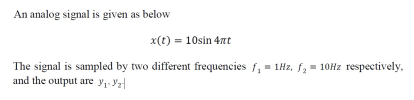 Please explain the answer, thank you
An analog signal is given as below x(t) 10sin 4Tt The signal is sampled by two different frequencies f and the output are y1, y2 10HZ respectively 1Hz, f2 Discuss whether f,, f2 aliasing effect. Explain your answer can successfully sample the analog signal x(t) without
Please explain the answer, thank you
An analog signal is given as below x(t) 10sin 4Tt The signal is sampled by two different frequencies f and the output are y1, y2 10HZ respectively 1Hz, f2 Discuss whether f,, f2 aliasing effect. Explain your answer can successfully sample the analog signal x(t) without
Question 1: (Sampling and Aliasing Effeet) (25 Marks) The given analog signal x(t)--sin(16xt)+ sin(11xt)+ sin (5nt), where t is in milliseconds, is sampled at a rate of 12kHz. The resulting sampl...
 Question 1: (Sampling and Aliasing Effeet) (25 Marks) The given analog signal x(t)--sin(16xt)+ sin(11xt)+ sin (5nt), where t is in milliseconds, is sampled at a rate of 12kHz. The resulting samples are immediately reconstructed by an ideal reconstructor. a. Find and sketch the spectrum of x(t) versus Ω. b. Find and sketch the spectrum of the sampled signal versus o. c. Determine the analog signal x (t) at the output of the reconstructor. d. Prove the x(0) and x(t) having...
Q1) Given an analog signal X(t) = 3 cos (2π . 2000t) + 2 cos (2π...
Q1) Given an analog signal X(t) = 3 cos (2π . 2000t) + 2 cos (2π . 5500t) sampled at a rate of 10,000 Hz, a. Sketch the spectrum of the sampled signal up to 20 kHz; b. Sketch the recovered analog signal spectrum if an ideal lowpass filter with a cutoff frequency of 4 kHz is used to filter the sampled signal in order to recover the original signal ; c. Determine the frequency/frequencies of aliasing noise . Q2)...
2.5. Given an analog signal x(t)5cos(2T 2, 5001) + 2cos(2T 4, 5001), for t2 0 sampled...
 2.5. Given an analog signal x(t)5cos(2T 2, 5001) + 2cos(2T 4, 5001), for t2 0 sampled at a rate of 8,000 Hz, a. sketch the spectrum of the sampled signal up to 20 kHz; b. sketch the recovered analog signal spectrum if an ideal lowpass filter with a cutoff frequency of 4 kHz is used to filter the sampled signal in order to recover the original signal; c. determine the frequneuencis f aliasing noise.
1. An analog signal \(\mathrm{x}(\mathrm{t})\) contains frequencies from 0 up to \(10 \mathrm{kHz}\). You can assume...
1. An analog signal \(\mathrm{x}(\mathrm{t})\) contains frequencies from 0 up to \(10 \mathrm{kHz}\). You can assume any arbitrary spectrum for this signal. (Note that this signals also has frequencies from 0 to \(-10 \mathrm{KHz} .)\) a) Draw the frequency spectrum of the signal after it has been sampled with a sampling frequency \(\mathrm{F}_{\mathrm{s}}=25 \mathrm{kHz}\) b) What range of sampling frequencies allows exact reconstruction of this signal from its samples? c) How is the original signal reconstructed from the sampled signal?...
1. Given the spectrum X(f) of an analog signal x(t), sketch the spectrum of its sampled...
 1. Given the spectrum X(f) of an analog signal x(t), sketch the spectrum of its sampled version x[n], assuming a sampling rate of 50, 40, and 30 Hz. (a) X()=rect(f/40) (b) X()=tri(f/20)
Q2.) Consider the sampling of the continuous-time signal x(t) to obtain a discrete-time signal x[...
 Q2.) Consider the sampling of the continuous-time signal x(t) to obtain a discrete-time signal x[n (1)-10cos(1000m + π/3) + 20cos(2000m + π/6). 110points! ], where x a) What is the maximum sampling interval (minimum sampling frequency) that could be used to ensure an aliasing free sampling of this signal? b) Plot the spectrum of the sampled signal if x() is sampled using a sampling frequency of (i) 2500 Hz (ii) 1800 Hz and state whether there will be an aliasing...
Problem 4.(30 pts) Given the analog signal x(t) cos(2 cos(3t)+2 sin(4mt) A.(10 pts) Find the Nyquist...
 Problem 4.(30 pts) Given the analog signal x(t) cos(2 cos(3t)+2 sin(4mt) A.(10 pts) Find the Nyquist frequency (sampling frequency) which guarantees That x() can be recovered from it's sampled version xIn] with no aliasing. B.(10 pts) If the sampling period of Ts 0.4 see is used identify all discrete frequencies Of the signal x(t), also indicate if this sampling period is adequate to recover x(t) from xn] C.(10 pts) Suppose signal x(t) is modulated by signal e(t) = cos(2000mt) what...
2. An analog signal x(t) = sin(480πt) + 3 sin(720πt) is sampled 600 times per second....
2. An analog signal x(t) = sin(480πt) + 3 sin(720πt) is sampled 600 times per second. (a) Determine the Nyquist sampling rate for x(t). (b) What are the frequencies (in radians) in the resulting discrete time signal xs[n]? (c) If xs[n] is passed through an ideal reconstructor, what is the reconstructed signal y(t)?
Given an analog signal ?? (?) = 10 cos(3500??) , ??? ? ≥ 0, sampled at...
Given an analog signal ?? (?) = 10 cos(3500??) , ??? ? ≥ 0, sampled at a rate of 8 kHz. Determine the expression for the spectrum ?(?) of the sampled signal and plot the spectrum of the sampled signal. You can use MATLAB wvtool for spectrum plot. Is there any aliasing?
 Please explain the answer, thank you
An analog signal is given as below x(t) 10sin 4Tt The signal is sampled by two different frequencies f and the output are y1, y2 10HZ respectively 1Hz, f2 Discuss whether f,, f2 aliasing effect. Explain your answer can successfully sample the analog signal x(t) without
Please explain the answer, thank you
An analog signal is given as below x(t) 10sin 4Tt The signal is sampled by two different frequencies f and the output are y1, y2 10HZ respectively 1Hz, f2 Discuss whether f,, f2 aliasing effect. Explain your answer can successfully sample the analog signal x(t) without
 Question 1: (Sampling and Aliasing Effeet) (25 Marks) The given analog signal x(t)--sin(16xt)+ sin(11xt)+ sin (5nt), where t is in milliseconds, is sampled at a rate of 12kHz. The resulting samples are immediately reconstructed by an ideal reconstructor. a. Find and sketch the spectrum of x(t) versus Ω. b. Find and sketch the spectrum of the sampled signal versus o. c. Determine the analog signal x (t) at the output of the reconstructor. d. Prove the x(0) and x(t) having...
 2.5. Given an analog signal x(t)5cos(2T 2, 5001) + 2cos(2T 4, 5001), for t2 0 sampled at a rate of 8,000 Hz, a. sketch the spectrum of the sampled signal up to 20 kHz; b. sketch the recovered analog signal spectrum if an ideal lowpass filter with a cutoff frequency of 4 kHz is used to filter the sampled signal in order to recover the original signal; c. determine the frequneuencis f aliasing noise.
 1. Given the spectrum X(f) of an analog signal x(t), sketch the spectrum of its sampled version x[n], assuming a sampling rate of 50, 40, and 30 Hz. (a) X()=rect(f/40) (b) X()=tri(f/20)
 Q2.) Consider the sampling of the continuous-time signal x(t) to obtain a discrete-time signal x[n (1)-10cos(1000m + π/3) + 20cos(2000m + π/6). 110points! ], where x a) What is the maximum sampling interval (minimum sampling frequency) that could be used to ensure an aliasing free sampling of this signal? b) Plot the spectrum of the sampled signal if x() is sampled using a sampling frequency of (i) 2500 Hz (ii) 1800 Hz and state whether there will be an aliasing...
 Problem 4.(30 pts) Given the analog signal x(t) cos(2 cos(3t)+2 sin(4mt) A.(10 pts) Find the Nyquist frequency (sampling frequency) which guarantees That x() can be recovered from it's sampled version xIn] with no aliasing. B.(10 pts) If the sampling period of Ts 0.4 see is used identify all discrete frequencies Of the signal x(t), also indicate if this sampling period is adequate to recover x(t) from xn] C.(10 pts) Suppose signal x(t) is modulated by signal e(t) = cos(2000mt) what...
Most questions answered within 3 hours.
-
Where is the error in this code sequence?
String s1 = "Hello";
String s2 = "ello";...
asked 11 months ago -
Financial data for Joel de Paris, Inc., for last year
follow:
Joel de Paris, Inc.
Balance...
asked 11 months ago -
Consider this reaction:
Al2(SO4)3 (aq)+ BaCl3
(aq) Al2Cl6 (aq)- +
3BaSO4(s) . What is the...
asked 11 months ago -
Suppose that Savneet is considering increasing her
recent random sample from 20 car rentals to 40...
asked 11 months ago -
Trucks arrive at an unloading terminal at an average rate of 120
per hour.
Trucks arrive...
asked 11 months ago -
Why are methanol and ethanol completely soluble in water while
octanol is not very little soluble....
asked 11 months ago -
A facilities manager at a university reads in a research report
that the mean amount of...
asked 11 months ago -
When the CuSO4 is rehydrated by adding water to the anhydrous
compound, is this an endothermic...
asked 11 months ago -
A ray of sunlight is passing from diamond into crown glass; the
angle of incidence is...
asked 11 months ago -
A block of mass 0.249 kg is placed on top of a light, vertical
spring of...
asked 11 months ago -
how do the kidneys compensate in the presences of acidosis
a) trigger hyperventilate
b) reserve acid...
asked 11 months ago -
Question 501 pts
The rental rate of capital to the firm increases. Which of the
following...
asked 11 months ago