
Homework Answers
(a)
For Model 1,
Numerator df = Number of predictors in regression model (k) = 5
Denominator df = degree of freedom for residual eror = 14
df total = 5 + 14 = 19
For Model 2,
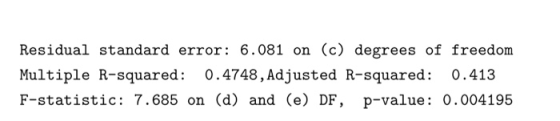
Numerator df = Number of predictors in regression model (k) = 2
Denominator df = df total - Numerator df = 19 - 2 = 17
Thus,
(a) = 5 , (b) = 14 , (c) = 17 , (d) = 2 (e) = 17
(b)
Standard error for model 1 = 6.157
Standard error for model 2 = 6.081
Model 2 has small test error.
(c)
n = df total + 1 = 19 + 1 = 20
AIC = n log( )
+ 2(k + 1)
)
+ 2(k + 1)
where s is the standard error.
For Model 1.
AIC = 20 log( )
+ 2(5 + 1) = 84.70359
)
+ 2(5 + 1) = 84.70359
For Model 2.
AIC = 20 log( )
+ 2(2 + 1) = 78.20677
)
+ 2(2 + 1) = 78.20677
Since AIC for model 2 is less than that of model 1, model 2 has small test error.
(d)
For Model 1,
F statistic value = 3.154 on 5 and 14 degree of freedom
For Model 2,
F statistic value = 7.685 on 2 and 17 degree of freedom
Add Answer to:
(a) fill the blank (a),(b),(c),(d), and (e)
(b) which model has small test error? justify your...
only part II is needed Regardless of your answer to (a), you come up with the following multiple regression model. b. Coefficients: Estimate Std. Error t value Pr>lt (Intercept) 72.2285 1.2697 56....
 only part II is needed
Regardless of your answer to (a), you come up with the following multiple regression model. b. Coefficients: Estimate Std. Error t value Pr>lt (Intercept) 72.2285 1.2697 56.89 2e-16 X2 X3 Residual standard error: 7.25 on 191 degrees of freedom Multiple R-squared: 0.494, Adjusted R-squared: 0.489 F-statistic: 93.3 on 2 and 191 DF, p-value: <2e-16 0.4590 0.0524-8.76 1.1e-15 0.4146 0.1290 3.21 0.0015** I) What percentage of the total variation in Life Expectancy can you explain with...
only part II is needed
Regardless of your answer to (a), you come up with the following multiple regression model. b. Coefficients: Estimate Std. Error t value Pr>lt (Intercept) 72.2285 1.2697 56.89 2e-16 X2 X3 Residual standard error: 7.25 on 191 degrees of freedom Multiple R-squared: 0.494, Adjusted R-squared: 0.489 F-statistic: 93.3 on 2 and 191 DF, p-value: <2e-16 0.4590 0.0524-8.76 1.1e-15 0.4146 0.1290 3.21 0.0015** I) What percentage of the total variation in Life Expectancy can you explain with...
Consider a multiple linear regression model Y; = Bo + B1Xi1 + B22:2 + 33213 +...
 Consider a multiple linear regression model Y; = Bo + B1Xi1 + B22:2 + 33213 + Blog(x14) + Ej. We have the following statistics for the regression Call: 1m formula = y “ x1 + x2 + x3 + log(x4) Coefficients: Estimate Std. Error t value Pr(>1t|) (Intercept) 154.1928 194.9062 0.791 0.432938 x1 -4.2280 2.0301 -2.083 0.042873 * x2 -6.1353 2.1936 -2.797 0.007508 ** x3 0.4719 0.1285 3.672 0.000626 *** x4 26.7552 9.3374 2.865 0.006259 ** Signif. codes: O '***'...
Consider a multiple linear regression model Y; = Bo + B1Xi1 + B22:2 + 33213 +...
 Consider a multiple linear regression model Y; = Bo + B1Xi1 + B22:2 + 33213 + Blog(x14) + Ej. We have the following statistics for the regression Call: 1m formula = y “ x1 + x2 + x3 + log(x4) Coefficients: Estimate Std. Error t value Pr(>1t|) (Intercept) 154.1928 194.9062 0.791 0.432938 x1 -4.2280 2.0301 -2.083 0.042873 * x2 -6.1353 2.1936 -2.797 0.007508 ** x3 0.4719 0.1285 3.672 0.000626 *** x4 26.7552 9.3374 2.865 0.006259 ** Signif. codes: O '***'...
Multiple regression Please show all work on paper. For a sample of n= 20 individuals, we...
Multiple regression Please show all work on paper. For a sample of n= 20 individuals, we have measurements of y = body fat, x1 = triceps skinfold thickness, x2 = thigh circumference, and x3 = mid-arm circumference. The result of a multiple linear regression applied to these data is: --- Model 1: Coefficients: Estimate Std. Error t value Pr(>|t|) (Intercept) 117.085 99.782 1.173 0.258 Triceps 4.334 3.016 1.437 0.170 Thigh -2.857 2.582 -1.106 0.285 Midarm -2.186 1.595 -1.370 0.190 Residual...
(13 points) Suppose you have a simple linear regression model such that Y; = Bo +...
 (13 points) Suppose you have a simple linear regression model such that Y; = Bo + B18: +€4 with and N(0,0%) Call: 1m (formula - y - x) Formula: F=MSR/MSE, R2 = SSR/SSTO ANOVA decomposition: SSTOSSE + SSR Residuals: Min 1Q Modian -2.16313 -0.64507 -0.06586 Max 30 0.62479 3.00517 Coefficients: Estimate Std. Error t value Pr(> It) (Intercept) 8.00967 0.36529 21.93 -0.62009 0.04245 -14.61 <2e-16 ... <2e-16 .. Signif. codes: ****' 0.001 '** 0.01 '* 0.05 0.1'' 1 Residual standard...
To investigate the impact of advertising medias (say youtube) on sales, we construct the fol- lowing...
 To investigate the impact of advertising medias (say youtube) on sales, we construct the fol- lowing simple linear regression model Y; = Bo + B12; + &i with std N(0,0%) where Y is the sales and x is advertising budget in thousands of dollars. The summary table is given below: Formula: Call: 1m (formula = sales youtube, data = marketing) Residuals: Min 1Q Median 3Q Max -10.0632 -2.3454 -0.2295 2.4805 8.6548 F=MSR/MSE, R2 = SSR/SSTO ANOVA decomposition: SSTO = SSE...
R is a little difficult for me, please answer if you can interpret the R code, I want to learn better how to interpret the R code 4. each 2 pts] Below is the R output for a simple linear regression m...
 R is a little difficult for me, please answer if you can
interpret the R code, I want to learn better how to interpret the R
code
4. each 2 pts] Below is the R output for a simple linear regression model Coefficients: Estimate Std. Error t value Pr(>t) (Intercept) 77.863 4.199 18.544 3.54e-13 3.485 3.386 0.00329* 11.801 Signif. codes: 0 0.0010.010.05 0.11 Residual standard error: 3.597 on 18 degrees of freedom Multiple R-squared: 0.3891, Adjusted R-squared: 0.3552 F-statistic: 11.47...
R is a little difficult for me, please answer if you can
interpret the R code, I want to learn better how to interpret the R
code
4. each 2 pts] Below is the R output for a simple linear regression model Coefficients: Estimate Std. Error t value Pr(>t) (Intercept) 77.863 4.199 18.544 3.54e-13 3.485 3.386 0.00329* 11.801 Signif. codes: 0 0.0010.010.05 0.11 Residual standard error: 3.597 on 18 degrees of freedom Multiple R-squared: 0.3891, Adjusted R-squared: 0.3552 F-statistic: 11.47...
Question 1 1 pts Consider the following model for estimating the salary of employees at a company (in $) by the number of years employed at the company. technitron.1m-(salary- yrs.empl, data technitr...
 Question 1 1 pts Consider the following model for estimating the salary of employees at a company (in $) by the number of years employed at the company. technitron.1m-(salary- yrs.empl, data technitron.af) sumary(technitron.1n ss Call: # In(formula . salary ~ yrs.enp1. dat. . technitron.df) # Residuals: Medianax Min -12854.7-4188.9 281.5 3254.4 16493. a# as Coefficients Estimate Std. Error t value Pr( ltl) < 2e-16 5.93e-10 (Intercept) 28394.2 1107 .2 1794.อ 140.4 15.828 7.884 a: yrs . enp1 ㆅ signif. codes...
> summaryCls) Call: Lm(formula y X) Residuals: -0.20283 -0.146910.02255 0.06655 0.44541 Coefficients: (Intercept) 0.36510 0.09904 3.686...
 > summaryCls) Call: Lm(formula y X) Residuals: -0.20283 -0.146910.02255 0.06655 0.44541 Coefficients: (Intercept) 0.36510 0.09904 3.686 0.003586 ** Min 1Q Median 3Q Max Estimate Std. Error t value Pr(>ltl) 0.96683 0.18292 5.286 0.000258*** Signif. codes: 00.001*0.010.050.11 Residual standard error: 0.1932 on 11 degrees of freedom Multiple R-squared 0.7175, Adjusted R-squared: 0.6918 F-statistic: 27.94 on 1 and 11 DF, p-value: 0.0002581 > anovaCls) Analysis of Variance Table Response : y Df Sum Sq Mean Sq F value PrOF) 1 1.04275 1.04275...
How do I interpret the p-values in terms of rejecting or failing to reject H0 at...
 How do I interpret the p-values in terms of rejecting or failing
to reject H0 at a 95% confidence level? What does the intercept
column mean in terms of p-value? How does the p-value of the F test
compare and what does it mean? In the simple linear regression I'd
conclude age isn't related to pulmonary disease (what does
intercept p-value mean) but for the multiple regression I'd say age
and height aren't related to pulmonary disease but smoking is...
How do I interpret the p-values in terms of rejecting or failing
to reject H0 at a 95% confidence level? What does the intercept
column mean in terms of p-value? How does the p-value of the F test
compare and what does it mean? In the simple linear regression I'd
conclude age isn't related to pulmonary disease (what does
intercept p-value mean) but for the multiple regression I'd say age
and height aren't related to pulmonary disease but smoking is...
 only part II is needed
Regardless of your answer to (a), you come up with the following multiple regression model. b. Coefficients: Estimate Std. Error t value Pr>lt (Intercept) 72.2285 1.2697 56.89 2e-16 X2 X3 Residual standard error: 7.25 on 191 degrees of freedom Multiple R-squared: 0.494, Adjusted R-squared: 0.489 F-statistic: 93.3 on 2 and 191 DF, p-value: <2e-16 0.4590 0.0524-8.76 1.1e-15 0.4146 0.1290 3.21 0.0015** I) What percentage of the total variation in Life Expectancy can you explain with...
only part II is needed
Regardless of your answer to (a), you come up with the following multiple regression model. b. Coefficients: Estimate Std. Error t value Pr>lt (Intercept) 72.2285 1.2697 56.89 2e-16 X2 X3 Residual standard error: 7.25 on 191 degrees of freedom Multiple R-squared: 0.494, Adjusted R-squared: 0.489 F-statistic: 93.3 on 2 and 191 DF, p-value: <2e-16 0.4590 0.0524-8.76 1.1e-15 0.4146 0.1290 3.21 0.0015** I) What percentage of the total variation in Life Expectancy can you explain with...
 Consider a multiple linear regression model Y; = Bo + B1Xi1 + B22:2 + 33213 + Blog(x14) + Ej. We have the following statistics for the regression Call: 1m formula = y “ x1 + x2 + x3 + log(x4) Coefficients: Estimate Std. Error t value Pr(>1t|) (Intercept) 154.1928 194.9062 0.791 0.432938 x1 -4.2280 2.0301 -2.083 0.042873 * x2 -6.1353 2.1936 -2.797 0.007508 ** x3 0.4719 0.1285 3.672 0.000626 *** x4 26.7552 9.3374 2.865 0.006259 ** Signif. codes: O '***'...
 Consider a multiple linear regression model Y; = Bo + B1Xi1 + B22:2 + 33213 + Blog(x14) + Ej. We have the following statistics for the regression Call: 1m formula = y “ x1 + x2 + x3 + log(x4) Coefficients: Estimate Std. Error t value Pr(>1t|) (Intercept) 154.1928 194.9062 0.791 0.432938 x1 -4.2280 2.0301 -2.083 0.042873 * x2 -6.1353 2.1936 -2.797 0.007508 ** x3 0.4719 0.1285 3.672 0.000626 *** x4 26.7552 9.3374 2.865 0.006259 ** Signif. codes: O '***'...
 (13 points) Suppose you have a simple linear regression model such that Y; = Bo + B18: +€4 with and N(0,0%) Call: 1m (formula - y - x) Formula: F=MSR/MSE, R2 = SSR/SSTO ANOVA decomposition: SSTOSSE + SSR Residuals: Min 1Q Modian -2.16313 -0.64507 -0.06586 Max 30 0.62479 3.00517 Coefficients: Estimate Std. Error t value Pr(> It) (Intercept) 8.00967 0.36529 21.93 -0.62009 0.04245 -14.61 <2e-16 ... <2e-16 .. Signif. codes: ****' 0.001 '** 0.01 '* 0.05 0.1'' 1 Residual standard...
 To investigate the impact of advertising medias (say youtube) on sales, we construct the fol- lowing simple linear regression model Y; = Bo + B12; + &i with std N(0,0%) where Y is the sales and x is advertising budget in thousands of dollars. The summary table is given below: Formula: Call: 1m (formula = sales youtube, data = marketing) Residuals: Min 1Q Median 3Q Max -10.0632 -2.3454 -0.2295 2.4805 8.6548 F=MSR/MSE, R2 = SSR/SSTO ANOVA decomposition: SSTO = SSE...
 R is a little difficult for me, please answer if you can
interpret the R code, I want to learn better how to interpret the R
code
4. each 2 pts] Below is the R output for a simple linear regression model Coefficients: Estimate Std. Error t value Pr(>t) (Intercept) 77.863 4.199 18.544 3.54e-13 3.485 3.386 0.00329* 11.801 Signif. codes: 0 0.0010.010.05 0.11 Residual standard error: 3.597 on 18 degrees of freedom Multiple R-squared: 0.3891, Adjusted R-squared: 0.3552 F-statistic: 11.47...
R is a little difficult for me, please answer if you can
interpret the R code, I want to learn better how to interpret the R
code
4. each 2 pts] Below is the R output for a simple linear regression model Coefficients: Estimate Std. Error t value Pr(>t) (Intercept) 77.863 4.199 18.544 3.54e-13 3.485 3.386 0.00329* 11.801 Signif. codes: 0 0.0010.010.05 0.11 Residual standard error: 3.597 on 18 degrees of freedom Multiple R-squared: 0.3891, Adjusted R-squared: 0.3552 F-statistic: 11.47...
 Question 1 1 pts Consider the following model for estimating the salary of employees at a company (in $) by the number of years employed at the company. technitron.1m-(salary- yrs.empl, data technitron.af) sumary(technitron.1n ss Call: # In(formula . salary ~ yrs.enp1. dat. . technitron.df) # Residuals: Medianax Min -12854.7-4188.9 281.5 3254.4 16493. a# as Coefficients Estimate Std. Error t value Pr( ltl) < 2e-16 5.93e-10 (Intercept) 28394.2 1107 .2 1794.อ 140.4 15.828 7.884 a: yrs . enp1 ㆅ signif. codes...
 > summaryCls) Call: Lm(formula y X) Residuals: -0.20283 -0.146910.02255 0.06655 0.44541 Coefficients: (Intercept) 0.36510 0.09904 3.686 0.003586 ** Min 1Q Median 3Q Max Estimate Std. Error t value Pr(>ltl) 0.96683 0.18292 5.286 0.000258*** Signif. codes: 00.001*0.010.050.11 Residual standard error: 0.1932 on 11 degrees of freedom Multiple R-squared 0.7175, Adjusted R-squared: 0.6918 F-statistic: 27.94 on 1 and 11 DF, p-value: 0.0002581 > anovaCls) Analysis of Variance Table Response : y Df Sum Sq Mean Sq F value PrOF) 1 1.04275 1.04275...
 How do I interpret the p-values in terms of rejecting or failing
to reject H0 at a 95% confidence level? What does the intercept
column mean in terms of p-value? How does the p-value of the F test
compare and what does it mean? In the simple linear regression I'd
conclude age isn't related to pulmonary disease (what does
intercept p-value mean) but for the multiple regression I'd say age
and height aren't related to pulmonary disease but smoking is...
How do I interpret the p-values in terms of rejecting or failing
to reject H0 at a 95% confidence level? What does the intercept
column mean in terms of p-value? How does the p-value of the F test
compare and what does it mean? In the simple linear regression I'd
conclude age isn't related to pulmonary disease (what does
intercept p-value mean) but for the multiple regression I'd say age
and height aren't related to pulmonary disease but smoking is...
Most questions answered within 3 hours.
-
Where is the error in this code sequence?
String s1 = "Hello";
String s2 = "ello";...
asked 10 months ago -
Financial data for Joel de Paris, Inc., for last year
follow:
Joel de Paris, Inc.
Balance...
asked 10 months ago -
Consider this reaction:
Al2(SO4)3 (aq)+ BaCl3
(aq) Al2Cl6 (aq)- +
3BaSO4(s) . What is the...
asked 10 months ago -
Suppose that Savneet is considering increasing her
recent random sample from 20 car rentals to 40...
asked 10 months ago -
Trucks arrive at an unloading terminal at an average rate of 120
per hour.
Trucks arrive...
asked 10 months ago -
Why are methanol and ethanol completely soluble in water while
octanol is not very little soluble....
asked 10 months ago -
A facilities manager at a university reads in a research report
that the mean amount of...
asked 10 months ago -
When the CuSO4 is rehydrated by adding water to the anhydrous
compound, is this an endothermic...
asked 10 months ago -
A ray of sunlight is passing from diamond into crown glass; the
angle of incidence is...
asked 10 months ago -
A block of mass 0.249 kg is placed on top of a light, vertical
spring of...
asked 10 months ago -
how do the kidneys compensate in the presences of acidosis
a) trigger hyperventilate
b) reserve acid...
asked 10 months ago -
Question 501 pts
The rental rate of capital to the firm increases. Which of the
following...
asked 10 months ago