
Homework Answers
Bromine water dissipates its brown color with alkenes, alkynes, phenols and enols.
Among the given pairs of compounds, the compounds in option B can be distinguished by using bromine water.
CH3CH2CHCHCH3 and CH3CH2CH2CH2CH3
CH3CH2CHCHCH3 is an alkene and will decolorize bromine water whereas CH3CH2CH2CH2CH3 will not decolorize bromine water.
The decolorization happens due to following addition reaction
CH3CH2CH=CHCH3 +
Br2(aq)
CH3CH2CH(Br)CH(Br)CH3
CH3CH2CH2CH2CH3
+ Br2(aq) No
decolorization of brown color of bromine water
Among the other pairs given, none of the compounds can dissipate brown color of bromine water in dark, hence they cannot be distinguished by reacting with bromine water.
Add Answer to:
why
34. Which pair of compounds can be distinguished by reacting them with dilute bromine water...
The compounds shown below can be distinguished by which 1H-NMR characteristics? I) number of signals II)...
 The compounds shown below can be distinguished by which
1H-NMR characteristics?
I) number of signals
II) splitting
III) integration
IV) chemical shift
Select one:
a. IV
b. I, II, IV
c. I, IV
d. II
The compounds shown below can be distinguished by which
1H-NMR characteristics?
I) number of signals
II) splitting
III) integration
IV) chemical shift
Select one:
a. IV
b. I, II, IV
c. I, IV
d. II
answer them all thanks Which of the following compounds fits the proton NMR shown below? ЗН...
 answer them all thanks
Which of the following compounds fits the proton NMR shown below? ЗН 1.0 ppm A) CH,CH,CH_COCH B) CHỊCH COCHẠCH ) CH3COCH_CH.CH D) CH,CCH_CHOCH MacBook Air esc Identify the CAHgCl isomer given the following proton NMR data: doublet 8 1.04 (6H) multiplet 81.95 (1H) doublet o3.35 (21) A) (CH3),CCI B) CHCHCH-CH-CI C) CH3CHCHCH, D) (CH3),CHCH_CI Ос ОА Ma hybridized CH absorption in its mollion tion in c 72 and n o R etina 1725 m. Assume each...
answer them all thanks
Which of the following compounds fits the proton NMR shown below? ЗН 1.0 ppm A) CH,CH,CH_COCH B) CHỊCH COCHẠCH ) CH3COCH_CH.CH D) CH,CCH_CHOCH MacBook Air esc Identify the CAHgCl isomer given the following proton NMR data: doublet 8 1.04 (6H) multiplet 81.95 (1H) doublet o3.35 (21) A) (CH3),CCI B) CHCHCH-CH-CI C) CH3CHCHCH, D) (CH3),CHCH_CI Ос ОА Ma hybridized CH absorption in its mollion tion in c 72 and n o R etina 1725 m. Assume each...
C. REACTION WITH BROMINE Hydrocarbon Observations of Bromine Addition Balanced Equation for Addition Reaction Cyclohexane CHI...
 C. REACTION WITH BROMINE Hydrocarbon Observations of Bromine Addition Balanced Equation for Addition Reaction Cyclohexane CHI Cyclohexene CHIO Toluene C-Hs Unknown Hydrocarbon Positive test: the red from the bromine goes away Negative test: the red stays 3. Which classes of compounds cannot perform addition reactions? D. REACTION WITH POTASSIUM PERMANGANATE Hydrocarbon Observations of KMnO. Addition Balanced Equation for Oxidation Reaction Cyclohexane C6H12 Cyclohexene C.Hjo Toluene C Hs Unknown Hydrocarbon Positive test: purple color goes away and turns brown (two layers)...
7. The addition of bromine to the alkene shown would give: H CH2CH CH3 H A....
 7. The addition of bromine to the alkene shown would give: H CH2CH CH3 H A. One meso compound B. One pair of enantiomers C. Two meso compounds D. Four stereoisomers [2 MARKS] 8. Which is the expected product of the reaction shown? Brz но но [2 MARKS] 6. What is the product of the reaction sequence shown? CH3 H CH3 H CH3 D CH3 OH CH3
2 Nered For each pair of compounds (a e), indicate the compound that will be faster...
 2 Nered For each pair of compounds (a e), indicate the compound that will be faster in the given reaction. If the reaction rates should be approximately the same, indicate that instead. of 2.50 estion Compound A Compound B a or cho Br in E2 reaction CH) el CHE b. or in E2 reaction c. CI or in S, 2 reaction Br H H H Н. d. or in E2 reaction CH Br CH H H H H Br Br...
Question 11 of 19 1 Points Which pair of compounds is most likely to be completely...
 Question 11 of 19 1 Points Which pair of compounds is most likely to be completely miscible with one another? The term "miscible" means soluble in all proportions -- no matter how much solute is added to the solvent, a homogeneous mixture (a solution) will result. A. hexane (CH2) and water B. methanol (CH,OH) and water C. table sugar (sucrose, C12H3201) and water D. sodium chloride (NaCl) and water Reset Selection
Why is C the right answer? Which of the following compounds will react with water in...
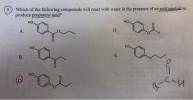 Why is C the right answer?
Which of the following compounds will react with water in the presence of an acid catalyst to produce propanoic acid? но но, Но, НО CH
Why is C the right answer?
Which of the following compounds will react with water in the presence of an acid catalyst to produce propanoic acid? но но, Но, НО CH
Full Name Dis Sec. Day/Time Forces Which of the following series of compounds is listed in...
 Full Name Dis Sec. Day/Time Forces Which of the following series of compounds is listed in serms of insreasing intermolecular forces decreasing vapor pressure, increasing boiling point and freezing point NaCl CCl. Ar A) NaCI> CCl. HOA D) HO>NaCI> Ar > CCL 2 Circle the species having the smallest (Gowest) value of the property listed A) Viscous B) Intermolecular Forces C) Vapor Pressure CCL H,0 D) Freezing Point E) Solubility in WaterCH, Cl CH CH CH CH CH,OH 3. Which...
could IR spectroscopy be used to distinguish between the following pair of compounds? You 6. How...
 could IR spectroscopy be used to distinguish between the following pair of compounds? You 6. How should also list all the major absorption bands in the IR spectra of each of compound А СНзОСНСН, and CH,CHCH,0H B HOCH,CH,CHO and CH,CH CO,H C CH,COCH-CHCH,CH, and CH,COCH,CH,CH-CH2 D CH,CH,CECH and CH,CECCH, E CH-CHCH,CH(CH,)2 and CH,CH,CH,CH(CHah
And explain why? 6.68. In which of the following compounds would intermolecular hydrogen bonds be likely...
 And explain why?
6.68. In which of the following compounds would intermolecular hydrogen bonds be likely in the liquid state? a. diethyl ether (C2H5OC2H5) b. ammonia (NH3) c. methane (CH4) d. hydrogen fluoride (HF) e. acetic acid (CH3COOH) f. bromine (Br2) g. ethylene glycol (HOCH, CH, OH) h. methylamine (CH3NH2)
And explain why?
6.68. In which of the following compounds would intermolecular hydrogen bonds be likely in the liquid state? a. diethyl ether (C2H5OC2H5) b. ammonia (NH3) c. methane (CH4) d. hydrogen fluoride (HF) e. acetic acid (CH3COOH) f. bromine (Br2) g. ethylene glycol (HOCH, CH, OH) h. methylamine (CH3NH2)
 The compounds shown below can be distinguished by which
1H-NMR characteristics?
I) number of signals
II) splitting
III) integration
IV) chemical shift
Select one:
a. IV
b. I, II, IV
c. I, IV
d. II
The compounds shown below can be distinguished by which
1H-NMR characteristics?
I) number of signals
II) splitting
III) integration
IV) chemical shift
Select one:
a. IV
b. I, II, IV
c. I, IV
d. II
 answer them all thanks
Which of the following compounds fits the proton NMR shown below? ЗН 1.0 ppm A) CH,CH,CH_COCH B) CHỊCH COCHẠCH ) CH3COCH_CH.CH D) CH,CCH_CHOCH MacBook Air esc Identify the CAHgCl isomer given the following proton NMR data: doublet 8 1.04 (6H) multiplet 81.95 (1H) doublet o3.35 (21) A) (CH3),CCI B) CHCHCH-CH-CI C) CH3CHCHCH, D) (CH3),CHCH_CI Ос ОА Ma hybridized CH absorption in its mollion tion in c 72 and n o R etina 1725 m. Assume each...
answer them all thanks
Which of the following compounds fits the proton NMR shown below? ЗН 1.0 ppm A) CH,CH,CH_COCH B) CHỊCH COCHẠCH ) CH3COCH_CH.CH D) CH,CCH_CHOCH MacBook Air esc Identify the CAHgCl isomer given the following proton NMR data: doublet 8 1.04 (6H) multiplet 81.95 (1H) doublet o3.35 (21) A) (CH3),CCI B) CHCHCH-CH-CI C) CH3CHCHCH, D) (CH3),CHCH_CI Ос ОА Ma hybridized CH absorption in its mollion tion in c 72 and n o R etina 1725 m. Assume each...
 C. REACTION WITH BROMINE Hydrocarbon Observations of Bromine Addition Balanced Equation for Addition Reaction Cyclohexane CHI Cyclohexene CHIO Toluene C-Hs Unknown Hydrocarbon Positive test: the red from the bromine goes away Negative test: the red stays 3. Which classes of compounds cannot perform addition reactions? D. REACTION WITH POTASSIUM PERMANGANATE Hydrocarbon Observations of KMnO. Addition Balanced Equation for Oxidation Reaction Cyclohexane C6H12 Cyclohexene C.Hjo Toluene C Hs Unknown Hydrocarbon Positive test: purple color goes away and turns brown (two layers)...
 7. The addition of bromine to the alkene shown would give: H CH2CH CH3 H A. One meso compound B. One pair of enantiomers C. Two meso compounds D. Four stereoisomers [2 MARKS] 8. Which is the expected product of the reaction shown? Brz но но [2 MARKS] 6. What is the product of the reaction sequence shown? CH3 H CH3 H CH3 D CH3 OH CH3
 2 Nered For each pair of compounds (a e), indicate the compound that will be faster in the given reaction. If the reaction rates should be approximately the same, indicate that instead. of 2.50 estion Compound A Compound B a or cho Br in E2 reaction CH) el CHE b. or in E2 reaction c. CI or in S, 2 reaction Br H H H Н. d. or in E2 reaction CH Br CH H H H H Br Br...
 Question 11 of 19 1 Points Which pair of compounds is most likely to be completely miscible with one another? The term "miscible" means soluble in all proportions -- no matter how much solute is added to the solvent, a homogeneous mixture (a solution) will result. A. hexane (CH2) and water B. methanol (CH,OH) and water C. table sugar (sucrose, C12H3201) and water D. sodium chloride (NaCl) and water Reset Selection
 Why is C the right answer?
Which of the following compounds will react with water in the presence of an acid catalyst to produce propanoic acid? но но, Но, НО CH
Why is C the right answer?
Which of the following compounds will react with water in the presence of an acid catalyst to produce propanoic acid? но но, Но, НО CH
 Full Name Dis Sec. Day/Time Forces Which of the following series of compounds is listed in serms of insreasing intermolecular forces decreasing vapor pressure, increasing boiling point and freezing point NaCl CCl. Ar A) NaCI> CCl. HOA D) HO>NaCI> Ar > CCL 2 Circle the species having the smallest (Gowest) value of the property listed A) Viscous B) Intermolecular Forces C) Vapor Pressure CCL H,0 D) Freezing Point E) Solubility in WaterCH, Cl CH CH CH CH CH,OH 3. Which...
 could IR spectroscopy be used to distinguish between the following pair of compounds? You 6. How should also list all the major absorption bands in the IR spectra of each of compound А СНзОСНСН, and CH,CHCH,0H B HOCH,CH,CHO and CH,CH CO,H C CH,COCH-CHCH,CH, and CH,COCH,CH,CH-CH2 D CH,CH,CECH and CH,CECCH, E CH-CHCH,CH(CH,)2 and CH,CH,CH,CH(CHah
 And explain why?
6.68. In which of the following compounds would intermolecular hydrogen bonds be likely in the liquid state? a. diethyl ether (C2H5OC2H5) b. ammonia (NH3) c. methane (CH4) d. hydrogen fluoride (HF) e. acetic acid (CH3COOH) f. bromine (Br2) g. ethylene glycol (HOCH, CH, OH) h. methylamine (CH3NH2)
And explain why?
6.68. In which of the following compounds would intermolecular hydrogen bonds be likely in the liquid state? a. diethyl ether (C2H5OC2H5) b. ammonia (NH3) c. methane (CH4) d. hydrogen fluoride (HF) e. acetic acid (CH3COOH) f. bromine (Br2) g. ethylene glycol (HOCH, CH, OH) h. methylamine (CH3NH2)
Most questions answered within 3 hours.
-
Where is the error in this code sequence?
String s1 = "Hello";
String s2 = "ello";...
asked 10 months ago -
Financial data for Joel de Paris, Inc., for last year
follow:
Joel de Paris, Inc.
Balance...
asked 10 months ago -
Consider this reaction:
Al2(SO4)3 (aq)+ BaCl3
(aq) Al2Cl6 (aq)- +
3BaSO4(s) . What is the...
asked 10 months ago -
Suppose that Savneet is considering increasing her
recent random sample from 20 car rentals to 40...
asked 10 months ago -
Trucks arrive at an unloading terminal at an average rate of 120
per hour.
Trucks arrive...
asked 10 months ago -
Why are methanol and ethanol completely soluble in water while
octanol is not very little soluble....
asked 10 months ago -
A facilities manager at a university reads in a research report
that the mean amount of...
asked 10 months ago -
When the CuSO4 is rehydrated by adding water to the anhydrous
compound, is this an endothermic...
asked 10 months ago -
A ray of sunlight is passing from diamond into crown glass; the
angle of incidence is...
asked 10 months ago -
A block of mass 0.249 kg is placed on top of a light, vertical
spring of...
asked 10 months ago -
how do the kidneys compensate in the presences of acidosis
a) trigger hyperventilate
b) reserve acid...
asked 10 months ago -
Question 501 pts
The rental rate of capital to the firm increases. Which of the
following...
asked 10 months ago